Breaking News
Breaking News
from Washington and beyond

How the FBI Is Planning a Purge Over January 6

The FBI is identifying and targeting agents and employees who worked on January 6 cases.

The FBI building in Washington, D.C.
J. David Ake/Getty Images

The FBI is investigating more than 2,400 agents and employees who worked on cases related to the January 6 attack on the Capitol.

According to an internal FBI document obtained by NBC News, the agency is using its own case file management system to track down agents who worked on January 6–related cases. Targeted employees are being asked to fill out a questionnaire about their role in the investigation.

Employees must provide the information by Tuesday afternoon, ABC News reported. The request for information came from acting Deputy Attorney General Emil Bove just days after the Justice Department swept its own agency of prosecutors who worked on January 6–related cases.

The FBI questionnaire asks agents what role they had in any of the cases, whether they made any arrests, and whether they appeared in court, among other things. It was sent to employees on Friday, the same day six senior FBI officials were ordered to resign if they didn’t want to be fired.

But the agency of more than 38,000 employees is pushing back against the Justice Department’s incessant witch hunt for Donald Trump’s enemies, urging affected agents to hold their ground.

“Do NOT resign or offer to resign. While we would never advocate for physical non-compliance, you need to be clear your removal is not voluntary,” the FBI Agents Association wrote in an email obtained by CNN.

In a letter to Bove released Sunday, lawyers for implicated FBI agents warned that the firing of agents who worked on cases involving Trump is a “direct assault on the national security of American citizens.”

“If you proceed with terminations and/or public exposure of terminated employees’ identities, we stand ready to vindicate their rights through all available legal means,” the letter reads.
Elon Musk’s Crusade to Shut Down USAID Suddenly Gets More Serious

Donald Trump’s right-hand man is escalating his war to gut the federal government.

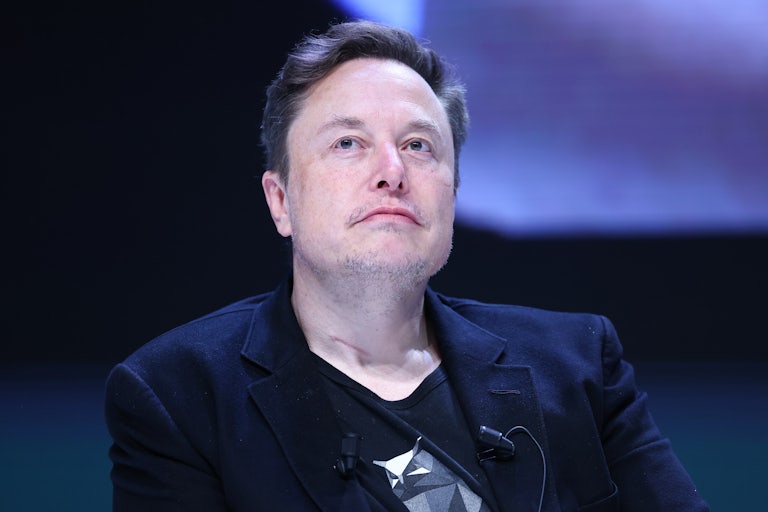
Elon Musk
Marc Piasecki/Getty Images

Elon Musk and Donald Trump are trying to shut down the U.S. Agency for International Development. 

In a live broadcast on his social media site X Sunday, Musk said the Trump administration was in the process of getting rid of the entire agency, saying, “It’s beyond repair.”

“As we dug into USAID it became apparent that what we have here is not an apple with a worm in it, but we have actually just a ball of worms. If you have an apple with a worm in it, you can take the worm out. If you have a whole ball of worms, it’s hopeless,” Musk told his online audience. “USAID is a ball of worms. There is no apple … that is why it’s gotta go. It’s beyond repair.”

USAID staff were sent an email telling them not to come into the office Monday unless they had  essential on-site duties. Trump seems to agree with Musk’s plan, telling reporters Sunday that the agency had “been run by a bunch of radical lunatics, and we’re getting them out … and then we’ll make a decision (on its future).”

Staffers at the agency say about 600 employees lost access to USAID computer systems overnight, and the Trump administration placed two security chiefs at the agency on leave over the weekend after they refused to turn over restricted classified information to Musk’s “Department of Government Efficiency” henchmen. On Saturday, the USAID website was taken down. 

Abby Maxman, president and CEO of prominent charity Oxfam America, said in a statement that “dismantling USAID would be a callous, destructive political power play that would have deadly consequences for millions of people living in dire humanitarian emergencies and extreme poverty.”

If Trump and the tech mogul–fascism enthusiast succeed in destroying the agency, it could have devastating results. USAID is the largest single contributor of humanitarian assistance worldwide, and the president’s foreign aid freeze last week has already wasted thousands of dollars’ worth of perishable food and forced international organizations to make hard decisions regarding their beneficiaries’ lives.

Secretary of State Marco Rubio tried to walk back the aid freeze last week, only to cause more confusion, and this latest news about USAID is going to cause shock waves across the U.S. and the world. With the president’s ill-advised tariffs kicking in over the weekend as well, America’s international image is taking a nosedive.  

Trump’s Tariffs War Is About to Hit Republicans Where It Hurts Most

Canada has a plan to target red states in response to Trump’s tariffs.

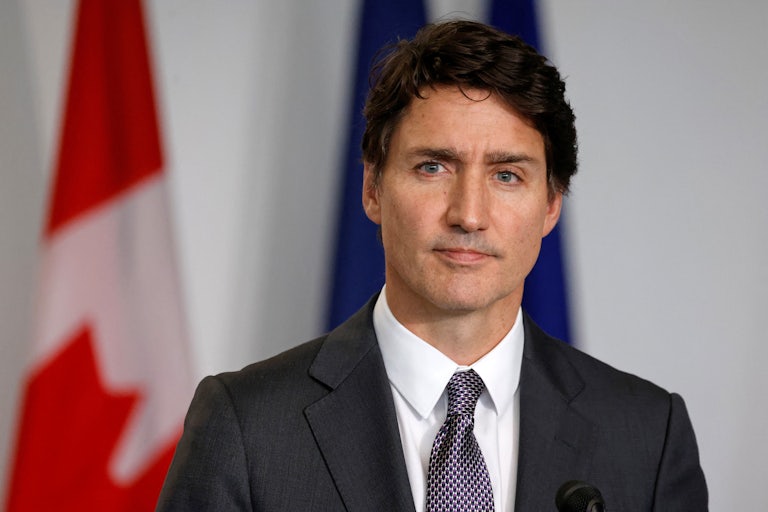
Canadian Prime Minister Justin Trudeau
LUDOVIC MARIN/AFP/Getty Images

Canada is ready to fight fire with fire—and burn Republicans in the process.

As Trump’s aggressive 25 percent tariffs on the country went into effect at midnight, Canada responded with retaliatory tariffs of its own.

Prime Minister Justin Trudeau announced over the weekend that the country will impose 25 percent tariffs on more than $105 billion worth of U.S. goods like alcohol, coffee, clothes, and furniture. On Sunday, he clarified the retaliation will also include “precision strikes” against red states, with tariffs on Kentucky whiskey, Florida oranges, and appliances from South Carolina, according to The Wall Street Journal. This set of tariffs drops Tuesday.

Canada also plans to levy another tariff on cars, trucks, and agriculture in three weeks. Ontario and British Columbia, some of the largest consumers of U.S. alcohol, are blocking its sale in those provinces after spending $700 million per year on them. And on Monday, Ontario dumped a $100 million contract with Elon Musk’s Starlink.

Mexico, not to be outdone, planned to announce its own set of Republican-targeted retaliatory tariffs on Monday while also starting a “Made in Mexico” campaign. But at the last minute, Mexican President Claudia Sheinbaum announced that the two countries had come to an agreement delaying the start of Trump’s tariffs by at least one month.

Still, the trade war with Canada is expected to significantly hurt the consumer the most. Inflation will rise, as will unemployment. Even Trump himself knows this.

“THIS WILL BE THE GOLDEN AGE OF AMERICA! WILL THERE BE SOME PAIN? YES, MAYBE (AND MAYBE NOT!)” the president wrote on Truth Social on Sunday. “BUT WE WILL MAKE AMERICA GREAT AGAIN, AND IT WILL ALL BE WORTH THE PRICE THAT MUST BE PAID. WE ARE A COUNTRY THAT IS NOW BEING RUN WITH COMMON SENSE — AND THE RESULTS WILL BE SPECTACULAR!!!”

We’ll see just how much pain red states are willing to bear for Trump’s trade war very soon.

This piece has been updated.

Here’s Every Product Trump Just Made More Expensive

Donald Trump has announced massive tariffs on Canada and Mexico, America’s biggest trading partners.

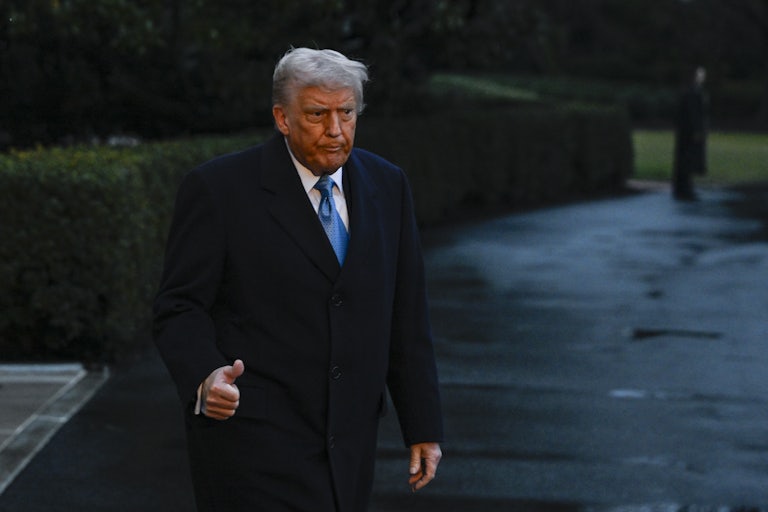
Donald Trump purses his lips and gives a thumbs-up while leaving the White House
Celal Gunes/Anadolu/Getty Images

Donald Trump’s tariff war with the nation’s biggest trading partners will affect just about every sector of life for the average American.

Fox News compiled a list of items that are already affected by Trump’s executive order, which is slated to take effect on Tuesday.

Those products include groceries such as avocados, maple syrup, ground beef, cherry tomatoes, sugar, bananas, nuts, cooking oil, squash, cucumbers, strawberries, and pineapples. The order also had immediate ramifications for countless other business sectors, raising the price on everything from liquor to gas.

Children’s toys, shoes, beer and alcohol, and crude oil were all hit in Trump’s 25 percent tariff hike on Canada and Mexico, alongside an additional 10 percent tariff on China. Car manufacturers BMW, Audi, Nissan, and Mazda were also affected, as was American-owned Ford. And every industry that relies on lumber and steel, from artisan goods to construction, will also see mark-ups as the materials themselves become more costly.

Economic experts have always cautioned that Trump’s tariff plan would hurt the country. In a joint letter released before the election, nearly two dozen Nobel Prize–winning economists formally warned against Trump’s economic plan, arguing that the MAGA leader’s stiff tariff increases and tax cuts would spell disaster for the average American.

Economist Larry Summers reiterated that concern on Saturday after Trump announced the tariffs. “This is a ‘Stop or I’ll shoot myself in the foot’ threat. It defies economic logic,” Summers told CNN. “It means higher prices for consumers. It means more expensive inputs for American producers.”

Trump Admits His Tariffs Will Make Life Way More Expensive

Donald Trump acknowledged that his tariffs will likely make things worse, not better.

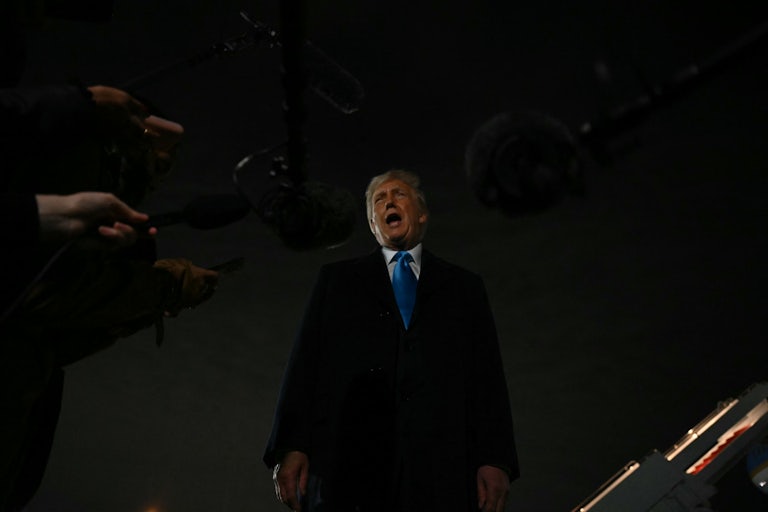
Donald Trump speaks to reporters outside Air Force One
Jim Watson/AFP/Getty Images

Against his own promises, Donald Trump’s tariff plan will actually cost Americans more money, according to him.

For months on the campaign trail, Trump insisted—without evidence—that it would be other countries who footed the bill in negotiations, lowering the cost of goods in the United States while bringing more manufacturing employment stateside. But on Saturday, Trump’s executive order ushering in a steep 25 percent tariff on all goods and 10 percent tariff on energy products from Canada and Mexico—the country’s largest trade partners—effectively launched the nation into a trade war.

Trump’s executive order on the raised tariffs is set to take effect on Tuesday.

America’s two neighbors immediately announced retaliatory tariffs of their own. Canadian Prime Minister Justin Trudeau announced an equal tariff hike on $20 billion in U.S. goods starting Tuesday, while Mexican President Claudia Sheinbaum said she would announce a “plan B” for trading with the American economy sometime Monday.

And Trump was forced to acknowledge that that will hurt. “We may have short term, some, a little pain, and people understand that, but, long term, the United States has been ripped off by virtually every country in the world,” he told reporters Sunday at Joint Base Andrews.

“We have deficits with almost every country, not every country, but almost,” he continued. “And we’re going to change it. It’s been unfair. That’s why we owe $36 trillion; we have deficits with everybody.”

Meanwhile, the leaders of U.S. banks seem perfectly happy with the increased expenses. Speaking with CNBC on Sunday, JP Morgan Chase CEO Jamie Dimon—whose net worth is assessed at $2.8 billion—described tariffs as an “economic weapon” and said that if the fallout of Trump’s plan is inflation, then Americans should “get over it.”

“They’re an economic weapon, depending on how you use it,” Dimon said. “I would put it in perspective; if it’s a little inflationary but it’s good for national security, so be it. Get over it.”

Dimon also argued that Trump’s tariff plan could be used to settle “unfair trade” with America’s allies.

But economic experts have always believed that Trump’s tariff plan would hurt the country. In a joint letter released before the election, nearly two dozen Nobel Prize–winning economists formally warned against Trump’s economic plan, arguing that the MAGA leader’s stiff tariff increases and tax cuts would spell disaster for the average American.

Economist Larry Summers reiterated that concern on Saturday after Trump announced the tariffs. “This is a ‘Stop or I’ll shoot myself in the foot’ threat. It defies economic logic,” Summers told CNN. “It means higher prices for consumers. It means more expensive inputs for American producers.”

Trump falsely claimed in December that Mexico and Canada’s trade deficits with the U.S. were “subsidies,” rather than indicators that America’s neighbors are purchasing more goods from the U.S. than they sell to it. In 2023, that differential—or deficit, as Trump insists—was nearly $41 billion with Canada and $162 billion with Mexico, according to the U.S. Census Bureau. Trump also vastly overinflated the reality of the deficits, wrongly asserting that the U.S. is “subsidizing” its neighbors to the tune of hundreds of billions of dollars each.