Breaking News
Breaking News
from Washington and beyond

Mitch McConnell Explains His Sad Lone “No” Vote on Tulsi Gabbard

The former Senate majority leader couldn’t get a single Republican to vote with him against confirming Tulsi Gabbard as director of national intelligence.

Mitch McConnell takes the subway in the Capitol. He glances downard as if forlorn.
Alex Wong/Getty Images

Mitch McConnell has gone from being one of the most powerful men in the GOP, the face of conservatism, to failing to convince a single Republican colleague to vote “no” with him on Tulsi Gabbard’s nomination for director of national intelligence.

The former Senate majority leader was the only Republican to vote “no on Gabbard’s confirmation Wednesday, noting her support for NSA whistleblower Edward Snowden, her support for Russia’s Vladimir Putin, and her views on China as dealbreakers for him.

“The nation should not have to worry that the intelligence assessments the President receives are tainted by a Director of National Intelligence with a history of alarming lapses in judgment,” McConnell said in a statement after the vote. “Entrusting the coordination of the intelligence community to someone who struggles to acknowledge these facts is an unnecessary risk.”

McConnell’s logic wasn’t enough to convince any of his colleagues. McConnell being the only Republican to vote against Gabbard signals a long fall from power for the man who has long been seen as the last bastion of “normal” conservatism in the face of Trump’s MAGA conservatism (not that they’re all that different in practice). Those days are long gone.
Republicans Finally Reveal How They’ll Pay for Tax Cuts for the Rich

Mike Johnson has just released House Republicans’ budget plan—and it’s not good.

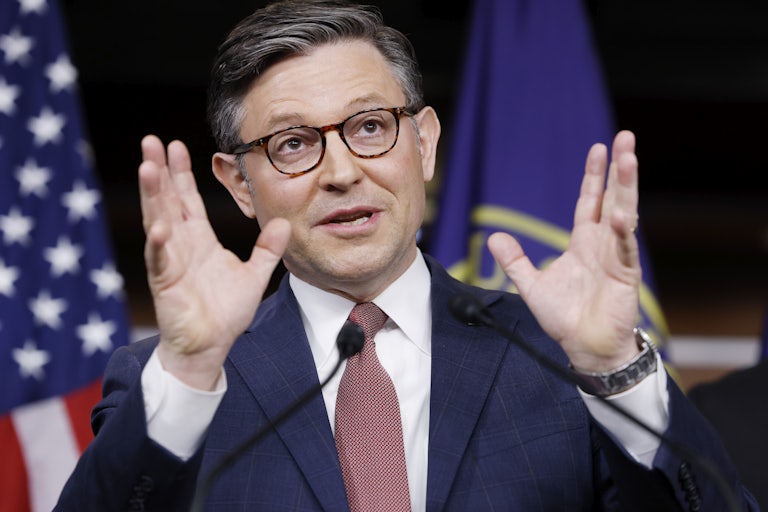
House speaker Mike Johnson makes a hand gesture while speaking to reporters
Anna Moneymaker/Getty Images

Shocking: Republicans don’t care about fiscal conservatism very much when it comes to funding their—and their rich friends’—agendas.

Mike Johnson and House Republicans on Wednesday released their budget plan, which would raise the debt ceiling by $4 trillion in order to dole out $4.5 trillion in tax cuts to the wealthy. They also threw in $2 trillion of compulsory cuts, $880 billion of which are expected to hit Medicaid, making health care even more expensive and inaccessible for large swathes of America.*

Adding $4 trillion to the national debt limit is a deeply ironic move for a party that is currently allowing the richest man in the world to destroy crucial federal institutions that he doesn’t like, in the name of “efficiency.” The programs that the Department of Government Efficiency is cutting are nowhere near as expensive as this blatantly pro-billionaire handout.

The U.S. Agency for International Development, for example, costs the government about $40 billion a year. The GOP’s tax cuts will eclipse that yearly amount easily, but Republicans are justifying it with classic “trickle-down” economics.

“There will be a lot of economic growth. And if you think about what happened in 2017—dramatic economic growth, possibly even more this time,” Representative Steve Scalise said to HuffPost last Friday.

This appears to be a more shameless redux of the 2017 tax cuts, which crippled the country’s revenue base while lining the pockets of corporations and the wealthy.

* This piece has been updated to correct the expected cuts to Medicaid under the House budget bill.

Trump’s DOJ Lawyers Are Hilariously Struggling in All His Lawsuits

Lawyers at the Department of Justice are fumbling their defense of Donald Trump’s executive orders.

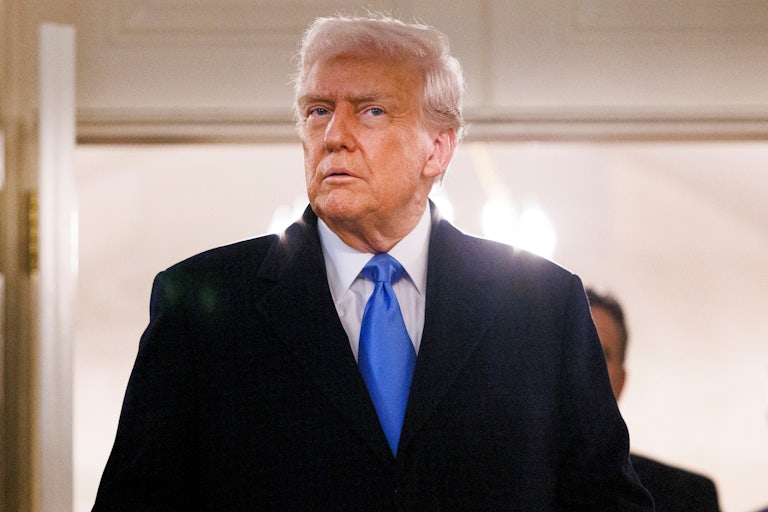
Donald Trump enters a room at the White House for a press conference
Aaron Schwartz/CNP/Bloomberg/Getty Images

The Department of Justice appears to be struggling to keep up with the torrent of lawsuits sparked by Donald Trump’s sweeping actions to freeze funding to federal agencies, and significant errors have cropped up in one of their cases.

In a court filing made Monday, prosecutors were forced to correct two factual mistakes they’d made during a court hearing, according to ABC News.

The lawyers had claimed that only 500 USAID employees had been put on administrative leave, and that only their future contracts had been frozen. In reality, more than 2,100 employees were out of a job, and all future and existing contracts had been paused, the lawyers revealed in the filing.

“Defendants sincerely regret these inadvertent misstatements based on information provided to counsel immediately prior to the hearing and have made every effort to provide reliable information in the declaration supporting their opposition to a preliminary injunction,” the filing said.

The errors had downplayed the scale of the Trump administration’s illegal efforts to dismantle USAID without the permission of Congress.

Last week, some USAID employees received letters telling them they’d been placed on administrative leave with pay “until further notice,” according to correspondence reviewed by The Hill. Some didn’t immediately receive a letter because they had been locked out of the agency’s system. The USAID website was taken down, and when it was eventually restored, it only included a note announcing that employees had been placed on “administrative leave globally.”

In a separate legal battle, in which 19 states are suing to rip Elon Musk and his Department of Government Efficiency goons away from Americans’ taxpayer records at the Treasury, DOJ lawyers made another mistake.

They referred to Marko Elez, the 25-year-old DOGE goon who resigned and was then rehired after his racist social media posts were discovered, as a “special government employee” within the Treasury.

In a filing Monday, lawyers said that Elez was a “Special Advisor for Information Technology and Modernization” at the Treasury, meaning he is a full-fledged employee subject to certain ethics requirements from which a “special government employee” would be exempt, according to ABC News.

Last week, DOJ lawyers also fumbled when asked whether they could ensure that a list of FBI agents who had investigated January 6 rioters would be kept confidential. They later said they had no “intention” to release the names. But Trump said Friday that he intended to “fire some of” the FBI personnel who’d been involved in the investigation, alleging that they were corrupt.

GOP Falls in Line to Confirm National Security Threat Tulsi Gabbard

Tulsi Gabbard is officially the director of national intelligence. Only one Republican voted “no.”

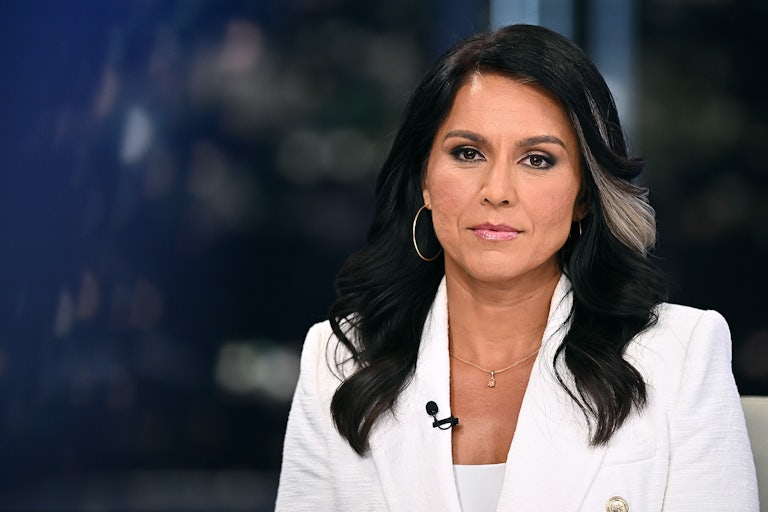
Tulsi Gabbard
Steven Ferdman/Getty Images

The Senate voted Wednesday to confirm former Democratic Representative and current right-wing personality Tulsi Gabbard as director of national intelligence.

The Senate voted 52–48 to confirm Gabbard, with Republicans falling mostly in line. The only Republican to join all Democrats in voting “no” was Mitch McConnell, a stunning rebuke from the former Senate majority leader.

Gabbard overcame Republican skepticism after previous concerns over her sympathy for authoritarian leaders, her pro-Russia stances, and her rough confirmation hearings. Gabbard’s nomination also raised national security concerns, considering she met with U.S. adversary and former Syrian dictator Bashar Al Assad while she served in Congress. She was reportedly the subject of a conversation between two Hezbollah operatives while on that trip to the Middle East. In December, nearly 100 former national security officers warned Gabbard would become the “least experienced Director of National Intelligence since the position was created.”

Gabbard, who has ties to the Science of Identity Foundation, an extremist religious organization described as a cult, will now oversee some of America’s most sensitive information.

Pete Hegseth Gives Russia Alarming Win on Ukraine War

Donald Trump’s defense secretary just ceded two major points to Russian President Vladimir Putin.

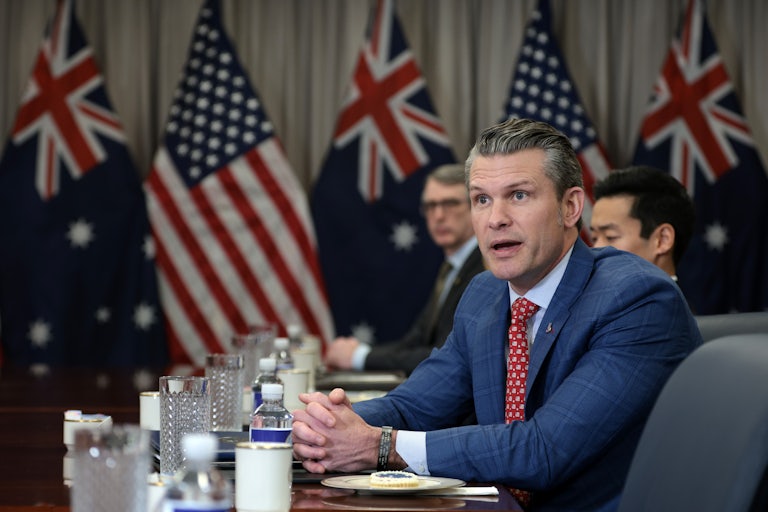
Defense Secretary Pete Hegseth speaks to members of the press while seated at a table with Australian officials. (The U.S. and Australian flags can be seen in the background.)
Alex Wong/Getty Images

The Trump administration’s Ukraine policy is off to a poor start.

Secretary of Defense Pete Hegseth is visiting Europe, and met with the Ukraine Defense Contact Group Wednesday in London, immediately telling U.S. allies that liberating all of Russia’s occupied Ukrainian territory “is an unrealistic objective.”

Then it got even worse, with Hegseth telling the alliance of 57 countries, including all 32 members of NATO, that “the United States does not believe that NATO membership for Ukraine is a realistic outcome of a negotiated settlement.

“Instead, any security guarantee must be backed by capable European and non-European troops,” Hegseth added.

Hegseth seems to have given up two main points to Russian President Vladimir Putin, including a key piece of leverage in future negotiations to end the war between Ukraine and Russia. One of Putin’s major complaints about Ukraine has been the prospect of the country joining NATO along with the rest of Eastern Europe.

Coupled with Donald Trump’s comments on the release of American Marc Fogel from a Russian prison Tuesday, where he claimed “we were treated very nicely by Russia,” Hegseth’s remarks suggest the new administration will prioritize better relations with Putin over defending Ukrainian sovereignty. The deal to secure Fogel’s release raises questions too, as a suspected Russian cybercrime kingpin was part of the swap.

While campaigning for president, Trump boasted that he could end the war in Ukraine within “24 hours.” Shortly after Trump’s election, Russia shot down that idea, and even boosted its troop numbers days later. The president’s choice for special envoy to Ukraine and Russia, Lt. Gen. Keith Kellogg, has in the past suggested withholding aid for Ukraine in order to force negotiations with Russia, something Trump did just days into his presidency.

In the past few weeks, Trump has said he will use tariffs as leverage against Russia and shaken down Ukraine for its natural resources in exchange for continued support. All of this doesn’t bode well for the future of Ukraine, which seeks not only to end Russian occupation of its land but also better relations with the U.S. and Europe instead of a subservient relationship with Russia. Trump seems more concerned with keeping Putin happy and getting a payoff.