Breaking News
Breaking News
from Washington and beyond

Democrats Finally Sue Trump for Trying to Control Elections

The Democratic Party has filed a lawsuit against one of Trump’s most dangerous executive orders.

Donald Trump holds up a signed executive order while sitting in the Oval Office.
Alex Wong/Getty Images

The Democratic Party is fighting back.

On Friday, the Democratic National Committee, as well as two other national party committees, filed a lawsuit against President Trump, stating that his executive order to seize control of the Federal Elections Commission breaks federal law.

Trump’s order also claims authority over a vast array of other federal agencies, like the Securities and Exchange Commission, the Federal Trade Commission, and the National Labor Relations Board. But the targeting of the FEC makes up the Democrats’ lawsuit, as it’s a clear bold-faced move that could place the future of free and fair elections in jeopardy.

“Executive Order 14215 grounds its unprecedented assertion of presidential power in Article II of the U.S. Constitution. But the constitutionality of FECA’s vesting of authority in the FEC is beyond question,” the DNC wrote in its suit.

“The assertion is incompatible with nearly a century’s worth of Supreme Court precedent blessing Congress’s authority to insulate certain agencies and officials from day-to-day control by the president,” the lawsuit states.

“Congress’s authority is especially true in this context, where the credibility of the entire regulatory enterprise would be fatally undermined if the party controlling the White House can unilaterally structure campaign rules and adjudicate disputes to disadvantage its electoral competitors.”

This is the Democratic Party’s first lawsuit against Trump during his second term.

The White House has yet to respond.
Trump Melts Down in Deranged Rant During Zelenskiy Meeting

Donald Trump decided the meeting was the perfect time to list all his personal grievances.

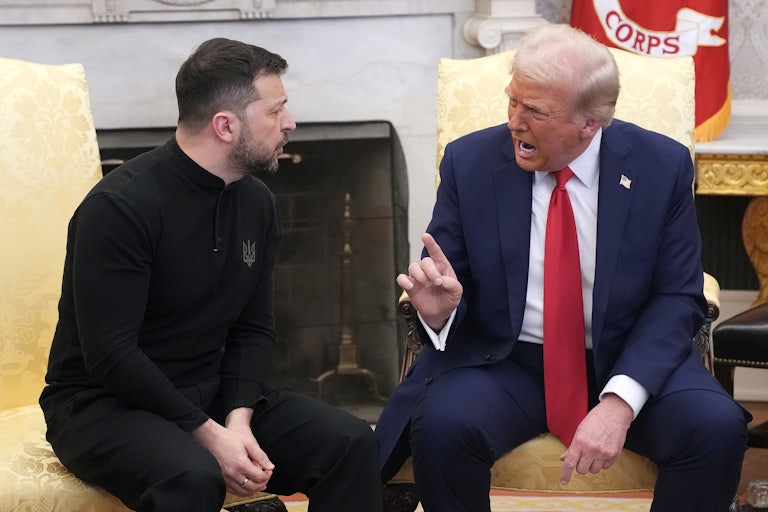
Donald Trump raises his finger and speaks to Ukrainian President Volodymyr Zelenskiy as they sit in the Oval Office
Andrew Harnik/Getty Images

Donald Trump’s meeting with Ukrainian President Volodymyr Zelenskiy on Friday was magnitudes below presidential, as the United States leveraged the critical wartime meeting for measly political gain by defending Russian President Vladimir Putin while denigrating former American officials, including Presidents Joe Biden and Barack Obama, Hillary Clinton, and California Senator Adam Schiff.

Before the American media, Trump and Vice President JD Vance berated the Ukrainian president, repeatedly cutting Zelenskiy off from speaking while claiming he wasn’t grateful enough for American assistance.

But one question from a Ukrainian reporter about the potential for Russia to break a ceasefire arrangement seemed to really set Trump off.

“What if anything? What if a bomb drops on your head right now?” Trump said in response.

“They broke it with Biden, because Biden, they didn’t respect him. They didn’t respect Obama. They respect me,” Trump continued. “Let me tell you, Putin went through a hell of a lot with me.”

Trump then spoke at length about Russian interference in the 2016 presidential election, calling it a “phony witch hunt” and a “Democrat scam.” Fact check: The U.S. intelligence community determined that Russia did conduct a disinformation campaign to interfere in American democracy that year, and that the campaign was ordered directly by Russian President Vladimir Putin.

Following a lengthy investigation, special counsel Robert Mueller determined that there was not enough evidence to bring collusion or conspiracy charges against Trump or his associates for benefiting from the foreign attack, though Mueller’s 448-page final report did not make a final determination on whether Trump had obstructed justice. In a letter following the report’s release, former Attorney General William Barr wrote that the report “does not exonerate” Trump.

The president then continued to rave about the Hunter Biden laptop scandal, which fell apart last year after Republicans’ star witness admitted that the story had been completely fabricated with help from top Russian officials.

Both points were made in defense of Putin, claiming that the Russian leader “had to put up with that.”

“He was being accused of all that stuff,” Trump continued. “All I can say is this, he might have broken deals with Obama and Bush, and he might have broken them with Biden. He did. Maybe, maybe he did. I don’t know what happened, but he didn’t break it with me.

“He wants to make a deal. I don’t know if you can make a deal,” he added, before turning to Zelenskiy.

“The problem is, I’ve empowered you to be a tough guy, and I don’t think you’d be a tough guy without the United States, and your people are very brave, but you’re either going to make a deal or we’re out, and if we’re out, you’ll fight it out.

“I don’t think it’s going to be pretty, but you’ll fight it out, but you don’t have the cards, but once we sign that deal, you’re in a much better position, but you’re not acting at all thankful. And that’s not a nice thing. I’ll be honest. That’s not a nice thing,” Trump said, before adding that the whole fiasco was going to “make great television.”

Moments after the meeting, a statement was posted to Trump’s Truth Social account that described the meeting as “very meaningful” while practically wiping Ukraine out of ongoing negotiations to end the war.

“Much was learned that could never be understood without conversation under such fire and pressure,” Trump wrote. “It’s amazing what comes out through emotion, and I have determined that President Zelenskyy is not ready for Peace if America is involved, because he feels our involvement gives him a big advantage in negotiations.

“I don’t want advantage, I want PEACE. He disrespected the United States of America in its cherished Oval Office. He can come back when he is ready for Peace,” Trump said.

Russian forces crossed the Ukrainian border on February 24, 2022, which Putin tried to justify by falsely claiming that he needed to protect civilians in eastern Ukraine.

The U.S. and Russia opened discussions at a meeting in Saudi Arabia earlier this month, seeking a conclusion to the three-year war, but the assembly conspicuously excluded Ukrainian leadership.

Trump and Vance Demand Zelenskiy Thank Them in Grotesque Display

Donald Trump and JD Vance tried to bully the Ukrainian president.

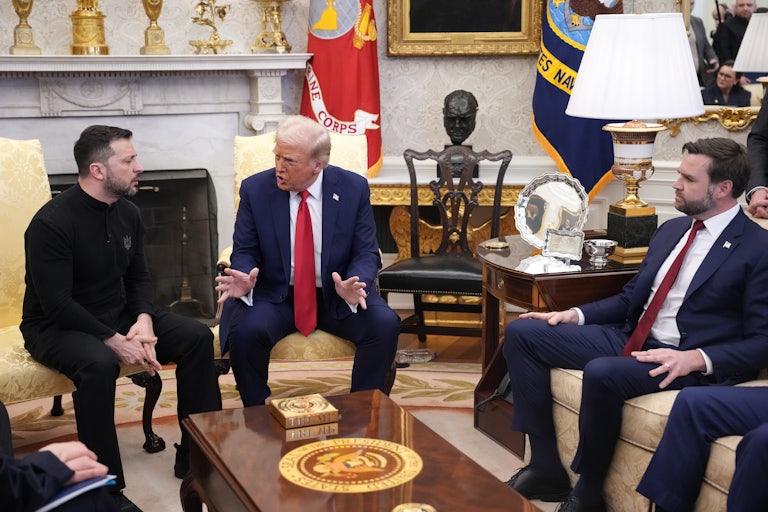
Ukrainian President Volodymyr Zelenskiy, Donald Trump, and JD Vance sit in the Oval Office
Andrew Harnik/Getty Images

Donald Trump’s meeting with Ukrainian President Volodymyr Zelenskiy Friday went off the rails, as the grievance-addled U.S. president started arguing with the world leader.

Amid tough negotiations to end the Russian invasion of Ukraine, which has killed more than 43,000 soldiers and destroyed cities, Trump and JD Vance took Zelenskiy’s visit as an opportunity to scold him for not acting more grateful to them for American financial support.* (It seems worth noting that they weren’t in the White House when that aid was actually approved.)

Trump has repeatedly claimed that the U.S. has sent $350 billion, but the actual figure appropriated by Congress is closer to $174 billion. He has also begun to falsely claim that other countries are getting their money back. Trump has been increasingly desperate to recuperate the money, and he and his sniveling sidekick Vance lost their tempers during the meeting.

Zelenskiy’s unforgivable faux pas seems to have been explaining to Vance and Trump about Russia’s invasion of Crimea in 2014—that’s when the scolding started, anyway.

“Mr. President, I think it’s disrespectful for you to come into the Oval Office and try to litigate this in front of the American media,” Vance scolded. “Right now, you guys are going around and forcing conscripts to the front line because you have manpower problems. You should be thanking the president for—”

“Have you ever been to Ukraine, that you see what problems we have?” Zelenskiy said, leaving the vice president buffering. “Come once.”

“I’ve actually watched and seen the stories, and I know what happens is you bring people, you bring them on a propaganda tour Mr. President,” Vance said. “Do you disagree that you’ve had problems bringing people into your military?”

“We have problems—” Zelenskiy tried to answer, but Vance wouldn’t relent.

“And do you think that it’s respectful to come to the Oval Office of the United States of America and attack the administration that is trying to prevent the destruction of your country?” the vice president plowed on.

“I will answer, I will answer,” Zelenskiy said. “A lot of questions, let’s start from the beginning. First of all, during the war, everybody has problems. Even you, but you have nice ocean, and don’t feel now. But you will feel it in the future. God bless—”

“You don’t know that, you don’t know that—” Trump interjected, visibly agitated.

“God bless, you will not have a war—” Zelenskiy assured him, but Trump continued speaking over his guest.

“Don’t tell us what we’re gonna feel. We’re trying to solve a problem, don’t tell us what we’re gonna feel,” Trump said.

“I’m not telling you, I’m answering—” Zelenskiy said.

“Because you’re in no position to dictate that, remember this,” Trump warned, still speaking over Zelenskiy. “You’re in no position to dictate what we’re gonna feel. We’re gonna feel very good.”

“You will feel influence. I’m telling you, you will feel influence,” Zelenskiy warned.

“We’re gonna feel very good and very strong. You’re right now, not in a very good position. You’ve allowed yourself to be in a very bad position, which he happens to be right about. You’re not [in] a good position. You don’t have the cards right now. With us you start having cards,” Trump insisted.

“I’m not playing cards, I’m very serious, Mr. President. I’m very serious. I’m the president in a war—” Zelenskiy tried to respond.

“But right now—yeah you’re playing cards. You’re playing cards,” Trump ranted. “You’re gambling with the lives of millions of people. You’re gambling with World War III. You’re gambling with World War III. And what you’re doing is very disrespectful to the country! This country!”

“Have you said thank you once?” Vance fumed, suddenly deciding to rejoin the fight.

“A lot of times, even today,” Zelenskiy said.

“You went to Pennsylvania and campaigned for the opposition in October. Offer some words of appreciation for the United States of America and the president who’s trying to save your country!” Vance said.

In September, Zelenskiy met with Kamala Harris at the White House, where she affirmed her support for him. Zelenskiy also visited a munitions factory in Scranton, Pennsylvania—Joe Biden’s hometown located in a critical swing state—to shore up support for Ukrainian resistance, giving a boost to Harris’s campaign.

During that visit, Trump had refused to meet with him, and then complained that the Ukrainian president wanted Harris to win.

To Trump and Vance, it seems that they were expecting a supplicant president, but were instead greeted with Zelenskiy’s well-founded doubts about their approach to the ongoing negotiations, which could lead to Russian President Vladimir Putin getting everything he wants, and no assurances for the future security and stability of a war-torn Ukraine.

This story has been updated.

* This story originally misidentified the type of casualties killed.

Republicans Are Secretly Freaking Out About Trump’s Big Budget Win

Republicans are suddenly not so pleased with their reconciliation bill victory.

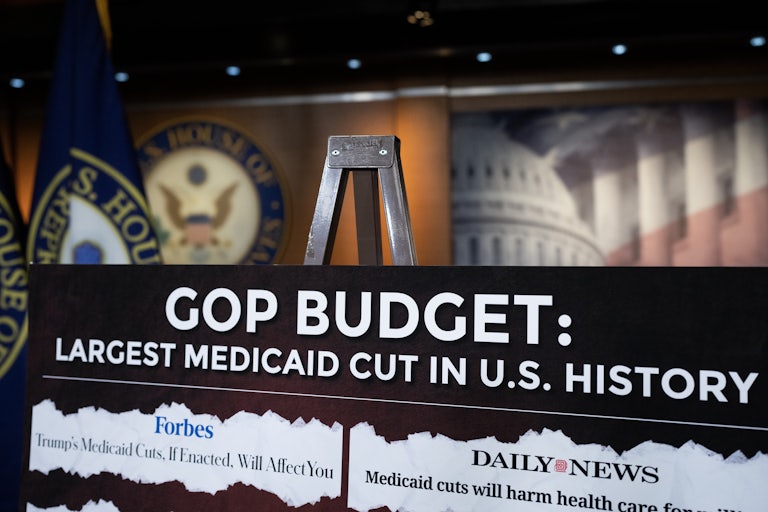
A poster at a Democratic press conference warns the Republican Party will cut Medicaid
Tom Williams/CQ-Roll Call, Inc/Getty Images

Republicans are already worried that their aggressive policy agenda could bite them come midterms.

The House GOP passed a budget resolution Tuesday that will gut major social services, including Medicaid, which provides health insurance to more than 72 million Americans. The $880 billion cut is a trade-off for conservatives who were tasked by Donald Trump to extend his 2017 tax plan, which will overwhelmingly benefit corporations and is projected to add as much as $15 trillion to the national deficit.

But now that the budget resolution is in the rearview, conservative lawmakers are afraid that the forthcoming fiscal package could damn their chances at reelection.

“It could be trouble.… We saw what happened in 2018,” one moderate Republican told Axios, referring to the last Trump administration’s midterm year when anger over the GOP agenda flipped 40 House seats in favor of the Democrats.

Conservatives were quick to distance themselves from the budget framework following a 217–215 vote, which passed with no Democratic support and only one Republican defection (Representative Thomas Massie).

“Last night’s vote was just a procedural step to start federal budget negotiations and does NOT change any current laws,” Republican Representative Rob Bresnahan said in a statement Wednesday.

Others practically lied about the contents of the resolution, misdirecting Americans into believing that the bill did not task the House Energy and Commerce Committee to find, at minimum, $880 billion in savings from programs that fall under its jurisdiction, a seismic order that leaves the committee with practically no other option than to cut away at Medicaid.

Speaking with CNN, Montana Representative Ryan Zinke insisted that there was “zero mention of cutting Medicaid,” which, while technically true, misrepresented the scope of the resolution.

“A billion dollars is our goal over 10 years,” Zinke relented after being repeatedly pressed by CNN’s John Berman on how much Republicans would be willing to cut from the program.

In the days since the vote, House Speaker Mike Johnson has reportedly “ruled out” the largest cuts to the health insurance program, though he’s failed to offer any specifics as to how the party will do so without affecting Americans’ benefits.

Meanwhile, Republicans at home have faced fiery town halls led by their irate constituents, furious to discover that their elected representatives are sailing them down the river in order to advance Trump’s agenda.

Kash Patel Wants to Work From Home for FBI. But Who Does He Live With?

The new FBI director says he plans to WFH and run things remotely from Las Vegas. But why won’t he answer about who else lives in his house?

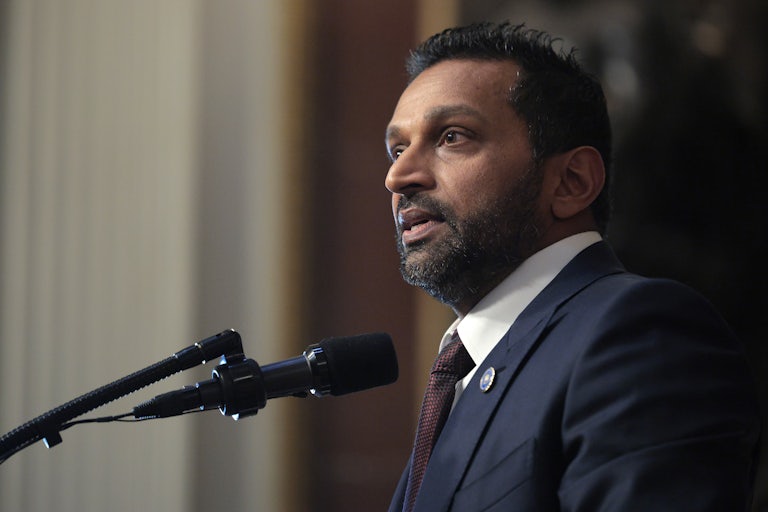
FBI director Kash Patel speaks at a mic
Chip Somodevilla/Getty Images

Kash Patel’s appointment as FBI director seems to be coming with conditions: He wants to live part-time in Las Vegas and work remotely, far away from FBI headquarters in Washington.

Why Las Vegas? Patel has long called the city home, but what’s most intriguing is his actual place of residence. The FBI director lives at a home owned by Michael Muldoon, a Republican Party megadonor who runs shady time-share companies, reported the Nevada Independent earlier this month. Muldoon has been sued over allegations of running a “bait and switch” scheme in his time-shares, where “owners” didn’t actually own their properties and were gouged for fees at the same time.

Muldoon appears to have a history of cozying up to law enforcement officials. He has donated a lot of money to the political campaigns of former Nevada Attorney General Adam Laxalt, whose office received multiple complaints about Muldoon’s businesses but never pursued them. And apart from sharing an address with Patel, Muldoon also has intricate business dealings with him, utilizing the same incorporation and legal services.

Patel and Muldoon even took a golf trip together to Scotland back when the FBI director was a federal employee on the National Security Council, which could be an ethics violation. Patel at the time was barred from accepting gifts, and the NSC at the time wasn’t approving any trips. He also would have had to report the trip, and records aren’t available from that time to confirm whether he did or did not.

All of this raises questions as to how Patel is going to run not one, but two, prominent federal law enforcement agencies (he is also head of the Bureau of Alcohol, Tobacco, Firearms and Explosives) with such extensive ties to someone with questionable practices, living in Las Vegas part-time. It seems that the appearance of corruption is not a barrier to working in the Trump administration, even if you’re in charge of enforcing the law.