Breaking News
Breaking News
from Washington and beyond

Trump Just Cost the U.S. Access to Key Intelligence

Donald Trump’s clear affection for Vladimir Putin has U.S. allies rethinking a few things.

Donald Trump shakes hands with Vladimir Putin during a meeting in Helsinki in 2018
Chris Ratcliffe/Bloomberg/Getty Images

The United States’ new alignment with Russia is causing some of our longest allies to question if they should continue to share military intelligence with Washington.

Israel, Saudi Arabia, and the four other members of the Five Eyes spy alliance—Australia, Canada, New Zealand, and the United Kingdom—are reportedly examining how they could revise their current protocols with Washington in order to safeguard foreign assets, according to four sources and a foreign official that spoke with NBC News.

“Those discussions are already happening,” one source with direct knowledge of the conversations told NBC. No actions have been taken as of yet.

“Every intelligence agency treats its commitments to foreign agents as sacrosanct, pledging to keep agents safe and shield their identities,” NBC reported. “Anything that jeopardized that obligation would violate that trust, former officials said, and that could lead some spy services to hold back on some information sharing with Washington.”

Decisions over whether to continue to include America in international intelligence alliances come part and parcel as countries around the globe question their economic, military, and diplomatic cooperation with Washington.

Droves of world leaders have denounced the U.S. in the weeks since Donald Trump was inaugurated. They have condemned his administration’s decision to backtrack on international treaties, his aggression toward the U.S.’s longstanding alliances, and his willingness to throw Western nations into a reckless trade war, and have cast aspersions on his seemingly warm relationship with Russian President Vladimir Putin.

While withholding intelligence from the Pentagon would prove to be a drastic shift in world relations, it would also be little more than a reflection of Trump’s own foreign policy approach that has thrown the Western world into tumult in a matter of days.

Following a disastrous meeting with Ukrainian President Volodymyr Zelenskiy on Friday, in which Trump and Vice President JD Vance effectively challenged the U.S.’s strongest alliances while ceding the world stage to America’s adversaries, the White House has ordered a pause on military aid and intelligence sharing with Kyiv in its ongoing war with Russia. That alone is expected to devastate Ukraine’s ability to target Russian forces in its fight against the dictator-led superpower.

Trump has repeatedly ducked reporters’ questions as to whether his administration’s actions have aligned U.S. policy with Moscow.

Several of Trump’s former advisers have criticized Trump’s approach to ending the war, including two of his first term national security advisers H.R. McMaster and John Bolton.

“Vladimir Putin couldn’t be happier,” McMaster told 60 Minutes on Sunday, sizing up the events of Trump’s explosive meeting with Zelenskiy “Because what he sees is all of the pressure on Zelensky, all of the pressure on Ukraine and no pressure on him.”

McMaster then went on to describe Putin as a “master manipulator” who had successfully worked Trump to Russia’s advantage.

Elon Musk’s Government Email Address Is Now Public Information

Do with this what you will.

Elon Musk stares at the Capitol ceiling during Donald Trump’s inauguration.
CHIP SOMODEVILLA/POOL/AFP/Getty Images

The government email address of powerful unelected bureaucrat Elon Musk is now publicly available.

The Intercept reports that Musk has been assigned the email address erm71@who.eop.gov, due to his status with the White House Office and the Executive Office of the President. Erm71 refers to Musk’s full initials and his 1971 birth year and is different from other email addresses in the EOP, which usually include the employee’s full first and last name. 

The publication has already filed multiple Freedom of Information Act (FOIA) requests for Musk’s emails to his pet project, the Department of Government Efficiency, as well other agencies that have worked closely with DOGE, such as the Office of Management and Budget and the Office of Personnel Management. In addition, the Intercept filed FOIA requests with several agencies in DOGE’s crosshairs.  

The Trump administration has tried to classify DOGE, and by extension, Musk, under the EOP to claim that its administrator reports to the White House chief of staff, and therefore, White House lawyers argue, isn’t subject to FOIA. The administration has also argued in court that Musk is not in charge of DOGE, but merely is a senior adviser to the president, which President Trump has repeatedly contradicted publicly. 

Given DOGE’s massive reach within the federal government and its efforts to decimate federal agencies through mass purges of employees, its attempts at subterfuge are facing numerous legal challenges. Now that Musk’s apparent government email address is public, the lawsuits from government employees and watchdog organizations trying to exact some transparency and accountability over DOGE just got some new ammunition.

Republicans Hurl Racist Insult at Democratic Hispanic Caucus Chair

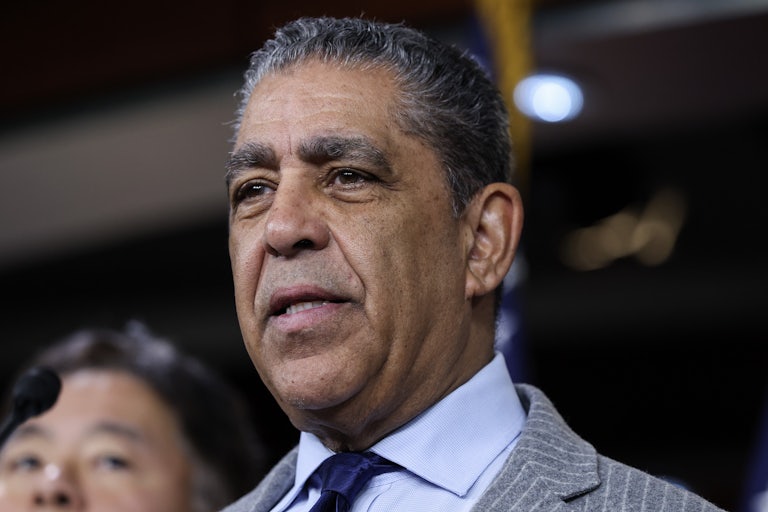
The attack on Representative Adriano Espaillat puts Republicans’ racism on full display.

Representative Adriano Espaillat speaks to reporters during a press conference
Kayla Bartkowski/Getty Images

The Republican Party isn’t even pretending not to be racist now.

The National Republican Congressional Committee published an atrocious social media post Wednesday calling Hispanic Caucus Chair Adriano Espaillat an “illegal immigrant,” after the New York Democrat gave a Spanish-language rebuttal to Donald Trump’s address to Congress.

Espaillat accused Trump of fostering an “environment of fear among the immigrant community” during his Tuesday night speech, and told a story about a U.S. citizen who had been wrongfully detained by Immigration and Customs Enforcement as part of Trump’s crackdown on undocumented immigrants.

The NRCC, which once posted a wildly xenophobic ad showing A.I.-generated images of immigrants flooding U.S. national parks, issued a new installment in its catalogue of extremely racist posts, this time targeting Espaillat.

“Democrats literally chose an illegal immigrant to give their response to President Trump’s address,” the NRCC wrote on X. “Predictably, this radical called Trump’s presidency a ‘reign of terror.’ Democrats couldn’t be more disconnected from the American people.”

Espaillat has been a U.S. citizen for more than 40 years and is the first formerly undocumented immigrant to serve in Congress. When his family first immigrated to the U.S. from the Dominican Republic roughly 60 years ago, they briefly overstayed their tourist visa but obtained green cards within the year, according to HuffPost.

The Congressional Hispanic Caucus released a statement hitting back at the Republican group’s attack on its chairperson.

“This xenophobic rhetoric from Trump Republicans proves that you can follow the law, get your papers, become a citizen, get elected to Congress—swear multiple oaths to protect and defend the Constitution—and all you will ever be to Trump Republicans: an ‘illegal immigrant,’” the group wrote in a post on X Wednesday.

Since entering office, Trump has made clear that legal protections for all immigrants—not just those who are undocumented—are subject to rescission. It’s clear from the NRCC’s attack on Espaillat that Republicans are taking Trump’s rhetoric of targeting individuals based on their race, or skin color, to heart.

Trump Suddenly Reverses Some Mexico Tariffs After Massive Backlash

Well, that was quick.

Donald Trump is a little sweaty while speaking at a mic
Win McNamee/Getty Images

Just two days after he started a global trade war, Donald Trump is already walking back some of the tariffs he implemented—again.

In a Truth Social post Thursday, the president announced Mexico will not pay tariffs on any products that comply with the United States-Mexico-Canada Agreement, or USMCA, until April 2.

On Tuesday, Trump implemented 25 percent tariffs on Mexico and Canada, a disastrous move that plummeted financial markets and prompted retaliatory actions from both American trading partners.

Following the news, Mexican President Claudia Sheinbaum took a measured approach to dealing with the reactionary American leader. She promised to safeguard Mexico’s interests and announced she would implement tariffs of U.S. goods, but not until Sunday, giving her and Trump enough time to negotiate a deal. It worked.

“After speaking with President Claudia Sheinbaum of Mexico, I have agreed that Mexico will not be required to pay Tariffs on anything that falls under the USMCA Agreement.” Trump wrote on Truth Social Thursday. “I did this as an accommodation, and out of respect for, President Sheinbaum.”

It’s just the latest walkback from Trump, who is endlessly flip-flopping on a decision that would spur economic catastrophe across the U.S. and abroad.

He first threatened to impose tariffs on February 1, but later agreed to a 30-day pause after widespread backlash. After finally beginning the tariffs on Tuesday, he’s already granted a one-month exemption to U.S. automobile companies, and now to USMCA products.

Who knows what the next move will be in Trump’s relentless pursuit to implement tariffs, and rid the U.S. of its allies while he’s at it.

Trump Prepares to Add Two New Countries to His Travel Ban

Donald Trump is reportedly planning a Muslim Ban 2.0.

Donald Trump
Win McNamee/Getty Images

Donald Trump may introduce a new travel ban similar to the “Muslim ban” from his first term, possibly as soon as next week.

Reuters reports that the order would bar people from Afghanistan and Pakistan from entering the United States, based on a government review of security and vetting risks, citing three anonymous sources, who also said that other countries could be included.

In his first term, Trump used a series of executive orders that infamously banned visitors from the Muslim-majority countries of Iran, Libya, Somalia, Sudan, Syria, and Yemen. Iraq was initially included, but later dropped after the country promised to improve vetting for its own citizens. Despite several legal challenges, the Supreme Court ultimately approved the ban in 2018, and Trump later added six more countries with large Muslim populations to the list.

If Trump’s new ban becomes a reality, it will complicate efforts to resettle tens of thousands of Afghans cleared to come to the U.S. as refugees or on “special immigrant visas” because they worked for the U.S. and fear retribution after the Taliban took control of Afghanistan.

According to one of the sources, the State Department Coordinator for Afghan Relocation Efforts is trying to get an exemption for special immigrant visa holders, “but it’s not assumed likely to be granted,” especially since that office was told to plan for its closure by April.

While campaigning for president in 2023, Trump floated the idea of reinstating and expanding the “Muslim ban,” calling for a “strong ideological screening of all immigrants to the United States” and saying he would ban immigrants from Libya, Somalia, Syria, and Yemen, “or anywhere else that threatens our security.”

In Trump’s first term, the travel ban caused a lot of confusion and chaos, with thousands of people, including immigration lawyers, gathering at airports to protest the move. If the ban comes back, Trump will have a more compliant judiciary. The question is whether protesters will show up in the same numbers with support from Democratic politicians.