Breaking News
Breaking News
from Washington and beyond

Trump Drops Eye-Watering Number for How Long High Prices Could Last

Donald Trump suggested the U.S. had taken too shortsighted an approach to financial stability.

Donald Trump waves while walking outside the White House
Kayla Bartkowski/Getty Images

Americans should come up with a totally new calendar to measure how long they’ll be affected under the president’s tariff plan, per the president.

During an interview with Fox Business’s Maria Bartiromo that aired Sunday, Donald Trump dodged whether the country would dive headlong into a recession, and suggested that Americans should model their economic projections on a 100-year model—like China—rather than assess his performance on a quarterly basis.

“Are you expecting a recession this year?” Bartiromo asked.

“I hate to predict things like that. There is a period of transition because what we’re doing is very big,” Trump said.

Instead, Trump said, “There could be a little disruption.”

“Look, what I have to do is build a strong country,” the president continued, responding to criticism about the recent stock market drop. “You can’t really watch the stock market. If you look at China, they have a 100-year perspective. We have a quarter. We go by quarters. And you can’t go by that.”

Last month, Trump announced he would impose a 25 percent tariff on goods from America’s closest neighbors. Two days later, he backtracked, giving Canada and Mexico a one-month delay. On March 4, the tariffs went into effect, sparking retaliatory tariffs from Canada, as well as outcry from America’s Big Three automakers.

A couple more days later, Trump directed another one-month pause for goods that met his 2020 trade deal, the United States-Mexico-Canada Agreement, which a White House official told CNBC covered roughly 50 percent of Mexican imports and 38 percent of Canadian imports. And then, in an interview that aired Friday, Trump said the tariffs could go higher than 25 percent.

As a result, the last week saw drastic market fluctuations, with the stock market tumbling as the tariffs went into effect. The Dow dropped 670 points, and by the end of the week, Republican lawmakers were fed up.

“The tariffs could go up as time goes by, and they may go up,” Trump told Bartiromo. “We may go up with some tariffs. I don’t think we’ll go down, but we may go up.”

“For years, globalists have been ripping off the United States. They’ve been taking money away from the United States, and all we’re doing is getting some of it back, and we’re going to treat our country fairly,” Trump said, echoing language from one of his former key advisers, Steve Bannon. “This country has been ripped off from every nation in the world, every company in the world. We’ve been ripped off at levels never seen before, and what we’re going to do is get it back.”
Trump Suggests People Should “Shut up” About Egg Prices

Donald Trump had a simple response to his plan to lower egg prices falling apart.

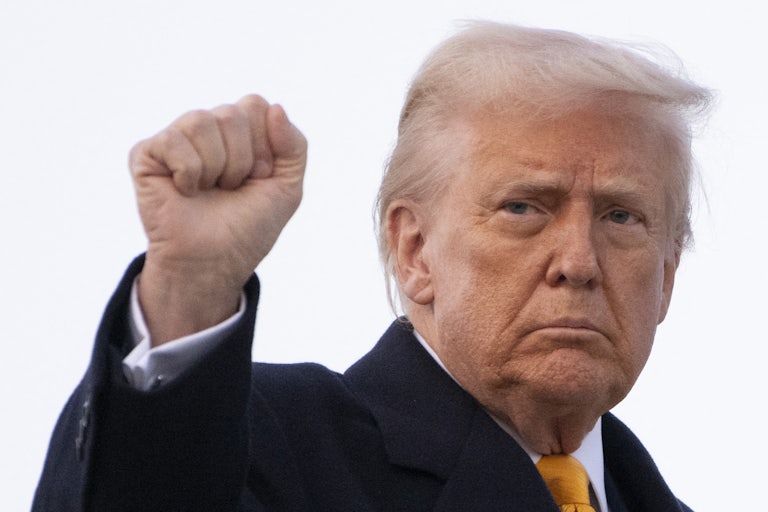
Donald Trump raises his fist
Roberto Schmidt/AFP/Getty Images

Donald Trump wants Americans to “shut up” about the soaring price of eggs.

Trump shared an article on Truth Social Saturday titled, “Shut Up About Egg Prices—Trump Is Saving Consumers Millions,” written by Charlie Kirk, the CEO of the conservative youth organization Turning Point USA, which assisted the president during his campaign.

The article posited that Democrats were “positively giddy about the price of eggs,” which reached $8 a dozen last week. While Democrats may long for “proof that these backward, ‘extreme’ MAGA Republicans didn’t know what they were voting for,” the high price of eggs was “in no way President Trump’s fault,” Kirk wrote.

Kirk echoed the right-wing claim that the high egg prices were the fault of the Biden administration, because it had killed way too many chickens in response to the bird flu outbreak—in reality, that’s an Agriculture Department policy that has continued during the first months of the Trump administration.

Kirk also claimed that it didn’t matter if egg prices went up—though Trump seemed to think it did when trying to win votes on the campaign trailbecause the Trump administration would save consumers money in other important ways, by cutting taxes on tips, overtime, and Social Security.

Trump has bragged about winning the election based solely on his promise to lower the price of groceries. Since claiming the presidency, though, Trump has plainly stated that he actually has no idea how to get consumer prices down. With the president’s endorsement, Kirk’s article reads like an admission. “I’m Sorry. I Can’t. Don’t Hate Me.”

Trump’s unwieldy economic policy only makes that more clear.

The president’s decision to enact steep tariffs on America’s closest trading partners, Canada, Mexico, and China, led to a major sell-off in the stock market last week and new forecasts predicting a recession on the horizon. Washington Post economic columnist Heather Long said on MSNBC that it was “hard to envision” prices coming down amid the ensuing trade war.

Trump’s insistence that American consumers should keep quiet about their concerns is particularly disturbing when just last week, he seemed to soft-launch the idea that despite his promises to reverse inflation, the U.S. was headed toward another recession. Already, members of the Trump administration have been trying to sugarcoat the economic meltdown, calling it a “detox” or “transition” period.

In a post on Truth Social Sunday evening, Trump had a much different message.

“We’re going to become so rich, you’re not gonna know where to spend all that money,” he wrote. “I’m telling you—just watch!”

Marco Rubio Announces Stunning Extent of USAID Purge

Secretary of State Marco Rubio says the six-week review of USAID is complete.

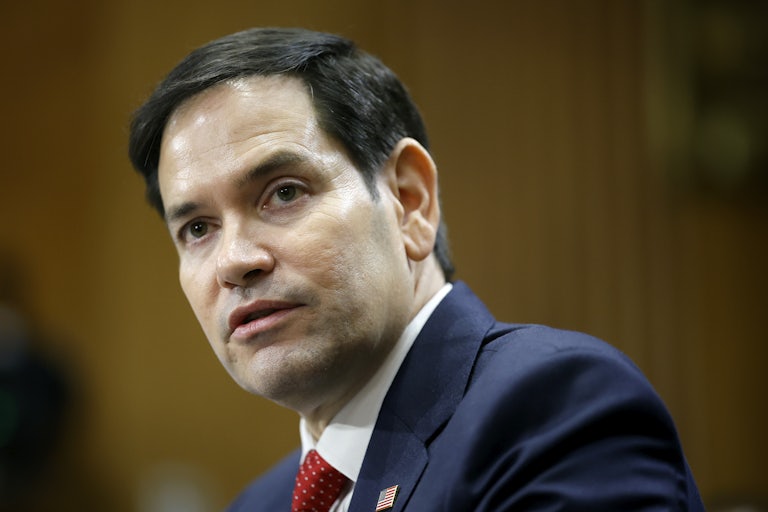
Secretary of State Marco Rubio
Kevin Dietsch/Getty Images

Marco Rubio has put the final nail into the USAID coffin.

“After a 6 week review we are officially cancelling 83% of the programs at USAID,” Trump’s secretary of state wrote on X early Monday morning. “The 5200 contracts that are now cancelled spent tens of billions of dollars in ways that did not serve, (and in some cases even harmed), the core national interests of the United States.

“In consultation with Congress, we intend for the remaining 18% of programs we are keeping (approximately 1000) to now be administered more effectively under the State Department,” Rubio continued. “Thank you to DOGE and our hardworking staff who worked very long hours to achieve this overdue and historic reform.

“Tough, but necessary. Good working with you,” purger-in-chief Elon Musk commented under Rubio’s post. “The important parts of USAID should always have been with Dept of State.”

In reality, this isn’t about efficiency or savings—these are ideologically motivated cuts that will have devastating, deadly impacts throughout the world. Last week, Nicholas Elrich, a recently fired USAID official, noted that the cuts will lead to “12.5–17.9 million cases of malaria with an additional 71,000–166,000 deaths annually,” “a 28 to 32 percent increase in tuberculosis globally,” “an additional 200,000 paralytic polio cases a year,” and in a potential worst-case scenario, over “28,000 cases of Ebola, Marburg, or related diseases.” His sentiments were echoed across the political landscape.

“USAID’s own internal projections suggest hundreds of thousands of kids will die from malaria or malnutrition, or be disabled by polio as a result of this,” Mehdi Hasan wrote on X. “Shame on Rubio and Trump. Cruel and catastrophic beyond belief.”

“Huge mistake. We needed reform of USAID not dismantlement,” wrote Stanford professor Michael McFaul. “China is not ending is foreign assistance programs. In an age of great power competition, the Trump administration is unilaterally destroying one of our best instruments of soft power influence.”

“You sad, shitty human,” said Lincoln Project founder Rick Wilson. “You know the damage to America this will do in the world, but can’t resist the lure of power and Trump’s approval.”

ICE Arrests Palestinian Activist—Despite Green Card

The arrest of Mahmoud Khalil is a chilling assault on the First Amendment.

Columbia University student Mahmoud Khalil stands in the middle of 4 other people and reads something from a piece of paper in his hands.
Selcuk Acar/Anadolu/Getty Images
Columbia University student Mahmoud Khalil (center) talks to the press during a briefing organized by pro-Palestine protesters who set up a new encampment at the Morningside Heights campus on June 1.

The Trump administration detained a pro-Palestine activist Saturday night in a chilling assault on free speech.

Immigration and Customs Enforcement arrested Mahmoud Khalil, a leader in the Columbia University protest movement, despite his being a green card holder. Initially, they told his lawyer, Amy Greer, that his student visa was being revoked, even though he didn’t have one. When ICE agents were informed over the phone by Greer that Khalil has a green card, they reportedly hung up the phone on her.

“On March 9, 2025, in support of President Trump’s executive orders prohibiting anti-Semitism, and in coordination with the Department of State, U.S. Immigration and Customs Enforcement arrested Mahmoud Khalil, a former Columbia University graduate student. Khalil led activities aligned to Hamas, a designated terrorist organization,” a spokesperson for the Department of Homeland Security, Tricia McLaughlin, said.

Secretary of State Marco Rubio posted about Khalil’s arrest on X Sunday, adding, “We will be revoking the visas and/or green cards of Hamas supporters in America so they can be deported.”

It was unknown where Khalil was being held for days, but on Monday, the ICE locator finally showed him in the LaSalle Detention Facility in Louisiana. His wife is eight months pregnant and a U.S. citizen.

“ICE’s arrest and detention of Mahmoud follows the U.S. government’s open repression of student activism and political speech, specifically targeting students at Columbia University for criticism of Israel’s assault on Gaza,” Greer said. “The U.S. government has made clear that they will use immigration enforcement as a tool to suppress that speech.”

On Friday, the Trump administration announced that it was canceling $400 million in federal grants to Columbia over its “continued inaction in the face of persistent harassment of Jewish students,” a pointed reference to its pro-Palestine protest movement. Last week, Trump himself posted on Truth Social, “Federal Funding will STOP for any College, School, or University that allows illegal protests,” threatening to deport foreign students who take part in such protests.

Khalil’s detention appears both to follow up Trump’s threat against pro-Palestine protesters and to continue to make an example out of Columbia University, despite the institution’s crackdown on student activists. Legal challenges to this assault on the First Amendment are surely coming, but it remains to be seen if the legal system will reinforce the right to free speech or strengthen the Trump administration’s draconian efforts.

Trump Twice Refuses to Answer Easy Question About Recession

Donald Trump refused to answer a question about recession two times.

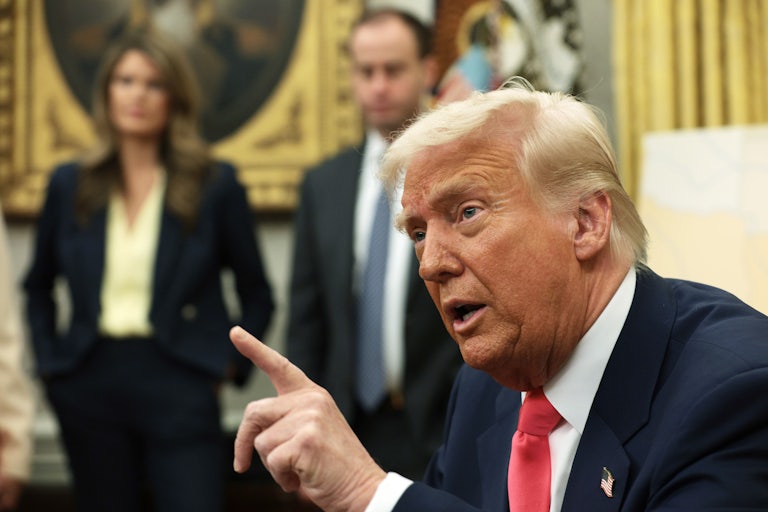
Donald Trump speaks and points a finger while seated at his desk in the Oval Office.
Alex Wong/Getty Images

Trump is soft-launching a recession. 

The president has now twice refused to rule out a recession in the wake of his own policies, including reckless tariff wars and massive cuts to the federal government. 

“Look I know that you inherited a mess,” Fox’s Maria Bartiromo asked him on Sunday Morning Futures. “But are you expecting a recession this year?”

“I hate to predict things like that. There is a period of transition, because what we’re doing is very big. We’re bringing wealth back to America, that’s a big thing. And there are always periods of.… It takes a little time, it takes a little time. But I think it should be great for us,” Trump responded, completely avoiding the question.

“A lot of people said ‘Oh, this is the business president,’” Bartiromo continued. “And now we have tariffs and the market has been going down.”

“Well not much, in all fairness.”

“You said ‘Look, we’re gonna have disruption but we’re OK with that.’ Is that what you meant; the stock market going down was the disruption?” 

“Look what I have to do is build a strong country. You can’t really watch the stock market.… What we’re doing is we’re building a tremendous foundation for the future.”

Bartiromo pressed even further. “The public companies wanna make sure that we have clarity. After April 2, when those reciprocal tariffs go in, is that it? Are you gonna change anything after that? Will we have clarity?”

“You’ll have a lot. But we may go up with some tariffs, it depends. We may go up, I don’t think we’ll go down, but we may go up. They have plenty of clarity.… They always say that,” Trump said.  

Trump continued this economic dismissiveness later that same day. 

“Are you worried about a recession?” a reporter asked him on Air Force One Sunday evening. “Maria Bartiromo asked you, and you kind of hesitated.”

The president shrugged. “I’ll tell you what, of course you hesitate. All I know is this: We’re gonna take in hundreds of billions of dollars in tariffs and we’re gonna become so rich you’re not gonna know where to spend all that money, I’m telling you, you just watch! We’re gonna have jobs, we’re gonna have factories, it’s gonna be great.” 

The businesses and farmers Trump claims to be doing this for might not survive the incoming recession that these tariffs—10 percent on China for now, with tariffs on Canada and Mexico to be determined later—will surely bring. It’s obvious now that Trump couldn’t care less about the American people’s economic suffering as long as it serves his spiteful political goals of sticking it to our allies and kneecapping the federal government.