Breaking News
Breaking News
from Washington and beyond

Judge Rips Elon Musk’s DOGE for Seizing Americans’ Personal Data

A federal judge has blocked DOGE from getting even more access to Americans’ sensitive personal data.

Elon Musk exits a building
Anna Moneymaker/Getty Images

The judicial system has handed DOGE another loss.

Judge Deborah Boardman on Monday ruled that Elon Musk’s Department of Government Efficiency has no legal right to the personal information of American citizens held at the Department of Education, the Office of Personnel Management, and the Treasury Department.

“No matter how important or urgent the President’s DOGE agenda may be, federal agencies must execute it in accordance with the law. That likely did not happen in this case,” Boardman wrote. She then filed a preliminary injunction blocking the aforementioned departments from sharing sensitive information with DOGE.

Boardman also referred to the Privacy Act of 1974 after noting that DOGE had already gotten its hands on systems containing Americans’ banking information, Social Security numbers, and marital and citizenship status.

“Congress’s concern back then was that ‘every detail of our personal lives can be assembled instantly for use by a single bureaucrat or institution’ and that ‘a bureaucrat in Washington or Chicago or Los Angeles can use his organization’s computer facilities to assemble a complete dossier of all known information about an individual,’ Boardman wrote. Those concerns are just as salient today.”

This story has been updated.
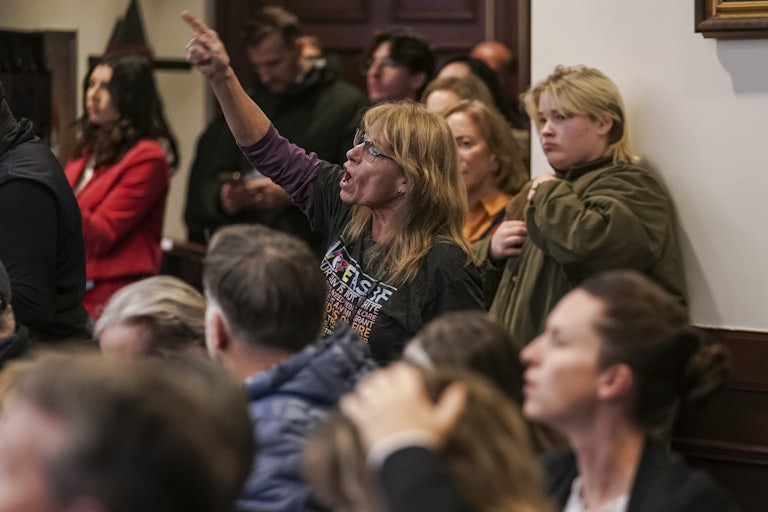
Voters Rage at “Empty Chair” Town Halls as Republicans Won’t Show Up

Pissed-off voters in red states across the country are revealing how afraid lawmakers are of their own constituents.

A woman in a crowd yells and points her finger at someone not pictured, as others listen.
Elijah Nouvelage/The Washington Post/Getty Images

Activist groups are holding “empty chair” town halls in Republican districts to show how abandoned some red-state voters are feeling four months into Trump’s second term.

A dozen town halls over the last week have featured angry voters yelling at a picture of their no-show Republican lawmaker. Hundreds railed against Andy Harris in Maryland on Saturday, where Representative Jamie Raskin stepped up in his absence.

“What’s interesting is that the people who are showing up are not paid protesters, but the people who are not showing up are paid politicians,” Raskin said while organizers showed a giant “MISSING” milk carton ad with Harris’s face on it. “If your name is on the ballot, your face should not be on the milk carton.”

X screenshot Jamie Raskin @jamie_raskin: Honored to join the spectacular Cambridge Indivisible Town Hall in #MD01. While MAGA ducks questions about their role in dismantling our democracy, Dems show up everywhere to hear the people and stop this assault on America. (4 photos of large crowds, and an MIA milk carton on stage)

Senator Thom Tillis was attacked in South Carolina on Friday.

“We need [Senator Tillis] to know that a lot of bills that are going through that he’s voting for us, the people, a lot of us are against,” said town hall attendee Rebekah Burks. “And we want him to know that we are unhappy with that. He works for us. We’re his constituents. He works for us. We have the right to talk to him, and he should answer our questions.”

“Will you stand up for your people and Congress by taking food out of the mouths of hungry constituents in your district?” a constituent said to the empty chair New York Representative Elise Stefanik should have been in. “She promoted higher education and Pell grants, and today she’s calling for the destruction of the Department of Education, which administers those grants,” said another.

In Ohio, a whopping 1,400 people showed up to rebuke Senators Bernie Moreno and Jon Husted on Saturday.

“As an ex–federal employee and a union member, I’m mad as hell,” attendee Arnold Scott said. “How about these billionaires pay their taxes? When they cut employees at the various agencies, actually what they’re doing is cutting the services that the taxpayers are paying for. When they cut the VA, they’re cutting veterans. You stand there and say you support the veterans, but then you cut the veterans. When you cut them, that translates into it taking longer for them to receive the services that they’re entitled to.”

More of the same happened in San Diego, where voters’ main concern was “what Elon Musk and DOGE is doing as far as having an unelected person just dismantling the government.”

These town halls, organized by progressive group Indivisible, come as Trump and Musk’s current and proposed purges to Social Security, the Department of Veterans Affairs, the Food and Drug Administration, and much more have started to hit their own constituents where it hurts—with no resistance from their representatives.

Judge Rejects Trump’s Deportation Plan, Warns It’s Doomed to Fail

Judge James Boasberg refused to lift his block on Donald Trump’s efforts to use the Alien Enemies Act.

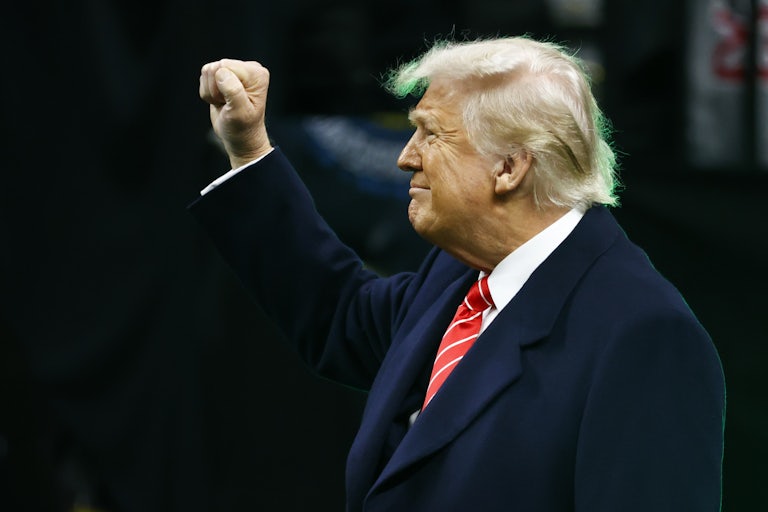
Donald Trump raises his fist as he enters a stadium in Philadelphia for a college wrestling tournament
Isaac Wasserman/NCAA Photos/Getty Images

A federal judge refused Monday to lift a pause on Donald Trump’s deportations of alleged gang members under the Alien Enemies Act.

In a 37-page filing, U.S. District Judge James Boasberg ruled that the ACLU was “likely to succeed” in arguing that individuals the government had claimed were members of the Tren de Aragua gang were “entitled to individualized hearings to determine whether the Act applies to them at all.”

“As the government itself concedes, the awesome power granted by the Act may be brought to bear only on those who are, in fact, ‘alien enemies,’” Boasberg wrote.

Boasberg also wrote that deportees under the AEA would suffer irreparable harm due to the horrible conditions of Salvadoran prisons, where prisoners are reportedly abused, humiliated, and left to rot without their families knowing anything about their whereabouts or well-being. Trump has agreed to pay Salvadoran President Nayib Bukele $6 million to hold deportees, including the 261 people whom Trump deported last week.

“There may well also be independent restrictions on the Government’s ability to deport class members—at least to Salvadoran prisons—even if they do fall within the Proclamation’s terms,” Boasberg wrote. The judge cited the Foreign Affairs Reform and Restructuring Act of 1998, which states that “it shall be the policy of the United States not to expel … any person to a country in which there are substantial grounds for believing the person would be in danger of being subjected to torture.”

The plaintiffs, who were loaded onto airplanes and denied their due process, were not given the opportunity to claim legal protection from potential torture afforded to them by U.S. law. When detainees asked where they were being deported, immigration officers simply laughed and said they didn’t know, according to the filing.

Ultimately, Boasberg denied the government’s motion to vacate his temporary restraining order on AEA deportations.

Earlier this month, after Trump invoked the AEA to deport alleged members of Tren de Aragua—now labeled an invading force—without due process, lawyers from the ACLU sought emergency relief for five individuals who claimed they had been wrongly identified as gang members.

In response, Boasberg had ordered the Trump administration to temporarily pause deportations under the AEA, but the government continued with the removal of more than 100 Venezuelan nationals—in defiance of the judge’s order.

The Trump administration has refused to reveal how immigration authorities were able to identify the individuals as gang members. One attorney alleged that her client had been wrongly labeled a member of the gang merely because of a tattoo that looked suspicious to immigration officials.

During a hearing Friday, Boasberg said that Trump’s “expanded” application of the eighteenth-century law was a “long way from the heartland” of the rule.

This story has been updated.

Trump Has Massive Tantrum Over a Portrait of Him He Thinks Is Ugly

Donald Trump is focused on the real issues of the day: this painting he thinks is ugly.

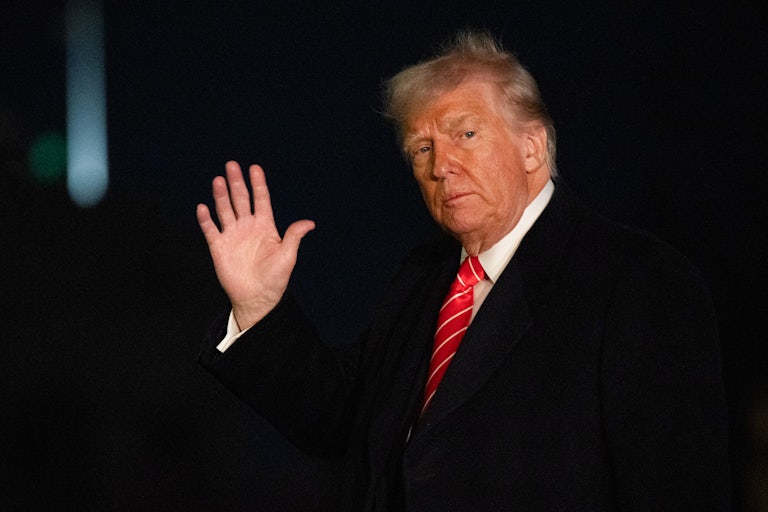
Donald Trump waves while walking outside the White House
Annabelle Gordon/AFP/Getty Images

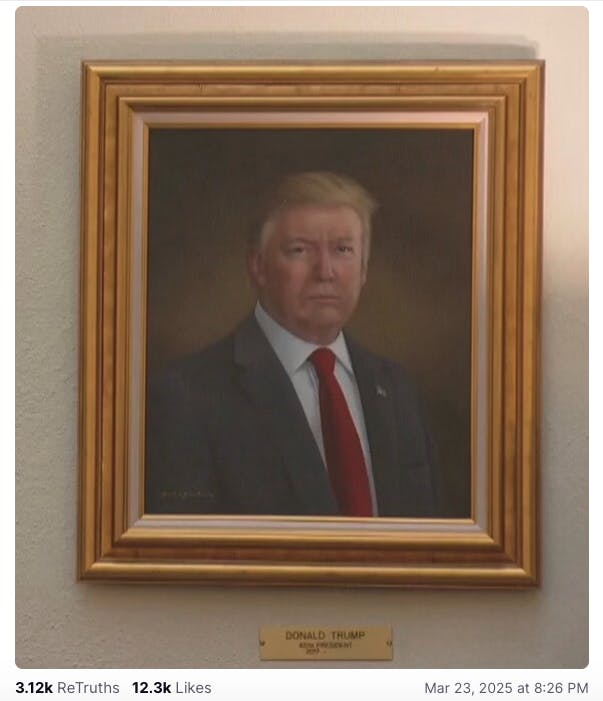
President Donald Trump threw a temper tantrum Sunday, demanding that an unflattering portrait of him be taken out of the Colorado state Capitol.

“Nobody likes a bad picture or painting of themselves, but the one in Colorado, in the State Capitol, put up by the Governor, along with all other Presidents, was purposefully distorted to a level that even I, perhaps, have never seen before,” Trump wrote in an outraged post on Truth Social.

“The artist also did President Obama, and he looks wonderful, but the one on me is truly the worst. She must have lost her talent as she got older,” he wrote.

In his post, Trump included a photograph of the portrait, showing a blanched president with furrowed brows, rounded cheeks, and a faded jaw line—not totally dissimilar from the president’s own face. Certainly not “purposefully distorted.”

Ever insistent on his mandate, Trump claimed that he was really engaging in childish whining on behalf of the people. “In any event, I would much prefer not having a picture than having this one, but many people from Colorado have called and written to complain. In fact, they are actually angry about it!

“I am speaking on their behalf to the Radical Left Governor, Jared Polis, who is extremely weak on Crime, in particular with respect to Tren de Aragua, which practically took over Aurora (Don’t worry, we saved it!), to take it down,” Trump wrote. “Jared should be ashamed of himself!”

Screenshot of a photo of Donald Trump’s portrait in the Colorado state Capitol
Screenshot

Trump’s shot at Democratic Governor Jared Polis also included a reference to Aurora, Colorado. During his campaign for the White House, Trump had falsely claimed Aurora had been “taken over” by an armed Venezuelan gang. He now claims to have saved the city, where Immigration and Customs Enforcement continues to crack down on undocumented immigrants and suspected gang members.

Earlier this month, Trump invoked the Alien Enemies Act, a wartime law from the eighteenth century, to declare Tren de Aragua an invading force, for the purpose of deporting its members without due process. The president’s use of the law is currently being reviewed in federal court after two legal advocacy groups alleged that the government had wrongly identified their clients as gang members. A federal judge issued a temporary pause on the deportations, but the government proceeded to send more than 100 Venezuelan nationals to a prison in El Salvador.

A spokesperson for Polis commended the president’s commitment to complaining about something so minute, telling The Hill, “Gov. Polis was surprised to learn the President of the United States is an aficionado of our Colorado State Capitol and its artwork. The State Capitol was completed in 1901, and features Rose Onyx and White Yule Marble mined in Colorado, and includes portraits of former Presidents and former governors. We appreciate the President and everyone’s interest in our capitol building and are always looking for any opportunity to improve our visitor experience.”

Supreme Court Shockingly Stands up to Trump on Press Freedom

The Supreme Court has rejected a bid by one of Donald Trump’s allies to attack a key press protection.

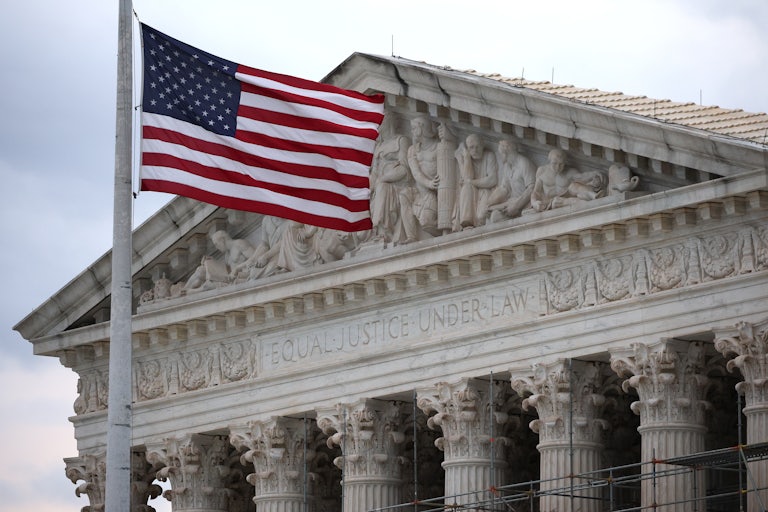
The Supreme Court building in Washington, D.C.
Win McNamee/Getty Images

The Supreme Court will not take on a case aimed at rescinding press protections via libel lawsuits.

The nation’s highest judiciary rejected an effort Monday by Republican megadonor Steve Wynn, declining to hear his argument for overturning New York Times v. Sullivan, a landmark 1964 decision that raised the standards required for a plaintiff to win a defamation lawsuit against a media organization.

In that case, the bench unanimously found that it wasn’t enough for reported information to be found false for a plaintiff to win a suit. Instead, Justice William Brennan Jr. argued that in order to win a defamation case, public figures must prove that journalists published details with “actual malice”—as in, a gross recklessness or disregard for the truth.

In a petition filed in February, Wynn claimed that the 61-year-old precedent was “unfit for the modern era.”

“Instead, everyone in the world has the ability to publish any statement with a few keystrokes. And in this age of clickbait journalism, even those members of the legacy media have resorted to libelous headlines and false reports to generate views. This Court need not further this golden era of lies,” the attorney for the former Republican National Committee finance chair wrote.

The high court has thrown out previous attempts to upend the libel standard. In 2022, the Supreme Court refused to hear a similar challenge to the “actual malice” definition when Coral Ridge Ministries Media sued the Southern Poverty Law Center for listing them as an “anti-LGBTQ hate group.” But not everyone on the court was in agreement—in a controversial dissenting opinion, Justice Clarence Thomas left the door open for possible future attempts to undo the decision, writing that the original ruling was “allowing media organizations and interest groups ‘to cast false aspersions on public figures with near impunity.’”

Ultimately, the “actual malice” standard for public figures and officials is intended to deter lawsuits from people who don’t need to rely on the legal system in order to correct or address negative coverage. Instead, people in power can call for news conferences or (in the case of elected officials) draft new laws that counteract the narrative of their unwanted media coverage. Times v. Sullivan also protects press organizations from people with enormous wealth who could potentially leverage their financial resources in order to silence criticism of their behavior.

Defamation standards for private figures are different: Average, everyday people suing media organizations for incorrect coverage do not have to prove “actual malice,” and instead only need to show a court that the information was incorrect and damaged their reputation.

Wynn’s case against press protections comes with its own baggage. In 2018, the casino mogul sued the Associated Press for defamation after the newswire reported that two women had accused him of sexual assault in the 1970s.

Wynn resigned as chairman and CEO of Wynn Resorts that year, just two weeks after The Wall Street Journal reported that the billionaire had paid out a $7.5 million settlement to a hired manicurist he allegedly raped.

“After she gave Mr. Wynn a manicure, she said, he pressured her to take her clothes off and told her to lie on the massage table he kept in his office suite, according to people she gave the account to,” the Journal reported at the time. “The manicurist said she told Mr. Wynn she didn’t want to have sex and was married, but he persisted in his demands that she do so, and ultimately she did disrobe and they had sex, the people remember her saying.”

The Nevada state Supreme Court ruled against Wynn in November, with Justice Ron Parraguirre writing that “one of the most recognized figures in Nevada” needed to show “clear and convincing evidence to reasonably infer that the publication was made with actual malice.”

This story has been updated.

Read more about press protections: