Breaking News
Breaking News
from Washington and beyond

MAGA’s Mad at JD Vance for Group Chat—But Not for the Reason You Think

JD Vance is catching heat for his actions in the Signal group chat.

JD Vance raises his finger while speaking during a visit to a space base in Greenland
Jim Watson/AFP/Getty Images

Vice President JD Vance may have stepped in it with his fellow Republicans by questioning Donald Trump’s plan to strike the Houthis, NBC News reported Sunday.

Earlier this month, Vance, and other senior Trump officials discussed sensitive plans to strike the Houthis in Yemen in a Signal group chat that was widely publicized after Trump’s national security adviser Mike Waltz accidentally added a high-profile reporter. In the chat, Vance alone aired doubts about the plan, warning that the strike was not in alignment with Trump’s America First policies, because it would help Europe more than it would help the U.S.

“I am not sure the president is aware how inconsistent this is with his message on Europe right now,” Vance wrote. “There’s a further risk that we see a moderate to severe spike in oil prices. I am willing to support the consensus of the team and keep these concerns to myself. But there is a strong argument for delaying this a month, doing the messaging work on why this matters, seeing where the economy is, etc.”

When Defense Secretary Pete Hegseth insisted that the strike wasn’t about the Houthis at all but about safeguarding trade and reestablishing deterrence, Vance relented. “If you think we should do it let’s go. I just hate bailing Europe out again,” he wrote.

Hegseth agreed, and White House Deputy Chief of Staff Stephen Miller responded, “As I heard it, the president was clear: green light, but we soon make clear to Egypt and Europe what we expect in return.”

Vance distinguished himself as the most ideological member of the Signal chat, freely expressing his contempt for Europe and a profound lack of interest in preventing the disruption of trade routes. Vance’s reluctance to help another country was arguably the most MAGA position to take—but some of the more hawkish senior Republicans didn’t like that he didn’t mindlessly submit to Trump’s directive, NBC News reported.

“Capitol Hill Republicans still have their jaws on their floor with how actively the VP worked to try and undo a Trump decision,” one senior Republican official in Washington wrote in a text. “Thank goodness Miller stepped in and put him in his place.”

“It’s one thing to have a healthy interagency debate before a decision is made. It’s another to try and undo a Commander-in-Chief decision once Trump gives the execute order. This is the latter, and it’s very Bolton-esque,” the senior Republican official added, referring to John Bolton, Trump’s former national security adviser who has become an outspoken critic of the president.

Some Republicans even believed that Vance’s question was tantamount to obstruction.

“These are the president’s policies, and for JD Vance to question them like that is ridiculous. He is the commander in chief,” another Republican on Capitol Hill told NBC News. It seems that to many Republicans, the most MAGA thing a person can do is agree with Trump about anything.

On the flip side, others in the Trump administration are reportedly concerned that the strike against the Houthis could lead to messy, drawn-out conflict.

“It’s 2002 all over again,” said one current administration official who spoke with NBC News anonymously because he wasn’t permitted to speak to the press. Already, the Pentagon has begun directing aircraft carriers and resources to the region, indicating that the fight with the Houthis is far from over.

During a trip to Greenland last week, Vance was asked whether he had raised his concerns with Trump and what he meant when he wrote that the president “wasn’t aware that his directions for Yemen were inconsistent with his message for Europe.”

“Well I didn’t quite say that. I think that’s a slight misunderstanding of what I said,” Vance replied, though of course, that was exactly what he had said.

In the end, Vance didn’t answer either question but instead launched into a rant about what he’d learned from “Signalgate.”

“Sometimes we all agree, and sometimes we all disagree. But it’s important that we all have an honest conversation amongst ourselves, and with the president of the United States about what we think is in the best interest of the national security of the United States of America,” said Vance, who had readily shut down his own dissenting opinion.

Vance claimed that he had “always supported the president’s decision to strike the Houthis.”
Trump Insists Economy Not About to Explode as Banks Warn Differently

Donald Trump appears to be driving the U.S. right into a recession.

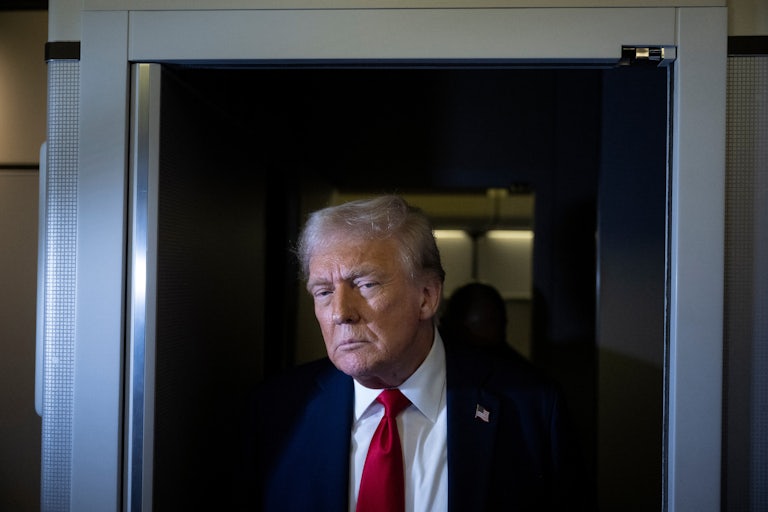
Donald Trump stands with reporters on Air Force One
Brendan Smialowski/AFP/Getty Images

Banks are predicting a downturn for the American economy.

Goldman Sachs raised its 12-month recession probability from 20 percent to 30 percent on Monday, reported Reuters. The banking giant also downgraded American gross domestic product growth forecast from 2 percent to 1.5 percent, and projected three interest rate cuts by the Federal Reserve.

In a Sunday note to its investors, Goldman speculated that the average U.S. tariff rate will rise 15 percent points over the next year, 5 percent higher than it previously predicted. That’s thanks to Donald Trump’s decision to spark a global trade war.

“Almost the entire [tariff rate] revision reflects a more aggressive assumption for ‘reciprocal’ tariffs,” the brokerage firm wrote in a memo obtained by Reuters.

Trump has driven a wedge in America’s trade and military alliances by suddenly imposing large tariffs on the nation’s longtime partners. On Thursday, Canadian Prime Minister Mark Carney announced that his country’s cozy relationship with the U.S. had come to an end and that they would wean themselves off American products and services “at speeds we haven’t seen in generations.”

The seismic diplomatic shift followed another tariff announcement by the Trump administration, this time imposing a 25 percent hike on auto imports. Carney called the levy—which will take effect on vehicle imports April 3 and vehicle parts in May—a “direct attack” on Canada, but the news also immediately hit America’s Big Three automakers, whose stock dropped multiple percentage points in reaction to the news.

Trump’s tariffs will have an even more significant effect on Europe, which Goldman warned could enter a “technical” recession by the end of the year, with “little” growth—as in, 0.0 percent growth in the third quarter.

“We estimate that our new tariff assumptions will lower euro area real GDP by an additional 0.25 percent compared to our previous baseline, for a total hit to the level of GDP of 0.7 percent compared to a no-tariff counterfactual by end-2026,” Goldman wrote in another note issued Sunday.

Trump, however, seemed completely unconcerned by the looming economic peril. Speaking with reporters aboard Air Force One on Sunday, Trump brushed off concerns about high unemployment and “stagflation,” which is when economic growth stagnates but inflation remains high. Instead, he insisted that “this country is going to be more successful than it ever was.”

“It’s going to boom,” the president said. “We’re gonna have boomtown USA. We’re gonna boom.”

Did Trump Just Break the Law on Deportations?

Secretary of State Marco Rubio announced another mass deportation to El Salvador.

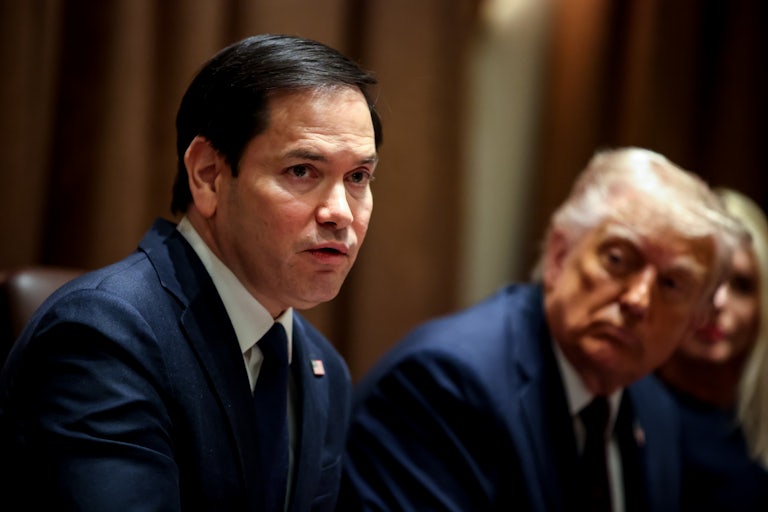
Secretary of State Marco Rubio speaks at a Cabinet meeting. Donald Trump can be seen in the background, seated beside him listening.
Samuel Corum/Sipa/Bloomberg/Getty Images

Secretary of State Marco Rubio may have just violated a court order stopping the Trump administration’s fast-tracked deportations.

Rubio announced that a group of alleged gang members had been deported Sunday night.

“Last night, in a successful counter-terrorism operation with our allies in El Salvador, the United States military transferred a group of 17 violent criminals from the Tren de Aragua and MS-13 organizations, including murderers and rapists,” Rubio wrote on X Monday morning. He noted that both TdA and MS-13 were considered foreign terrorist organizations, which implies that they could be subject to removal under the Alien Enemies Act, or AEA.

Rubio thanked the Salvadoran government and President Nayib Bukele for “their unparalleled partnership in making our countries safe against transnational crime and terrorism.”

Multiple judges have rebuked Donald Trump’s use of the AEA and filed injunctions against his administration—and Rubio’s latest deportations may have just violated one.

Last week, U.S. District Court Judge Brian Murphy issued a temporary restraining order requiring the government to provide written notice and an opportunity for detainees to apply for protection before deporting them to a third country.

It seems that with this latest round of deportations, the Trump administration has violated that court order, and continued to fast-track its removal of alleged gang members.

Earlier this month, Trump invoked the AEA, a wartime law that suspends due process. Under the act, the Trump administration swiftly deported 261 Venezuelan nationals to Centro de Confinamiento del Terrorismo, or CECOT, the prison in El Salvador that is notorious for human rights abuses. The U.S. government claimed that everyone deported was a terrorist.

The deportees were removed without notifying their family members or lawyers, and they were not provided with the opportunity to challenge their deportation or their designation as gang members. In many cases, the government seems to have rounded up immigrants for supposedly suspicious tattoos that ended up having nothing to do with TdA at all.

In another filing last week, Judge James Boasberg wrote that by sending the prisoners to CECOT, the Trump administration had likely violated the Foreign Affairs Reform and Restructuring Act of 1998, which states that “it shall be the policy of the United States not to expel … any person to a country in which there are substantial grounds for believing the person would be in danger of being subjected to torture.” Boasberg wrote that at CECOT, prisoners are reportedly abused, humiliated, and left to rot without their families knowing anything about their whereabouts or well-being.

Trump National Security Adviser’s Latest Signal Defense Makes No Sense

Mike Waltz has backed himself into a corner.

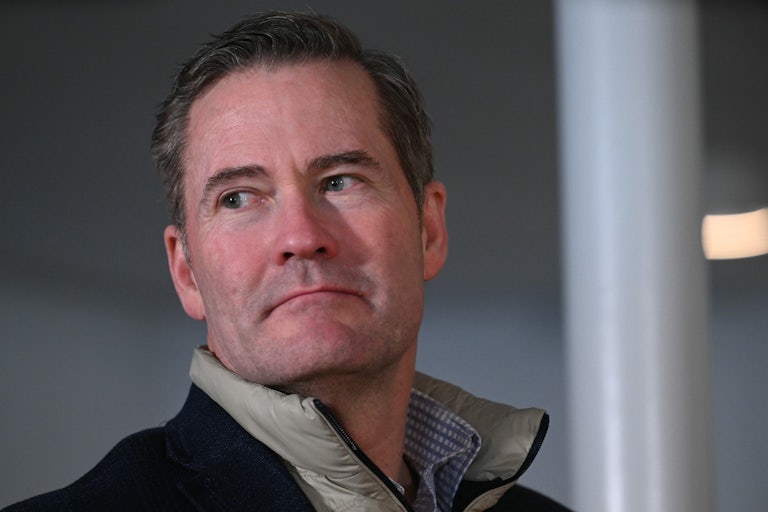
National Security Adviser Mike Waltz looks to the side while visiting a space base in Greenland
Jim Watson/Getty Images

National security adviser Mike Waltz is grasping at straws to defend the fact that he invited The Atlantic’s Jeffrey Goldberg to a Signal group chat about bombing Yemen.

During an interview on Fox News last week, Waltz attempted to explain away the enormous bluster by claiming that the editor’s number had simply been “sucked in” to his phone.

“I’m sure everybody out there has had a contact where you, it was, it said one person, and then a different phone number,” Waltz told the network.

“But you never talked to him before, so how is the number on your phone?” pressed Fox’s Laura Ingraham.

“Well, if you have somebody else’s contact, and then somehow it gets sucked in. It gets sucked in,” Waltz said.

That response—which comes from an individual who is supposed to be the pinnacle of American expertise on national security matters—completely misunderstands how cell phones work. Lest it need explanation, cell phones do not “suck in” phone numbers; instead, numbers are inserted by the people who use the device.

“This isn’t The Matrix,” Goldberg told NBC News Sunday, responding to Waltz’s comments. “Phone numbers don’t just get sucked into other phones. I don’t know what he’s talking about there.

“My phone number was in his phone because my phone number is in his phone,” Goldberg continued. “He’s telling everyone that he’s never met me or spoken to me. That’s simply not true.”

Democratic Representative Sean Casten was a little more blunt, branding Waltz as “full of shit.”

“If what he says is true, then he is choosing to discuss classified information on a platform where—in his own telling—he has no control over who is listening in,” Casten tweeted Sunday afternoon, reposting a clip of Goldberg’s interview. “Either he’s a liar or a traitor. Pick one.”

Waltz was the singular admin for a group chat created earlier this month on the retail app Signal in which over a dozen senior Trump administration officials discussed seemingly classified information regarding an imminent attack on Yemen. To make matters worse, Waltz blindly added Goldberg, who reported on the exchange last week. Donald Trump has continued to back Waltz publicly, but in private, the president was reportedly “mad” and “suspicious” that Waltz had Greenberg’s contact in his phone to begin with.

Former intelligence officials have warned that America’s adversaries “undoubtedly” already have the chat records, largely thanks to the Trump administration’s special envoy to the Middle East Steve Witkoff’s physical presence in Russia when he was added to the chat.

In an interview with MeidasTouch Tuesday, former national security adviser Susan Rice said that Witkoff’s use of Signal while in Russia basically hand-delivered news of the attack to the Kremlin hours before it took place.

“Russians have whatever Witkoff was doing or saying on his personal cell phone,” Rice told the podcast.

The Signal fiasco also angered U.S. military pilots, who claimed that such a careless leak had blatantly put the lives of service members at risk. Dozens of interviewed Navy and Air Force pilots told The New York Times that the Trump administration’s operational security blunder had not only upended decades of military doctrine but had also shattered pilots’ trust that the Pentagon would prioritize their safety.

“The whole point about aviation safety is that you have to have the humility to understand that you are imperfect, because everybody screws up. Everybody makes mistakes,” Lieutenant John Gadzinski, a retired Navy F-14 pilot who flew combat missions from aircraft carriers in the Persian Gulf, told the Times. “But ultimately, if you can’t admit when you’re wrong, you’re going to kill somebody because your ego is too big.”

Trump Pulls a 180 on His Tariffs Threat—and Makes Things Way Worse

Trump has just made his most extreme tariffs threat yet.

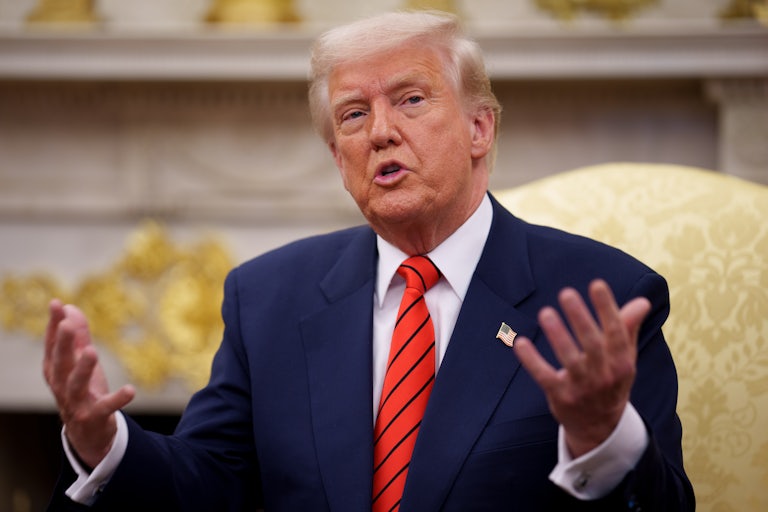
Donald Trump speaks in the White House.
Andrew Harnik/Getty Images

President Trump continues to pivot endlessly on tariffs, badly destabilizing the very market he claims he’s trying to balance.

“On the tariffs that you’re planning … you’re expected to hit something like 10 to 15 countries, is that right?” a reporter asked Trump on Sunday, referring to Treasury Secretary Scott Bessent’s description of the countries with the largest trade deficits with the U.S. as the “Dirty 15.”

“I don’t know who told you 10 or 15 countries,” Trump replied.

“Well we heard that.”

“But you didn’t hear it from me.”

“How many countries will be in that initial chunk?” the reporter pressed.

“You start with all countries, so let’s see what happens,” Trump said, dramatically expanding his threat.

“There are many countries.… If you look at the history, and you look at what’s happened to us.… Go to Asia, and you take a look at every single country in Asia, what they’ve done to the United States in trade,” Trump continued vaguely. “I wouldn’t say anybody has treated us fair, or nicely.”

Trump plans to drop these reciprocal tariffs on Wednesday, which he is framing as “Liberation Day.” But this spiteful trade war will only hurt American consumers and manufacturers already dealing with inflation, potentially leading the country into a recession. But Trump has already admitted he doesn’t care.