Breaking News
Breaking News
from Washington and beyond

Trump Finally Takes Revenge on CDC With Total Bloodbath

The Centers for Disease Control and Prevention just fired a ton of its employees—in the most chaotic way possible.

Donald Trump points and purses his lips.
Win McNamee/Getty Images

In a stroke of revenge for Donald Trump and Health Secretary Robert F. Kennedy Jr., thousands of employees of the Centers for Disease Control and Prevention lost their jobs Tuesday.

The “reduction in force” affected workers across many departments vital to U.S. public health, including the National Center for Injury Prevention and Control, the Division of Population Health, the Division of Reproductive Health, the Division of HIV Prevention, the National Institute of Occupational Safety and Health, and the Division of Environmental Health Science and Practice, Wired reports.

Even programs at the centers on Chronic Disease Prevention and Health Promotion as well as HIV, Viral Hepatitis, STD, and Tuberculosis Prevention were affected. The HIV program reportedly lost at least half of its workforce. Employees across the agency received notices via email beginning 5 a.m. Tuesday, with some workers showing up to their offices to find their ID badges didn’t work anymore.

“I regret to inform you that you are being affected by a reduction in force (RIF) action,” the email notice stated, according to Wired. “This RIF does not reflect directly on your service, performance, or conduct. It is being taken solely for the reasons stated in the memorandum. After you receive this notice you will be placed on administrative leave and will no longer have building access beginning Tuesday, April 1, unless directed otherwise by your leadership.”

One CDC employee told the magazine, “There has been no effort in allowing staff to transfer projects, programs, or responsibilities.” Even the Freedom of Information Act office at the CDC, as well as the FDA’s communications and web office, were cut.

The move comes among massive layoffs from Kennedy across the entire Department of Health and Human Services on Tuesday. Those firings include people at the National Institutes of Health, the Food and Drug Administration, and the Centers for Medicare and Medicaid Services.

Kennedy has long been an anti-vaccine activist, so the move is in line with his beliefs, especially since he has already revoked over $11 billion in Covid-19 aid funding from HHS. Trump has long held a grudge against the CDC and other public health agencies, blaming them for tanking his first term when it was really his own mishandling of the Covid-19 pandemic. Now he and Kennedy are dealing a crippling blow to public health in America.
Nine House Republicans Torpedo Mike Johnson’s Plans

Nine Republicans voted against their House speaker on proxy voting for new parents—causing him to abandon all plans for the rest of the week.

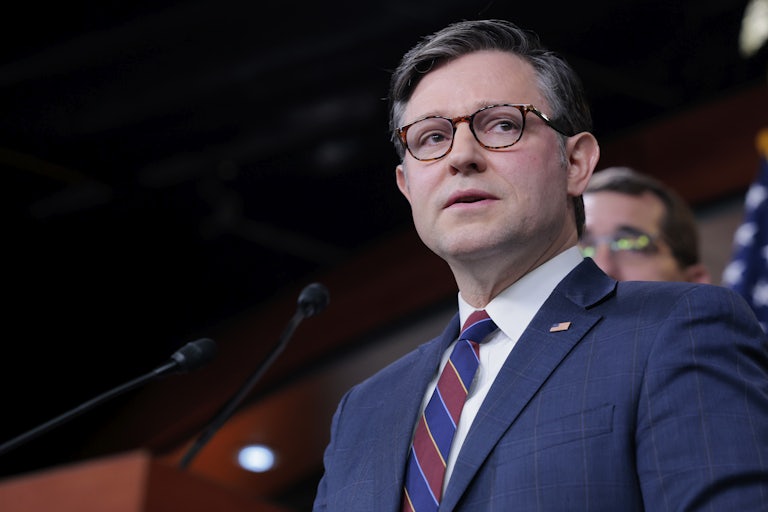
House Speaker Mike Johnson
Anna Moneymaker/Getty Images

Nine House Republicans defected from their party on the parental proxy vote Tuesday in a direct rejection of Speaker Mike Johnson’s plans.

The vote was for a bill regarding whether to allow new parents in the House to have a proxy vote for them in the first 12 weeks after the birth of their child. The legislation, which would have helped new mothers and fathers, was put forth by MAGA Republican Anna Paulina Luna and Democrats Brittany Pettersen and Sara Jacobs. Luna and Pettersen each gave birth recently, and there is no parental leave for members of Congress.

When Johnson and other House Republican leaders went out of their way to block the bill, nine House Republicans—Luna, Kevin Kiley, Tim Burchett, Jeff Van Drew, Greg Steube, Mike Lawler, Ryan Mackenzie, Nick LaLota, and Max Miller—all turned on Johnson, torpedoing his plans and passing the parental proxy bill.

The nine betrayals bothered Johnson so much that he canceled votes in the House for the rest of the week.

Johnson, who doesn’t have the greatest working relationship with Luna, insisted that the parental proxy bill would lead to more representatives voting remotely.

“I believe it’s unconstitutional. I believe it violates more than two centuries of tradition in the institution, and I think that it opens a Pandora’s box where, ultimately, maybe no one is here, and we’re all voting remotely by AI or something. I don’t know,” Johnson said at a press conference last week. “I don’t think that’s what Congress is supposed to be. This is a deliberative body. You cannot deliberate with your colleagues if you’re out somewhere else.”

Republicans are weirdly obsessed with killing this bill, whether it be for anti–work from home reasons, anti-woman reasons, or both.

Pettersen, who is the thirteenth active House member to give birth, spoke in support of Luna’s bill on the House floor while holding her 9-week-old son, Sam, in her arms. Sam was born prematurely.

“No mom or dad should be in the position that I was in and so many parents have found themselves in. It is anti-woman, it’s anti-family, and we need to come together,” she said. “We have a long ways to go to make this place accessible for young families like mine.… For all of the parents here, we know that when we have newborns, it’s when they’re the most vulnerable in their life. It’s when they need 24-7 care.”

Here’s Where Trump’s Cuts to Planned Parenthood Will Hurt Most

Donald Trump just froze millions in funding to Planned Parenthood.

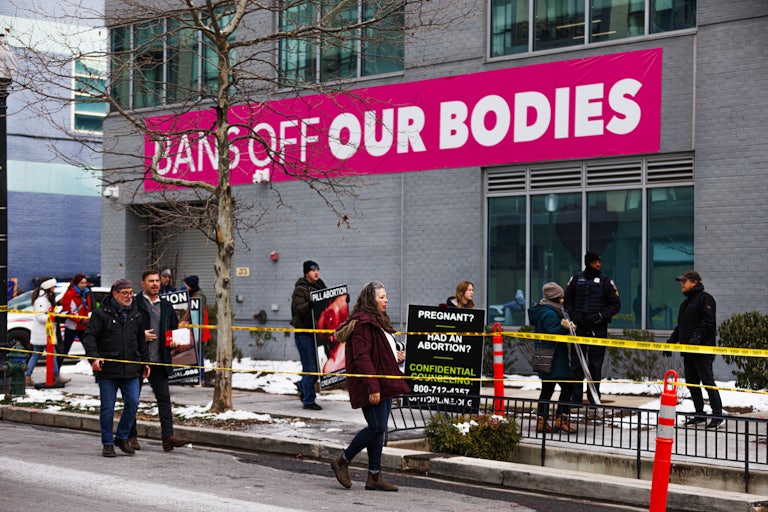
A Planned Parenthood clinic with the sign "Bans off our bodies."
Aaron Schwartz/NurPhoto/Getty Images

The Trump administration on Tuesday froze $35 million in family planning, sexual, and reproductive health funding.

The “Abortion, Every Day” newsletter reports that the move, which targets funding under Title X, will hit multiple nonprofit organizations, including conservatives’ bogeyman Planned Parenthood. Several states will be impacted, with Maine, Missouri, Mississippi, Montana, Tennessee, and Utah having their Title X funds reduced to zero.  

Other states, such as Pennsylvania, Minnesota, and Alaska will lose the majority of their funding, while Connecticut, Idaho, Indiana, Kentucky, New Hampshire, Ohio, South Carolina, Texas, and Virginia will lose part of their funding. 

Title X provides funds, mostly to uninsured and low-income Americans, for cancer screenings, birth control, and testing for sexually transmitted infections, as the country’s only federal family planning program. Sixty percent of women benefit from publicly funded clinics as their usual source of health care, while for 40 percent, these clinics are their only health care option. 

The move comes after the White House froze $120 million in Title X program grants last week, half of the entire program, to make sure that recipients were complying with executive orders against diversity, equity, and inclusion. Conservatives have also wanted to defund Planned Parenthood and other organizations that advocate for abortion rights for a long time, despite federal law already prohibiting taxpayer funds being used for the procedure.

Now it seems that the right is going even further in targeting family planning and reproductive health altogether. Millions of people will lose access to pregnancy testing, contraception, STI treatment, infertility evaluation and counseling, and numerous other health services. But, as was said in the first Trump administration, the cruelty is the point.

Press Secretary Suddenly Knows Nothing About Trump Tariff Comments

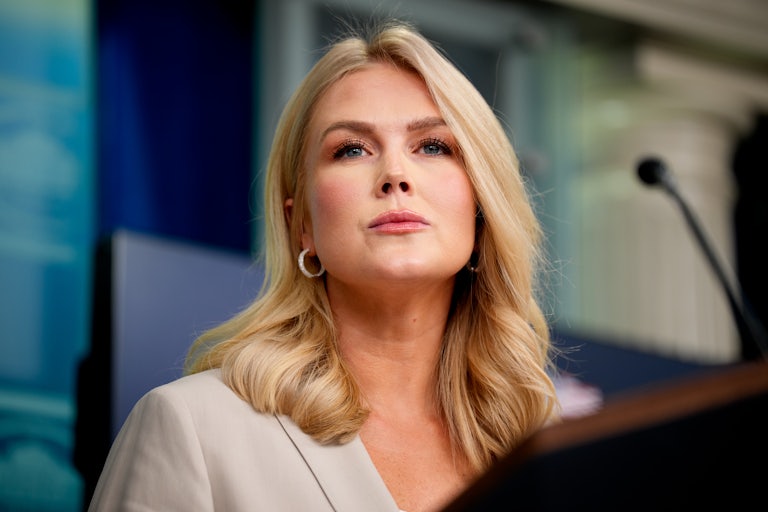
Karoline Leavitt had yet another ridiculous defense for Donald Trump and his tariffs.

Press Secretary Karoline Leavitt stands at a podium during a White House briefing
Andrew Harnik/Getty Images

The White House’s lines of communication appear to be frayed or, at the very least, out of date.

Just last month, Donald Trump practically threatened executives of America’s auto industry over a phone call, insisting that the tariffs would be “great,” that their companies would benefit from his plan to resurrect stateside manufacturing, and that, ultimately, the White House would not look favorably if they chose to raise prices on their product, reported The Wall Street Journal.

But White House press secretary Karoline Leavitt insisted Tuesday that she was unaware whether the president had urged America’s largest automakers not to raise prices due to his tariffs.

While answering a question highlighting that Trump has previously and repeatedly promised that other countries would “eat the cost” of his tariffs, Leavitt said she wasn’t sure if the comment “was made or was not made.”

“A tariff will be a tax on these foreign nations, these foreign companies, and if they want to be absolved of that tariff then they can come here to the United States of America to do business, bring their jobs here,” Leavitt reiterated.

But former White House officials—and some of the world’s top economists—argue that Trump’s tariffs will only spell disaster for the average American.

“So he’s doing this thinking that it’s going to restore manufacturing, but it’s actually going to have the opposite effect, and market participants know this,” former White House communications director Anthony Scaramucci told MSNBC last month, pointing to the redirection of capital into European markets since Trump announced the tariffs.

At the time, Scaramucci warned that Trump’s tariffs were scaring CEOs across multiple industries, who he had heard were blowing up the president’s phone in an effort to reverse the clock on the president’s trade war.

Trump’s global tariff war is expected to affect just about every sector of life for the average American.

Products that will see prices rise include groceries such as avocados, maple syrup, ground beef, cherry tomatoes, sugar, bananas, nuts, cooking oil, squash, cucumbers, strawberries, and pineapples. Trump’s tariff-related executive orders have also had immediate ramifications for countless other business sectors, raising the price on everything from liquor to gas.

Children’s toys, shoes, beer and alcohol, and crude oil were all hit in Trump’s 25 percent tariff hike on Canada and Mexico, alongside an additional 10 percent tariff on China. Car manufacturers BMW, Audi, Nissan, and Mazda were also affected, as was American-owned Ford. And every industry that relies on lumber, aluminum, and steel—from artisan goods to construction—will see markups as the materials themselves become more costly.

The rising cost of screws, for instance, has already started to affect supply chains for American companies that make everything from “car parts to appliances and football helmets to lawn mowers,” reported The Wall Street Journal.

Trump has leaned into tariffs as a key component of affording an extension to his 2017 tax plan, which overwhelmingly benefits corporations and is projected to add as much as $15 trillion to the national deficit. But experts believe that a trade war would be to the overwhelming detriment of American consumers and allies abroad—and that the self-inflicted pain could only serve to benefit U.S. adversaries around the globe.

Putin Suddenly Gives Trump the Middle Finger on Ukraine Peace Talks

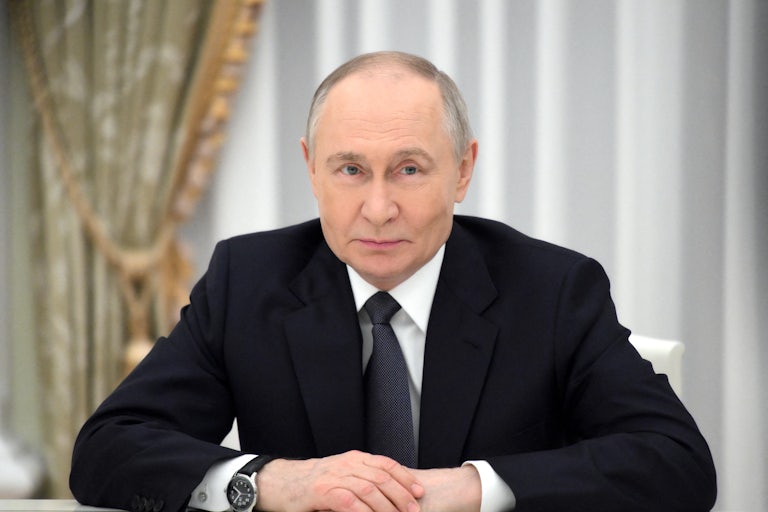
Russia has poured cold water on Donald Trump’s efforts to end the war in Ukraine.

Russian President Vladimir Putin sits at a table with his hands folded on top of it
Grigory Sysoyev/AFP/Getty Images

Surprise, surprise: Russia has not turned out to be a reliable negotiating partner in ending the war in Ukraine.

Peace talks between the United States and the world power have seemingly stalled, Reuters reported Tuesday.

The interrupted discussion suggests that the White House and the Kremlin have been unable to broker a new deal since Russian President Vladimir Putin objected to America’s last proposal some two weeks ago.

Moscow “cannot accept” the current proposal to end the war because it fails to address problems that the Kremlin believes to have caused the conflict, Deputy Foreign Minister Sergei Ryabkov said in an interview published Tuesday with a Russian state-sponsored magazine, International Affairs.

“We take the models and solutions proposed by the Americans very seriously, but we can’t accept it all in its current form,” Ryabkov said. “As far as we can see, there is no place in them today for our main demand, namely to solve the problems related to the root causes of this conflict. It is completely absent, and that must be overcome.”

Kremlin spokesman Dmitry Peskov indicated on Tuesday that a breakthrough in talks between the nations “isn’t imminent,” according to PBS.

“The issues that we are discussing in connection with the Ukrainian settlement are quite complex, and they require a lot of additional efforts,” Peskov said during a conference call.

The White House appears to be growing increasingly frustrated with the situation. In a weekend spat more akin to a high school fight than a diplomatic negotiation, Donald Trump told NBC News’s Kristen Welker that he was “pissed off” with Putin over insults the Russian dictator had tossed at Ukrainian President Volodymyr Zelenskiy.

The ordeal inspired Trump to pitch secondary tariffs between 25 and 50 percent on buyers of Russian oil, blaming the nation’s continued efforts to evade an end to the war.

“If Russia and I are unable to make a deal on stopping the bloodshed in Ukraine, and if I think it was Russia’s fault—which it might not be—but if I think it was Russia’s fault, I am going to put secondary tariffs on oil, on all oil coming out of Russia,” Trump said on Sunday.

Trump’s threat followed a call by Putin on Friday in which the Russian ruler demanded a transitional government to be put in place in Ukraine—a threat to Zelenskiy’s leadership, reported Agence France-Presse.

Zelenskiy lambasted Moscow in an address late Sunday, arguing that the Kremlin “blatantly makes a mockery of our partners’ efforts to advance a peace agenda.”

The conflict began when Russian forces crossed the Ukrainian border on February 24, 2022, which Putin tried to justify by falsely claiming that he needed to protect civilians in eastern Ukraine. The U.S. and Russia opened peace discussions at a meeting in Saudi Arabia in February, seeking a conclusion to the three-year war, but from the jump, the assembly conspicuously excluded Ukrainian leadership.

Russia has made a series of demands in order to end the war—which Defense Secretary Pete Hegseth blunderingly signed off on and then gently walked back at a February NATO conference in Munich. At the time, Hegseth said that the administration’s peace talks with Russia had taken several chips “off the table,” including Ukraine’s possible NATO membership (something the military alliance had promised in 2008), the possibility of a U.S. presence in Ukraine to enforce postwar security guarantees, and the end of NATO missions to Ukraine.

Since then, Putin has also insisted on taking complete control of the four Ukrainian regions Russia partially occupies as a result of the war, and that the Ukrainian army be limited going forward.*

European leaders have been watching the negotiations closely. On Tuesday, German Foreign Minister Annalena Baerbock described the deal as a “deadlock” and urged the U.S. not to capitulate to Putin’s “stalling tactics.”

* This article has been updated to clarify how much territory Russia controls.