Breaking News
Breaking News
from Washington and beyond

Trump Just Let a Far-Right Troll Purge the National Security Council

Laura Loomer, a figure so extreme many Trump loyalists spurn her, just got the president to fire three members of the National Security Council for alleged "disloyalty."

Laura Loomer, a far right troll, wears a shirt saying "Donald Trump did nothing wrong" while yelling outside a Miami courthouse.
Stephanie Keith/Getty Images
Laura Loomer outside Donald Trump's 2022 Manhattan fraud trial

Multiple National Security Council staffers have been fired at the behest of MAGA conspiracy theorist and Trump loyalist Laura Loomer, according to Axios and the Associated Press.

The NSC, headed by Mike Waltz, made headlines after Signalgate, in which Waltz inadvertently added The Atlantic’s Jeffrey Goldberg to a Signal chat where multiple Cabinet members were discussing plans to bomb Yemen.

A source close to the situation told Axios that the firings were “being labeled as an anti-neocon move.” Waltz has been accused of being insufficiently MAGA by the farthest right of the party.

Loomer apparently “presented [Trump] with her research and evidence” alleging that more traditional neoconservative foreign policy hawks were too well represented in the administration.

Loomer, who Trump has described as a “free spirit,” is a “proud Islamophobe” who was pushed out of Trump’s inner circle during the campaign due to numerous statements that were deemed too incendiary for MAGA. She’s stated that 9/11 was an “inside job” and that the White House would “smell like curry” if Kamala Harris, who is of Indian descent, won the election.

This may be the worst time to allow a crank like Loomer back into the fold. The Signalgate controversy has already demonstrated the administration’s capacity for foolishness, and relationships with the rest of the world are arguably at an all-time low, thanks to Trump’s suicidal tariff regimen.

Loomer has declined to share any of what she discussed in her Oval Office meeting.
Former Trump Treasury Secretary Clearly Thinks Tariffs Are Stupid

Steven Mnuchin, who served as Trump’s treasury secretary during his first term, went on television to very delicately prod the president to change his approach.

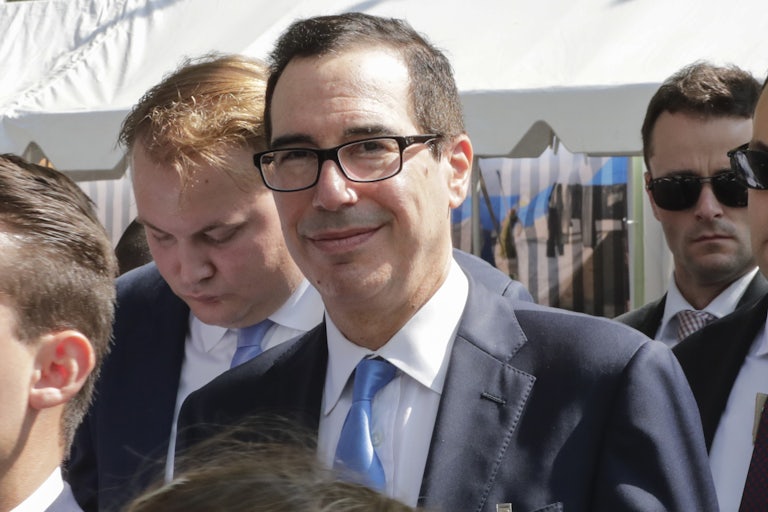
Steven Mnuchin smiles at the camera
EuropaNewswire/Gado/Getty Images
Former Treasury Secretary Steven Mnuchin in 2019

Steven Mnuchin, the treasury secretary during Donald Trump’s first term, is worried about the president’s new tariffs and hoping to change them via the president’s favorite medium: television.

On CNBC Thursday morning, Mnuchin tried to delicately ask for carve-outs and concessions, attempting to explain that “there’s a transition period here that needs to be adjusted to.

“It’s the larger tariffs that are called the reciprocal tariffs. I’m hopeful that those will be negotiated down, that those will bring people to the table, that those will be negotiated down. For many businesses, it takes a while to move the manufacturing base,” Mnuchin said.

“I hope the president will consider giving people credits for those people who have made real commitments, not just announcements, but real commitments, to build in the U.S,” added the longtime investment banker.

Mnuchin is not on bad terms with Trump or the administration, but it’s telling that he’s willing to point out some of the obvious flaws in Trump’s half-baked economic plan. And only last month he said that “people are overreacting a bit” to the administration’s policy changes.

“I don’t think we’re going to have a recession. I don’t think the outlook looks like we’re going to have a recession. And Larry Summers saying there’s a 50 percent probability, I just don’t agree with that,” Mnuchin said on CNBC at the time, referring to comments from another former Treasury head. The interview is a window into the way Mnuchin, who was widely seen as one of the “adults in the room” during his first term, likely approached the president when he served as his treasury secretary: as a toddler.

While Mnuchin didn’t mention a recession in Thursday’s interview, it’s clear he’s now worried about Trump’s actions and is hoping that, from behind a TV screen, Trump might see some sense with a very mild recommendation. Maybe he should be overreacting now.

Trump Delusionally Brags About Tariffs as Stock Market Crashes

Donald Trump’s expectations are not playing out so well against reality.

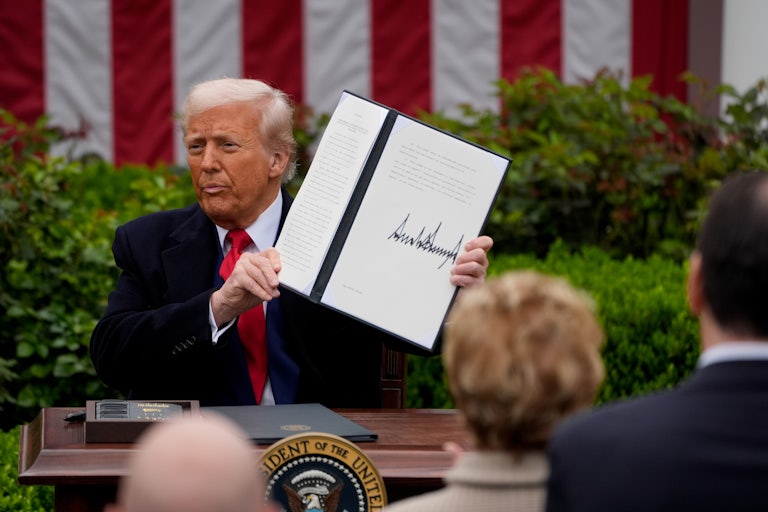
Donald Trump holds up a signed executive order while sitting at a table in the White House Rose Garden
Kent Nishimura/Bloomberg/Getty Images

In the topsy-turvy world of the Trump administration, market panic and financial suffering are somehow good things.

The president unveiled his economic agenda on Wednesday, revealing steep tariff hikes on practically every country in the world—regardless of whether the U.S. is running a trade deficit or surplus there.

The news sent markets reeling. But by Thursday morning, Donald Trump was still celebrating his plan.

“THE OPERATION IS OVER! THE PATIENT LIVED, AND IS HEALING,” Trump posted on Truth Social. “THE PROGNOSIS IS THAT THE PATIENT WILL BE FAR STRONGER, BIGGER, BETTER, AND MORE RESILIENT THAN EVER BEFORE. MAKE AMERICA GREAT AGAIN!!!”

But it’s unclear what metrics—if any—Trump used to measure his success.

In reality, American businesses were seriously disturbed. The blue chip Dow Jones Industrial Average plunged by 1,500 points, about 3.5 percent, while the S&P 500 sank by 3.9 percent, setting both on pace for their worst day since the 2022 inflation crisis. The Nasdaq Composite tanked by more than 5 percent—bringing it down by 17 percent from its all-time high and down 13 percent year-to-date, the index’s worst performance since March 2020.

Stock futures similarly plummeted. The value of the U.S. dollar dropped, and the price for a troy ounce of gold skyrocketed.

Overnight, some of the country’s most competitive companies lost hundreds of billions of dollars. Nike and Lululemon, whose business models rely on international manufacturing deals in China and Vietnam, each lost more than 10 percent. Big-box stores also saw prominent losses: Best Buy, Target, and Home Depot lost 5 percent.

The tech industry was similarly shaken: Apple was down 9 percent (worth approximately $300 billion in market value), Alphabet by 4 percent, Amazon by 7 percent, Meta by 7 percent, Microsoft by 3 percent, and Nvidia by 6 percent.

Stores that rely heavily on imported goods saw their stocks tank too. Five Below lost 29 percent, Dollar Tree fell by 8 percent, and the Gap suffered a 22 percent loss.

“The macro does not make sense, but the level of chaos and uncertainty, coupled with revaluing highly overpriced stocks, is hitting hard,” assessed CNBC analyst Ron Insana on Thursday.

In a note to investors, JP Morgan said that Trump’s tariffs had a 40 percent chance of slingshotting the U.S. economy into a recession. JP Morgan underscored that the tariffs would cause a price surge—adding 2 percent to the consumer price index—and additionally raise taxes on Americans by $660 billion a year, “the largest tax increase in recent memory by a long shot,” reported CNN.

“The impact on inflation will be substantial,” the analysts said, according to CNN. “We view the full implementation of these policies as a substantial macroeconomic shock.”

Trump’s Deportations Hit Major Snag as Judge Orders Man Released

Donald Trump’s mass deportations continue to be a disaster.

An ICE officer stands outside a building
Christopher Dilts/Bloomberg/Getty Images

A judge has ordered the Trump administration to release a man whom it wrongly detained and planned to deport to El Salvador.

In a brief one-page filing overnight Wednesday, U.S. District Judge Rolando Olvera ordered that the government not only release Adrian Gil Rojas but that it buy him a ticket from Brownsville, Texas, back to New York.

“The Court holds that the Petitioner is a Venezuelan national with a valid Temporary Protected Status and was wrongfully detained,” Olvera wrote.

“The Court further holds that Respondents produced no evidence that Petitioner is a danger to the public,” he added.

The government had argued that it should be allowed to detain and deport Gil Rojas because his TPS was set to expire on April 2, but his lawyer insisted that he was in the process of reopening his immigration case and that there was reason to believe that the Trump administration’s efforts to repeal TPS would fail.

The lawyer was right: On Monday, a San Francisco judge blocked the government from revoking the protected status of about 350,000 Venezuelans. Judge Edward Chen slammed Homeland Secretary Kristi Noem for making “sweeping negative generalizations about Venezuelan TPS beneficiaries.”

“Acting on the basis of a negative group stereotype and generalizing such stereotype to the entire group is the classic example of racism,” Chen said in his order.

Gil Rojas, who said that he was arrested in New York last month, had been one of dozens of Venezuelan nationals detained by ICE who were sneakily moved closer and closer to an airfield in Harlingen, Texas, where the government staged a mass deportation to a notorious torture prison in El Salvador.

On March 14, the plane that was supposed to take Gil Rojas suffered a mechanical issue and was rescheduled for the following day, giving his lawyer enough time to get Olvera to issue an order blocking his immediate removal. Gil Rojas was spared, unlike the dozens of others for whom due process was suspended under Donald Trump’s invocation of the Alien Enemies Act, a wartime law he has reappropriated to aid in his mass deportation efforts.

Olvera said that when Gil Rojas was returned to New York, he should be released on his own recognizance, and recommended that he wear an ankle monitor while his immigration case was pending.

Earlier this week, the Trump administration admitted that it had wrongly deported Kilmer Armado Abrego Garcia, a Salvadoran national who had been granted protected status from being sent back to El Salvador. The government blamed an “administrative error,” and a judge ruled that the man could not be returned to the U.S. because the court lacked jurisdiction now that he was out of U.S. custody.

Evidence that the government expedited the deportation of individuals who, as Olvera put it, were not a “danger to the public” only continues to mount. The government revealed that it had heavily relied on the tattoos to identify members of Tren de Aragua, a Venezuelan gang the U.S. government has deemed a terrorist group, for deportation. But experts on the gang say that there are no tattoos that signify TdA affiliation.

Egg Prices Are About to Get Even Higher

The Trump administration brought prices down by importing millions of eggs. Officials can’t answer simple questions about whether those eggs will be subject to substantial tariffs.

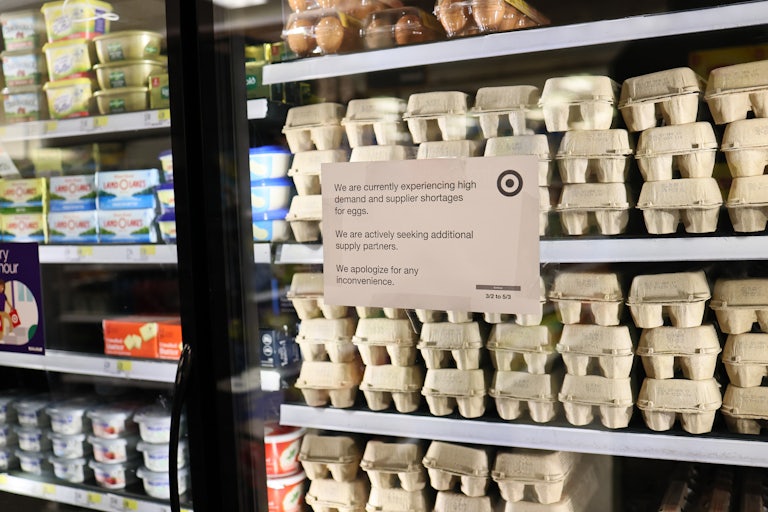
A sign at a Target store indicates that customers can only by a limited number of eggs due to high demand.
Michael M. Santiago/Getty Images
An egg display at a New York Target on April 2

When Democrats attacked the Trump administration for the gargantuan price of eggs, the administration responded by importing vast quantities from Turkey and South Korea—two countries that were hit hard by the tariffs imposed on Wednesday. 

When asked about the issue, Agriculture Secretary Brooke Rollins had no definitive answer on whether those imported eggs would be tariffed, reinforcing the multiple contradictions at the center of Trump’s isolationist trade war in the process. 

“President Trump yesterday gave you much praise talking about the job you’ve done in the last month and a half. I wanna talk about what you’ve done with eggs,” Fox Business’s Maria Bartiromo asked Rollins on Thursday. “National egg prices have declined 9 percent from last week, now averaging $3 a dozen, according to the USDA. Secretary … are eggs gonna be tariffed?” 

“Well, so, yeah let’s pivot to eggs.… Listen, we rolled out a very bold plan about a month ago.… Obviously it’s his vision we’re effectuating. The market reacted very favorably to it, [it] included some short-term imports but also included helping our poultry farmers in America,” Rollins answered, avoiding the question. “So as we repopulate our chicken farms and our egg-laying farms, I think we’ll see the price coming down even more.… Only good news on the egg front, and hopefully it will hold.”

“So where are the eggs coming from that you’re importing?” Bartiromo asked. 

“Well, we’re importing from Turkey, we’re importing from South Korea, to a few other countries right now,” Rollins responded. “But again, at the end of the day. once our farms are repopulated … then we’ll go back to pretty much using all American-lain eggs.”

“So then that means that eggs will be tariffed, if you’re taking them from Turkey, right? That’s part of the tariff plan,” Bartiromo pushed. There will be a 10 percent tariff on Turkey, according to Trump’s “Liberation Day” announcement.  

“Well, yes, all to be determined,” Rollins replied, refusing to commit. ‘We’re all at negotiations, but yes, that’s a possibility.” 

Lower grocery prices—and lower prices in general—were a central theme of Trump’s campaign. Trump himself riffed on it at his “Liberation Day” announcement. But the new tariffs go directly against those promises, and even his inner circle are struggling to find a way to explain themselves.