Breaking News
Breaking News
from Washington and beyond

Elon Musk’s DOGE Defense Cuts Won’t Affect This Key Person

Defense Secretary Pete Hegseth has been hyping up many supposed savings at the Department of Defense.

Elon Musk wears a hat that says "Trump Was Right About Everything"
Win McNamee/Getty Images

Defense Secretary Pete Hegseth announced plans to cut $580 million in “wasteful spending” at the Pentagon, but the major slashes to grants and contracts will spare Elon Musk’s SpaceX, The Intercept reported Thursday.

Over the past 25 years, the Pentagon’s contracts with SpaceX have only grown, totaling almost $8 billion. Musk and his businesses have received a whopping $38 billion in total government contracts. On March 21, the day after Hegseth announced the sweeping cuts, he had a private meeting with Musk. In a post on X, Hegseth said the two had discussed “innovation, efficiencies & smarter production.”

Despite Hegseth’s cuts, Musk, who heads the government’s cost-cutting efforts, is poised to make a killing from upcoming defense contracts to work on new rocket launchpads and rocket-booster landing zones, as well as Donald Trump’s fantasies of creating a “Golden Dome” missile defense system that is projected to cost up to $2.5 trillion—more than double the Pentagon’s currently enormous budget.

Stephen Semler, a senior fellow at the Center for International Policy, told The Intercept that since the election, SpaceX has become the Pentagon’s “most valued” contractor. Musk’s financial support of the Trump administration had boosted investor confidence that there would be kickbacks, he explained.

“Musk and DOGE are ignoring the one place where you would actually find savings within the government,” Semler said. “Musk realizes that although he is already getting tons of money from NASA contracts, the untapped potential for his businesses from the Pentagon budget is truly massive.”

Rather than make cuts to SpaceX contracts, Hegseth opted to eliminate programs such as the Defense Civilian Human Resources Management System, which Hegseth claimed had ballooned to 780 percent over budget. Hegseth said that in addition to cuts announced in February, the Defense Department was now prepared to cut a total of around $800 million from its budget—a comparatively small slice of the Pentagon’s nearly $1 trillion budget.

William Hartung, a senior research fellow at the Quincy Institute for Responsible Statecraft, told The Intercept that proposed cuts were still “extremely modest” when compared to other agencies. “And unlike these other agencies, savings found in one part of the Pentagon will simply be invested in other Pentagon programs, with no net reduction in the department’s bottom line,” he added.

Will Congress Stop Trump From Destroying the Economy?

A bipartisan Senate bill would give Congress power to stop the madness from the White House. Unfortunately, it is unlikely to pass the House.

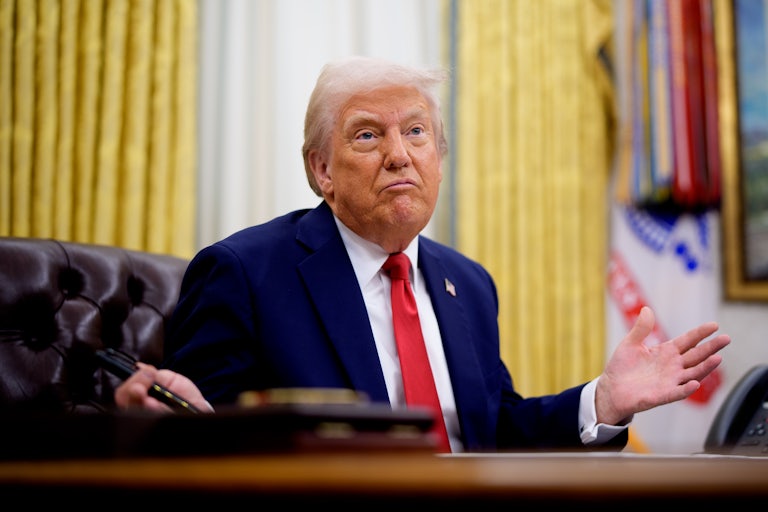
Donald Trump gestures while sitting at his desk in the Oval Office
Andrew Harnik/Getty Images

Republicans and Democrats in the Senate are proposing a bipartisan bill to try and rein in President Trump’s crazy tariffs.

Iowa Republican Chuck Grassley and Washington Democrat Maria Cantwell, both members of the Senate Finance Committee, are co-sponsoring the “Trade Review Act of 2025,” which would require congressional approval for the president to impose new tariffs, one day after Trump’s “Liberation Day” event upended international markets.

Specifically, Trump would have to notify Congress about new tariffs within 48 hours of imposing them, and then the House and Senate would have 60 days to approve them or else the tariffs would expire. According to the two senators, the bill is modeled after the War Powers Resolution of 1973, which places limits on the president’s ability to deploy troops overseas without congressional approval.

In a statement, Grassley said, “For too long, Congress has delegated its clear authority to regulate interstate and foreign commerce to the executive branch.”

“I’m joining Senator Cantwell to introduce the bipartisan Trade Review Act of 2025 to reassert Congress’ constitutional role and ensure Congress has a voice in trade policy,” the statement added.

Cantwell said that the bill was necessary to reassert “Congress’s role over trade policy to ensure rules-based trade policies are transparent, consistent, and benefit the American public.

“Arbitrarily, tariffs, particularly on our allies, damage U.S. export opportunities and raise prices for American consumers and businesses. As representatives of the American people, Congress has a duty to stop actions that will cause them harm,” Cantwell’s statement said.

But the bill faces little chance of passing, especially considering that its House companion has no Republican co-sponsors and would likely be blocked by House Speaker Mike Johnson. Johnson praised the tariffs on X Wednesday night, claiming that they “level the playing field for American workers and innovators.” Even if, by some miracle, the bill passes the House, Trump would likely veto it. The War Powers Act of 1973, moreover, has been proven time and time again to be toothless—presidents have deployed troops on a number of occasions without congressional approval.

It looks like the country will be in economic free fall for a while.

Trump’s Extreme Tariffs Have Already Hit the Auto Industry

Donald Trump’s commerce secretary, meanwhile, promised that employment would go up as a result of the tariffs.

A phone screen displays the Stellantis logo
Thomas Fuller/SOPA Images/LightRocket/Getty Images

American companies are not “leaping” to hire new employees, as the White House promised. Instead, they’re rapidly letting them go.

Stellantis—one of the Big Three automakers in the U.S.—announced Thursday that it would be laying off hundreds of U.S. workers in the wake of Donald Trump’s sweeping tariffs. The company is also planning to temporarily pause production at two foreign assembly plants in Canada and Mexico.

“We are continuing to assess the medium- and long-term effects of these tariffs on our operations, but also have decided to take some immediate actions, including temporarily pausing production at some of our Canadian and Mexican assembly plants,” Chief Operating Officer Antonio Filosa told employees in an email on Thursday.

Some 900 U.S.-based employees are expected to be laid off at Stellantis’s Warren Stamping and Sterling Stamping plants in Michigan, as well as three of its transmission and casting plants in Indiana.

Speaking with CBS earlier Thursday, Commerce Secretary Howard Lutnick had claimed that “people are going to start building factories right now” and that companies will “employ Americans today.”

“Factories rebuilding, all the ships are going to be running hot across America now; you’re going to see employment leaping starting today,” Lutnick said.

But Lutnick’s insistence on following Trump’s tariff plan has veered totally into the delusional. In an interview with CNN the same day, Lutnick implored voters and investors to “let Donald Trump run the global economy,” promising that Trump would cut deals “if and only if these countries can change everything about themselves.”

Wall Street analysts have predicted bad news for automakers and their investors as they attempt to navigate Trump’s 25 percent tariff on imported vehicles and auto parts, which took effect Thursday. In the near term, that will look like increased market volatility and shaken supply chains.

While there are vehicles that are assembled in America, there are no vehicles in the U.S. that are made entirely with domestic products and labor. Instead, producing a car or a truck requires thousands of parts that are sourced from the global supply chain—an international relationship that Trump’s tariffs will undoubtedly hurt.

“We stress that the concept of a U.S. car maker with parts all from the U.S. is a fictional tale that does not exist and would take years to make this concept a reality,” Wedbush analyst Dan Ives wrote in an investor note Wednesday obtained by CNBC.

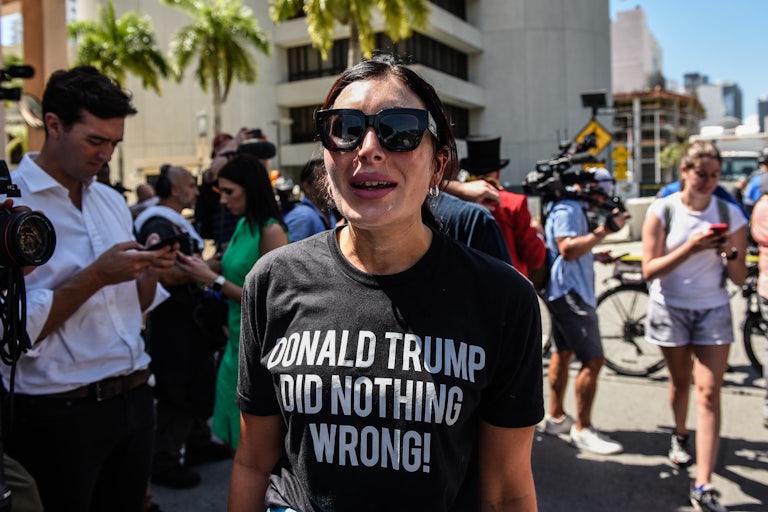
Trump Just Let a Far-Right Troll Purge the National Security Council

Laura Loomer, a figure so extreme many Trump loyalists spurn her, just got the president to fire three members of the National Security Council for alleged "disloyalty."

Laura Loomer, a far right troll, wears a shirt saying "Donald Trump did nothing wrong" while yelling outside a Miami courthouse.
Stephanie Keith/Getty Images
Laura Loomer outside Donald Trump's 2022 Manhattan fraud trial

Multiple National Security Council staffers have been fired at the behest of MAGA conspiracy theorist and Trump loyalist Laura Loomer, according to Axios and the Associated Press.

The NSC, headed by Mike Waltz, made headlines after Signalgate, in which Waltz inadvertently added The Atlantic’s Jeffrey Goldberg to a Signal chat where multiple Cabinet members were discussing plans to bomb Yemen.

A source close to the situation told Axios that the firings were “being labeled as an anti-neocon move.” Waltz has been accused of being insufficiently MAGA by the farthest right of the party.

Loomer apparently “presented [Trump] with her research and evidence” alleging that more traditional neoconservative foreign policy hawks were too well represented in the administration.

Loomer, who Trump has described as a “free spirit,” is a “proud Islamophobe” who was pushed out of Trump’s inner circle during the campaign due to numerous statements that were deemed too incendiary for MAGA. She’s stated that 9/11 was an “inside job” and that the White House would “smell like curry” if Kamala Harris, who is of Indian descent, won the election.

This may be the worst time to allow a crank like Loomer back into the fold. The Signalgate controversy has already demonstrated the administration’s capacity for foolishness, and relationships with the rest of the world are arguably at an all-time low, thanks to Trump’s suicidal tariff regimen.

Loomer has declined to share any of what she discussed in her Oval Office meeting.

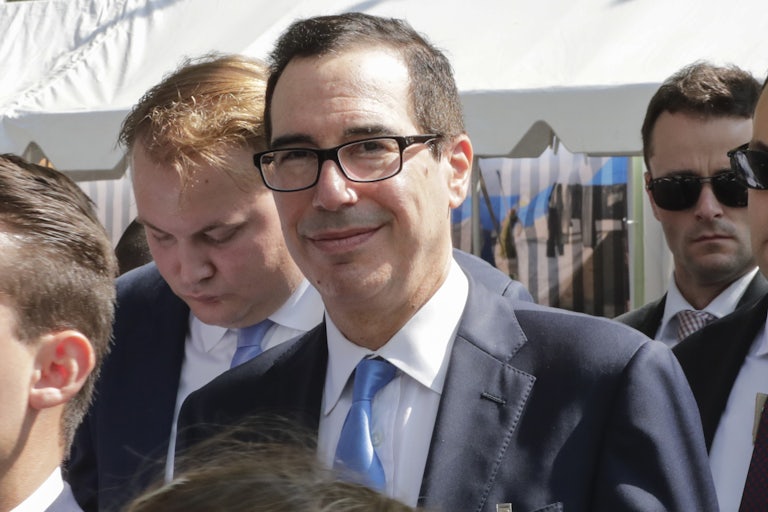
Former Trump Treasury Secretary Clearly Thinks Tariffs Are Stupid

Steven Mnuchin, who served as Trump’s treasury secretary during his first term, went on television to very delicately prod the president to change his approach.

Steven Mnuchin smiles at the camera
EuropaNewswire/Gado/Getty Images
Former Treasury Secretary Steven Mnuchin in 2019

Steven Mnuchin, the treasury secretary during Donald Trump’s first term, is worried about the president’s new tariffs and hoping to change them via the president’s favorite medium: television.

On CNBC Thursday morning, Mnuchin tried to delicately ask for carve-outs and concessions, attempting to explain that “there’s a transition period here that needs to be adjusted to.

“It’s the larger tariffs that are called the reciprocal tariffs. I’m hopeful that those will be negotiated down, that those will bring people to the table, that those will be negotiated down. For many businesses, it takes a while to move the manufacturing base,” Mnuchin said.

“I hope the president will consider giving people credits for those people who have made real commitments, not just announcements, but real commitments, to build in the U.S,” added the longtime investment banker.

Mnuchin is not on bad terms with Trump or the administration, but it’s telling that he’s willing to point out some of the obvious flaws in Trump’s half-baked economic plan. And only last month he said that “people are overreacting a bit” to the administration’s policy changes.

“I don’t think we’re going to have a recession. I don’t think the outlook looks like we’re going to have a recession. And Larry Summers saying there’s a 50 percent probability, I just don’t agree with that,” Mnuchin said on CNBC at the time, referring to comments from another former Treasury head. The interview is a window into the way Mnuchin, who was widely seen as one of the “adults in the room” during his first term, likely approached the president when he served as his treasury secretary: as a toddler.

While Mnuchin didn’t mention a recession in Thursday’s interview, it’s clear he’s now worried about Trump’s actions and is hoping that, from behind a TV screen, Trump might see some sense with a very mild recommendation. Maybe he should be overreacting now.