Breaking News
Breaking News
from Washington and beyond

Trump: The Economy Crashing Is Good, Actually

Asked about the economic collapse that has resulted from his massive tariffs, Trump said “I think it’s going very well."

Donald Trump holds up a big list of tariffs
Chip Somodevilla/Getty Images

Donald Trump thinks everything is going just fine with his insane tariffs.

In his lone statement about the tariffs Thursday, Trump didn’t seem bothered when a reporter asked him, “The markets today are way down. The worst day in years. Because of the tariffs. So, how’s it going?”

“I think it’s going very well. It was an operation like when a patient gets operated on, and it’s a big thing. I said this would be exactly the way it is. We have six or seven trillion dollars coming into our country, and we’ve never seen anything like it,” Trump said, repeating what he said in a Truth Social post hours earlier. “The markets are going to boom, the stock is going to boom, the country is going to boom, and the rest of the world wants to see, is there any way they can make a deal?”

“They’ve taken advantage of us for many, many years. For many years, we’ve been at the wrong side of the ball, and I tell you what, I think it’s going to be unbelievable,” Trump added.

Right now, international markets aren’t agreeing with Trump’s ideas, with stock indexes plummeting everywhere. Criticism has come from fellow Republicans and former Trump administration officials, and some companies, such as automaker Stellantis, are laying off employees. Republicans and Democrats in the Senate are even working together on a bill to rein the president in, although it is unlikely to pass.

And the rest of the world isn’t lining up to make deals: Canadian Prime Minister Mark Carney strongly rebuked the tariffs Thursday, saying that America’s economic dominance is over. France’s Emmanuel Macron has called for European companies to stop investing in America. Right now, this “medical operation” is crippling Americans.
Republicans Are in Denial About Trump’s Catastrophic Tariffs

House Republicans insist that the tariffs that are currently destroying the economy are part of a “negotiation” the White House insists isn’t happening.

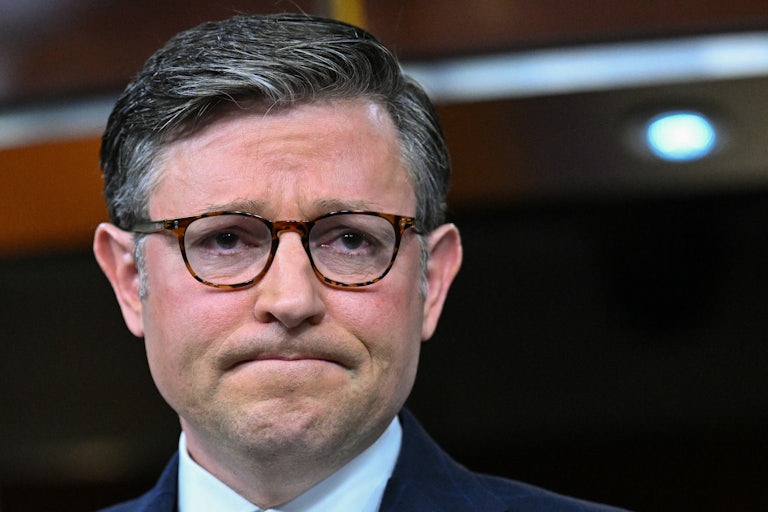
House Speaker Mike Johnson purses his lips into a frown
ROBERTO SCHMIDT/AFP/Getty Images
Mike Johnson in March

President Trump’s “Liberation Day” tariffs have already resulted in even more GOP infighting, according to Punchbowl News.

“There’s a massive disconnect between the White House and Capitol Hill Republicans on tariffs right now,” Jake Sherman wrote on X. “Here on the Hill, Republicans keep saying “well, this is the beginning of a negotiation. The administration says that this is not a negotiation.”

These tariffs—placed on friend and foe alike—are certain to drive up costs for both manufacturers and consumers, especially in red, rural states that rely on foreign goods in both imports and exports. This feeble attempt to spin these tariffs into a “negotiation” falls flat in the face of an administration that is touting them as law. Trump has been very clear that he believes the tariffs will be so successful that they will replace the income tax and make the country wealthier than it has been at any point in its history—not that he is levying them in order to make marginally better trading deals.

Senior Senate Republican Chuck Grassley has already moved to take action against Trump with his Trade Review Act of 2025, a bill that—while almost certainly dead on arrival—demonstrates the uncomfortable decisions that many Republicans will soon be forced to make as their president’s wanton tariffs make everything more expensive for constituents already struggling.

This is the second sign of internal disunity in 24 hours. On Thursday, it was reported that far-right crank Laura Loomer had an Oval Office meeting in which she convinced the president to fire multiple members of the National Security Council on the grounds that they were “neocons.” Loomer denies this report.

Canadian Prime Minister Darkly Warns U.S. Economic Dominance Is Over

Mark Carney had a grim prediction for Donald Trump’s tariffs.

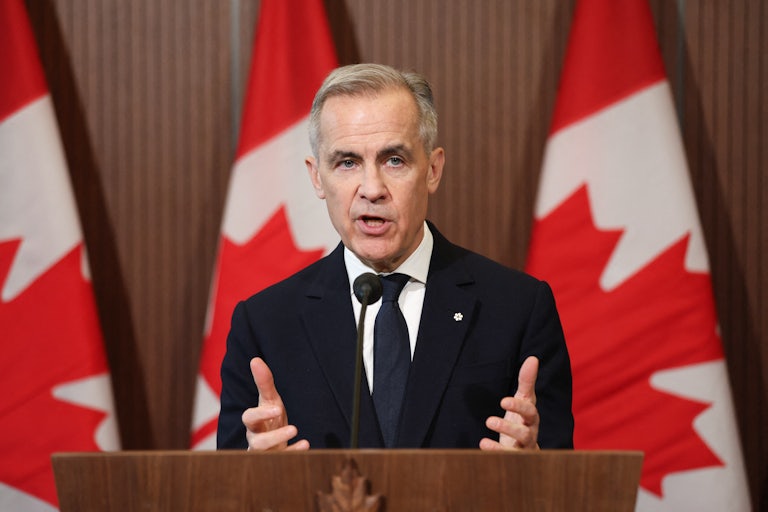
Canadian Prime Minister Mark Carney gestures while speaking at a podium
Dave CHan/AFP/Getty Images

Canada has brutally dumped the United States over its tariffs … again.

Canadian Prime Minister Mark Carney issued a strong rebuke Thursday of Donald Trump’s sweeping tariffs on nearly every country in the world. 

“The global economy is fundamentally different today than it was yesterday,” Carney said. “The system of global trade anchored on the United States, that Canada has relied on since the end of the second World War—a system that, while not perfect, has helped to deliver prosperity to our country for decades—is over.

“Our old relationship of steadily deepening integration with the United States is over. The 80-year period when the United States embraced the mantle of global economic leadership, when it forged alliances rooted in trust and mutual respect, and championed the free and open exchange of goods and services is over,” Carney continued. “While this is a tragedy, it is also the new reality.

“We must respond with both purpose and force. We are a free, sovereign, and ambitious country. We are masters in our own home,” he added.  

Trump’s announcement does mark the end of U.S. leadership in global trade, favoring the kind of protectionist economic policy that drove the U.S. into the Great Depression nearly 100 years ago. And Carney, who is a former central banker and a former deputy minister for Canada’s Finance Department, likely understands exactly how destructive Trump’s tariff policy would be. 

Canada was spared from Trump’s newest tariff announcement, because the president had already levied steep 25 percent tariffs on all imports to the U.S. More than 100 U.S. trading partners were hit with a baseline tariff of 10 percent or more Wednesday. 

Last week, Carney slammed Trump’s “permanent” 25 percent tariff on all imported vehicles and autoparts as a “direct attack” on Canadian autoworkers, and in a stunning break with its longtime ally, Carney announced that Canada’s relationship with the U.S. was “over.” Carney had warned that Canada, which is currently one of the top importers of U.S. goods, totaling $412.7 billion in 2024, would need to reshape its economy to wean itself off its southern neighbor.

Carney doubled down on this threat Thursday, saying that Canada would begin “looking elsewhere to expand” its trade partnerships. Earlier Thursday, he posted on X that he had already spoken to German Chancellor Olaf Scholz about expanding trade relations between the two countries.

Elon Musk’s DOGE Defense Cuts Won’t Affect This Key Person

Defense Secretary Pete Hegseth has been hyping up many supposed savings at the Department of Defense.

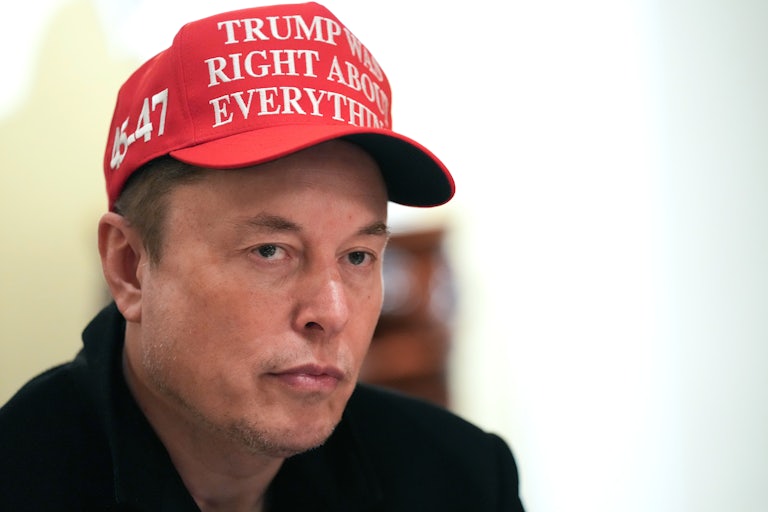
Elon Musk wears a hat that says "Trump Was Right About Everything"
Win McNamee/Getty Images

Defense Secretary Pete Hegseth announced plans to cut $580 million in “wasteful spending” at the Pentagon, but the major slashes to grants and contracts will spare Elon Musk’s SpaceX, The Intercept reported Thursday.

Over the past 25 years, the Pentagon’s contracts with SpaceX have only grown, totaling almost $8 billion. Musk and his businesses have received a whopping $38 billion in total government contracts. On March 21, the day after Hegseth announced the sweeping cuts, he had a private meeting with Musk. In a post on X, Hegseth said the two had discussed “innovation, efficiencies & smarter production.”

Despite Hegseth’s cuts, Musk, who heads the government’s cost-cutting efforts, is poised to make a killing from upcoming defense contracts to work on new rocket launchpads and rocket-booster landing zones, as well as Donald Trump’s fantasies of creating a “Golden Dome” missile defense system that is projected to cost up to $2.5 trillion—more than double the Pentagon’s currently enormous budget.

Stephen Semler, a senior fellow at the Center for International Policy, told The Intercept that since the election, SpaceX has become the Pentagon’s “most valued” contractor. Musk’s financial support of the Trump administration had boosted investor confidence that there would be kickbacks, he explained.

“Musk and DOGE are ignoring the one place where you would actually find savings within the government,” Semler said. “Musk realizes that although he is already getting tons of money from NASA contracts, the untapped potential for his businesses from the Pentagon budget is truly massive.”

Rather than make cuts to SpaceX contracts, Hegseth opted to eliminate programs such as the Defense Civilian Human Resources Management System, which Hegseth claimed had ballooned to 780 percent over budget. Hegseth said that in addition to cuts announced in February, the Defense Department was now prepared to cut a total of around $800 million from its budget—a comparatively small slice of the Pentagon’s nearly $1 trillion budget.

William Hartung, a senior research fellow at the Quincy Institute for Responsible Statecraft, told The Intercept that proposed cuts were still “extremely modest” when compared to other agencies. “And unlike these other agencies, savings found in one part of the Pentagon will simply be invested in other Pentagon programs, with no net reduction in the department’s bottom line,” he added.

Will Congress Stop Trump From Destroying the Economy?

A bipartisan Senate bill would give Congress power to stop the madness from the White House. Unfortunately, it is unlikely to pass the House.

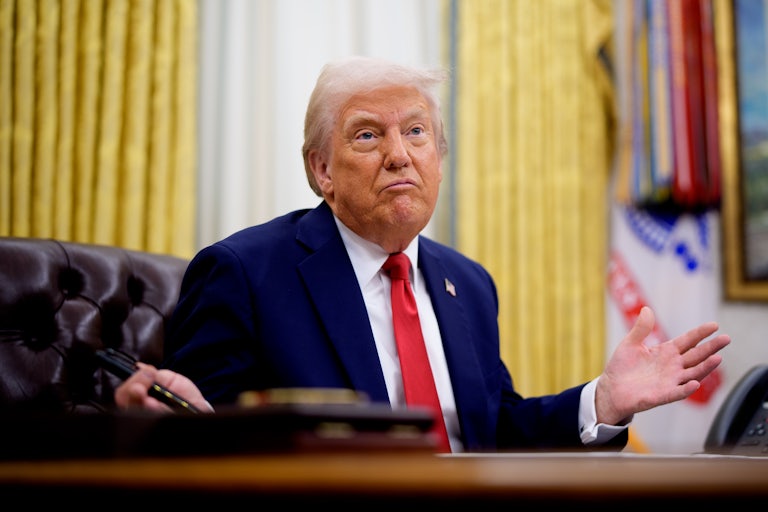
Donald Trump gestures while sitting at his desk in the Oval Office
Andrew Harnik/Getty Images

Republicans and Democrats in the Senate are proposing a bipartisan bill to try and rein in President Trump’s crazy tariffs.

Iowa Republican Chuck Grassley and Washington Democrat Maria Cantwell, both members of the Senate Finance Committee, are co-sponsoring the “Trade Review Act of 2025,” which would require congressional approval for the president to impose new tariffs, one day after Trump’s “Liberation Day” event upended international markets.

Specifically, Trump would have to notify Congress about new tariffs within 48 hours of imposing them, and then the House and Senate would have 60 days to approve them or else the tariffs would expire. According to the two senators, the bill is modeled after the War Powers Resolution of 1973, which places limits on the president’s ability to deploy troops overseas without congressional approval.

In a statement, Grassley said, “For too long, Congress has delegated its clear authority to regulate interstate and foreign commerce to the executive branch.”

“I’m joining Senator Cantwell to introduce the bipartisan Trade Review Act of 2025 to reassert Congress’ constitutional role and ensure Congress has a voice in trade policy,” the statement added.

Cantwell said that the bill was necessary to reassert “Congress’s role over trade policy to ensure rules-based trade policies are transparent, consistent, and benefit the American public.

“Arbitrarily, tariffs, particularly on our allies, damage U.S. export opportunities and raise prices for American consumers and businesses. As representatives of the American people, Congress has a duty to stop actions that will cause them harm,” Cantwell’s statement said.

But the bill faces little chance of passing, especially considering that its House companion has no Republican co-sponsors and would likely be blocked by House Speaker Mike Johnson. Johnson praised the tariffs on X Wednesday night, claiming that they “level the playing field for American workers and innovators.” Even if, by some miracle, the bill passes the House, Trump would likely veto it. The War Powers Act of 1973, moreover, has been proven time and time again to be toothless—presidents have deployed troops on a number of occasions without congressional approval.

It looks like the country will be in economic free fall for a while.