Breaking News
Breaking News
from Washington and beyond

Trump Celebrates as Global Markets Collapse Over His Tariffs

Donald Trump is living in an alternate reality.

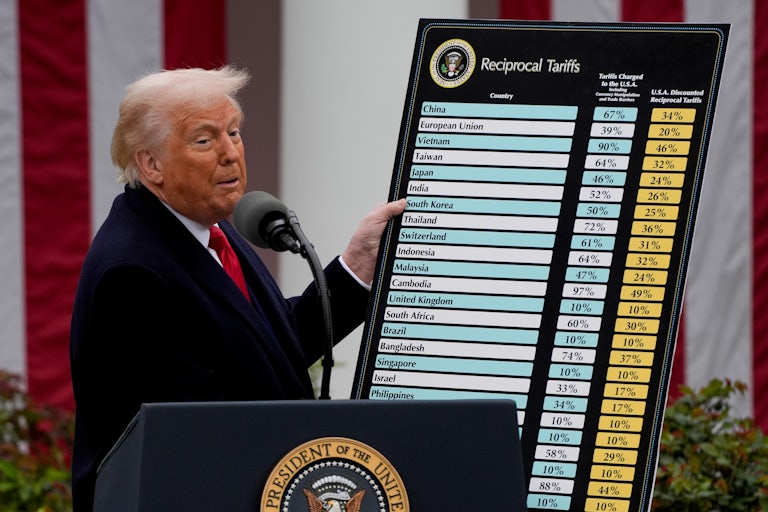
Donald Trump holds up a big list of tariffs
Chip Somodevilla/Getty Images

On Monday morning, Donald Trump seemed to be celebrating even as the global stock market continued to plunge. 

The president boasted on his Truth Social page of low oil prices, lower food prices, and of “Billions of Dollars a week from the abusing countries on Tariffs,” despite the tide of bad news from Dow futures, the S&P 500, and indexes across Europe and Asia resulting in a $9.5 trillion wipeout in global equity value.

After Trump’s baseline 10 percent tariff went into effect on Saturday, a market sell-off quickly ensued. When asked about it on Sunday, the president said, “Sometimes you have to take medicine to fix something,” claiming that such measures were needed to address the trade deficit with China. 

“We have to solve our trade deficit with China,” Trump said to reporters on Air Force One. “We have a trillion-dollar trade deficit with China; hundreds of billions of dollars a year we lose with China. And unless we solve that problem, I’m not going to make a deal.”

Meanwhile, the dollar is sliding while the euro is gaining value and stocks from construction equipment giant Caterpillar to Elon Musk’s Tesla are struggling. Trump’s tariffs have even soured his relationship with close ally Musk, who spent the weekend attacking administration officials including Commerce Secretary Howard Lutnick and adviser Peter Navarro. 

It seems that the president is ignoring all of the indications of an insanely bad policy, even lashing out at a reporter who asked if there’s “pain in the market at some point you’re unwilling to tolerate,” calling her question “stupid.” The real question is how much pain the American people, as well as Trump’s Republican allies and supporters, are willing to tolerate. 
Judge Orders Trump Administration to Return Wrongly Deported Man

The administration had falsely accused Kilmar Abrego Garcia of being a member of the MS-13 gang.

Trump
Chip Somodevilla/Getty Images

A federal judge has ordered the Trump administration to return an Salvadoran man who was deported to El Salvador back to the United States by midnight Monday.

Maryland resident Kilmar Abrego Garcia was deported due to an “administrative error,” but White House officials insist that he has ties to the MS-13 gang and have even made the brazen claim that there’s nothing that any court can do to order Abrego Garcia back because he is no longer in U.S. custody. On Friday, U.S. District Judge Paula Xinis ruled otherwise.

“This was an illegal act,” Xinis told an attorney for the Justice Department. “Congress said you can’t do it, and you did it anyway.” Vice President JD Vance and White House press secretary Karoline Leavitt have both accused Abrego Garcia of being an MS-13 gang member with no evidence of a criminal conviction, a fact Xinis stressed in her ruling.

“That’s just chatter, in my view. I haven’t been given any evidence,” Xinis said. “In a court of law, when someone is accused of membership in such a violent and predatory organization, it comes in the form of an indictment, a complaint, a criminal proceeding that has robust process so we can assess the facts.”

Abrego Garcia was found to face a legitimate fear of prosecution in his home country by a U.S. immigration judge in 2019, and was thus barred from being deported back to El Salvador. Immigration officials still rushed him onto a plane to El Salvador anyway, and now he’s being held in Centro de Confinamiento del Terrorismo, a prison notorious for human rights abuses.

Surprisingly, the Justice Department lawyer representing the government in this case said that even he wasn’t provided evidence.

“I am also frustrated that I have no answer for you on a lot of these questions,” said Erez Reuveni, an assistant director in the Justice Department’s Office of Immigration Litigation. “The government made a choice here to produce no evidence.”

At one point, Xinis asked to see a 2019 immigration warrant for Abrego Garcia, to which Reuveni replied, “I do not have that order. It is not in the record.”

Reuveni said he has also asked his government clients why they couldn’t return Abrego Garcia to the U.S.

“When this case landed on my desk, I asked my clients that very question. I have not received to date an answer that I find satisfactory,” Reuveni said, and even asked Xinis before her ruling whether he could have 24 hours to persuade administration officials to return Abrego Garcia to the U.S. without a further court ruling.

“I would ask the court to give us, the defendants, one more chance to do this,” Reuveni said. “That’s my recommendation to my client, but so far that hasn’t happened.” Ultimately, the judge ruled against the Trump administration, which is not likely to go over well considering that the U.S. has a $6 million deal with El Salvador to accept prisoners, brokered by Secretary of State Marco Rubio. But at the very least, there’s hope that Abrego Garcia, a married father of a child with autism, can receive justice and return home.

The Trump Administration Just Violated Another Court Order

It gets worse: The order found that the administration was covertly withholding millions in FEMA funds from blue states.

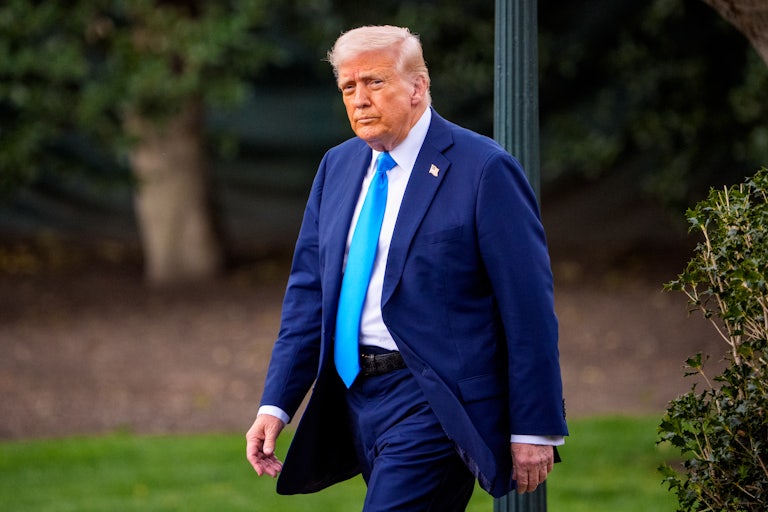
Donald Trump walks across the White House lawn
Andrew Harnik/Getty Images

A federal judge ruled Friday that the president violated a court order to stop freezing federal funds by withholding Federal Emergency Management Agency relief to at least 19 states. The judge said that the Trump administration seemed to be making a “covert” effort to punish states whose immigration practices differed from the White House.

U.S. District Judge John McConnell issued an injunction in March on behalf of 23 states that sued the federal government after the White House moved to pause aid to states, ruling that the move ​​“fundamentally undermines the distinct constitutional roles of each branch of our government.”

On Friday, McConnell found that the Trump administration disregarded the court order, with at least 19 states, all of whom with Democratic attorneys general, presenting “undisputed evidence” that they were not receiving FEMA funds already appropriated by Congress.

Oregon, for example, still hasn’t received $120 million in funds meant for winter storms, flooding, landslides, wildfires, and flood mitigation. Hawaii said FEMA has yet to deliver $6 million to rebuild after wildfires devastated Maui in 2023.

For its part, the Trump administration claimed that it was creating a new review process for allocated funding. The states, however, said that they weren’t being given their funds since early February, which McConnell ruled was a clear violation of the order. The judge noted that this appeared to be in accordance with Trump’s executive order barring “sanctuary” states from receiving aid.

This isn’t the first court order that the Trump administration has violated, and it probably won’t be the last. But with a weak Congress, the judiciary is the only check on the president’s power right now, and in this case, millions of Americans struggling to recover from natural disasters are the ones who are suffering. Will there be accountability?

Trump’s Tariff War Tanks Stock Market Even Further

China has hit back at Donald Trump’s tariffs.

Donald Trump holds up a chart of tariffs while standing at a podium during a press conference in the White House Rose Garden
Kent Nishimura/Bloomberg/Getty Images

The Dow Jones plunged more than 2,000 points, or 5.1 percent, Friday as investors reacted to China’s retaliatory tariffs. The drop-off followed a 1,679-point decline the day before.

Beijing’s Commerce Ministry announced it would impose a 34 percent tariff on imports of all U.S. products as soon as April 10, matching the 34 percent tariff that Donald Trump announced he would impose on Chinese imports as part of his “Liberation Day” tariff strategy.

Despite publicly celebrating the enforcement of his plan, the U.S. president’s nonsensical economic strategy has tanked markets in just two days.

Wall Street’s “fear gauge,” the CBOE S&P 500 Volatility Index (VIX), jumped to 44.4 by Friday afternoon—a 22.8-point jump since Wednesday, and a 26.5-point jump since the beginning of the year, according to data compiled by The Wall Street Journal, putting the economy on track for a bear market.

In a note to investors, JP Morgan said that Trump’s tariffs had a 40 percent chance of slingshotting the U.S. economy into a recession. JP Morgan underscored that the tariffs would cause a price surge—adding two percent to the Consumer Price Index—and additionally raise taxes on Americans by $660 billion a year, “the largest tax increase in recent memory by a longshot,” CNN reported Thursday.

“The impact on inflation will be substantial,” the analysts said, according to the network. “We view the full implementation of these policies as a substantial macroeconomic shock.”

Beyond the economic devastation, Trump’s tariffs have also landed the U.S. in legal hot water. China also announced Friday it would be suing the U.S. via the World Trade Organization, arguing that Trump’s tariff plan “seriously undermines” global trade.

“The United States’ imposition of so-called ‘reciprocal tariffs’ seriously violates WTO rules, seriously damages the legitimate rights and interests of WTO members, and seriously undermines the rules-based multilateral trading system and international economic and trade order,” the Commerce Ministry said. “It is a typical unilateral bullying practice that endangers the stability of the global economic and trade order. China firmly opposes this.”

The Trump administration is also facing lawsuits over the sweeping tariff plan at home.

The New Civil Liberties Alliance sued the president Thursday, claiming that Trump’s decision to invoke the International Emergency Economic Powers Act to enforce the tariffs—which impacts trade with some 200 countries—did not give him the power to “usurp” Congress’s right to control tariffs or “upset the Constitution’s separation of powers.”

In a press release, the right-wing group (which has financial ties to Leonard Leo and the Koch network) argued that the emergency statute “authorizes specific emergency actions like imposing sanctions or freezing assets to protect the United States from foreign threats.”

“It does not authorize the President to impose tariffs,” the NCLA wrote.

Trump Has Bonkers Theory for How Tariffs Will Save TikTok

What can’t Donald Trump’s tariffs fix?

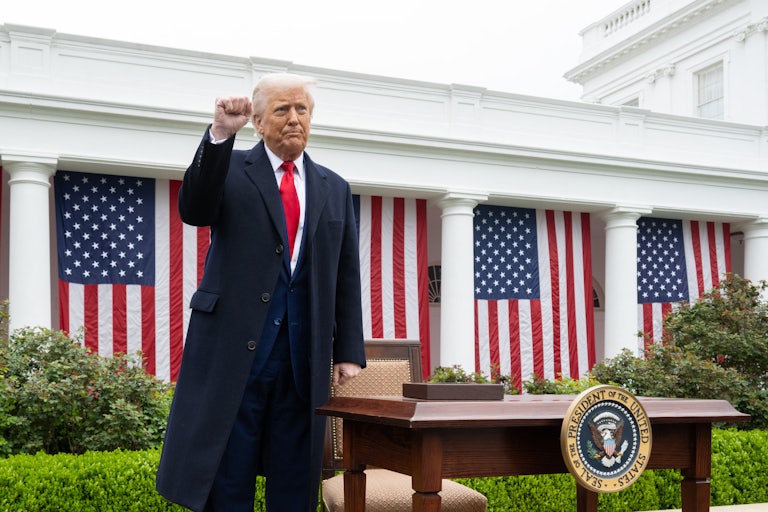
Donald Trump raises his fist while standing next to a desk in the White House Rose Garden
Saul Loeb/AFP/Getty Images

President Donald Trump has once again swooped in to save TikTok, after the president’s sweeping tariffs undermined a deal with China.

“My Administration has been working very hard on a Deal to SAVE TIKTOK, and we have made tremendous progress,” Trump wrote on Truth Social Friday.

The president said that he planned to sign an executive order to delay the enforcement of the U.S. TikTok ban for an additional 75 days.

Trump continued to say that U.S. officials hoped to continue negotiations with China, “who I understand are not very happy about our Reciprocal Tariffs.”

“This proves that Tariffs are the most powerful Economic tool, and very important to our National Security! We do not want TikTok to ‘go dark.’ We look forward to working with TikTok and China to close the Deal. Thank you for your attention to this matter,” Trump wrote.

Trump appeared to suggest that his “reciprocal tariff” policy, which placed a baseline 10 percent tariff on nearly every country in the world, was some kind of chip in negotiations over TikTok’s parent company, Beijing-based ByteDance. In 2024, Congress passed a law that required the firm to sell TikTok’s U.S. operations to a non-Chinese owner, or see it banned in the U.S. Trump has now swooped in twice to rescue the app from going dark (after putting it on Congress’s radar in the first place).

In reality, Trump’s decision to impose steep tariffs on China has only gotten in the way of negotiations. The White House had nearly reached an agreement with China on TikTok, but the country hit the breaks after Trump’s tariff announcement Wednesday, the Associated Press reported.

After Trump imposed a 34 percent tariff on Chinese imports to the U.S. earlier this week, in addition to two previous rounds of 10 percent duties, China responded in kind, levying its own 34 percent tariff on all imports from the U.S. on Friday.

In 2024, the U.S. imported $438.9 billion worth of Chinese goods, and China imported $143.5 worth of American goods, according to the U.S. trade representative.

Trump previously signed an executive order in January to keep the app running for U.S. users for 75 days, “to permit my Administration an opportunity to determine the appropriate course of action with respect to TikTok.” The grace period was set to expire Saturday, April 5.

This story has been updated.