Breaking News
Breaking News
from Washington and beyond

Trump Forgets Basic European History in Bizarre Tariff Rant

Donald Trump unloaded on the European Union.

Donald Trump holds his hands out to the side and speaks while sitting in the Oval Office
Saul Loeb/AFP/Getty Images

The European Union graciously offered to negotiate with Donald Trump on tariffs before retaliating, but the U.S. president is too blinded by his own conspiracy to even consider the deal.

On Monday, European Commission President Ursula von der Leyen offered the United States a “zero-for-zero tariff” on cars and industrial goods to avoid a trade war, a pretty generous offer given Trump slapped 20 percent tariffs on the EU—and pretty much everywhere else—last week.

“We have offered zero-for-zero tariffs for industrial goods as we have successfully done with many other trading partners. Because Europe is always ready for a good deal. So we keep it on the table,” von der Leyen said in a statement.

Trump, however, told reporters Monday afternoon that the deal isn’t enough. “The EU has been very tough over the years, I always say it was formed to really do damage to the United States and trade,” Trump said. “That’s the reason it was formed.”

In case you forgot, the EU was not, in fact, formed to screw the United States but to foster peace and cooperation among European countries post-World War II. It was founded in 1992 and is made up of 27 countries and seven major institutions that manage a common budget, facilitate trade, and make laws.

The president continued his rewrite of European history, claiming the EU was formed solely “to create a unified force against the United States for trade.” He added that the union has used NATO—an alliance that the United States is a part of—to take advantage of the United States.

The outlandish rant is Trump’s way of saying, no, he won’t accept von der Leyen’s deal. It’s a refusal that will likely result in further retaliatory tariffs on the United States as an economic recession looms.
Trump Adviser Releases Insane List of Demands for Tariffed Countries

Top White House economist Stephen Miran apparently wants free handouts from other nations.

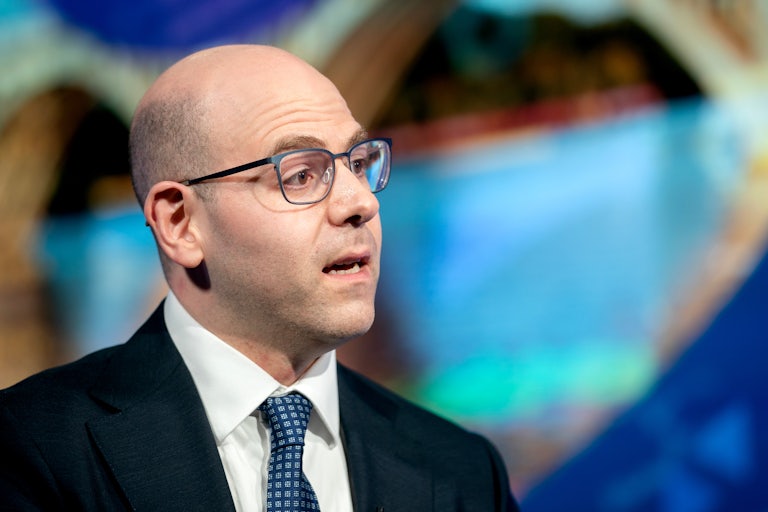
White House economic adviser Stephen Miran speaks during an interview with Bloomberg TV
Stefani Reynolds/Bloomberg/Getty Images

Donald Trump’s chief economic adviser put out a list of outrageous demands Monday for other countries inflicted by the president’s tariffs to start “burden sharing.”

Stephen Miran, chair of the Council of Economic Advisers, delivered a speech at the Hudson Institute complete with a to-do list for other countries looking to lighten the load that “unfair barriers to trade” and “unsustainable trade deficits” have supposedly inflicted on the United States.

Miran said that these factors had led to a “decline of our manufacturing workforce by over a third since its peak and a reduction in our share of world manufacturing production of 40 percent.”

It’s worth noting that while manufacturing employment has gone down, U.S. manufacturing output is up and nearing its all-time high of December 2007. Who exactly will actually work all of these hypothetical manufacturing jobs? No one seems to know! Trump’s own secretary of commerce said earlier this month that he planned to use automation to replace cheap labor, and the treasury secretary suggested Monday that maybe ousted federal workers could pick up some shifts.

Other countries should work to improve “burden sharing” to address the issues, a process that could take many forms, said Miran.

For instance, countries could roll over and accept Trump’s tariffs without retaliation. “Critically, retaliation will exacerbate rather than improve the distribution of burdens and make it even more difficult for us to finance global public goods,” Miran said in his remarks.

Miran said that countries could “stop unfair and harmful trading practices” by buying more American products, specifically noting that countries could boost defense spending and procurement from the U.S. by “taking strain off our servicemembers and creating jobs here.”

He also suggested that countries invest in U.S. manufacturing and open factories in the U.S. “They won’t face tariffs if they make their stuff in this country,” Miran said.

Finally, Miran said that countries could “simply write checks” to the Treasury Department.

The CEA chair did not indicate whether compliance with these suggestions would alleviate the—in some cases—very steep tariffs imposed by Trump.

Miran argued that other countries ought to comply with Trump’s demands for more money because of the “global public goods” that the U.S. provides, including global security and the dollar and other reserve assets, “which make possible the global trading and financial system which has supported the greatest era of prosperity mankind has ever known.

“In my view, to continue providing these twin global public goods, there needs to be improved burden-sharing at the global level,” Miran said. “If other nations want to benefit from the U.S. geopolitical and financial umbrella, then they need to pull their weight, and pay their fair share. The costs cannot be solely borne by everyday Americans who have already given so much.”

But that’s not how public goods work: If you have to pay to use them, then they’re not actually public goods.

Miran singled out China as America’s “biggest adversary” responsible for weakening U.S. manufacturing, and even blamed it for the 2008 financial crisis. Trump is currently mounting a trade war with Beijing, and threatened a new round of tariffs Monday, bringing the total tariff rate on imports from China to 104 percent.

Miran insisted that the U.S. would somehow survive not being able to do business with its largest trading partners. “America has plenty of substitution options: We can make stuff at home, or we can buy from countries that treat us fairly instead of from countries that take advantage of us,” he said. But last week, Trump placed tariffs of at least 10 percent on nearly every country.

Trump said Sunday that he’d told global leaders that he wanted to erase the U.S. trade deficit because he viewed any deficit as a “loss,” though that’s not quite how economics works.

Cognitive Decline? Trump Calls for Open Borders in Rant on Tariffs

Trump went on a truly wild rant about his own tariffs.

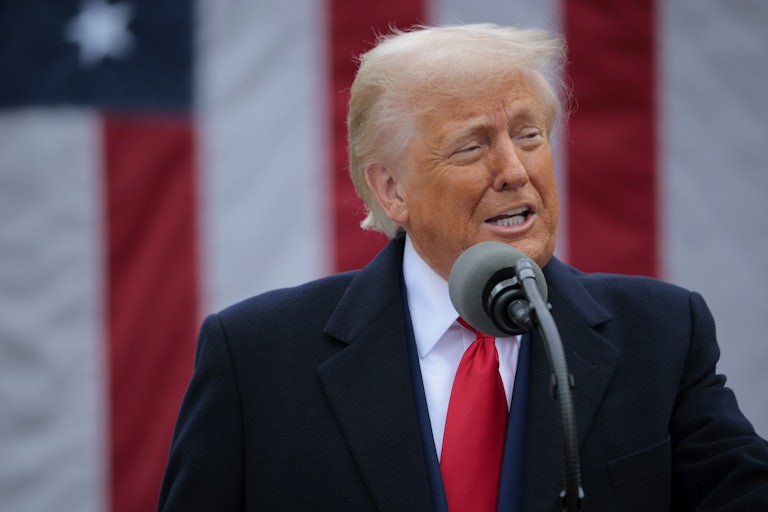
Donald Trump speaks at a mic outdoors.
Chip Somodevilla/Getty Images

Donald Trump responded to a question about confusing tariff language from his administration by adding to the confusion. 

During a press conference with Israeli Prime Minister Benjamin Netanyahu in the Oval Office Monday, a reporter asked the president about “mixed messages from your administration. You’re talking about negotiations and yet others in your administration are saying these tariffs are actually permanent.” 

Trump’s response was anything but clarifying. 

“Well, it can both be true,” Trump responded. “There can be permanent tariffs and there can also be negotiations, because there are things that we need beyond tariffs. We need open borders.”

Is Trump actually going back on his vehement anti-immigrant, pro–border closure stances? His words seem to make little sense coupled with his mass deportation policies and attempts to restrict border crossings. Perhaps he’s referring to fewer restrictions on trade, which is probably how his surrogates and spokespeople will try to spin his remarks, and it could also be a slip of the tongue related to his ongoing cognitive decline

Trump’s tariff policy is so erratic and ill thought out that it’s nearly impossible to know what he actually means by “open borders.” In his bonkers remarks about trying to make Canada the fifty-first state, he’s complained about an “artificial line” separating the U.S. from its northern neighbor, but he has also long complained about crime, drugs, and rapists coming from Mexico through the America’s southern border. One thing is likely, though: The president will contradict his own remarks within days or even hours. 

Treasury Secretary Says Fired Federal Workers Can Work in the Factory

Scott Bessent has an unbelievable career pivot in mind for all the federal employees the Trump administration has fired.

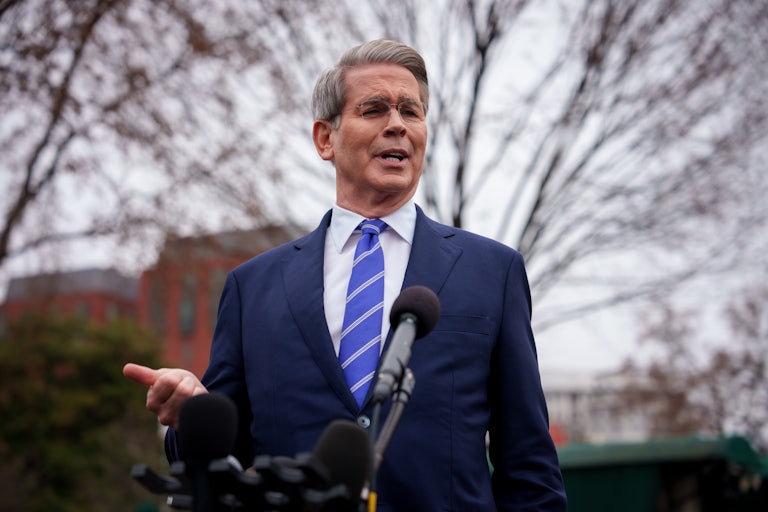
Treasury Secretary Scott Bessent speaks to reporters outdoors.
Andrew Harnik/Getty Images

Treasury Secretary Scott Bessent thinks that all the federal workers who were fired by DOGE will move to manufacturing and reinvigorate the domestic industry.

“We are shedding excess labor in the federal government and bringing down federal borrowings.… That will give us the labor we need for the new manufacturing,” Bessent said in an interview with Tucker Carlson released on Friday. “And we’re going to relever the private sector. So the private sector, in essence, has been in recession during the Biden years. And this is an opportunity to right-size the federal government and unleash the private sector again, because it’s been hemmed down by excessive regulation, and it’s been crowded out by the government.”

It sounds like Bessent—after weeks of federal DOGE layoffs and days of global market collapse from Trump’s tariff war—is suggesting that the federal bureaucrats who were formerly working at departments like Health and Human Services, Education, or Defense are willing and ready to do their best Rosie the Riveter impersonations in the name of restoring domestic manufacturing. This comes just days after Commerce Secretary Howard Lutnick said that it’d be robots that would bring back American manufacturing.

Bessent went on to dismiss the widespread economic anxiety that his administration has caused.

“I think one of the things that we won’t get credit for but that this administration will have done is avoiding a financial calamity,” he said to Carlson. “We’re putting on the reinforced doors before the crash.”

RFK Jr. Forces Out Top Vaccine Regulator After Fight Over Data

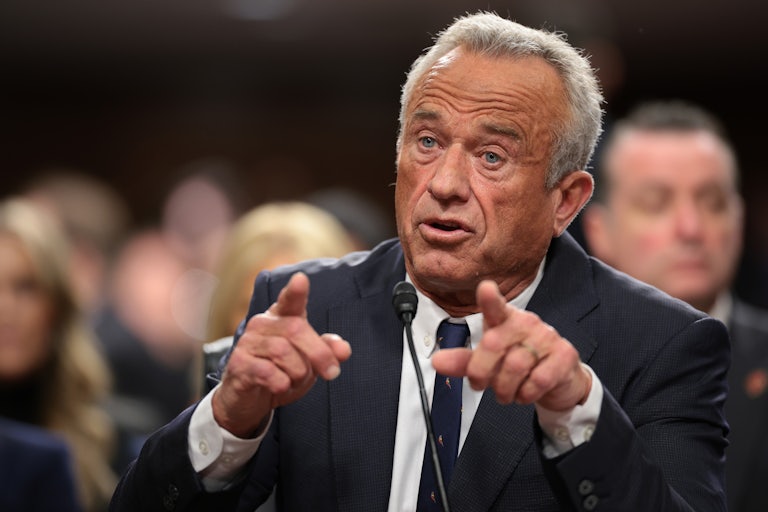
The top vaccine regulator in the country is now gone, thanks to HHS Secretary Robert F. Kennedy Jr.

Robert F. Kennedy Jr. speaks at his confirmation hearing for HHS secretary.
Win McNamee/Getty Images

The former top vaccine official at the Food and Drug Administration says he was forced out of his job for trying to protect vaccine data from Robert F. Kennedy Jr.

Dr. Peter Marks told The Associated Press Sunday he refused to hand over unrestricted access to a vaccine safety database to the Health and Human Services secretary and his team, fearing that the information might be misused, manipulated, or deleted altogether.

Initially, Marks said that he tried to be on good terms with his vaccine-skeptic new boss regarding vaccine safety, making plans to develop a “vaccine transparency action plan.” Marks also gave Kennedy and his team the ability to view reports from the Vaccine Adverse Event Reporting System, or VAERS, but drew the line at allowing them to edit the data.

“Why wouldn’t we? Because frankly we don’t trust [them],” Marks said, using an expletive. “They’d write over it or erase the whole database.”

Marks’s interview came the same day that Kennedy visited Seminole County in Texas, where a young child became the third person, and second child, to die from this year’s measles outbreak. None of the three had received the measles, mumps, and rubella, or MMR, vaccine. Kennedy has a long reputation of being anti-vaccine, which he tried to deny during his confirmation hearings.

But ever since Kennedy’s swearing in as secretary of Health and Human Services, his true colors have been on full display, as he has responded poorly to the initial deaths from the measles outbreak, expressed support for dubious measles treatments, ended support for vaccine initiatives, and even at one point claimed the measles vaccine was as bad as the disease itself.

Over the weekend in Texas, Kennedy attempted some damage control by saying, “The most effective way to prevent the spread of measles is the MMR vaccine.” But, while on that visit, he also met with two doctors who claim to have treated children with measles using the steroid aerosolized budesonide and the antibiotic clarithromycin, calling them “extraordinary healers.”

Both treatments are considered unproven and aren’t accepted by the medical community, once again showing that Kennedy hasn’t actually given up his vaccine skepticism, even as the measles outbreak continues to grow and his government agency fires the people responsible for fighting diseases.