Breaking News
Breaking News
from Washington and beyond

Economist Cited in Trump’s Wild Tariffs Says He Got Math “Very Wrong”

Donald Trump’s team made a critical error when calculating the tariffs.

Donald Trump holds up a chart of tariffs while speaking into a microphone during a press conference in the White House Rose Garden
Brendan Smialowski/AFP/Getty Images

The Trump administration’s calculations justifying the most consequential tariff scheme of the last century are all wrong.

In an op-ed for The New York Times published Monday, economist Brent Neiman, whose research was used to justify the White House’s implementation of reciprocal tariffs, wrote that the White House fundamentally misunderstood his work.

“My first question, when the White House unveiled its tariff regime, was: How on earth did it calculate such huge rates?” Neiman wrote in the op-ed. “The next day it got personal.”

Shortly after the Trump administration announced its plan to implement tariffs of 10 percent or more on 90 countries—which it claims will eliminate the trade deficit but has only spurred global economic chaos—the Office of the United States Trade Representative published its methodology for the tariff calculations, citing a paper by Neiman and four other economists.

“But it got it wrong. Very wrong. I disagree fundamentally with the government’s trade policy and approach,” Neiman wrote. “But even taking it at face value, our findings suggest the calculated tariffs should be dramatically smaller—perhaps one-fourth as large.”

So if the White House had done the math right, and wanted its absurd trade plan to actually work, 20 percent tariffs should have been … 5 percent.

That wasn’t the only mistake, Neiman pointed out. The Trade Office claimed its reciprocal tariff calculations would eliminate trade deficits with each American trading partner. Neiman concluded that is not a “reasonable goal.”

“Trade imbalances between two countries can emerge for many reasons that have nothing to do with protectionism.… There are some reasonable arguments in favor of reducing the overall trade deficit, such as to reduce risks from our debt. But these arguments don’t apply country by country,” Neiman wrote, further exposing the White House’s lack of reasoning.

Even if all trade deficits are eliminated (which Neiman points out is basically impossible), reciprocal tariffs still won’t work.

“The administration’s tariff formula assumes that a tariff placed on one country won’t affect imports from any others and ignores any implications for exports,” Neiman said. “These assumptions may work for an action against one small trade partner, but not for the broad salvo announced last week.”

Neiman went on to decimate pretty much every justification the Trump administration has provided for tariff implementation, including its selective picking and choosing of his research results to support its claims.

“As a result of these and other methodological choices, Wednesday’s reciprocal tariffs will bring average tariff rates to their highest level in over 100 years. I would strongly prefer that the policy and methodology be scrapped entirely. But barring that, the administration should divide its results by four.” Neiman concluded, a grim reminder of the economic chaos yet to come.
Trump Weighs Bombing Mexico—Because Everything Else Is Going So Well

Donald Trump is considering drone strikes on one of our closest trade partners.

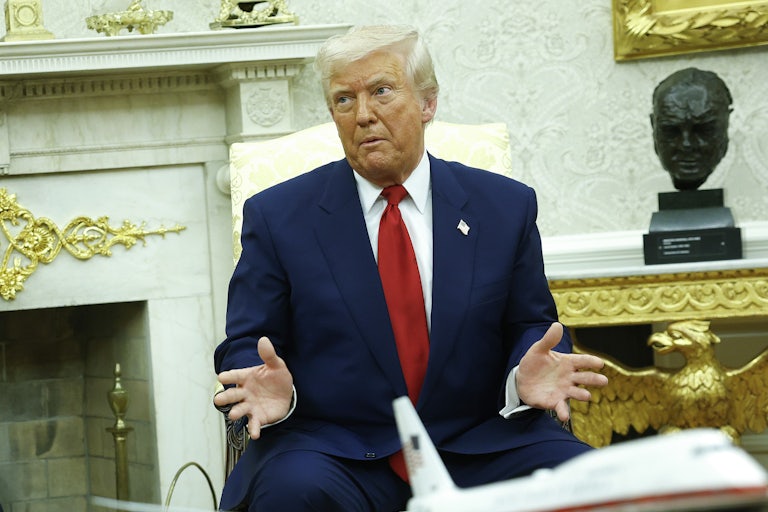
Donald Trump sits in the White House and spreads his hands out, as if in exasperation or confusion.
Kevin Dietsch/Getty Images

The Trump administration is thinking about bombing Mexico.

Former and current U.S. military officials who spoke with NBC News said that communication between the White House, the Defense Department, and intelligence officials have included discussion of drone strikes on cartels and their networks in Mexico. No final decision has been made, but the report is still alarming.

The CIA and U.S. military have been conducting more surveillance flights over Mexico in the wake of President Trump last month designating drug cartels in the country as foreign terrorist organizations. While the flights have been approved by Mexican President Claudia Sheinbaum, the unilateral hostilities that the U.S, seems to be preparing for are not. This is set to make an already shaky relationship between the two allies even more unstable.

“We’re taking nothing off the table. Nothing,” Defense Secretary Pete Hegseth said in February when asked about military strikes in Mexico.

“There is no doubt if there were unilateral action inside Mexico, this would put the bilateral relationship into a nosedive,” former Mexican ambassador to the United States Arturo Sarukhán told NBC News. “It would be put in a tailspin, as it would represent a violation of international law and an act of war.”

Sheinbaum herself came out in staunch opposition to this very kind of activity from Trump back in February when the administration released the cartel terrorism designation.

“The people of Mexico, under no circumstances will accept interventions, interference or any other act from abroad that is harmful to the integrity, independence and sovereignty of the nation,” she said. “What we want to make clear with this designation is that we do not negotiate sovereignty, this can’t be an opportunity by the United States to invade our sovereignty…. They can call [cartels] whatever they decide, but with Mexico it is collaboration and coordination, never subordination, no interference and even less invasion.”

Trump Announces Record Pentagon Budget as DOGE Cuts Everything Else

The Trump administration’s list of priorities is really something.

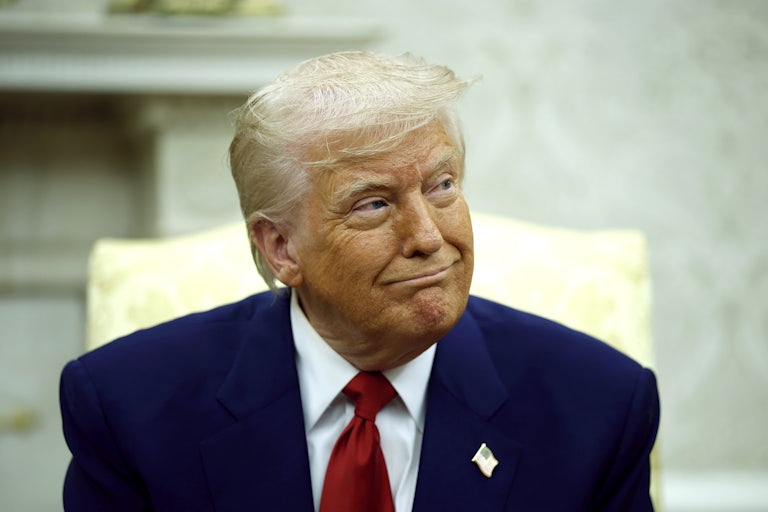
Donald Trump smiles while seated in the White House
Kevin Dietsch/Getty Images

Donald Trump’s quest to slash the federal government appears to end with the Pentagon.

The president announced Monday that he wants the Department of Defense to have a $1 trillion budget, its highest ever, saying that “we have great things happening with our military.

“We also essentially approved a budget which is in the facility—you’ll like to hear this—of a trillion dollars, $1 trillion, and nobody’s seen anything like it. We have to build our military and we’re very cost conscious. But the military is something that we have to build, and we have to be strong, because you got a lot of bad forces out there now,” Trump said.

With the help of fellow fascism enthusiast Elon Musk, Trump has gutted key government agencies, firing several thousand federal workers and attempting to eliminate the U.S. Agency for International Development, the Consumer Financial Protection Bureau, and the Department of Education.

Regarding the Pentagon, Secretary of Defense Pete Hegseth had originally told DOD and military leaders in February to plan to cut 8 percent of the defense budget for each of the next five years. It seems that idea was doomed early on, especially considering Musk’s SpaceX contracts are being spared.

Musk will be making a killing from upcoming defense contracts to work on new rocket launchpads and rocket-booster landing zones, as well as Trump’s fantastical “Golden Dome” missile defense system. That idea will cost a whopping $2.5 trillion and isn’t necessary by any means. It looks like Trump will continue to keep the DOD bloated even though it has never passed an audit.

Ketanji Brown Jackson Torches Supreme Court Shadow Docket in Dissent

The justice wrote a scathing dissenting opinion in the court’s latest decision to back Donald Trump.

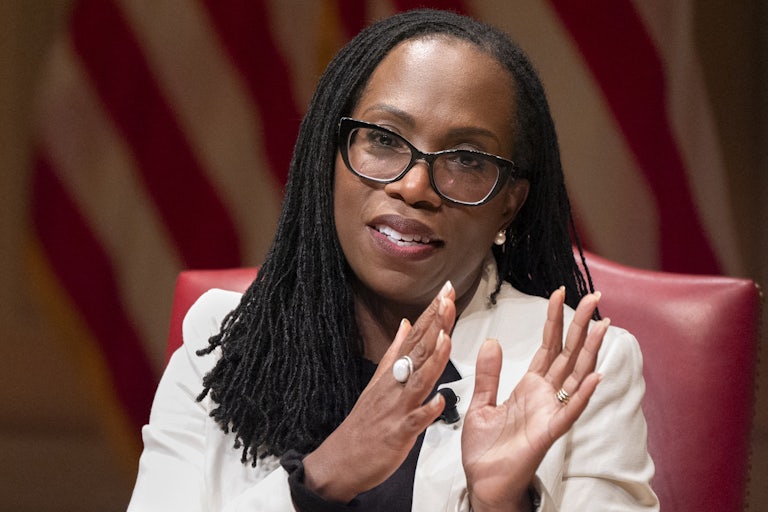
Supreme Court Justice Ketanji Brown Jackson gestures while seated onstage
Jacquelyn Martin/AFP/Getty Images

Supreme Court Justice Ketanji Brown Jackson slammed the “inequitable” and “inappropriate” way the court ruled to allow Donald Trump to proceed with his deportations under the Alien Enemies Act of 1798.

In a scathing dissent, Jackson voiced her disapproval of the court’s Monday decision to strike down U.S. District Court Judge James Boasberg’s injunction pausing deportations under the AEA, which was used last month to expedite the deportation of more than 100 alleged gang members to a prison in El Salvador notorious for human rights abuses.

“The President of the United States has invoked a centuries-old wartime statute to whisk people away to a notoriously brutal, foreign-run prison,” Jackson wrote. “For lovers of liberty, this should be quite concerning.”

The court’s newest justice also took issue with how her colleagues had ruled on the issue, as part of the bench’s emergency, or shadow, docket, which sees immediate action on issues ranging from scheduling proceedings to requests to halt lower court rulings—like the government’s request to halt Boasberg’s injunction.

“I lament that the Court appears to have embarked on a new era of procedural variability, and that it has done so in such a casual, inequitable, and, in my view, inappropriate manner,” she wrote.

“At least when the Court went off base in the past, it left a record so posterity could see how it went wrong,” she wrote. Jackson then cited Korematsu v. United States, in which the Supreme Court had ruled that the government was right to order the incarceration of Japanese American citizens during World War II. President Franklin Roosevelt had used the Alien Enemies Act to justify the brutality of Japanese internment.

The Supreme Court condemned its ruling in Korematsu in 2018, calling it “morally repugnant” and “gravely wrong” but at the same time rubber-stamped Trump’s travel ban targeting six Muslim-majority countries.

Jackson argued that the court hadn’t learned anything.

“With more and more of our most significant rulings taking place in the shadows of our emergency docket, today’s court leaves less and less of a trace. But make no mistake: We are just as wrong now as we have been in the past, with similarly devastating consequences. It just seems we are now less willing to face it,” she wrote.

In recent years, justices have begun to issue far more significant rulings through the shadow docket, according to the Brennan Center for Justice. Unlike the 60 or 70 merit docket cases that the justices decide each term, shadow docket cases do not receive extensive briefings or hearings, and their decisions are accompanied by scant explanations.

“Surely, the question whether such Government action is consistent with our Constitution and laws warrants considerable thought and attention from the Judiciary,” Jackson wrote.

“But this Court now sees fit to intervene,” she said, “hastily dashing off a four-paragraph per curiam opinion discarding the District Court’s order based solely on a new legal pronouncement that, one might have thought, would require significant deliberation.”

Trump Claims Nazis Treated Jewish Prisoners With “Love”

Donald Trump made the unbelievable claim during a press conference with Israeli Prime Minister Benjamin Netanyahu.

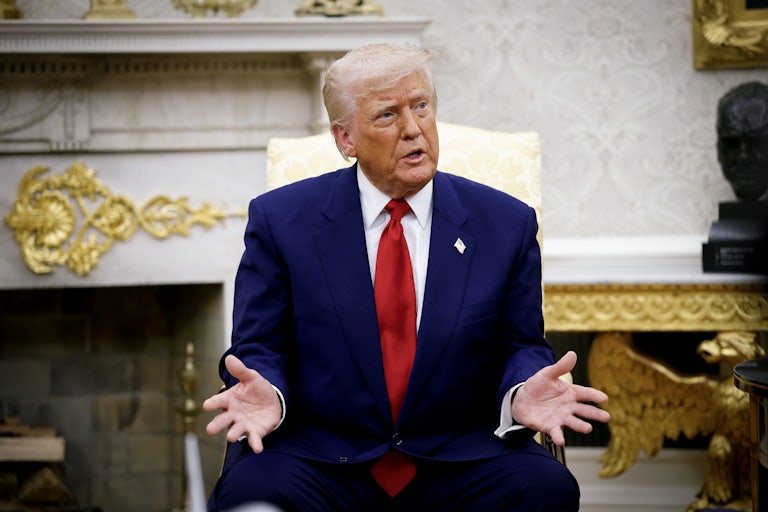
Donald Trump gestures while speaking and sitting in the Oval Office
Kevin Dietsch/Getty Images

In his latest rewrite of European history, Donald Trump made a ridiculous and sympathetic declaration about the Nazis.

Amid the tariff chaos he spurred, Trump met with Israeli Prime Minister Benjamin Netanyahu in the Oval Office Monday, where he was asked by reporters about his plan to bring about the release of the 59 Israeli hostages being held captive in Gaza by Hamas.

In typical Trump fashion, the president dodged the question and went on a bizarre rant that seemingly remembered Nazis for … their sympathy.

“I said to them, was there any sign of love?” Trump said, recounting his conversation with released hostages.

“Did the, Hamas, show any signs of like, help? Or liking you? Did they wink? Did they give you a piece of bread extra? Did they give you a meal on the side? … Like, you know, what happened in Germany?” Trump said, absurdly comparing the hostages’ situation to the Holocaust, which murdered six million Jews.

“People would try and help people that were in unbelievable distress,” the president went on, suggesting that the Nazis were known for their generosity.

“No, they didn’t do that, they’d slap us,” Trump said the hostages told him about Hamas, while sitting next to the man who is currently leading Israel’s genocide in Gaza. “Their hatred is unbelievable.”

Trump’s claim about Nazi kindness sent people reeling on social media.

“This isn’t just delusional. It’s Holocaust cosplay. He’s romanticizing genocide like it’s a fucking history podcast,” one user wrote on X.

“Equating hostages held by Hamas to victims in Nazi Germany isn’t just offensive, it’s also a grotesque distortion of history,” wrote another. “He’s always saying the first thing that pops into his head without understanding the weight of those words. And he’s sitting next to Israeli Prime Minister. Crazy stuff!”