Breaking News
Breaking News
from Washington and beyond

Trump Hilariously Roasted for Suddenly Walking Back Tariffs

“OUR PLAN IS WORKING PERFECTLY AND IS JUST A NEGOTIATING TACTIC BUT IT IS ALSO GOING TO BE PERMANENT.”

Donald Trump holds up a chart of tariffs in the White House Rose Garden
Chip Somodevilla/Getty Images

Donald Trump is once again the laughingstock of the internet after his shocking decision Wednesday to issue a 90-day pause on some of his sweeping tariffs—with the exception of China—after the White House insisted for days that the president had no intention to hit the brakes. 

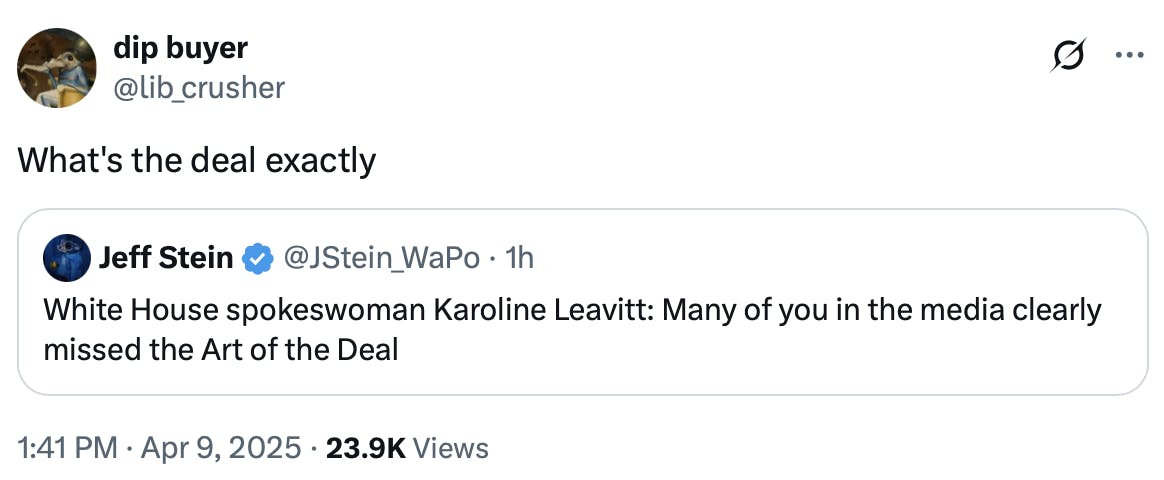
“Many of you in the media clearly missed The Art of the Deal,” said White House press secretary Karoline Leavitt, as she tried to spin Trump’s sudden reversal as part of a long-unfolding plan to either boost domestic manufacturing or something else entirely—actually, it’s become kind of unclear. 

Online people were quick to make what have now become running jokes about Trump’s so-called “art,” and the Trump administration’s mind-boggling insistence that his tariffs are at once a brilliant negotiation tactic and a legitimate policy meant to bolster the U.S. economy. 

“Oh my god she did the meme,” wrote Tahra Jirari, the director of economic analysis at the Chamber of Progress, on X.  

Screenshot of a tweet
Screenshot

“The Art of the Deal is panicking and reversing course less than 24 hours after tariffs go into effect?” wrote Aaron Reichlin-Melchick, a senior fellow at the American Immigration Council, in a post on X. 

Pod Save America host Jon Favreau also took aim at Trump’s deal-making prowess, writing, on X, “Art of the Deal: 1) Impose massive tariffs on nearly every country that crash the markets and create the conditions for global economic collapse 2) Make zero deals with zero countries 3) Pause tariffs 4) VICTORY!!”

While Trump bragged about the scores of foreign leaders who’d come to kiss the ring, many foreign officials said that they’d received no reply to their requests to make a deal with the Trump administration, according to Politico

With Treasury Secretary Scott Bessent’s hollow claims that Trump’s decision was not a response to the last week’s tumultuous stock market, many struggled to understand Trump’s rationale in power-checking foreign countries. 

Screenshot of a tweet
Screenshot
Screenshot of a tweet
Screenshot

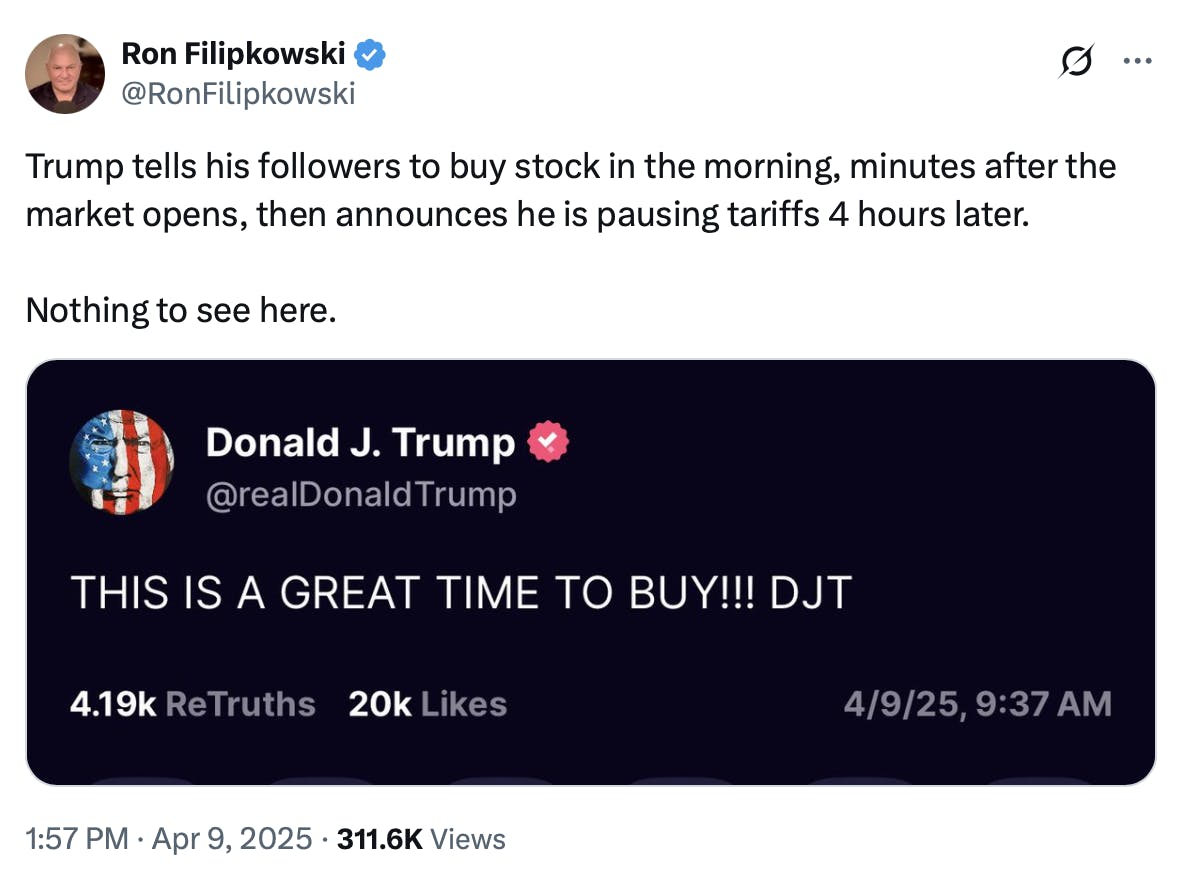
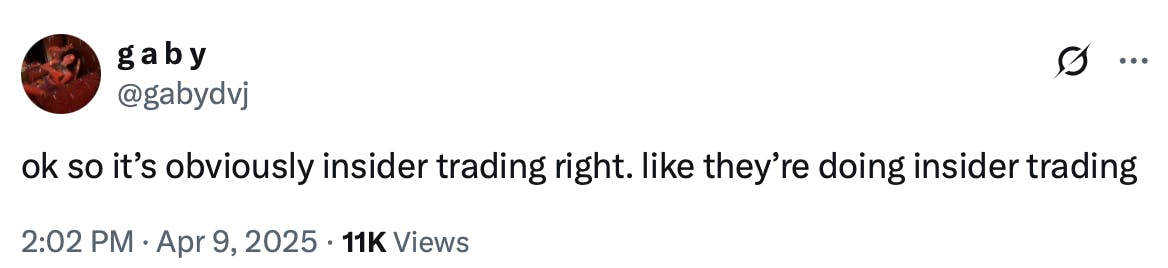
Meanwhile, others suggested that Trump, having urged his followers on Truth Social that it was a “great time to buy” earlier Wednesday, was attempting to create a window for his allies to buy low, knowing he was about to rescind his tariffs.
Screenshot of a tweet
Screenshot
Screenshot of a tweet
Screenshot

But Hawaii Senator Brian Schatz pointed out that there was likely no method to Trump’s madness at all. 

“OUR PLAN IS WORKING PERFECTLY AND IS JUST A NEGOTIATING TACTIC BUT IT IS ALSO GOING TO BE PERMANENT AND WE WILL BE THE WORLD LEADER IN TEXTILES AND NOW THERE IS A PAUSE AND EVERYONE NEEDS TO CHILL BUT ALSO WE WILL NEVER BACK DOWN AAAAAAHHHHHH,” Schatz wrote in a hilariously candid post on X.
Trump’s Team Has No Idea What to Say About His Sudden Tariffs Reversal

Members of Trump’s inner circle are struggling to explain his pivot on tariffs.

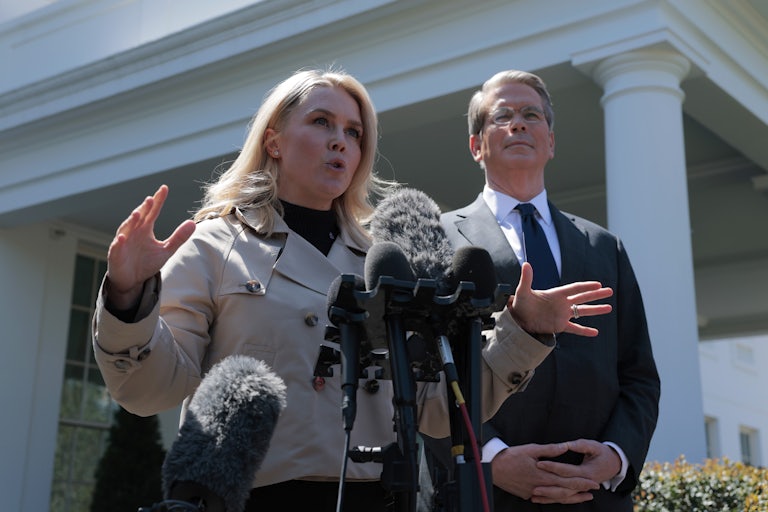
White House press secretary Karoline Leavitt and Treasury Secretary Scott Bessent give a press conference outside the White HOuse.
Anna Moneymaker/Getty Images
White House press secretary Karoline Leavitt and Treasury Secretary Scott Bessent

Donald Trump’s reversal on tariffs Wednesday afternoon seems to have caught his administration off guard.

The president announced on Truth Social that tariffs would return to a baseline 10 percent level in most countries, while staggering 125 percent duties would be imposed on China. But his own officials couldn’t explain why. When a reporter asked Treasury Secretary Scott Bessent if he could, he replied, “No.”

“Again, President Trump created maximum leverage for himself,” Bessent said, adding, “We have just been overwhelmed, overwhelmed by the response mostly from our allies who want to come and negotiate in good faith.”

Press secretary Karoline Leavitt, as usual, took a combative approach, telling reporters, “Many of you in the media clearly missed The Art of the Deal, you clearly failed to see what President Trump is doing here.”

It’s obvious at this point that Trump has never had a plan for his tariff scheme, and is making it up as he goes along. Wednesday’s reversal was likely prompted by growing criticism from his own supporters and normally fawning right-wing media and by a government debt sell-off, showing weakening confidence in the American economy. But Trump’s own sycophants aren’t going to admit that the president would ever back off.

Fund Managers Worry Trump Might Be “Insane”

Donald Trump’s moves are making people who actually understand the economy very nervous.

Donald Trump speaks into a microphone
Saul Loeb/AFP/Getty Images

As Donald Trump’s tariff plan slams the stock market, investors are beginning to wonder if the president doesn’t have some broader economic agenda—but rather if he’s just mentally ill.

“In the last few days, we have had many conversations with macro fund managers,” wrote Tom Lee, the head of research at the financial analysis firm FSInsights.

“And their concern is that the White House is not acting rationally, but rather on ideology. And some even fear that this may not even be ideology,” Lee continued. “A few have quietly wondered if the President might be insane.”

Lee placed the blame for any economic fallout squarely in Trump’s lap, arguing that Trump’s decisions behind the Resolute Desk lead to a “binary outcome,” though they don’t always make sense.

“Multiple officials have stated they do not want nor expect a recession. And there are enough economy-savvy advisors that they are aware of this. Moreover, the two-to-three percent fiscal stimulus needed to reverse a recession would negate any promised cuts to government spending,” Lee wrote, underscoring that “this is a rational view.

Trump’s reciprocal tariffs and unexpected tariff reversals gave the market whiplash on Wednesday. China and the U.S. volleyed for most of the day, with Trump eventually claiming that he would spike levies on the nation, one of America’s biggest trading partners, to 125 percent after China revealed its own reciprocal tariff rate at 84 percent on U.S. goods.

Then, in the afternoon, the White House announced that it would be instituting a pause on the majority of its tariffs (except on China), lowering the tariffs to a universal baseline rate of 10 percent.

That sent the market into a frenzy, with the S&P 500 spiking by 7 percent in a matter of minutes.

Lee’s assessment—which was published early Wednesday, before the swing—argued that prolonged stock fluctuations would lead to “tightening financial conditions.”

“Thus, the longer this volatility lasts, the greater the risk the US and the world are getting pushed into a needless recession,” he warned.

Other financial experts, including JP Morgan Chase CEO Jamie Diamond, have similarly assessed that Trump’s plan has pushed the U.S. to the brink of a recession.

Trump Backs Off Most of His Dumb Tariffs—but What’s Left Is Still Bad

Donald Trump isn’t pausing all of his tariffs. And it’s going to hurt.

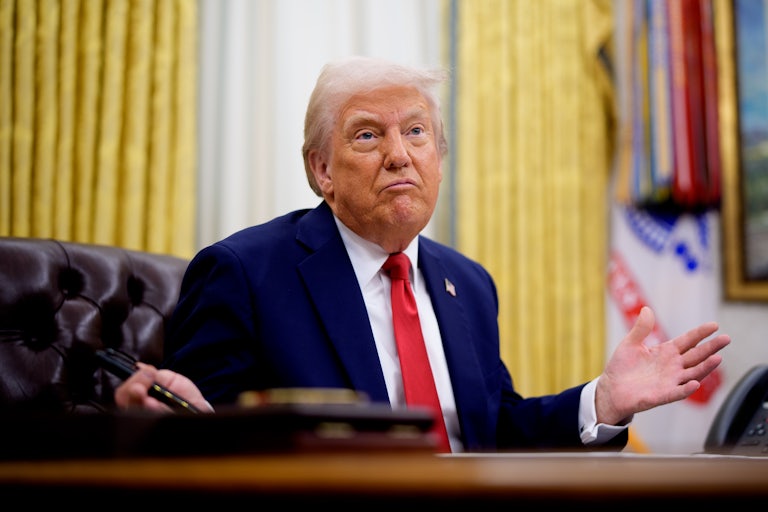
Donald Trump shurgs and makes a weird face while seated at his desk in the White House.
Andrew Harnik/Getty Images

Donald Trump has placed a 90-day pause on most of his reciprocal tariffs, despite repeatedly insisting that no such pause would take place. 

“Based on the fact that more than 75 Countries have called Representatives of the United States, including the Departments of Commerce, Treasury, and the USTR, to negotiate a solution to the subjects being discussed relative to Trade, Trade Barriers, Tariffs, Currency Manipulation, and Non Monetary Tariffs, and that these Countries have not, at my strong suggestion, retaliated in any way, shape, or form against the United States, I have authorized a 90 day PAUSE, and a substantially lowered Reciprocal Tariff during this period, of 10%, also effective immediately,” Trump wrote on Truth Social on Wednesday.

Trump refused to stop his trade war with China, however, declaring in the same announcement that tariffs on the country would rise even more, to 125 percent. 

“Based on the lack of respect that China has shown to the World’s Markets, I am hereby raising the Tariff charged to China by the United States of America to 125%, effective immediately. At some point, hopefully in the near future, China will realize that the days of ripping off the U.S.A., and other Countries, is no longer sustainable or acceptable,” Trump wrote in the same Truth Social post.

While the 10 percent tariffs on remaining countries is a significant reduction, by the measure of just a few months ago, it’s still quite extreme.

Trump’s decision to renege on his aggressive “Liberation Day” tariffs was almost immediately met with allegations of caving at best and market manipulation at worst.  

“Wow. Trump just caved on the sweeping across-the-board tariffs, issuing a 90-day pause,” wrote Democratic strategist Sawyer Hackett. “All of that chaos, trillions of dollars evaporated—for nothing at all.”

“[Trump] has put our economy in disarray and near collapse. We have small businesses and Americans who are concerned about their well-being…. We have people that are planning to send their kids to college this fall, people who are retiring whose benefits have declined,” Representative Steven Horsford asked Trump Trade Representative Jamieson Greer at a hearing mere minutes after Trump tweeted out the news. “Is this market manipulation?”

“No,” said Greer.

“Why not? If it was always the plan, how is this not market manipulation? 

“It’s not market manipulation,” Greer insisted again. 

“So if it’s not market manipulation, what is it? Who’s benefiting? What billionaire just got richer? And all the while, there aren’t even any Republicans left in this hearing.” 

This story has been updated.

ICE Deportee’s Lawyers Torch Trump DOJ’s Case: “No Actual Evidence”

Kilmar Abrego Garcia was deported to El Salvador despite having no ties to gangs.

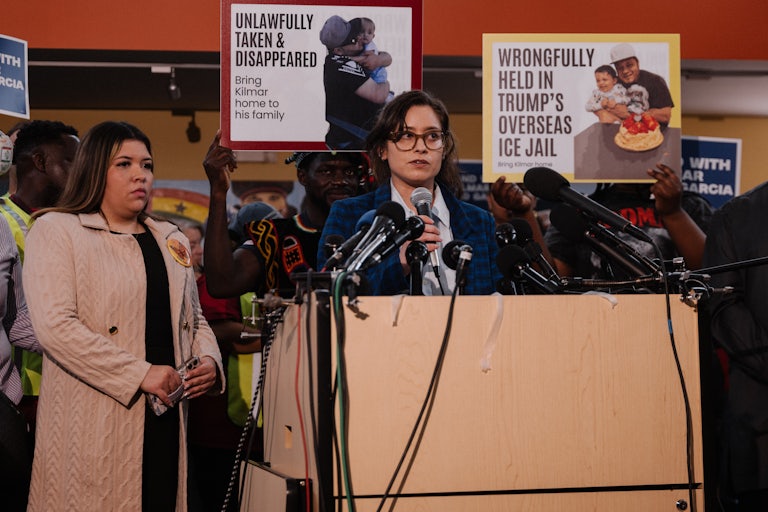
A lawyer for Kilmar Abrego Garcia speaks at a podium during a press conference and rally in support of bringing him back from El Salvador
The Washington Post/Getty Images

Lawyers for a man mistakenly deported to El Salvador slammed the Department of Justice for trying to claim that the foreign country could have its own reasons for keeping him in prison.

Kilmar Abrego Garcia was one of many alleged gang members that the Trump administration deported to El Salvador in mid-March, after invoking the Alien Enemies Act and denying detainees’ due process. The government later admitted that Abrego Garcia, who has no criminal record, was included on the flight manifest due to an “administrative error,” and had been subject to a protective order shielding him from deportation to El Salvador because he faced a legitimate threat of persecution there.

The Supreme Court on Monday halted a judge’s order to immediately retrieve Abrego Garcia. The government has continued to claim it cannot retrieve Abrego Garcia, who is among those incarcerated in El Slavador’s notorious mega-prison Centro de Confinamiento del Terrorismo, or CECOT, for a plethora of reasons. In a filing Monday, the DOJ claimed one more, alleging that El Salvador’s government “may have its own compelling reasons to detain” Abrego Garcia, and “has its own legal rationales for detaining members of … foreign terrorist groups like MS-13”—which the U.S. government has yet to actually demonstrate that Abrego Garcia is.

But, in an eight-page filing Wednesday, lawyers for Abrego Garcia shot down the DOJ’s attempt to “ominously” introduce a flimsy excuse for leaving him there.

“These vague speculations are forfeited because they were never previously asserted and, in any event, devoid of factual support,” the lawyers wrote.

“There is no actual evidence that any nation has a criminal charge against Abrego Garcia. The only evidence is that he has never been charged or convicted of a crime in any country. And, of course, Abrego Garcia has not even lived in El Salvador since 2011—some 14 years ago—when he was 16 years old, rendering the Government’s claim implausible,” the lawyers wrote. “If the Government has evidence as to Abrego Garcia, it should say so. It refuses.

“The Government’s retreat to innuendo cannot bear the weight of the extraordinary relief it seeks: to perpetuate an unlawful incarceration that the United States itself engineered,” the lawyers added.