Breaking News
Breaking News
from Washington and beyond

Trump Brags as Even More Law Firms Crumble to His Every Whim

Trump announced a series of astonishing deals with law firms worth $600 million.

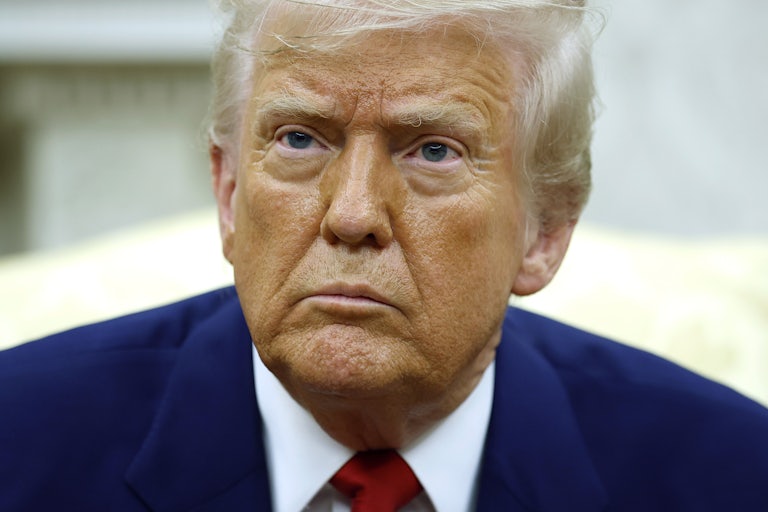
Donald Trump smiles while seated on an armchair in the White House.
Yuri Gripas/Abaca/Bloomberg/Getty Images

Five more major law firms have succumbed to President Donald Trump’s punitive threats as he continues his blatantly illegal intimidation of legal professionals. 

Kirkland & Ellis LLP, Allen Overy Shearman Sterling US LLP, Simpson Thacher & Bartlett LLP, and Latham & Watkins LLP will provide pro bono services of at least $500 million, Trump boasted in a Truth Social post Friday afternoon. In a separate post, Trump revealed another $100 million deal with Cadwalader, Wickersham & Taft LLP. 

The firms will provide services to causes “President Trump and the Law Firms both support and agree to work on, including in the following areas: Assisting Veterans and other Public Servants, including, among others, members of the Military, Gold Star families, Law Enforcement, and First Responders; ensuring fairness in our Justice System; and combatting Antisemitism,” Trump wrote, adding that the firms will not engage in “illegal” diversity, equity, and inclusion practices either.  

“The Law Firms will take on a wide range of pro bono matters that represent the full political spectrum, including Conservative ideals,” the post continues. In other words, the law firms will aid the Trump administration’s volatile attack on free speech, civil liberties, and the Constitution—for free. 

“Concurrent with these agreements, the EEOC has withdrawn the March 17, 2025 letters to the Law Firms, and will not pursue any claims related to those issues,” Trump noted, referring to his intimidation of the firms.

The announcements come as part of Trump’s widespread attack on law firms, punishing them for filing lawsuits he disagrees with or hiring attorneys he doesn’t like. He’s issued executive orders penalizing some of the country’s top law firms, many of which have bent to the president’s will—including Wilkie Farr & Gallagher, the law firm of former second gentleman Doug Emhoff. 

The total amount of free services pledged by law firms has now reached more than $900 million, a concerning statistic not only for other law firms but for the rule of law itself.
Trump DOJ Fights Judge on Returning Wrongly Deported Man

Rather than actually work to get Kilmar Abrego Garcia back, the Trump administration is choosing to make lame excuses.

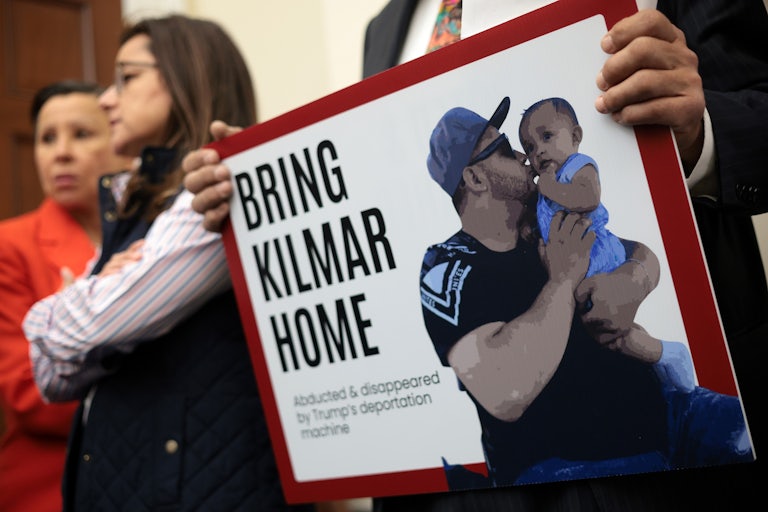
A person holds up a sign that says, "Bring Kilmar home" during a Congressional Hispanic Caucus press conference
Alex Wong/Getty Images

The Department of Justice offered a flimsy excuse Friday for why it couldn’t comply with an order to present plans to return the Maryland father wrongly deported to a notorious prison in El Salvador.

The Supreme Court upheld an order from U.S. District Judge Paula Xinis Thursday night directing the DOJ to deliver plans to the court by 9:30 a.m Friday morning “to facilitate and effectuate” the return of Kilmar Abrego Garcia.

Lawyers for the DOJ asked to have the hearing delayed to provide time to “evaluate” the Supreme Court’s order. When the clock elapsed on the government’s deadline, lawyers for Abrego Garcia argued that the DOJ had no excuse for being unprepared because it already had been under order to deliver their plans before Chief Justice John Roberts issued a stay on the order on Monday. Xinis granted the government’s request for an extension, which then elapsed again.

Finally, in a brief two-page filing Friday, lawyers for the government claimed that the court had set an “impractical” deadline and that they had been provided “insufficient” time to draw up plans.

The lawyers claimed that they didn’t fully understand Xinis’s order (“The Court has not yet clarified what it means to ‘facilitate’ or ‘effectuate’ the return,”) and that their perfect compliance with Roberts’s stay had prevented them from doing their homework.

The Supreme Court had instructed Xinis to clarify “the intended scope of the term ‘effectuate’” and warned that it “may exceed the District Court’s authority.” But the high court ruled that Xinis had “properly” ordered the government to facilitate Abrego Garcia’s return.

In its insistence not to share its plan going forward, the government completely ignored Xinis’s request to share “what it can concerning the steps it has taken” prior to the order, according to Kyle Cheney, Politico’s senior legal correspondent.

“Defendants are not in a position where they ‘can’ share any information requested by the Court. That is the reality,” the government’s lawyers wrote in its filing, arguing that the order had come in too late in the evening Thursday.

“Foreign affairs cannot operate on judicial timelines, in part because it involves sensitive country-specific considerations wholly inappropriate for judicial review,” the DOJ added.

Trump Trade Rep. Fumbles Key Question on How Much Tariffs Will Cost

Jamieson Greer rushed to downplay how much tariffs will increase costs for American households.

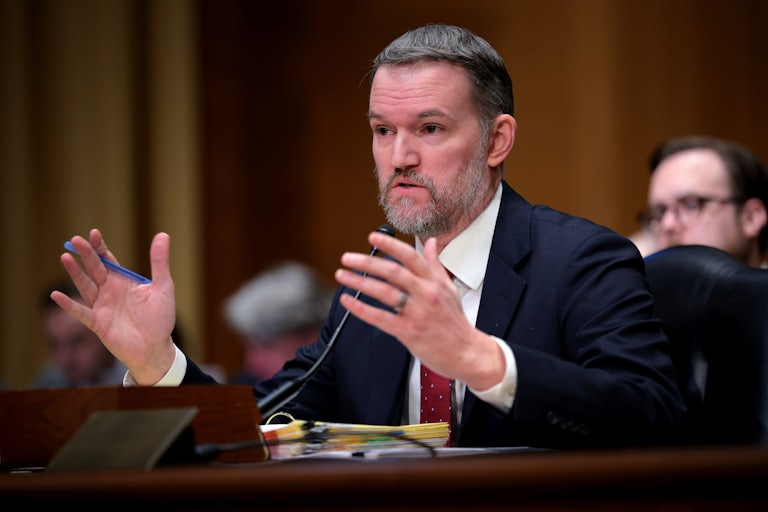
Trade Representative Jamieson Greer gestures while speaking into a microphone during a Senate Hearing
Kayla Bartkowski/Getty Images

The Trump administration is desperate to convince Americans that Donald Trump’s trade war won’t affect their wallets.

U.S. Trade Representative Jamieson Greer took to Fox News Friday, attempting to claim that the tariff plan had not destabilized the U.S. economy—but even on his favorite network, Trump’s policies faced heat.

“They say tariffs are gonna cost the American household $4,800,” prompted co-host Brian Kilmeade. “What do you say to those households?”

“First of all, I would say, with respect to those projections, a lot of those are Wall Street analysts who have a lot to lose themselves,” Greer said.

Except those numbers didn’t come from Wall Street analysts. Instead, the prediction came from a new report by the Yale Budget Lab, which assessed that Trump’s tariffs would raise the cost of goods by 2.9 percent, “the equivalent of a loss of purchasing power of $4,700 per household on average in 2024 dollars.”

And Greer’s point that it’d be men on Wall Street rejecting Trump’s roller-coaster ride of a market agenda rings especially hollow in light of the fact that the market has already seen its fair share of winners and losers. Some of the biggest winners, however, appear to be Trump’s billionaire buddies—notably his right-hand man Elon Musk, who has seen massive gains amid the up-and-down chaos.

Meanwhile, Trump’s weeklong global tariff volley and its ensuing volatility affected some 62 percent of Americans who participate in the market in some way or another, either by way of holding individual stocks or investing their money in retirement plans such as 401(k)s, IRAS, or pensions.

“I think the economic fundamentals of our country are still very, very good, and while there may be an adjustment, I think we’re going to be on a good path and I don’t think we’re going to see that level of increase in household expenses,” Greer added.

The administration’s slapdash approach to global trade was on full display Wednesday, when Greer was caught completely out of the loop while testifying before the ​​House Ways and Means Committee. His lack of prior knowledge made it abundantly clear that communication has eroded so thoroughly through Trump’s Cabinet that even the U.S. trade representative had not been apprised of the president’s decision to temporarily reverse course on his tariff agenda.

Manufacturing Workers Are Beyond Pissed at Trump Over Tariffs Whiplash

Donald Trump is quickly losing support of a key voter group.

Donald Trump
Kevin Dietsch/Getty Images

It turns out that Donald Trump’s erratic tariff policy is not popular with manufacturing workers.

A new Washington Post poll of over 500 workers showed that 52 percent oppose the trade measures, believing that they are bad for their livelihoods and the country. In addition, 57 percent of them said that tariffs would hurt their jobs and careers, while 59 percent said that tariffs would hurt the companies they work for.

When broken down on partisan lines, less than half of Donald Trump voters (44 percent) said they believed tariffs would help them, while 87 percent of Harris voters said they would hurt them. A slight majority of the poll’s respondents said they favored or leaned toward the Republican Party, making the results more striking.

Trump has alternately raised and lowered tariffs, confusing markets and businesses. At the moment, there are 145 percent tariffs on China, 25 percent tariffs on Mexican and Canadian goods not covered by the USMCA trade agreement, and 10 percent on most other countries. The moves have already led to layoffs in certain American industries, such as automobiles, and a looming recession would lead to even more job losses.

But Trump doesn’t seem to have any kind of plan with his tariffs and is making it up as he goes along. Without any clarity as to where things are going, not only will industries and markets continue to slide, but Trump may start to lose support from manufacturing workers, many of whom were part of the reason for his election victory in 2024.

Trump has already created thousands of disgruntled, laid-off federal workers. If Democrats capitalize on the vast numbers of Americans worried about their jobs, the result would be big losses for the GOP in 2026, and possibly even 2028.

Trump Is Begging China to Make a Deal Over Tariffs

Donald Trump appears to be growing increasingly desperate to fix the fallout over his tariffs.

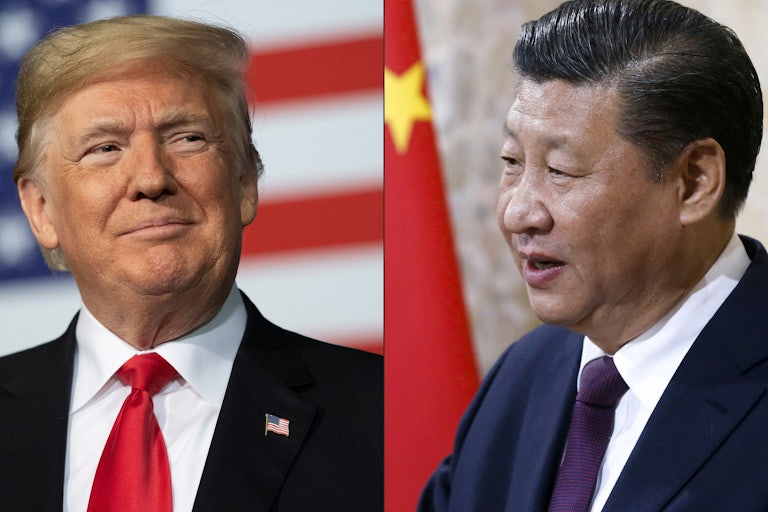
Donald Trump and Xi Jinping
Jim Watson, Peter Klaunzer/AFP/Getty Images

Donald Trump’s administration has been begging for a call from Chinese President Xi Jinping—despite Trump’s claims that his reciprocal tariff policy sent nations scrambling to cut deals with him. But instead of fostering negotiations, it seems their desperation only made things worse. 

Beijing announced Friday that it was raising tariffs on U.S. goods from 84 percent to 125 percent, following confirmation from the White House the day before that it was placing tariffs of 145 percent on Chinese goods. 

Ahead of Thursday’s announcement, the Trump administration had attempted to talk Chinese officials out of levying more retaliatory tariffs, and advised them to have their president give Trump a call, according to CNN

Instead of entreating Xi to a meeting, U.S. officials awoke Friday to even more tariffs, and no request to begin negotiations. 

U.S. Trade Representative Jamieson Greer confirmed Friday morning that the U.S. had not yet begun talks with Chinese officials to walk back the tariffs.

The White House has claimed to have started negotiations with officials from 75 countries—though it has refused to divulge which ones—in response to Trump’s reciprocal tariff policy. China has been a notable holdout, and was therefore made exempt from Trump’s 90-day pause on new rates going into effect. 

The Trump administration has been saying pretty much the same thing to China for roughly two months, insisting that Beijing must make the first move, but with no luck. Trump claimed Wednesday that “China wants to make a deal. They just don’t know how quite to go about it,” noting that the Chinese were a “proud” people.  

China’s Finance Ministry released a statement Friday saying that it wouldn’t fall for Trump’s blatant bullying. 

“Even if the U.S. continues to impose higher tariffs, it will no longer make economic sense and will become a joke in the history of world economy,” the ministry said in the statement, which CNBC translated.

“With tariff rates at the current level, there is no longer a market for U.S. goods imported into China,” the statement said, adding that “if the U.S. government continues to increase tariffs on China, Beijing will ignore.”