Breaking News
Breaking News
from Washington and beyond

Here’s How Much Money Trump’s Tariffs Are Actually Making

Donald Trump promised his tariffs would make the country rich.

Donald Trump hols his hands out the side and speaks while sitting in the Oval Office
Win McNamee/Getty Images

U.S. Customs and Border Protection has revealed how much money has been generated from Donald Trump’s tariffs—and it’s not nearly as much as the president has claimed, NBC News reported Wednesday.

“Since April 5, CBP has collected over $500 million under the new reciprocal tariffs, contributing to more than $21 billion in total tariff revenue from 15 presidential trade actions implemented since Jan 20, 2025,” CBP said in a statement to CNBC Monday.

But that directly contradicts Trump’s claim that his tariffs are raking in a whopping $2 billion every day.

The real number is closer to $250 million per day, according to the CBP. The Treasury Department reported Monday that the day’s deposits listed under “Customs and Certain Excise Taxes” totaled $305 million.

Earlier this month, Trump announced sweeping a “reciprocal tariff” policy, imposing a blanket 10 percent tariff on products from nearly every country in the world. After the stock market tanked, Trump announced a three-month pause on imposing the tariffs, with an exception for China, on which he has levied a 145 percent tariff on everything but certain tech products.

In return, China has imposed its own 125 percent tariff on all U.S. goods, which is already hurting American farmers, who exported $1.6 billion worth of beef to China last year.

Trump has also imposed a 25 percent tariff on goods from Canada and Mexico, as well as a 25 percent tariff on imported cars and autoparts.

Federal Reserve Chair Jerome Powell warned Wednesday that Trump’s sweeping tariff policy would likely raise inflation, despite the president’s many promises to lower prices upon entering office.
Dem Senator Exposes El Salvador’s Cruelty on Kilmar Abrego Garcia

Senator Chris Van Hollen visited El Salvador to try to return the wrongly deported Maryland resident. The answers he got there were appalling.

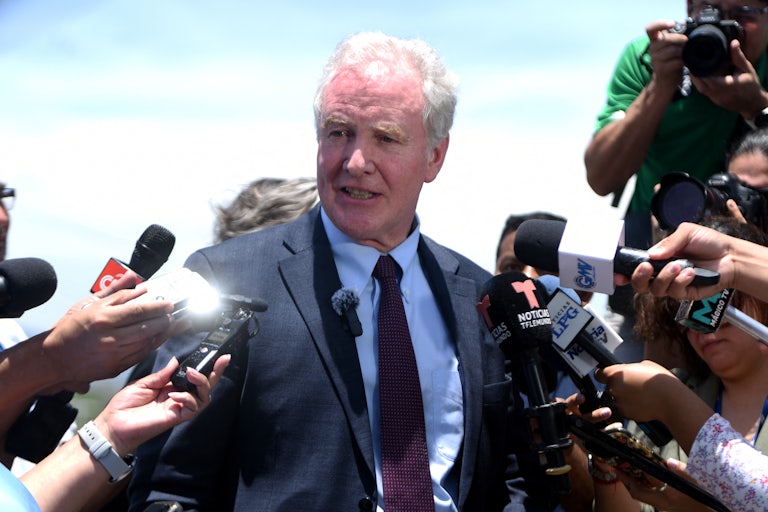
Senator Chris Van Hollen is surrounded by reporters’ microphones on his trip to El Salvador to visit the wrongly deported immigrant Kilmar Abrego Garcia.
MARVIN RECINOS/AFP/Getty Images

El Salvador won’t let Senator Chris Van Hollen have any contact with Kilmar Abrego Garcia, a Maryland resident who is being unlawfully detained in a megaprison in the country.

Van Hollen traveled to El Salvador Wednesday in search of answers about Abrego Garcia’s whereabouts. The father of three was deported last month due to an “administrative error” by the Trump administration, which continues to claim Abrego Garcia is a member of MS-13, despite there being no evidence to prove it.

The Democratic senator from Maryland asked Salvadoran Vice President Félix Ulloa if he could arrange a meeting with Abrego Garcia, he told reporters Wednesday.

“He said he was not able to make that happen,” Van Hollen said, adding that Ulloa gave him the same response when he asked if he could come back next week instead.

“So I asked if I could get on the phone, either video phone or phone, and talk to Mr. Abrego Garcia to see how he’s doing,” Van Hollen continued. Ulloa won’t let that happen either. Nor will he allow Abrego Garcia to speak with his family, for whom Van Hollen promised he would get answers.

The Trump administration is currently paying El Salvador $6 million to detain more than 200 immigrants in CECOT, a megaprison where people all but disappear once they’re locked up. The notorious institution is the centerpiece of President Nayib Bukele’s violent crackdown on crime, and can hold up to 40,000 inmates. CECOT inmates are shut out from the outside world—they’re not allowed visitors or phone calls with loved ones, nor are there any programs to help them integrate back into society upon release—a cruel but convenient place for Trump to send people he doesn’t want tracked down.

Last week, the Supreme Court ordered the White House to “facilitate” the return of Abrego Garcia, but Trump still hasn’t done anything to make that happen. And it seems like El Salvador won’t either, a scary indication of just how much the government is cozying up to Trump amid his mass deportation plans.

In a meeting with Trump on Monday, Bukele said he will not return Abrego Garcia to the U.S., nor will he release him in El Salvador, despite the Supreme Court’s orders. Van Hollen is the first Democrat to step up and demand Abrego Garcia’s release on Bukele’s home turf.

“The goal of this mission is to let the Trump administration, to let the government of El Salvador know that we are going to keep fighting to bring Abrego Garcia home,” he said, finally showing some long-awaited courage from the Democratic Party.

Stock Market Tanks After Fed Chair Powell’s Ominous Warning

Donald Trump’s policies are about to destroy the economy.

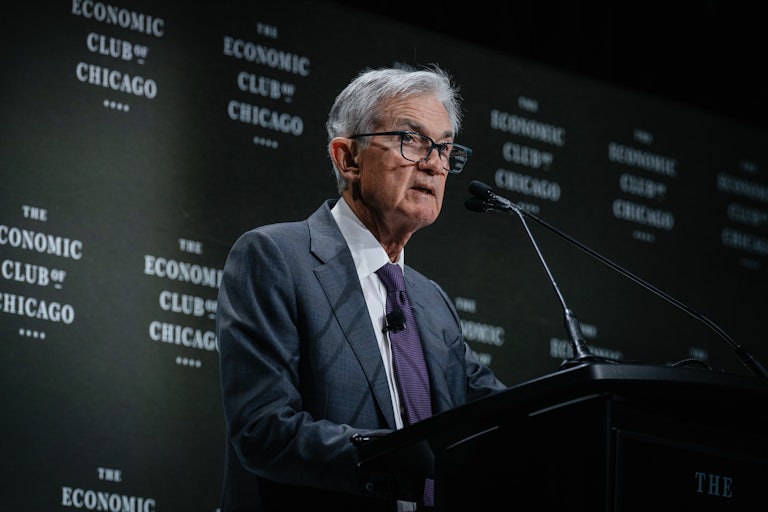
Federal Reserve Chair Jerome Powell speaks at a lectern at The Economic Club of Chicago.
Jamie Kelter Davis/Bloomberg/Getty Images

After Jerome Powell issued a warning about the economic consequences of tariffs Wednesday, the stock market fell, seeming to confirm his words.

The Dow Jones industrial average was down nearly 900 points, the S&P 500 fell over 150 points, and Nasdaq was down over 620 points as of this writing after the Federal Reserve chair’s remarks to the Economic Club of Chicago.

“The level of tariff increases announced so far is significantly larger than anticipated, and the same is likely to be true of the economic effects, which will include higher inflation and slower growth,” Powell said.

Trump’s tariffs have caused wild stock swings in the past few weeks as he seems to change his mind repeatedly on which countries are getting hit with which rates. The resulting uncertainty threatens to put the U.S. economy on a path of increased unemployment, rising inflation, and weak growth, which Powell warned is an unprecedented situation.

“These are very fundamental policy changes,” Powell said. “There isn’t a modern experience for how to think about this.”

Right now, in addition to a baseline 10 percent tariff on most U.S. imports, Trump has placed 25 percent tariffs on aluminum and steel as well as on Mexican and Canadian goods not covered by existing trade agreements. In addition, there is a 25 percent tariff on automobiles and a massive 145 percent tariff on all Chinese goods.

All of that threatens an economy that experts considered “historically strong” before Trump’s inauguration at the start of this year. Powell’s warnings Wednesday reflect how Trump changed that outlook in just three months, threatening a recession down the line. Sometime before that point, the president will demand interest rate cuts from Powell and the Fed, and how the chair will handle that remains to be seen.

Fed Chair Issues Grim Warning About Consequences of Trump’s Tariffs

Jerome Powell didn’t hold back when discussing Donald Trump’s tariffs.

Federal Reserve Chair Jerome Powell gestures and speaks while sitting onstage at the Economic Club of Chicago
Kamil Krzaczynski/AFP/Getty Images

Federal Reserve Chair Jerome Powell warned Wednesday that Donald Trump’s sweeping reciprocal tariff policy would likely raise inflation, despite the president’s many promises to lower prices upon entering office.
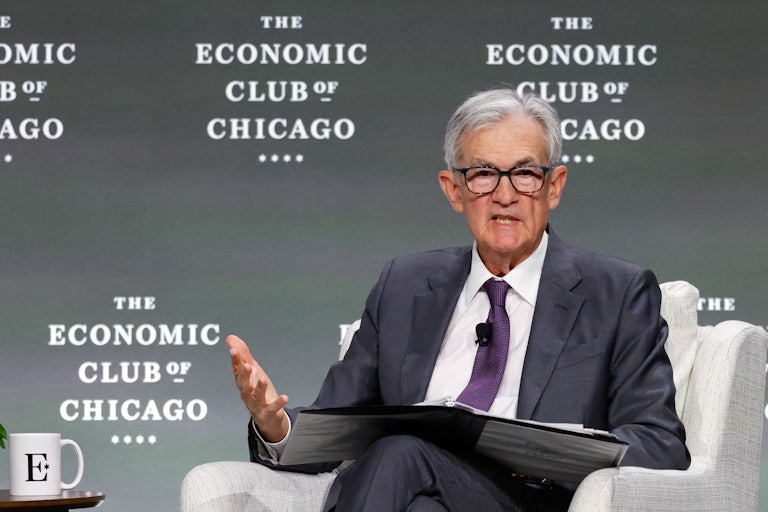
“The level of tariff increases announced so far is significantly larger than anticipated, and the same is likely to be true of the economic effects, which will include higher inflation and slower growth,” Powell said during an event hosted by the Economic Club of Chicago.

Powell’s words stand in marked contrast to Trump’s. During a press conference with Salvadoran President Nayib Bukele Monday, Trump claimed that he had “already solved inflation,” after the inflation rate had reached 2.4 percent in March, a six-month low.

“You know, if you look at the numbers, the numbers are incredible, actually. The stock market’s up,” Trump said. But that was only after he sent the stock market sinking with his announcement of blanket 10 percent tariffs on products from nearly every country in the world.

And that was in addition to the 25 percent tariffs he’d already announced on products from Canada and Mexico, as well as 25 percent tariffs on imported cars and autoparts. Not to mention his mounting trade war with China, which involved a 145 percent tariff on Chinese goods—with a temporary exception for electronics—that saddled the U.S. with a reciprocal 125 percent tariff on American exports to China.

When Trump announced a 90-day pause on his sweeping reciprocal tariffs, the stock market immediately shot back up, making millions for the president’s buddies at the expense of weakening the U.S. dollar and the U.S. Treasury market.

Powell warned that Trump’s economic policies were pushing the U.S. into uncharted territory. “There isn’t a modern experience for how to think about this,” Powell said Wednesday.

He added that the Federal Reserve might find itself “in the challenging scenario in which our dual-mandate goals are in tension,” referring to the central bank’s dual mandate of maximum employment and stable prices.

Powell said that if both prices and unemployment increased to a certain point, then the Fed “would consider how far the economy is from each goal, and the potentially different time horizons over which those respective gaps would be anticipated to close.”

Trump Officials Get Even More Power to Send Immigrants to Guantánamo

Trump promised to only send the worst people to Guantánamo Bay. A new memo shows that’s not really the case.

A group of 5 Venezuelan migrant men deported from Guantanamo Bay walk down from the Venezuelan Conviasa Airlines plane as they arrive at Simon Bolivar International Airport in Maiquetia, Venezuela. They wear gray sweatshirts and sweatpants and orange face masks.
PEDRO MATTEY/AFP/Getty Images
Venezuelan immigrants deported from Guantánamo Bay arrive at Simon Bolivar International Airport in Maiquetia, Venezuela, on February 20.

The Trump administration is creating a legal justification to send immigrants without criminal records to the U.S. Naval Base in Guantánamo Bay, Cuba.

CBS News obtained a government memo showing an agreement between the Department of Homeland Security and the Department of Defense creating broad discretion about who can be sent to the base. The criteria directly contradict President Trump’s comments about the Cuba base earlier this year, in which he said only the “worst” migrants should be sent there.

The memo doesn’t even mention criminality, stating that the departments agreed to use the base to detain immigrants with deportation orders who have “a nexus to a transnational criminal organization (TCO) or criminal drug activity.” Having a nexus, as defined by the memo, constitutes being part of a transnational criminal group or paying one “to be smuggled into the United States.”

Many immigrants crossing the southern U.S. border end up having to pay criminal groups to facilitate their journey, meaning this could be used to detain large numbers of people. And even if there’s no proof that they were involved with any criminal organization, the memo allows authorities to assume that they are if they’re from a country “where the preponderance of aliens from that country enter the United States in that fashion.”

The Trump administration has already flown some Venezuelan immigrants to Guantánamo Bay, but flew them back to the U.S. in February. Since then, it has reportedly held immigrants from different countries at the base before returning them to the U.S. or other countries. According to a DOD spokesperson, there are 42 immigrants still held at the base, including 10 “high-threat” detainees.

The fact that the Trump administration is using the Guantánamo base at all in its mass deportation efforts is egregious, considering that the base previously held detainees from the war on terror as a way to skirt the Geneva Conventions. Its revival suggests that administration officials see a need to dodge basic human rights laws in detaining immigrants.

Coupled with its sending of immigrants to El Salvador, the majority of whom also don’t have criminal records, the Trump administration’s use of Guantánamo Bay to hold immigrants it wants to deport is yet another human rights violation from officials who couldn’t care less.