Breaking News
Breaking News
from Washington and beyond

A Supreme Court Justice Finally Just Stood up to Trump

Justice Ketanji Brown Jackson criticized the president’s unsettling attacks on the judiciary.

Ketanji Brown Jackson smiles in front of a red curtain
Alex Wong/Getty Images
Ketanji Brown Jackson in October 2022

Justice Ketanji Brown Jackson has had enough of the Trump administration’s unchecked bullying of the nation’s judicial branch.

The Supreme Court’s most junior justice condemned Donald Trump’s attacks on the country’s judges Thursday night, decrying the hostility from the executive branch as a threat to democracy.

“Across the nation, judges are facing increased threats of not only physical violence, but also professional retaliation just for doing our jobs,” Jackson said at a judge’s conference in Puerto Rico, according to Politico. “And the attacks are not random. They seem designed to intimidate those of us who serve in this critical capacity.”

Jackson, who joined the nation’s highest bench in 2022 after she was appointed by former President Joe Biden, did not mention Trump by name but instead referred to the president as the “elephant in the room.”

Jackson further noted that Trump’s attacks are “not isolated incidents,” arguing that they “impact more than just individual judges who are being targeted.”

“The threats and harassment are attacks on our democracy, on our system of government. And they ultimately risk undermining our Constitution and the rule of law,” Jackson said. “I urge you to keep going, keep doing what is right for our country, and I do believe that history will vindicate your service.”

She added that the judiciary had faced similar challenges during the Civil Rights Movement and the Watergate scandal, when the branch of government was again in the public hot seat.

“Other judges have faced challenges like the ones we face today, and have prevailed,” Jackson said.

The sharp rebuke earned her a standing ovation at the conference, reported The Daily Beast. It’s the second such instance in which a Supreme Court justice has critiqued Trump’s attempts to coerce America’s courtrooms. In March, Chief Justice John Roberts pushed back against the president’s demands to impeach a federal judge who dared to rule against his deportation plans.

“For more than two centuries, it has been established that impeachment is not an appropriate response to disagreement concerning a judicial decision,” Roberts said of Trump’s threats against U.S. District Judge James E. Boasberg at the time.

But Baosberg isn’t the only judge Trump has threatened. Dozens of judges have ruled against Trump—and faced the wrath of his allies and his base for doing so.

Can John Fetterman Continue in the Senate?

The Pennsylvania Democrat is reportedly acting erratically—and saying a number of disturbing things about Gaza and Palestinians.

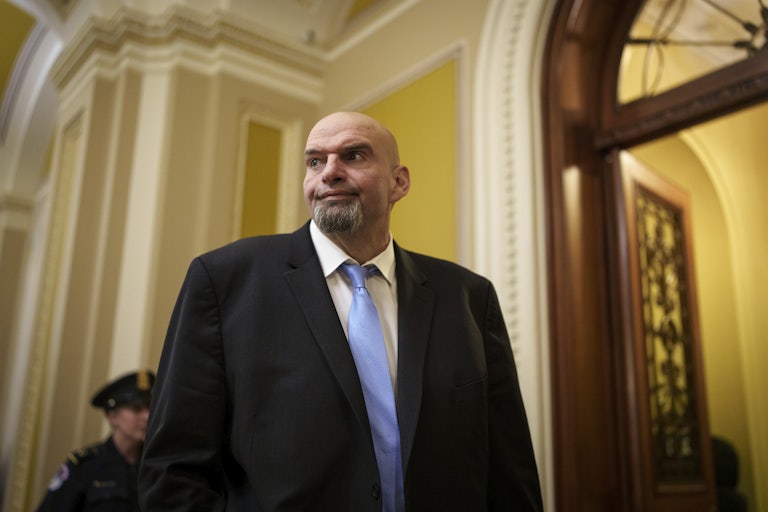
John Fetterman wears a suit in the Senate
Drew Angerer/Getty Images
John Fetterman in November 2022

Pennsylvania Senator John Fetterman, a formerly progressive Democrat who has decidedly shifted right in recent years, delivered a hard-line—and honestly bloodthirsty—stance in opposition to a ceasefire in Gaza during a meeting with pro-Israel group J Street’s president Jeremy Ben-Ami in February.

“Let’s get back to killing,” Fetterman said, referring to Israel’s mass slaughter of Palestinians. A person who heard the conversation told New York magazine that Fetterman, a staunch supporter of Israel’s military campaign, advocated to “kill them all.”

Fetterman denied this account and insisted that if he’d advocated for slaughter, he was speaking solely about members of Hamas. “I do support the destruction of that organization, down to its last member,” he said.

These statements and others are part of what current and former staffers believe is a trend of troubling, erratic behavior from Fetterman, detailed in the sweeping report that was published Friday.

The senator’s unsettling behavior and “I’m not progressive” flip has driven out multiple staffers, including three of his top spokespeople and his legislative director. Adam Jentleson, his former chief of staff, was so concerned by Fetterman’s erratic behavior that he stepped down from his position in April 2024.

Shortly afterward, Jentleson wrote a lengthy email to David Williamson, the medical director of the traumatic brain injury and neuropsychiatry unit at Walter Reed Medical Center, detailing the radical changes he’d seen in his boss, believing that he may be severely struggling with his mental health following a stroke in 2022.

Among other serious concerns, like doubts that his boss was taking his medications, obvious lying, and the purchase of a firearm, Jentleson said that Fetterman was demonstrating “conspiratorial thinking” and “megalomania.”

Fetterman “claims to be the most knowledgeable source on Israel and Gaza around but his sources are just what he reads in the news—he declines most briefings and never reads memos,” Jentleson wrote. During his meeting with Ben-Ami, Fetterman had claimed that he had never met an Arab person who would condemn Hamas, but the notes from the meeting stated that only a “single Arab he has met with that staff was present for wouldn’t outright condemn Hamas.”

Speaking about Palestinians, Fetterman said, “You can’t reform a carton of sour milk.”

After Israel set off on its genocidal campaign in Gaza, which has killed at least 52,000 people, following Hamas’s attack on October 7, Fetterman’s controversial social media posts alarmed staff members and constituents alike. Fetterman’s increasingly callous rhetoric about Palestine has manifested a sharp rift between him and the progressive staffers who saw him elected to the Senate in 2022.

Fetterman’s behavior is so concerning, it’s not clear if he’ll be able to continue in the Senate–let alone run for reelection in 2028, when his term ends.

Fetterman was also the first Democratic senator to meet with Trump at Mar-a-Lago in January, earning him praise from the far-right president. “I couldn’t be more impressed,” Trump said at the time.

It’s not clear how much of Fetterman’s turn to the right is related to his health issues, and Jentleson was more concerned for his former boss’s well-being than his political transformation.

“I believed in John’s ability to work through struggles that lots of Americans share,” he said. “He’s not locked into a downward trajectory; he could get back in treatment at any time, and for a long time I held out hope that he would. But it’s just been too long now, and things keep getting worse.

“Part of the tragedy here is that this is a man who could be leading Democrats out of the wilderness,” Jentleson said. “But I also think he’s struggling in a way that shouldn’t be hidden from the public.”

Email Mistake Exposes Trump’s Dark Agenda on Child Welfare Programs

The Department of Health and Human services is preparing cuts that will impact key programs like Head Start.

Donald Trump smiles with his mouth closed while standing before a mic.
Andrew Harnik/Getty Images

The Department of Health and Human Services plans to end research into how to improve child welfare programs like Head Start, according to an email mistakenly sent by an HHS employee to grant recipients. 

The email contained a spreadsheet listing 150 research projects on HHS’s chopping block, including grants funded by the Office of Planning, Research, and Evaluation. The office’s mission is to build “evidence to improve lives” by helping to examine programs helping low-income children and families. 

Other research grants under consideration for termination are related to childcare policy, child development, foster care, preventing child abuse, and the Temporary Assistance for Needy Families program. Over 50 universities were listed as having their grants terminated in the document, with state agencies and nonprofits also at risk of losing funding. 

The possible cancellation of these grants comes after HHS already made heavy cuts to its Administration for Children and Families, which is closing five regional offices and fired hundreds of employees last month. In January, the office had 2,400 employees, and now it’s down to just 1,500. 

Head Start, which provides preschool and other education services for low-income children, was one of the first programs to be hit by the Trump administration’s federal funding freeze in February, which later ran into legal trouble. The White House then weakened the program with mass layoffs, and earlier this month even suggested eliminating the program entirely.

Now, the news that research examining and supporting Head Start could be cut is an ominous sign. The Trump administration seems intent on cutting the program and everything connected to it, even though it has widespread support from the public. Already, Head Start offices have closed around the country.  What will fill the void for low-income families in America?

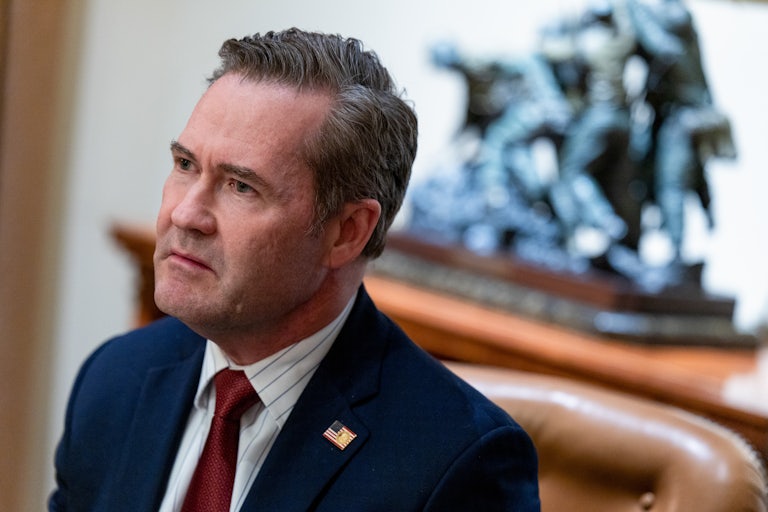
Mike Waltz Caught Using App Even Less Secure Than Signal

Trump’s recently ousted national security advisor just keeps making things worse for himself.

Mike Waltz in a Cabinet meeting.
Shawn Thew/EPA/Bloomberg/Getty Images

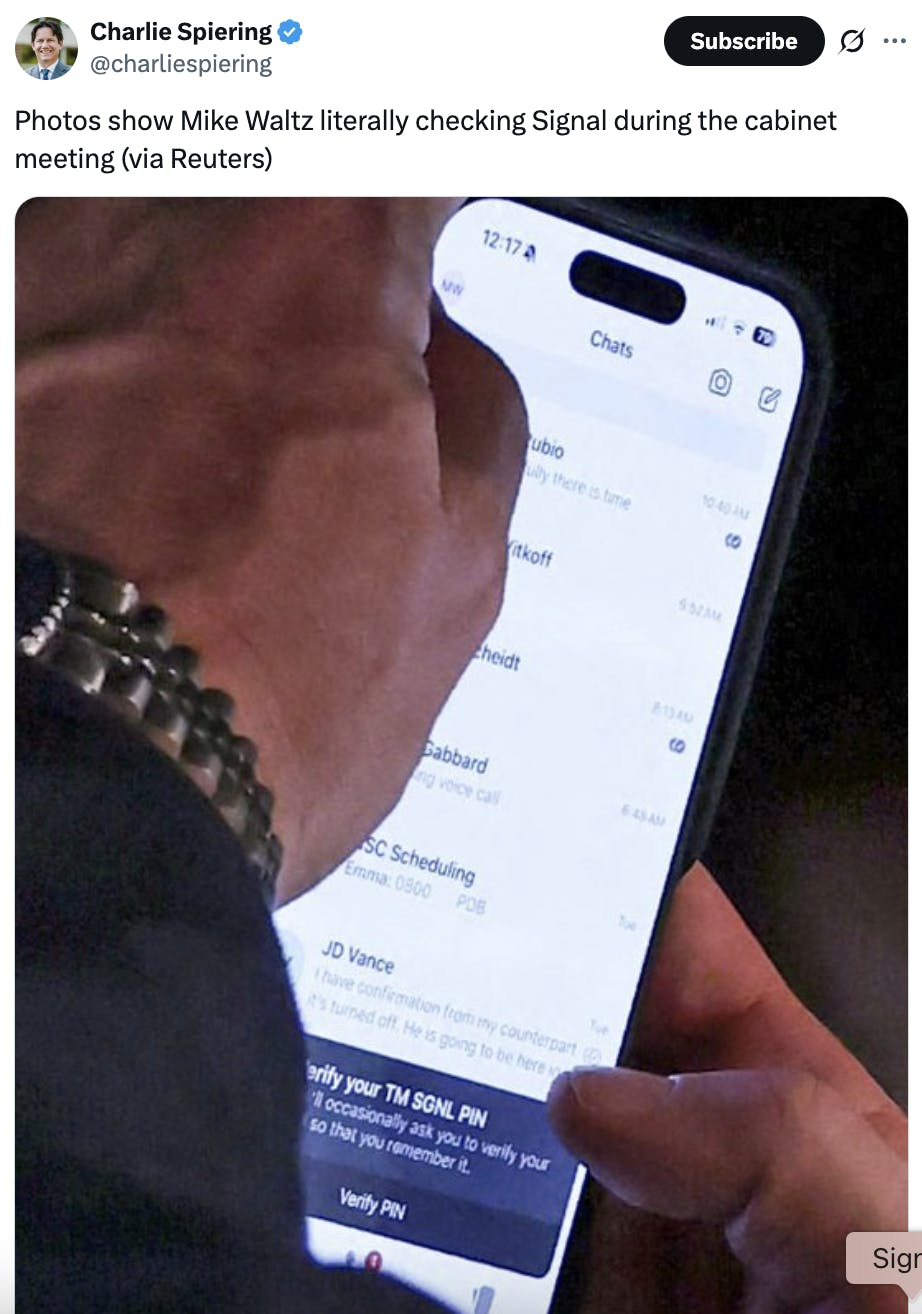
The version of Signal that recently ousted national security adviser Mike Waltz was caught checking during a Cabinet meeting Wednesday is an unofficial edition of the app meant to archive messages, according to 404 Media. The archiving capability suggests that the app may not use end-to-end encryption, making it less secure than the standard version of Signal.

X screenshot Charlie Spiering @charliespiering Photos show Mike Waltz literally checking Signal during the cabinet meeting (via Reuters) (photo of Mike Waltz using TM Signal)

In the images, published by Reuters on Thursday, there is a visible message at the bottom of Waltz’s screen asking him to verify his “TM SGNL PIN.” This is different from the standard version of Signal, where this notification just reads “Verify your Signal PIN.” Not only was Waltz using a private, insecure platform to discuss highly sensitive information, he was using the least secure version of that platform to do so. “TM SGNL” refers to a program from software company TeleMessage that captures and stores Signal messages for the user.

White House communications director Steven Cheung on Thursday said that “Signal is an approved app that is loaded onto our government phones.” It’s not clear if other Trump officials are using the far less secure TM SGNL as well.

The latest controversy comes as both Waltz and current Defense Secretary Pete Hegseth have made headlines for multiple Signal chats. On Thursday, Trump removed Waltz from his post as national security adviser and nominated him to be U.S. ambassador to the United Nations.

Could Medicaid Cuts Lead Republicans to Break With Trump?

$880 billion in proposed cuts are making some GOP members of Congress very nervous.

Rep. David Valdeo stares ahead as he walks in the Capitol
Bill Clark/CQ-Roll Call, Inc via Getty Images
Representative David Valadao, who has led GOP efforts to reduce Medicaid cuts

At least one Republican is thinking about the millions of Americans that depend on Medicaid.

Representative David Valadao, a California dairy farmer, represents more Medicaid recipients in his district than anyone else in his party. He also appears to be one of the few Republicans working overtime to keep the fallout of his party’s Medicaid slashing spree to a minimum.

Valadao has spent weeks coordinating group chats with other concerned conservatives and lobbying leadership over the proposed cuts. He also led a letter protest signed by a dozen vulnerable Republicans opposing the bill, all in hope of steering the party’s cart in a different direction from the steep cuts.

“He’s got a very good sense of what Americans need out of their health care. I appreciate his leadership,” New York Representative Nick LaLota, another vulnerable Republican, told Politico Friday. The two, according to LaLota, are in constant communication. “He’s been clear in his communications: We shouldn’t be throwing people off Medicaid who are designed to be on the program.”

Pennsylvania Representative Rob Bresnahan, who similarly has a lot of Medicaid recipients in his district, described Valadao as a “total pillar” of the internal Medicaid debate. “He’s someone I immediately gravitated to,” Bresnahan told Politico. “Just a great sounding board.”

Republicans have spent months attempting to pencil out a $880 billion cut to the program in order to extend Trump’s 2017 tax cuts for corporations and billionaires in an effort to make the tax cut’s estimated $6.8 trillion deficit hike more palatable to their base.

But Valadao, for his part, knows that his political future depends on keeping his constituents happy. The lawmaker was one of many House Republicans to lose his job in 2018 after he voted to repeal the Affordable Care Act—a failed effort that would have stripped health insurance from millions of Americans.

By 2020, Valadao was back in office with a better grip on the stakes of the job. But this time around, Valadao and his cohort are already facing aggressive counter campaigns, featuring provocative TV ads and town hills that oppose the Republican-led cuts.

“We’re going through this partisan exercise to do what is supposed to be a tax bill, and it’s becoming a health care bill, which is what we’re trying to avoid, on an issue that desperately needs reform to make it better,” Valadao told Politico.

One much-discussed solution to square the Medicaid cuts is to make the program more exclusive by way of adding returning work requirements, which House Speaker Mike Johnson said in April would encourage young men to “be at work instead of playing video games all day.”

Republican proposals to introduce a work requirement to Medicaid have thus far asked recipients to navigate work-reporting and verification systems on a monthly basis—a detail that would require significant federal funding. The plans would also negate coverage for individuals who find themselves temporarily unemployed, such as those who were recently fired or laid off.

A February report by the Center on Budget and Policy Priorities found that introducing work requirements to the insurance program could strip upwards of 36 million Americans of their health coverage—half of Medicaid’s 72 million enrollees.