Breaking News
Breaking News
from Washington and beyond

Trump Trashes Canada Just Minutes Before Prime Minister Visits

Donald Trump continues to insist that Canada needs the United States.

Donald Trump puts his hand on Canadian Prime Minister Mark Carney’s arm while they stand outside the White House
Alex Wong/Getty Images

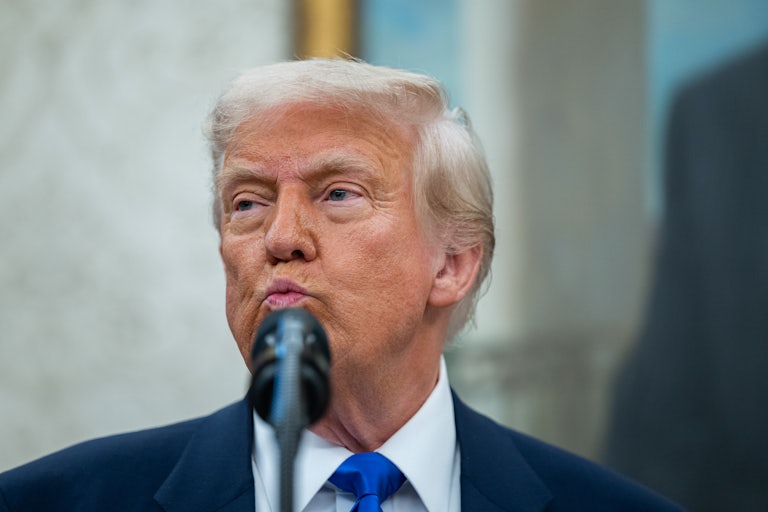
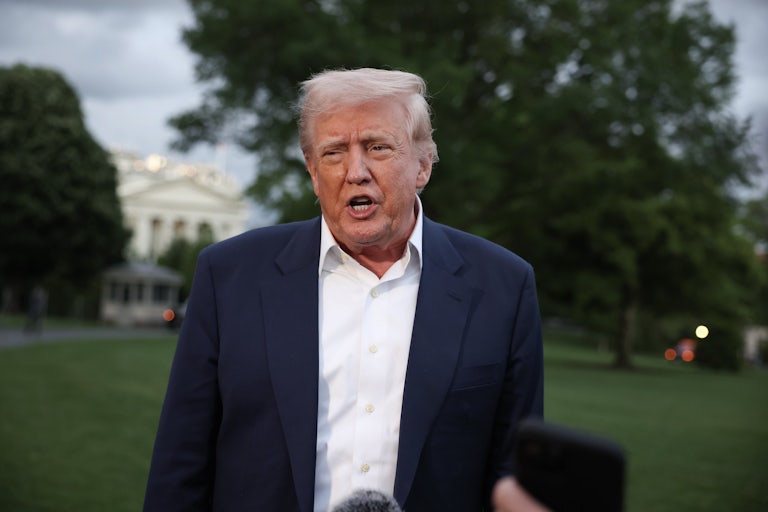
Donald Trump made a wild post Tuesday slamming Canada, just moments before Canadian Prime Minister Mark Carney arrived at the White House for a tense meeting to discuss tariffs.

“I look forward to meeting the new Prime Minister of Canada, Mark Carney. I very much want to work with him, but cannot understand one simple TRUTH—Why is America subsidizing Canada by $200 Billion Dollars [sic] a year, in addition to giving them FREE Military Protection, and many other things?” Trump wrote in a post at 11:23 a.m. on Truth Social.

“We don’t need their Cars, we don’t need their Energy, we don’t need their Lumber, we don’t need ANYTHING they have, other than their friendship, which hopefully we will always maintain. They, on the other hand, need EVERYTHING from us! The Prime Minister will be arriving shortly and that will be, most likely, my only question of consequence.”

Carney arrived at the White House at noon, according to NBC News.

Trump’s meeting with Carney will be their first in-person interaction since Trump announced he would impose 25 percent tariffs on U.S. exports to Canada. The U.S. president has facilitated a rapid breakdown in relations between the neighboring countries, continually criticizing Canada’s dependence on the U.S. and repeatedly joking that it should become the fifty-first state.

Carney responded to Trump’s aggression in April, proclaiming that Canada’s old relationship with the U.S. was “over” and that the country would begin seeking new trading partners.

After Carney’s Liberal Party won Canada’s national election late last month, he started out his new term by dissing Trump.

“As I have been warning for months, America wants our land, our resources, our water, our country. But these are not idle threats. President Trump is trying to break us so that America can own us,” Carney said. “That will never ever happen.”
Trump’s Law Firm Deals Aren’t Working Out How He Hoped

Law firms that caved to Donald Trump are revealing they have ways to wriggle out of the deals.

Donald Trump looks up while signing an executive order in the White House
Alex Wroblewski/AFP/Getty Images

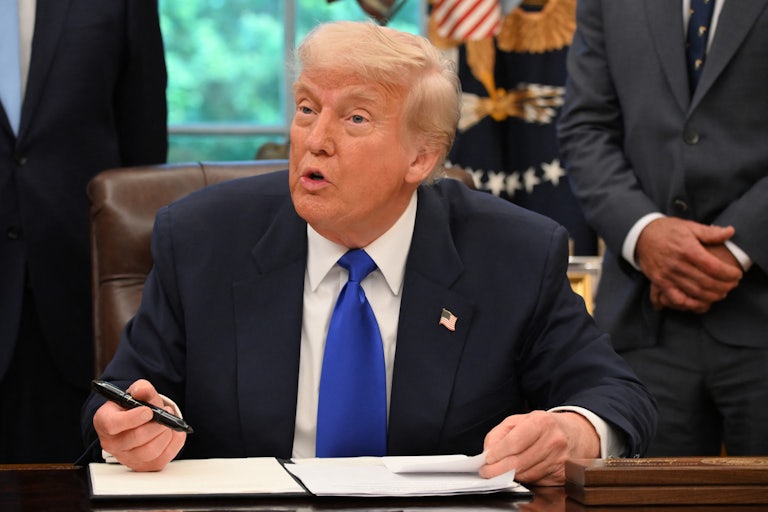
President Donald Trump may have thought he was getting a legal war chest by threatening several major law firms—but it seems the famed dealmaker didn’t know exactly what he was signing on to.

In a series of letters to Representative Jamie Raskin and Senator Richard Blumenthal obtained by The Bulwark, several major law firms that cut deals with the Trump administration provided details on the terms of their agreements—and it’s looking like the president may have gotten the short end of the stick.

While the firms had reportedly agreed to provide millions of dollars of pro bono work for specific causes, many asserted that they had total authority over the selection of their clients.

Allen Overy Shearman Sterling LLP wrote that its agreement to provide $125 million in pro bono work “does not call for, or permit, the administration or any other person or entity to determine what clients and matters the Firm takes on, whether they be pro bono matters or otherwise.” The firm said it had simply agreed to provide free legal services across “three specified areas,” including assisting veterans, ensuring fairness in the justice system, and combating antisemitism.

The Bulwark reported that other firms’ deals had similar stakes. Latham & Watkins wrote that it “maintains its complete independence as to the clients and matters the firm takes on,” while Simpson Thacher & Bartlett wrote that their agreement with the government did not “dictate or restrict what pro bono matters we will take on moving forward.” Cadwalader, Wickersham & Taft wrote that they “have not and will not restrict our pro bono activities or the positions we take on behalf of those clients.”

Nine law firms have signed deals with the president, promising nearly $1 billion in pro bono work.

Meanwhile, Trump has projected a far grander view of what he could call on firms to do for him. The president claimed that the major law firms who struck deals stood at the ready to help him make deals with foreign countries to alleviate the weight of his sweeping reciprocal tariffs. He also floated the idea of using his battalion of attorneys to help the coal industry. In the White House, discussions had begun about deploying lawyers at DOGE and the DOJ, The New York Times reported last month.

Other firms seem to be using a different legalese to prevent themselves from being strong-armed by Trump. Skadden, Arps, Slate, Meagher & Flom LLP executive partner Jeremy London said that the firm had agreed to provide $100 million in pro bono work that “the president and Skadden both support,” which could potentially provide an out should the firm be remanded to work on a specific cause.

Last month, Raskin and Blumenthal penned letters to five major law firms they accused of being “complicit in efforts to undermine the rule of law” and demanded information on the deals.

A group of Democratic lawmakers sent another series of letters to law firms last month, warning that the Trump administration’s scheme to use “coercive and illegal measures” to blackmail firms could potentially violate federal laws against bribery, defrauding the public, and even racketeering.

If the firms have truly maintained authority over selecting which clients they represent, and which matters they take up, then some of these concerns may be moot. However, the lawmakers raised the possibility that by signing a deal with Trump, the firms were opening themselves up to extortion, asking what each firm planned to do to “ensure that the administration will not be able to require more from the firm beyond the provisions currently in place?”

Read more about Trump’s attacks on law firms:

Trump Treasury Secretary Crashes When Asked Easy Question on Tariffs

Scott Bessent glitched as he tried to answer a question about the real costs of tariffs.

Treasury Secretary Scott Bessent testifies before Congress.
Tierney L. Cross/Bloomberg/Getty Images

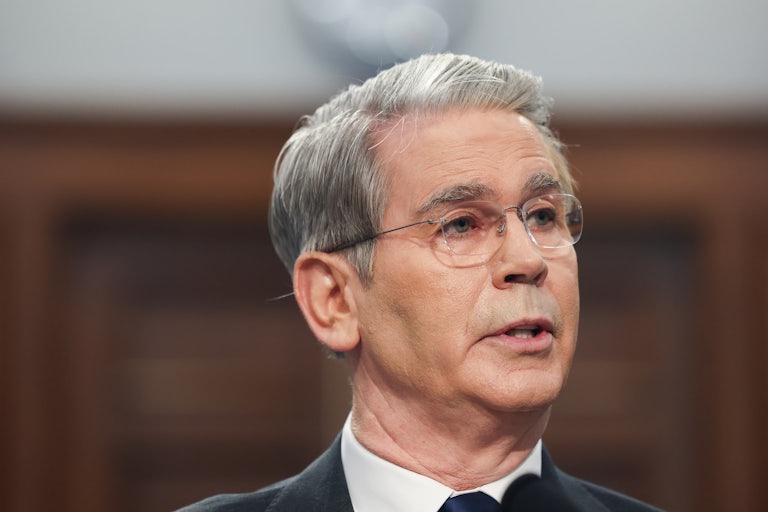
U.S. Treasury Secretary Scott Bessent stumbled and deflected when asked a simple, direct question about tariffs at a congressional hearing on Tuesday.

“Who pays tariffs, Mr. Secretary?” asked Representative Mark Pocan.

Bessent began to ramble on indirectly, frustrating Pocan. “Who pays tariffs? Mr. Secretary, please, the question is very simply, Who pays tariffs? Mr. Chairman, I’d like him to answer that question; he wants to answer other questions.”

Bessent replied shakily. “Well, Congressman, if the congressman, if the exporters, the … uh, dislike tariffs so much, why wouldn’t they? If, I think what you’re trying to get me to say—”

“Did you remember the question? I’m not sure you did,” Pocan said. “Who pays tariffs?”

“It’s a very complicated question.”

“Reclaiming my time. People pay tariffs, right?”

“No, no, no,” Bessent muttered, while Pocan reclaimed his time.

“You clearly aren’t gonna answer, I’m not gonna waste my time having you go ‘uh uh uh uh.’”

The Trump administration is doing everything in its power to gaslight Americans into thinking that the tariffs will be positive; that we’ll just have some short-term discomfort before everything is cheap and made in America again. That couldn’t be further from the truth.

Meanwhile, what Republicans are up to:

Trump’s Own Words Come Back to Bite Him in Brutal Ruling

Judge Beryl Howell used Donald Trump’s own words against him when striking down his suit.

Donald Trump purses his lips while standing in front of a microphone in the Oval Office
Annabelle Gordon/The Washington Post/Getty Images

Donald Trump’s braggadocio just upended one of his executive orders.

U.S. Judge Beryl Howell issued a permanent injunction against the president Friday night, ruling that his executive order targeting the law firm Perkins Coie was not only unconstitutional but amounted to an “unprecedented attack” on the pillars of the judicial system.

“No American President has ever before issued executive orders like the one at issue in this lawsuit targeting a prominent law firm with adverse actions to be executed by all Executive branch agencies but, in purpose and effect, this action draws from a playbook as old as Shakespeare, who penned the phrase: ‘The first thing we do, let’s kill all the lawyers,’” Howell wrote in a scathing 102-page opinion.

Trump signed an executive order against Perkins Coie in March, revoking the firm’s security clearances and their access to government buildings, and nixing government contracts with the firm, in part because they represented Hillary Clinton during her 2016 campaign.

But Howell dismantled the order, based on Trump’s own claims about forcing other law firms into submission. During an April 8 speech cited in Howell’s ruling, Trump peacocked that “lots of law firms have been signing up with Trump.”

“$100 million, another $100 million, for damages that they’ve done,” Trump said at the time. But they give you $100 million, and then they announce, ‘We have done nothing wrong.’ And I agree, they’ve done nothing wrong. But what the hell, they’ve given me a lot of money considering they’ve done nothing wrong.”

Also at fault was deputy White House chief of staff Stephen Miller, whose comments about another law firm—Susman Godfrey—included flaunting that the administration had effectively finagled upward of a billion dollars in “free legal work” thanks to the executive branch’s pressure campaign.

Trump’s and Miller’s comments effectively proved that the president had singled firms out for “retribution” based on whether they were willing to cut a deal with the White House.

Perkins Coie said in a statement that the decision “affirms core constitutional freedoms all Americans hold dear, including free speech, due process, and the right to select counsel without the fear of retribution.”

It is unclear if the Trump administration plans to appeal the ruling.

Trump’s Own Intel Agencies Destroy His Main Defense on Deportations

A newly declassified memo destroys Trump’s justification for using a wartime powers law to round up Venezuelan immigrants and deport them to El Salvador.

Donald Trump speaks to reporters outside the White House.
Tasos Katopodis/Getty Images

U.S. spy agencies do not believe that the Venezuelan government has authority over the Tren de Aragua gang—a development that directly contradicts Trump’s justification for his illegal, extrajudicial deportations of Venezuelans to a prison in El Salvador.

“While Venezuela’s permissive environment enables TDA to operate, the Maduro regime probably does not have a policy of cooperating with TDA and is not directing TDA movement to and operations in the United States,” a memo from the Office of the Director of National Intelligence read, according to The New York Times.

Trump has been claiming the exact opposite since he invoked the wartime Alien Enemies Act of 1798 in March to summarily round up Venezuelan immigrants and deport them without basic due process.

Trump first invoked the wartime powers act in March, asserting that “this is a time of war. Because Biden allowed millions of people, many of them criminals, many of them at the highest level.… Other nations emptied their jails into the United States, it’s an invasion. These are criminals, many many criminals … murderers, drug dealers at the highest level, drug lords. People from mental institutions. That’s an invasion.” He also said Tren de Aragua gang members were committing crimes in the United States “at the direction, clandestine or otherwise, of the Maduro regime in Venezuela.”

The memo directly delegitimizes his argument, further confirming that Trump is operating well outside the bounds of his executive powers.