Breaking News
Breaking News
from Washington and beyond

JD Vance Has Grim Warning for Russia on Ukraine Peace Talks

JD Vance indicated that peace talks in Ukraine are not going well.

Vice President JD Vance gestures while speaking into a microphone
Mandel Ngan/AFP/Getty Images

Vice President JD Vance said Wednesday that Russia was “asking for too much” in its negotiations to end the war in Ukraine.

During a Q&A at the Munich Leaders Meeting in Washington, Vance lobbed a rare criticism at Moscow over its lengthy list of demands required to end its invasion into Ukraine, when asked whether he thought Russia was serious about ending the conflict.

“I wouldn’t say—I’m not yet that pessimistic on this—I wouldn’t say that the Russians are uninterested in bringing this thing to a resolution. What I would say is right now the Russians are asking for a certain set of requirements, a certain set of concessions, in order to end the conflict,” Vance said. “We think they’re asking for too much.”

Russia’s list of demands have remained largely the same since its full-scale invasion first began in 2022. In April, Russian Foreign Minister Sergey Lavrov said that Russia requires full control of five Ukrainian regions: Donetsk, Luhansk, Zaporizhzhia, Kherson, and Crimea. Lavrov also insisted that Ukraine must be demilitarized, banned from entering NATO, and that Kyiv would need to introduce legislation to restore the state of Russian language, culture, and religious institutions.

The vice president claimed Wednesday that the next step for the U.S. was to facilitate a face-to-face meeting between the two warring governments. “It’s very important for the Russians and Ukrainians to start talking to one another,” Vance said.

This comes little over a week after Lavrov said that Russia wanted to lift a ban on Kyiv’s ability to directly negotiate with Moscow. Yaroslav Trofimov, the chief foreign affairs correspondent at The Wall Street Journal, said that Russia was essentially telling Trump to “get lost.”

Vance made it clear that in negotiations, the United States was still playing by Russia’s rules. After Russia refused to agree to a 30-day ceasefire, Vance said that the U.S. was abandoning those hopes as well. “We’ve tried to move beyond the obsession with the 30-day ceasefire,” he said.

During the Q&A, Vance waxed poetic about how important it was to truly understand each side, even if you didn’t agree with them, but he also took a moment to whine about all that pesky historical context he’d had to endure.

“They hate each other so much that if you have an hour conversation with either side, the first 30 minutes are just them complaining about some historical grievance from four years ago, or five years ago, or 10 years ago,” Vance said.

Speaking of history, one might flash back to Vance’s humiliating display in the Oval Office in February, when he lost his temper as Ukrainian President Volodymyr Zelenskiy explained Russia’s invasion of Crimea.

Is Trump Now Using ICE to Take Revenge on CBS?

ICE raids this week targeted a restaurant tied to CBS anchor Norah O’Donnell.

ICE agent
Christopher Dilts/Bloomberg/Getty Images

Immigration and Customs Enforcement on Tuesday raided a restaurant in Washington, D.C., owned by the husband of CBS News anchor Norah O’Donnell.

Early Tuesday morning, immigration officers dressed in Homeland Security uniforms busted into the American fare restaurant Chef Geoff’s and demanded to see employees’ work authorization, Fox5 reported. No one was taken into custody, marking yet another pointless, fearmongering raid from ICE.

O’Donnell is a senior correspondent for CBS News and a contributing correspondent for the network’s 60 Minutes, which Trump has targeted ever since the network did an interview with Kamala Harris before the 2024 election. It’s unclear whether ICE knew that O’Donnell’s husband, Geoff Tracy, is the owner of Chef Geoff’s.

ICE also raided at least seven other restaurants in Washington, D.C., on Tuesday, including Millie’s, Pupatella, and Chang Chang, to demand I-9 forms, The Washingtonian reported.

“We were under the impression that they were focusing on trying to find criminals,” Bo Blair, the owner of Millie’s, told The Washingtonian. “And this is just a whole new level of harassment to our hardworking, law-abiding employees.” The ICE agents informed staff at Millie’s that they will return on Monday to collect the remainder of the I-9 forms verifying employees’ identity and work authorization.

According to data from the Independent Restaurant Coalition, immigrants make up 22 percent of all U.S. workers in food services. Restaurant workers have long been bracing for ICE raids, and it looks like the GOP’s crackdown on yet another industry that relies heavily on immigrant labor is in full force.

Trump Has a New Target in His Weird Renaming Crusade

Donald Trump wants to rename something that’s not even near the U.S.

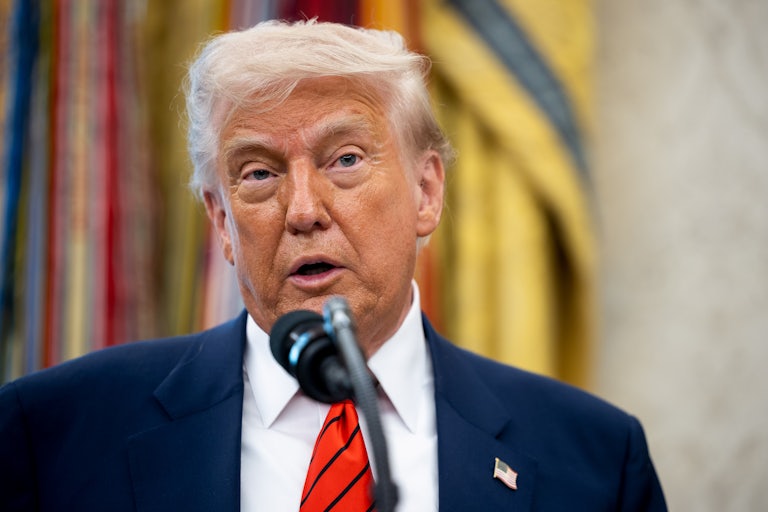
Donald Trump speaks into a microphone in the Oval Office
Francis Chung/Politico/Bloomberg/Getty Images

Donald Trump made the “Gulf of America” so great again that he’s considering implementing a similar rebrand for another body of water—this time, one thousands of miles away from U.S. territory.

The president is considering renaming the Persian Gulf the “Arabian Gulf,” mere days after his family announced billions of dollars in forthcoming real estate deals in the region.

Those plans include a Trump-branded golf course in Qatar (as part of a $5.5 billion development project), a $1 billion Trump hotel and residence in Dubai, and a $2 billion investment by an Abu Dhabi firm into one of Trump’s cryptocurrency projects, the World Liberty Financial Coin.

The family also revealed in December that they would be expanding their presence in Saudi Arabia, announcing Trump Tower Jeddah. The price tag for the building has not been made public, but one of the developers on the project, Dar Global, compared it to another $530 million Trump Tower in the city, reported Reuters.

The Trumps have held deep financial ties to the region for years. After Trump’s first term, Saudi Arabia invested $2 billion in a firm belonging to Jared Kushner, Trump’s son-in-law.

Trump is expected to travel to Saudi Arabia next week, where it’s anticipated that he’ll make the announcement publicly, according to two officials who spoke with the Associated Press.

As a reminder, it’s actually unconstitutional for presidents to profit from or receive compensation from foreign governments. The White House has contested that the deals are not a conflict of interest since the president’s assets are managed by his eldest sons, Eric and Donald Trump Jr. But Trump’s pockets will undoubtedly be lined by the deal—even if he has to wait a handful of years before he’s out of office to see the cashflow. In the meantime, he’ll receive myriad personal benefits from his relationships in the Middle East for arranging the deal.

Seven other nations surround the body of water, including Iran, Iraq, Qatar, Bahrain, Kuwait, Oman, and the United Arab Emirates.

The Persian Gulf has been the body’s predominant name since the sixteenth century, but its moniker has also been regionally contested by other countries in the Middle East, where it is mainly referred to as the “Gulf of Arabia” or “Arabian Gulf,” according to The Daily Beast.

Referring to the inlet as the Arabian Gulf hasn’t served Trump’s diplomatic relations well in the past. During one such instance in 2017, former Iranian President Hassan Rouhani told the U.S. leader that he needed to “study geography.”

“Everyone knew Trump’s friendship was for sale to the highest bidder. We now know that his geography is, too,” Iranian Foreign Minister Mohammad Javad Zarif wrote online at the time.

Biden Has Tone-Deaf Answer on Whether He Should Have Withdrawn Sooner

Joe Biden’s first interview since leaving the White House was completely embarrassing.

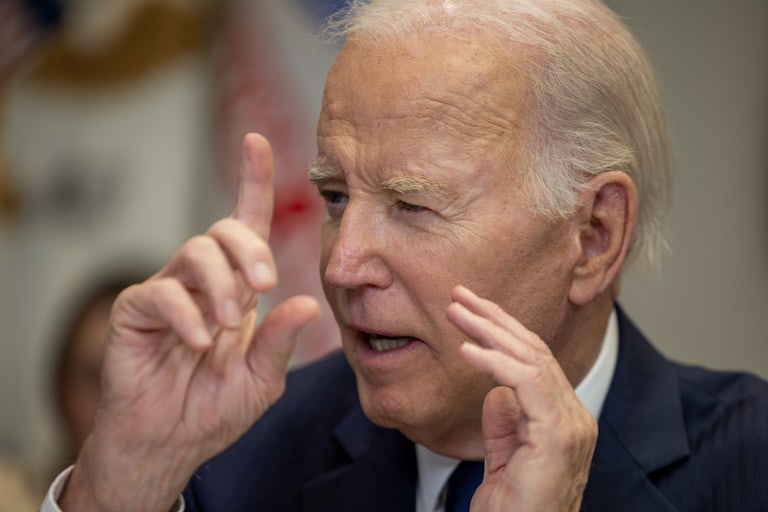
Joe Biden speaking and making hand gestures near his head.
Tasos Katopodis/Getty Images

Former President Joe Biden doesn’t think the election would have been any different if he’d dropped out sooner.

“I don’t think it would have mattered. We left at a time when we had a good candidate,” Biden told the BBC, in his first interview since leaving the White House. “Things moved so quickly that it made it difficult to walk away. And it was a hard decision.… I think it was the right decision. I think that … it was just a difficult decision.”

Biden dropped out a mere four months before Election Day, in the midst of mounting fears regarding his mental acuity. The White House insisted over and over again that he was as sharp as ever. Senator Chuck Schumer called the fears “right-wing propaganda,” former Federal Reserve Chair Janet Yellen said he was “at the top of his game,” and Senator Bernie Sanders said that Biden “seemed fine” to him. But the truth came out at the first televised debate between Trump and Biden, in which Biden delivered perhaps the worst performance of all time—a bumbling, sad, and incoherent showing that made it clear that he was not mentally prepared to run again.

It’s easy to play the “what if” game in hindsight. But it’s painfully obvious that Biden dropping out sooner would have allowed the Democratic Party to have an actual primary, in which a diverse field of candidates would have been able to sharpen their positions and differentiate themselves from one another. Instead there was no primary, no differentiation between Harris and Biden, and a brutal loss to show for it.

Trump Treasury Sec. Says Kids Need to Suck it up for Greater Good

Scott Bessent defended Donald Trump’s doll comments, saying it would be for the greater good.

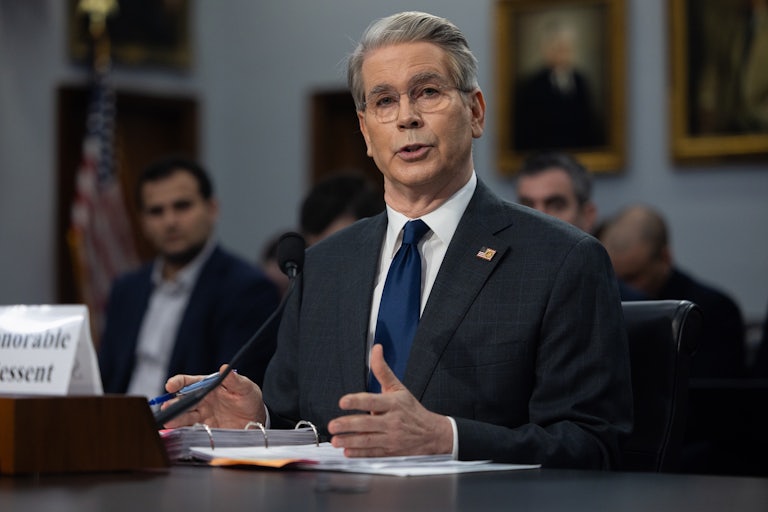
Treasury Secretary Scott Bessent speaks in a congressional hearing
Nathan Posner/Anadolu/Getty Images

Treasury Secretary Scott Bessent has a message for a hypothetical little girl worried that she won’t have more than two dolls because of Donald Trump’s disastrous tariff policy.

“I would tell that young girl that you will have a better life than your parents,” Bessent said, during an appearance on Fox News Tuesday night. “That you and your family, thanks to President Trump, can now be confident again that you will have a better life than your parents, which, working-class Americans had abandoned that idea.”

“Your family will own a home, you will be able to advance. You will have a good education, you will have economic freedom,” Bessent continued.

“Confident” is an interesting choice of words for Bessent, after consumer confidence sank a whopping 7.9 points in April, to its lowest level since May 2020.

The beleaguered Bessent has been desperate to rebrand Trump’s isolationist America First economic policy as a Buddhist-like maxim on desire as the root of all suffering. In March, Bessent claimed that “access to cheap goods is not the essence of the American dream.” In fact, being able to afford to live is a huge part of the American dream, and abundant consumer conveniences have become baked into our national identity.

But Bessent and Trump are insistent that they’re playing the long game—a little pinch in the present to make way for an expansive future they haven’t deigned to actually progress toward yet.

Small consumer grievances may illustrate the present-day realities of Trump’s tariffs, but they should not be used by the administration to obscure the larger picture. If we’re really going to play with hypotheticals, then we should imagine how a little girl’s “economic freedom” might be hurt by the collapse of her family’s soybean farm. Maybe then she can get a job in one of Commerce Secretary Howard Lutnick’s factories, and then her children can work there, and her children’s children. By then, maybe they’ll have dolls to play with.