Breaking News
Breaking News
from Washington and beyond

Cognitive Decline? Try to Decipher Trump’s Rant on Taxing the Rich

Donald Trump rambled on about raising taxes (or not?) on the wealthy.

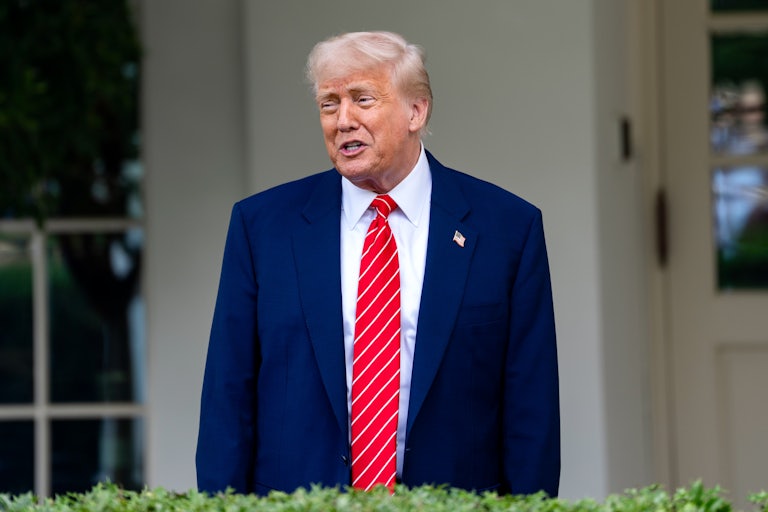
Donald Trump puckers his lips while speaking into a microphone
Stefani Reynolds/Bloomberg/Getty Images

The messages Donald Trump is sending about a proposal to increase taxes on the wealthiest Americans aren’t just mixed; they’re actually inscrutable.

In a post on Truth Social Friday, the president appeared torn about whether he planned to actually follow through on his proposal to hike taxes on the superrich.

“The problem with even a ‘TINY’ tax increase for the RICH, which I and all others would graciously accept in order to help the lower and middle income workers, is that the Radical Left Democrat Lunatics would go around screaming, ‘Read my lips,’ the fabled Quote by George Bush the Elder that is said to have cost him the Election. NO, Ross Perot cost him the Election! In any event, Republicans should probably not do it, but I’m OK if they do!!!” Trump wrote.

Trump was referring to President George H.W. Bush’s famous campaign promise, “Read my lips: no new taxes.” Ultimately, Bush left income tax alone but raised other levies on oil and chemicals, increased fees on international travel, and moved up the collection dates for certain taxes. Trump seemed unwilling to break his campaign promises to lower taxes for Americans.

But it was Trump who reportedly pitched House Speaker Mike Johnson Wednesday on creating a new 39.6 percent tax bracket for individuals earning at least $2.5 million, or couples making $5 million, people familiar with the discussions told Bloomberg. Trump has been adamant that his sweeping reciprocal tariffs will replace the federal funding lost by eliminating the income tax.

Commerce Secretary Howard Lutnick told Bloomberg Television’s Balance of Power
Thursday that higher taxes for the rich could help offset other tax cuts.

During his first term, Trump slashed rates “from 39.6 to 37. So, if he just goes back to what he did last time, I’m in favor of that,” Lutnick said. “I think it’s smart, as long as it is a redistribution to his priorities of no tax on tips, no tax on overtime, and no tax on Social Security.”
Manufacturers Say Trump Has Made Opening U.S. Factories Impossible

Donald Trump’s tariff chaos is to blame.

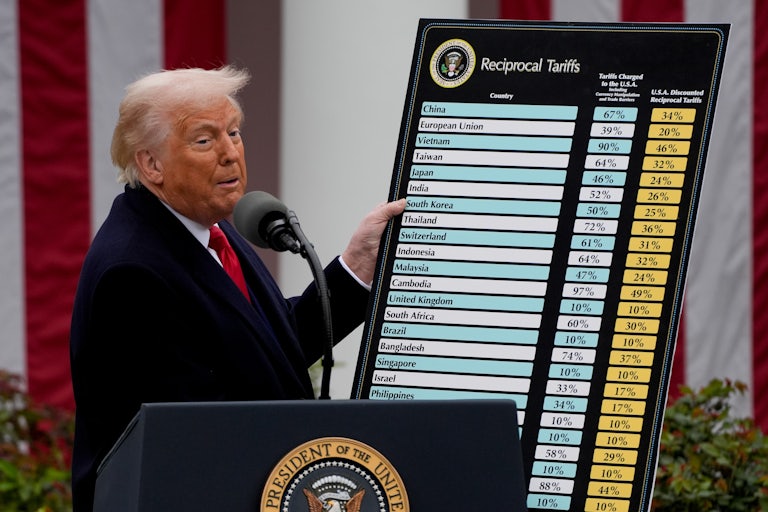
Donald Trump holds up a poster of his tariffs during a press conference in the White House Rose Garden
Kent Nishimura/Bloomberg/Getty Images

The Trump administration’s tariff scheme appears less and less likely to bring manufacturing jobs back to U.S. shores.

Businesses across the country are crunching the numbers and realizing that, despite Donald Trump’s insistence, they can’t balance out his tariff hikes across the supply chain.

“Some manufacturers who had plans to open factories in the country say the new duties are only adding to the significant obstacles they already faced,” Bloomberg reported Friday.

That’s because the supply chain to produce those goods in the United States simply isn’t there, requiring companies to import raw materials and factory equipment—which Trump’s tariffs have made unaffordable—from abroad.

And Trump’s unpredictable approach to announcing and enacting or even retracting his tariffs has added confusion and significant volatility to the market, making businesses less likely to invest in large, long-term projects such as factory development.

Nora Orozco, the owner of footwear company Evolutions Brands, wants to open a Texas factory that would create 200 jobs. But the nitty-gritty of Trump’s so-called “manufacturing renaissance” just doesn’t work, according to the small-business owner.

“I like the idea of onshoring, but this makes it impossible for us,” Orozco told Bloomberg.

Reinvigorating American manufacturing has been a tall order for both political parties since the country offshored and automated the bulk of those jobs decades ago. But 2022 did see a spike in job announcements for reshored manufacturing gigs, according to the Reshoring Initiative, a U.S. manufacturing advocacy nonprofit.

That was thanks to President Joe Biden’s Inflation Reduction Act, which passed with zero Republican support at the time, and his CHIPS and Science Act. Biden’s landmark legislative victory is currently on the chopping block as conservative lawmakers look to make room in the federal budget for an extension to Trump’s tax plan.

Trump Decides to Punish Rural America With Slower Internet

Trump has killed Biden’s Digital Equity Act, calling it “racist” and “unconstitutional.”

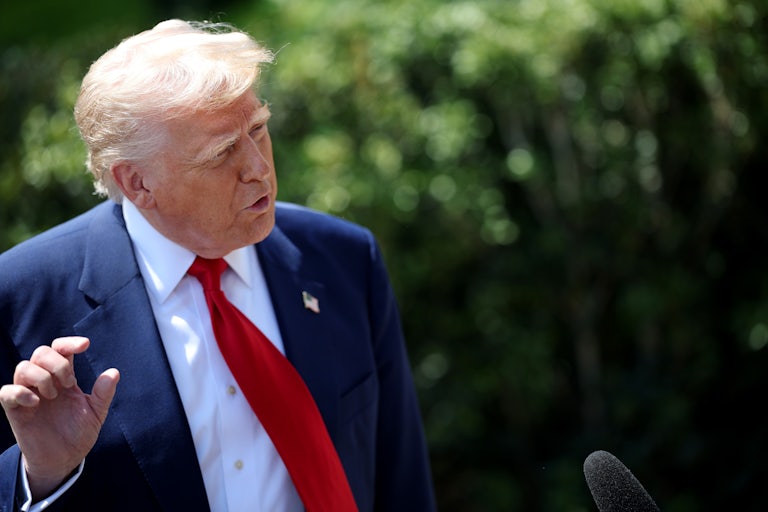
Donald Trump speaks to a reporter (not pictured) and makes a hand gesture as if it to say something is small.
Win McNamee/Getty Images

Trump thinks providing poor and rural Americans with high-speed internet is “racist” and “woke.” 

The president has decided to end the Digital Equity Act, Biden-era legislation that aims to expand high-speed internet across the country. 

“I have spoken with my wonderful Secretary of Commerce, Howard Lutnick, and we agree that the Biden/Harris so-called ‘Digital Equity Act’ is totally UNCONSTITUTIONAL,” Trump wrote on Truth Social Thursday. “No more woke handouts based on race! The Digital Equity Program is a RACIST and ILLEGAL $2.5 BILLION DOLLAR giveaway. I am ending this IMMEDIATELY, and saving Taxpayers BILLIONS OF DOLLARS!”

The Act does not explicitly mention race. All it says is that people can’t be blocked from using the Act “on the basis of actual or perceived race, color, religion, national origin, sex, gender identity, sexual orientation, age, or disability.”  This language is straight from the Civil Rights Act of 1964. 

The law provided many red states with grants to create and implement plans to make internet access more accessible. These plans have already been approved in conservative states like Indiana, Alabama, Arkansas, Iowa, and Kansas.

Internet access is a massive barrier to education, opportunity, and upward mobility. This legislation attempted to remedy that for people everywhere, especially in regions that went heavily for Trump. How is that a racist, woke handout?

ICE Sparks Chaotic Fight After Trying to Arrest Mom Holding Her Baby

Residents of the town surrounded ICE agents in an attempt to stop them from arresting the woman.

Four ICE agents (three white men, one Black man) all wear full protective gear and face masks.
TIMOTHY A. CLARY/AFP/Getty Images

Immigration and Customs Enforcement officers faced a crowd of opposition while attempting to arrest a mother clinging to her baby on the streets of Worcester, Massachusetts, Thursday morning.

The brazen arrest, in which ICE agents were swarmed by close to 25 onlookers demanding a warrant and identification, was captured on video. Agents attempted to control the crowd as they formed a “human ring” around the ICE vehicle holding the detained woman. Local police were called to the scene amid the chaos.

“The crowd was unruly,” police said in a statement. They claimed that some individuals “put their hands on federal agents and Worcester officers.”

The woman’s daughter, a 16-year-old, was left holding her baby sister and stood in front of the agents’ car at one point, trying to block it. She allegedly kicked the car after handing the baby to someone else, and now faces four criminal charges, including reckless endangerment of a child, disturbing the peace, disorderly conduct, and resisting arrest.

Also arrested was a Worcester School Committee candidate, Ashley Spring, who allegedly threw an unknown liquid substance on police officers and pushed them while they tried to arrest the 16-year-old.

Worcester City Councilor Etel Haxhiaj was among the residents who protested the arrest.

“As an elected official, it is my obligation to stand up for my constituents,” Haxhiaj said in a statement. “The way immigrants in Worcester and across the Commonwealth are being targeted and terrorized by this federal administration for deportation is absolutely unconstitutional.”

It’s only the latest brazen action from immigration agents attempting a deportation arrest. The Trump administration’s immigration officers have tried to detain other immigrants in the street without warning, identification, or the production of a warrant. Last month, in another Massachusetts arrest, ICE agents smashed a car window to detain an immigrant with no criminal record.

Trump’s Supposed U.K. Trade Deal Gets Trashed by Surprising Person

Even the far-right knows Donald Trump’s deal is garbage.

Donald Trump speaks while standing outside the White House
Bonnie Cash/UPI/Bloomberg/Getty Images

Not even people on Donald Trump’s side think that his trade negotiations with the United Kingdom have gone well.

Conservative radio show host and far-right influencer Erick Erickson blasted the Trump administration’s deal with one its longest and strongest international allies Thursday, likening the minimum rate tariff to permanent taxes on the American people.

“It’s actually a pretty shitty deal with the UK,” wrote Erickson on X. “First, they told us the 10 [percent] tariff was just a baseline for negotiations to get to free trade deals. Now we’re being told the 10 [percent] tariff is for keeps.

“That’s just a tax on the American people,” he noted.

The U.K. deal—announced Thursday—was the first handshake that Trump had secured since announcing his sweeping tariff plans last month. But even the two countries’ “special relationship” (per deceased British Prime Minister Winston Churchill) could not spare the U.K. from a seemingly permanent 10 percent baseline tariff.

“Under the deal, the U.K. can export 100,000 vehicles each year at a 10 percent rate, with any additional vehicles facing 25 percent duties. British steelmakers and the aluminum industry will be able to export tariff-free, down from the 25 percent rate that the U.S. imposed in February,” reported NBC News.

The 10 percent hike is just the tip of the iceberg, according to Trump, who called it a “low number” for future deals.

“They made a good deal,” he continued. “Some will be much higher because they have massive trade surpluses.”

Trump has argued that tariffs are the best solution to closing the country’s trade deficits, which he has incorrectly likened to taxpayer-backed “subsidies” for other nations. He has claimed that without tariffs, the U.S. is transferring wealth to other countries while receiving nothing in exchange. He has also pitched that hiking tariffs on other nations would bring jobs and manufacturing opportunities back to American shores, but economists don’t agree with either point.

Instead, droves of financial and economic experts have insisted that tariffs on other nations will only serve to harm America and its markets, making products more expensive stateside and making American consumers less likely to spend their money (something that Trump doesn’t seem to have any problem with, actually). The Harvard Kennedy Business School even floated in April that America’s trade deficit basically doesn’t matter, writing that “Americans earn more from, or earn just about as much from, their total investments abroad as foreigners earn in the United States.”

“So if you look historically, we have felt no additional pressure about sustainability of our position,” the school wrote in an early stage tariff explainer. “As long as we borrow the money and use it productively to increase investment in the United States, it is eminently sustainable, as with any investment.”

The president’s tariff shenanigans have not boded well for his popularity. The Cook Political Report observed Wednesday that Trump’s net job approval rating had plummeted since just April 15, dropping by seven points from -3.9 percent to -10.7 percent.

An ABC News/Washington Post/Ipsos poll published last month found that Trump’s approval rating had sunk to 39 percent—a 6 percent drop from February—marking the lowest first-100-day rating of a president since modern polling began roughly 80 years ago.

And an April report by the Conference Board found that its consumer confidence index had fallen by 7.9 points, bringing overall U.S. consumer confidence to 86 points. Consumer futures were brought to a 13-year low, with outlooks on the economy dropping by 12.5 points to 54.5 points—well below the threshold of 80 that “usually signals a recession ahead,” according to the Conference Board.

The root cause of the instability was “high financial market volatility in April” that hit American consumers’ stock portfolios and retirement savings hard and fast, per the Conference Board’s report. That was almost singularly due to Trump’s machinations in the White House, which included releasing (and stalling) a sweeping and vindictive tariff proposal plan that economists observed (and the White House eventually confirmed) was founded on bad math.