Breaking News
Breaking News
from Washington and beyond

Trump Scares Global Leaders With How Fast He Caved to Putin on Call

Donald Trump continues to give Vladimir Putin everything he wants.

Donald Trump waves while standing outside the U.S. Capitol
Ting Shen/Bloomberg/Getty Images

Several world leaders were shocked by how submissive Donald Trump was to Moscow’s demands following a two-hour phone call with Russian President Vladimir Putin.

Shortly after hanging up Monday with his favorite autocrat, Trump hopped on the line with Ukrainian President Volodymyr Zelenskiy, European Commission President Ursula von der Leyen, French President Emmanuel Macron, and a few other world leaders to update them on negotiations.

Sources told Axios that some of the leaders seemed “surprised” and “shocked” when Trump reported that Putin had agreed to begin negotiations toward a ceasefire—something that the Russian president had previously done, as talks had already taken place in Istanbul last week.

When Zelenskiy pointed this out, Trump did not respond.

Additionally, Trump reportedly pushed back on commitments to impose penalties on Moscow, after previously discussing levying sanctions on Russia with British Prime Minister Keir Starmer if Russia refused calls for a ceasefire. While Trump declined to ramp up pressure on Putin, Starmer followed through, imposing 100 new sanctions on Russia Tuesday.

It seems that, if anything, Putin was able to come out of the conversation with new economic prospects, rather than penalties, as Trump touted the “largescale trade” Russia could conduct with the U.S. once the “bloodbath” was over.

The leaders were surprised that Trump was presenting his discussion with Putin as a new development, when clearly nothing had been achieved during the discussion, sources said.

Putin seems to have once again succeeded at efforts to prolong peace talks with his latest nothingburger conversation with the U.S. president. After the call, Putin said that his government was prepared to work with Ukrainian officials on a “memorandum regarding a potential future peace treaty,” which means it will present a deal to Ukraine for its approval.

During the group call, Zelenskiy warned Trump that Russia wouldn’t budge on its unacceptable requests, such as obtaining Ukrainian territory, unless the U.S. president started to apply some pressure. One source on the call said that Trump claimed to have told Putin to pitch something that “people can agree to” and not something that will immediately be rejected.

Trump also seemed to want out of negotiations altogether, pitching direct negotiations between Russia and Ukraine. Last week, Russian officials seemed far from ready to make nice, after Putin bailed on talks with Zelenskiy in Istanbul, as did Russian Foreign Minister Sergey Lavrov, who called the jilted wartime president “pathetic.”
Cognitive Decline? Trump Goes on Nonsensical Rant About Food Benefits

Try to make any sense of what Donald Trump is saying here about Republicans’ planned cuts to food assistance.

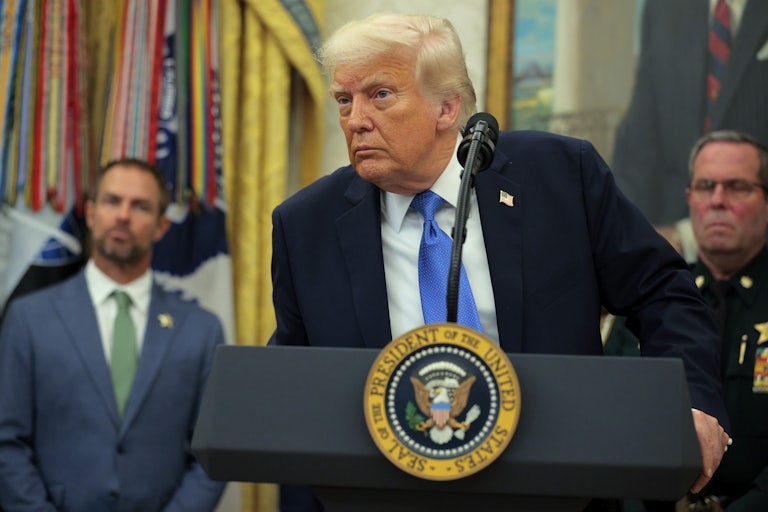
Donald Trump leans forward while standing at the presidential podium in the White House.
Chip Somodevilla/Getty Images

Donald Trump seems to think that cuts to food assistance mean cheaper and more abundant food for everyone.

“You campaigned on lowering the price of groceries. How can you justify cutting food assistance in this [budget] bill?” a reporter asked the president, on Capitol Hill Monday, after he emerged from a meeting with House Republicans.

The president’s response didn’t make any sense.

“Let me just tell you, the cut is going to give everybody much more food because prices are coming way down. Groceries are down,” Trump said. He added, “You know that eggs now? Way down. Everybody’s buying eggs. Grocery’s down. Energy’s down. Gasoline? They’re now buying—they’re buying gasoline now for $1.99.”

First of all, gasoline is not selling for that price anywhere in the United States, except possibly in wholesale markets. And cuts to the Supplemental Nutritional Assistance Program, commonly referred to as food stamps, would not lower food prices. As the head of a Nevada food bank told NBC last month, “These reductions don’t just affect people facing hunger—they also hurt the retailers, farmers, and businesses that supply fresh, local food to our region.”

The president’s answer seems to miss the point of the question, which was calling into question Trump’s campaign promise of lowering food prices, in contrast to Republican plans to cut food aid and shift the cost to the states. The Republican budget would threaten benefits for close to 42 million low-income Americans and would have little effect on overall food supply or prices, which the president would know if he understood basic economics.

But Trump’s mismanagement of the economy, as seen in his nonsensical, flip-flopping tariff policies, demonstrate that he doesn’t know what he’s doing. His decisions are already causing food prices to go up, and retailers like Walmart are complaining. Trump and his allies are responding to their concerns with threats and no recognition that they’re responsible for the problems.

Marco Rubio Suddenly Has Amnesia on Key Detail About Trump’s Qatar Jet

Secretary of State Marco Rubio apparently has frighteningly little knowledge about the supposed gift.

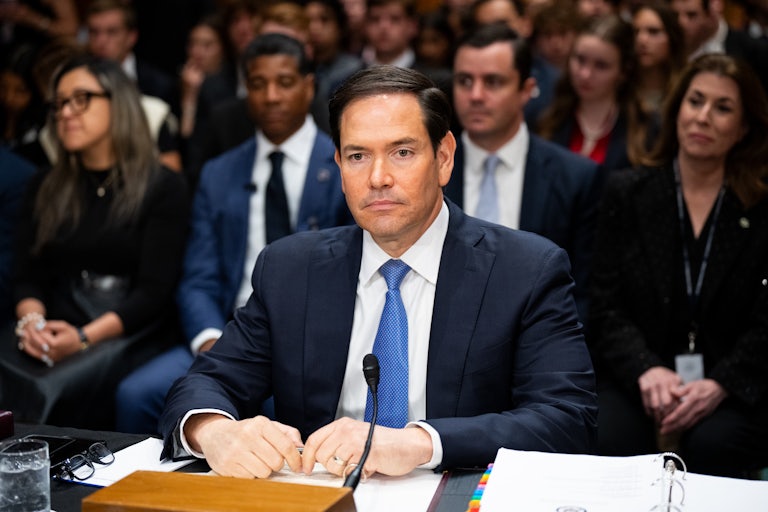
Secretary of State Marco Rubio sits at a table during a Senate hearing
Bill Clark/CQ-Roll Call, Inc/Getty Images

Either State Secretary Marco Rubio is playing dumb about Donald Trump’s new private jet from Qatar, or he’s actually dumb.

While testifying before Congress Tuesday, Rubio claimed that he had no knowledge of reports that ownership of the plane would eventually swap to Trump’s presidential library.

“It’s not your understanding that the plane ultimately will belong to Trump or to the president’s library?” pressed Connecticut Senator Chris Murphy.

“I’m not involved at that level, I’ve never heard that before,” the state secretary—whose job it is to manage and carry out U.S. foreign policy—said. “What I’ve heard is that plane will replace Air Force One, which is an Air Force plane.”

Murphy then made mention of Trump’s plans to meet this week with a couple hundred of the top investors in his cryptocurrency. Earlier this month, 19 of the top 25 holders registered on the meme coin site used foreign exchanges that exclude U.S.-based customers, reported Bloomberg, meaning that foreigners are effectively buying face-to-face time with the president.

“I don’t know anything about it, or didn’t even know there was a dinner Thursday night,” Rubio said.

“So you don’t know if any of the foreign individuals meeting with the president Thursday night, for instance, are on our list of sanctioned individuals or have connections to, let’s say, terrorist organizations abroad?” Murphy asked.

Rubio then deferred oversight of that responsibility to the Department of Homeland Security, repeating that he wasn’t aware of the dinner.

“You’re asking about a dinner that I don’t know anything about. I can’t answer you because I don’t know anything about this dinner. It’s the first I’ve heard of it,” Rubio said, claiming he doesn’t know the president’s “social schedule.”

Murphy then underscored the danger of major foreign interests potentially circumnavigating the State Department for unfettered access to Trump.

“It’s kind of naïve to believe that they aren’t going to be in that room talking about national security matters,” Murphy said. “I think that right there is a real problem for this committee, because there’s clearly a way around the State Department for foreign individuals of significant influence and wealth to be able to directly lobby the president of the United States. You are saying you don’t know this is happening; that in and of itself is a problem.”

Qatari leadership gifted Trump a super luxury jumbo jet earlier this month in an act that was widely interpreted as a foreign bribe, including by longtime supporters of the president’s agenda, such as far-right influencers Ben Shapiro and Laura Loomer. It was one of the most lavish gifts ever bestowed on a U.S. president.

Claiming that the plane is going toward the Defense Department is a convenient workaround that would allow Trump to ethically accept the pricy present, since it is obviously illegal for a president (or any U.S. public officeholder) to accept gifts “of any kind whatever, from any King, Prince, or foreign State,” per the Constitution’s foreign emoluments clause.

Trump has claimed the jet is a “gift” to the Defense Department and thus the country—except that the plane is not actually being donated to the American people. Instead, Trump is opting to use the luxurious aircraft as his new Air Force One until “shortly before he leaves office,” at which point he will transfer ownership of the plane to his presidential library foundation, sources with knowledge of the arrangement told ABC News.

Richard Briffault, a Columbia Law School professor, told NPR News Trump’s decision to accept the jumbo jet is a “pretty textbook case” of violating the emoluments clause, clarifying that if Trump hands the jet over to his library after leaving office, then it’s “not really a gift to the United States at all.”

Elon Musk Says He’s Stopping Political Spending for Funniest Reason

Elon Musk appears to still be butthurt about becoming a political loser.

Elon Musk wears a cheesehead and raises his arms above his head while on stage in Wisconsin
Robin Legrand/AFP/Getty Images

Elon Musk claimed Tuesday that he plans to back off from buying American elections, following his failed attempt to purchase a Wisconsin Supreme Court seat earlier this year.

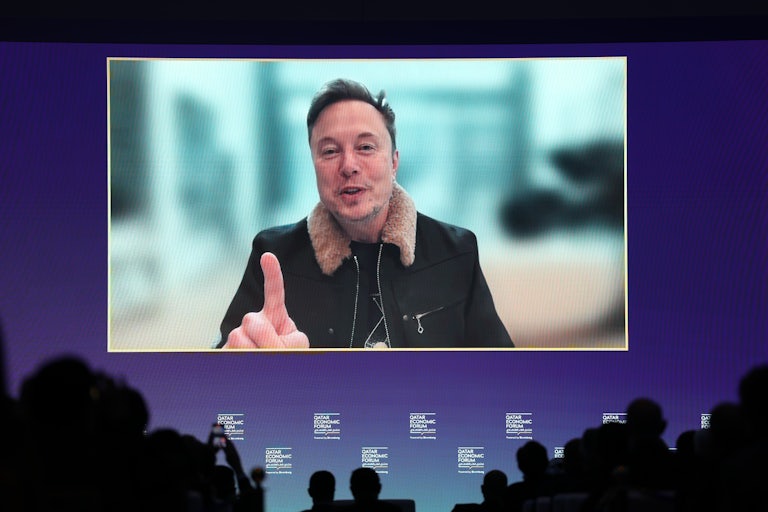
While speaking remotely at the Qatar Economic Forum, Musk was asked whether he intended to go on another shopping spree during America’s upcoming midterm elections. The billionaire bureaucrat had dropped a whopping $228 million on Donald Trump’s campaign.

“Are you going to continue to spend at that kind of level on future elections?” asked Bloomberg’s Mishal Husain.

“I think, in terms of political spending, I’m going to do a lot less in the future,” Musk replied.

“And why is that?” Husain asked.

“I think I’ve done enough,” Musk said. Some laughter echoed throughout the hall.

“Is it because of blowback?” Husain pressed.

“Well, if I see a reason to do political spending in the future, I will do it. And I don’t currently see a reason,” he said.

Musk spent at least $20 million to back the Republican candidate in Wisconsin’s Supreme Court race—but lost. Afterward, a humiliated Musk pretended he didn’t even care about the results, but it was too late: He’d proved himself a political liability instead of an asset.

Musk’s messy work with the Department of Government Efficiency has tanked public opinion of the current administration, while protesters across the country target their ire at the billionaire bureaucrat and his beloved Tesla dealerships. Musk shed 25 percent of his personal wealth in Trump’s first 100 days in office.

In a humiliating first-quarter earnings report, Musk’s Tesla said that profits had crashed by a whopping 71 percent, falling to a mere $409 million, compared with $1.39 billion from the same quarter last year. There was even a report that Tesla was looking to replace Musk as CEO, which the company promptly dismissed and which sent Musk into a rage.

Earlier in the interview, Husain had asked Musk about Tesla’s tough spot. “I wonder if some of what has happened to Tesla in the last few months—did you take it personally?”

“Yes,” Musk answered, to loud laughter in the audience.

“And did it make you regret, or think twice about, your political endeavors?” Husain asked.

After a long pause, Musk replied, “I did what needed to be done.”

Elon Musk Crashes Out When Asked About South Africa Starlink Deal

South Africa is bending its own rules for Trump adviser Elon Musk.

Elon Musk raises his finger and speaks during a livestream Q&A at the Qatar Economic Forum
Christopher Pike/Bloomberg/Getty Images

Elon Musk is having a hard time explaining his cushy new Starlink contracts.

While speaking with Bloomberg at the Qatar Economic Forum Tuesday, the world’s richest man aggressively dodged a direct question about his space-based internet network’s reported deal with South Africa, which would circumvent the country’s post-apartheid laws.

After refusing to engage with the idea that there had been a conflict of interest between his work for the Trump administration and operating his multibillion-dollar international businesses, Musk pushed back against the question that foreign governments could be using deals with his companies in order to cozy up to the White House.

“Starlink is obviously a very good internet service,” said Bloomberg’s Mishal Husain. “It also had more contracts coming its way, and there is some evidence that companies are allowing access to it because they want to be close to the Trump administration and send the right signals.”

South African President Cyril Ramaphosa is planning to offer Musk a Starlink contract ahead of Ramphosa’s meeting with Donald Trump, Bloomberg reported Tuesday, despite the fact that Musk’s business doesn’t fit the parameters of South Africa’s Black Economic Empowerment laws.

“That is being done on the event of the visit President Ramaphosa is expected to make to the White House. Do you recognize that as a conflict of interest?” Husain asked.

“No, of course not,” Musk responded. “First of all, you should be questioning why are there racist laws in South Africa. That’s the first problem; that’s what you should be attacking. It’s improper for there to be racist laws in South Africa.”

“The whole idea with what Nelson Mandela, great man, proposed, is that all races should be on equal footing in South Africa,” Musk continued. “Whereas there are now 140 laws in South Africa that basically give strong preference to if you’re a Black South African, and not otherwise.”

Musk then repeatedly pressed Husain on whether she believed that was “right,” while the moderator elaborated that the law was about to change to benefit Musk.

“Those rules were designed to bring about an era of more economic equality in South Africa, and it looks like the government has found a way to work around those rules for you,” Husain said.

“I asked you a question,” Musk said, eliciting an awkward laugh from the crowd. “Why do you like racist laws?”

“This is not for me to answer,” Husain said. “Now, you wouldn’t be trying to dodge a question that’s difficult for you to answer?”

The South African government’s Broad-Based Black Economic Empowerment policy stipulates that all companies that do business in the nation must have at least 30 percent of their ownership or economic involvement owned by Black South Africans. Musk claimed Tuesday that he’s been rejected for a business license in his home country because he’s “not Black,” though Starlink has failed to meet the requirements for the license.

The mandate is a part of the country’s efforts to correct inequalities left in the wake of apartheid, striving to “advance economic transformation and enhance the economic participation of black people in the South African economy,” per the South African Department of Trade, Industry, and Competition.

Meanwhile, in the U.S., Musk has practically made the notion of diversity his enemy through his work at the Department of Government Efficiency, where he pitched to strip and defund federal agencies whose missions make mention of inclusivity efforts.

And on his social media platforms, the billionaire’s X-based artificial intelligence bot Grok has practically confessed that its algorithm was changed in order to accommodate Musk’s “white genocide” conspiracy regarding South Africa.