Breaking News
Breaking News
from Washington and beyond

Four Supreme Court Justices Refuse to Read the First Amendment

The Supreme Court has deadlocked on the question of religious charter schools, thanks to four justices who didn’t bother reading what the First Amendment says about separation of church and state.

All the Supreme Court justices pose for a photo in their robes.
Erin Schaff/Getty Images

Four Supreme Court Justices wanted to make it legal for taxpayer dollars to fund religious charter schools.

The Supreme Court produced a 4–4 deadlock on Thursday on the question of whether an Oklahoma religious school could take part in the state’s publicly funded charter school programs. While the decision is unsigned, thanks to the even split, it is likely that Chief Justice Roberts sided with liberal Justices Sonia Sotomayor, Ketanji Brown Jackson, and Elena Kagan in opposition to the measure, while conservatives Clarence Thomas, Brett Kavanaugh, Neil Gorsuch, and Samuel Alito likely voted in favor of allowing religious charter schools access to public funds. Justice Amy Comey Barret recused herself due to attorneys from her alma mater, Notre Dame Law School, representing the religious schools.

The deadlock leaves in place an Oklahoma ruling that a Catholic public charter school is unconstitutional. But the Supreme Court sidestepped the question, deferring to the lower court decision.

The four judges who voted in favor of the measure seem to be ignoring that earmarking public funds for religious schools is a clear violation of the establishment clause of the First Amendment. This clause prohibits the government from “establishing” a religion and from blurring the lines between separation of church and state.

“The fact that the Court split 4–4 in this case, with Justice Barrett recused, is not especially surprising,” said CNN Supreme Court Analyst Steve Vladeck. “The surprise is that the court had agreed to take this case up, with Justice Barrett recused, in the first place. That had led some folks to wonder if Chief Justice Roberts might be willing to join the other four Republican appointees in favor of public funding for religious charter schools. Today’s affirmance without an opinion suggests that he isn’t, at least for now.”

* This story has been updated to remove references to the Lemon test.
Elon Musk Backlash Ramps Up as Tesla Loses Key Status Marker

The world is steadily turning on Elon Musk.

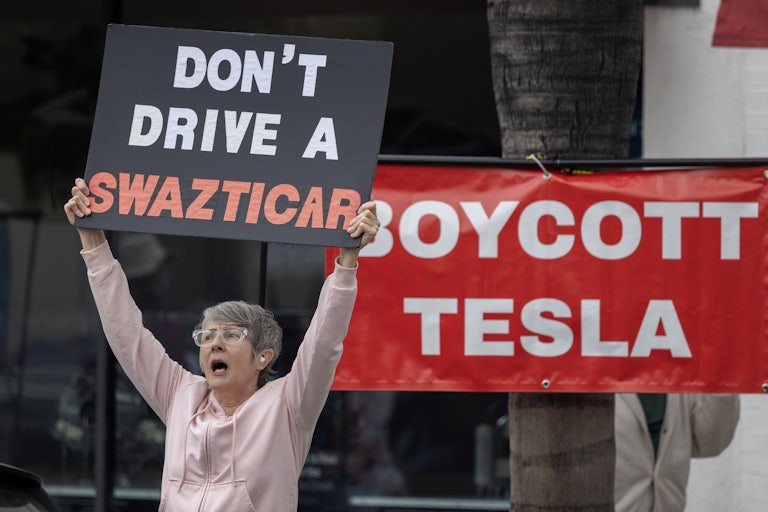
People protest against Elon Musk outside a Tesla dealership
David McNew/Getty Images

Elon Musk’s electric carmaker Tesla has been outsold in Europe by a rival company for the first time. 

The continent’s longtime electric favorite was overtaken by Chinese company BYD in April, which sold 7,231 fully electric cars compared to Tesla’s 1,165, according to data from Jato Dynamics.

It’s a major boon for the Chinese electric vehicle company, which only began selling cars in Norway and the Netherlands in late 2022. But Musk’s recent support for Donald Trump and the U.S. president’s far-right, government-destroying policies has influenced buyers, leading to boycotts at home and abroad that have drastically affected Tesla’s margins.

“This is a watershed moment for Europe’s car market, particularly when you consider that Tesla has led the European battery electric vehicle market for years, while BYD only officially began operations beyond Norway and the Netherlands in late 2022,” Felipe Munoz, global analyst at Jato Dynamics, told the Financial Times.

Tesla historically attracted a more liberal consumer base with its electric vehicles, but since Musk went “dark MAGA,” that same base has soured on the tech billionaire and his products. That’s proven especially true in some of Europe’s stronger economies, such as Germany, which has seen Tesla sales in the country fall by more than 70 percent in the beginning of the year, reported Bloomberg. Sales in China—where Tesla has two major factories—similarly plummeted, falling by 49 percent in February.

Musk, however, has brushed off the volatility. Speaking with Bloomberg at the Qatar Economic Forum on Tuesday, the world’s richest man pointed to Tesla’s rising stock as evidence that bullish investors were likely to ignore his political activism.

“We’ve lost some sales perhaps on the left, but we’ve gained them on the right. The sales numbers at this point are strong and we see no problem with demand,” the Tesla CEO said. “The stock wouldn’t be trading near all-time highs if things weren’t in good shape, they’re fine, don’t worry about it.”  

Republicans Sneak Terrifying Gun Law Change Into Trump’s Budget Bill

One Democrat slammed the GOP for helping “assassins” instead of American families.

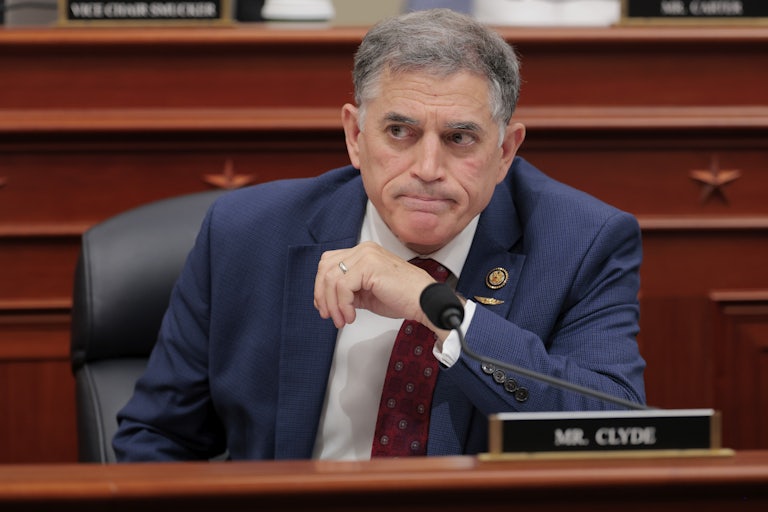
Representative Andrew Clyde sits in a congressional meeting.
Anna Moneymaker/Getty Images
Representative Andrew Clyde

Republicans narrowly passed Donald Trump’s sweeping budget reconciliation bill through the House Wednesday night, including a last-minute provision that would not require gun owners to register the purchase of silencers.

Georgia Representative Andrew Clyde had already ensured the elimination of a $200 transfer tax on gun silencers. But during negotiations Wednesday, he was able to add another provision altogether removing silencers from the regulatory purview of the National Firearms Act, which imposes taxes on the manufacture, distribution, and import of weapons, according to Politico.

The last-minute addition would strike another $200 tax on the manufacture of gun silencers. But by removing silencers from the purview of the National Firearms Act, lawmakers said that the change also had eliminated the NFA’s registration requirement with the Bureau of Alcohol Tobacco Firearms and Explosives.

“The question I have is, this was not in the bill that we were marking up. So, whose vote was bought with this provision that silencers will no longer need to be registered with the ATF or subject to background check purchasers?” asked Colorado Representative Joe Neguse on the House floor Wednesday night.

“What member was on the fence about this bill, and then went to Republican leadership and said, ‘I know you’re eliminating the tax on silencers but if you can just eliminate all regulation on silencers, I will vote for this bill?’”

Georgia Representative Austin Scott claimed that silencers’ exception from ATF registry did not mean that purchasers would not be subject to background checks. Scott, who argued in support of the provision, seemed confused about what it was actually about. He said it was about suppressors, rather than silencers—but that was incorrect.

When a person attempts to buy a firearm, they must complete an ATF form, and the seller then relays information to the National Instant Criminal Background Check System (NICS), according to the Federal Bureau of Investigation website. The NICS staff then performs a check to see whether the buyer has a criminal record or is in any way ineligible to purchase the firearm.

If the purchaser is not required to fill out a form with the ATF to purchase a silencer, it’s not clear how a background check would still be completed.

“Quite frankly, what is in the reconciliation bill does more to support assassins than it does American families,” said Massachusetts Representative Jim McGovern.

There was some laughter in the hall.

“Yeah, well you know what? Talk to law enforcement, talk to people who have been victims of gun violence,” McGovern continued. “I know you think it’s funny, but I don’t.”

Republicans Pass Horrid Tax Bill Thanks to Democrats Dying in Office

Republicans passed their terrible tax bill by one vote. Guess how many Democrats died in office this year.

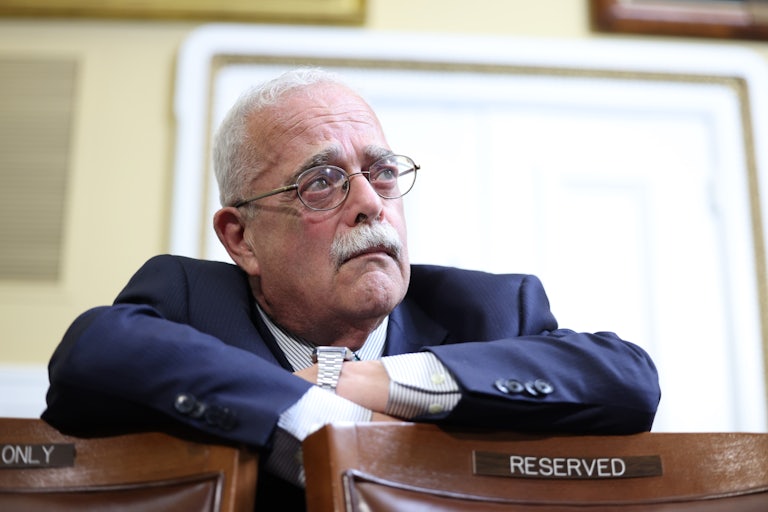
Representative Gerry Connolly crosses his arms on the back of two chairs.
Anna Moneymaker/Getty Image
Representative Gerry Connolly died the day before Republicans passed their tax bill by a one-vote margin.

House Republicans managed to pass their draconian budget bill, which promises to make massive cuts to Medicaid, Medicare, and food assistance, early Thursday morning by a narrow one-vote margin that was only possible due the deaths of three Democrats in this current Congress. 

The latest Democrat to pass away was 75-year-old Representative Gerry Connolly of Virginia, who died on Wednesday after battling esophageal cancer. In March, Representative Raul Grijalva of Arizona passed away at the age of 77 due to complications from cancer treatments. Representative Sylvester Turner of Texas, 70, a House freshman, died six days earlier. (Turner replaced Sheila Lee Jackson, who also died in office in July.)  

Had any of these three Democrats, who all are from safe Democratic districts, taken their health into consideration and decided not to run in 2024, such an egregious bill would have failed to pass. Do Democrats have an age problem? The party has been reluctant to give younger rising stars more prominent leadership positions, mostly notably when Connolly, whose condition was publicly known, was chosen to be the leading Democrat on the House Oversight Committee over the much younger Alexandria Ocasio-Cortez. 

In 2024, Democrats failed to connect with younger people and lost many of their votes, and this year, Americans of all ages have been urging the party to put up a vigorous fight against the Trump administration’s attacks on the country’s institutions. Are older politicians in their seventies and eighties up for that battle? 

The last eight members of Congress to have died in office were Democrats, with seven of them being over the age of 70 with significant health concerns. Six Democrats died in the last year alone. Democrats in Congress should decide whether they are physically and mentally up to the task of stopping the Republican effort to tear down America’s institutions—or make way for those who are.

Over a Dozen Officials Dumped Stocks Just as Trump Crashed the Market

Quite a few Trump officials knew exactly when to sell their stocks ahead of major Trump announcements.

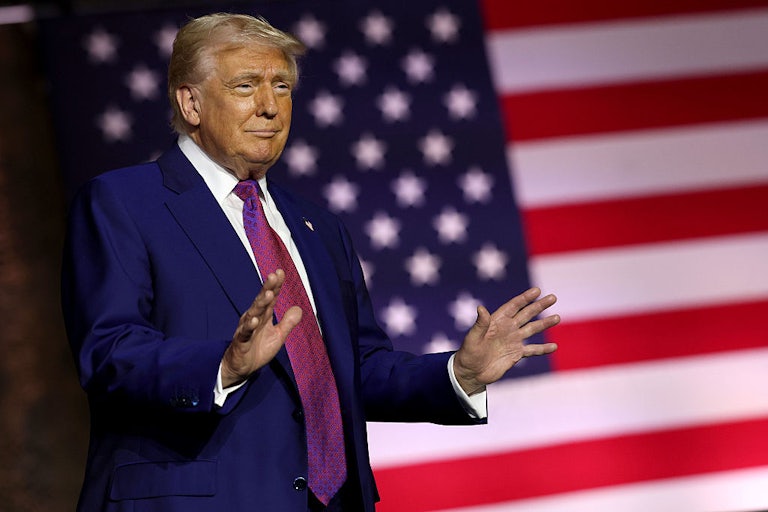
Donald Trump stands in front of a U.S. flag.
Win McNamee/Getty Images

Over a dozen officials within the Trump administration conveniently sold off their shares just days before their president crippled the stock market with his sweeping “Liberation Day” tariffs, according to ProPublica.

Attorney General Pam Bondi sold up to $5 million in her Trump Media shares on Liberation Day. One State Department official sold $50,000 in shares two days before. A White House lawyer sold off shares in nine different companies in February, the day before Trump announced tariffs on China, Mexico, and Canada. Transportation Secretary Sean Duffy sold shares in nearly 36 companies on February 11, two days before Trump teased his Liberation Day reciprocal tariffs. In each of the more than dozen instances, someone high up within the Trump administration sold off large amounts of their stock market shares right before Trump tanked the stock market, and some even bought a similar amount of shares back at much lower prices shortly after. 

There is no direct proof that these officials had nonpublic information about policies that would impact the stock market before everyone else, but the administration has clearly created an environment in which the potential for insider trading is incredibly high. And even if this administration isn’t insider trading, it’s doing an awful job at keeping up appearances. Trump himself posted in April, “THIS IS A GREAT TIME TO BUY!!! DJT,” a mere four hours before announcing a 90-day pause on most retaliatory tariffs except for those on China, yet another market-shocking announcement that caused stocks to shoot up. 

“Trump is creating giant market fluctuations with his on-again, off-again tariffs. These constant gyrations in policy provide dangerous opportunities for insider trading,” Senator Adam Schiff wrote on X at the time. “Who in the administration knew about Trump’s latest tariff flip flop ahead of time? Did anyone buy or sell  stocks, and profit at the public’s expense? I’m writing to the White House—the public has a right to know.”