Breaking News
Breaking News
from Washington and beyond

CBO Adds Fuel to Republican Budget Fight With Damning Deficit Forecast

Trump’s “big, beautiful bill” is a total disaster, according to the Congressional Budget Office.

Donald Trump stands in front of a mic in the White House.
Andrew Harnik/Getty Images

The Congressional Budget Office’s most recent score of President Trump’s One Big Beautiful Bill Act is the worst one to date.

The agency estimates the legislation would add $2.4 trillion to the national deficit over the next 10 years. Most of that deficit would happen “in the first four years when it has the most tax cuts,” wrote PBS NewsHour’s Lisa Desjardins

The bill is expected to cut $1.3 trillion in spending, but also cut $3.7 trillion in total revenue, leading to the massive deficit. (The report also estimates that 10.9 million people will lose their health care by 2034 because of cuts to Medicare and the Affordable Care Act.)

This report will make it even more difficult to get this bill through the Senate, as it gives Democrats, Elon Musk, and the few actual fiscal conservatives left in the GOP even more fodder for their criticism and opposition to the bill.

MAGA Republicans backing the bill continue to claim that the CBO is biased, rather than make any concessions, and it appears that the GOP will try to force the bill through regardless.

At its core, the OBBBA is a classic Republican budget bill that provides tax breaks for wealthy people and corporations while making unprecedented cuts to Medicaid and food stamps. For it to cut so much from social programs only to saddle the country with trillions of dollars in debt is unfortunately ironic, and will hurt poor, working Americans more than anyone else. This recent CBO report only reinforces that.
Democrat Sweeps to Stunning Victory in South Carolina Special Election

Keishan Scott celebrated a landslide victory in his campaign for a state House seat.

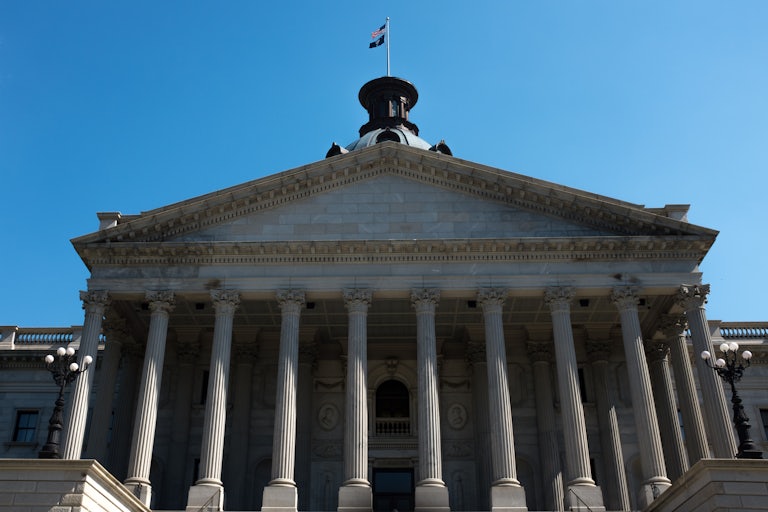
The South Carolina state legislature building in Columbia
Epics/Getty Images

The Democratic candidate in a South Carolina special election swept to a landslide victory Tuesday night, becoming the youngest person elected to the state legislature in nearly a decade.

Keishan Scott, 24, was elected to the state House to represent South Carolina’s 50th district, which encompasses Lee County and parts of Kershaw and Sumter counties. He won just under 71 percent of the nearly 3,700 votes cast, beating his Republican opponent by about 41 percentage points.

It’s not entirely surprising that a Democrat won the district. Scott was running to replace Democratic Representative Will Wheeler, who shockingly announced his resignation in January right after winning a fifth term.

The big shock comes from how handily Scott beat his opponent. Wheeler ran unopposed in four of his five elections, but the one year he had a Republican opponent (2022), Wheeler won by about 20 points—half of Scott’s victory margin.

Kamala Harris won the district by only about five points in the November election, and Joe Biden won the district by 15 points in 2020.

Scott pledged to capitalize on his overwhelming support. “I can promise you that every day I go into the Statehouse, I will carry the people with me,” he said in a victory speech. “Because certainly, it’s about people more than politics.”

“Your vote of confidence, it means the world to me,” he added.

U.S. Representative Jim Clyburn, a fellow South Carolina Democrat, had endorsed Scott ahead of the race and stressed that the special election was a must-win for the liberal party.

Electing Scott “will be the beginning of a Democratic comeback here in South Carolina,” said Clyburn, whose endorsement was critical for turning around Biden’s struggling 2020 campaign. “Irrespective of where you live, how old you may be, whatever gender you may be, this is about the future of Democrats in South Carolina.”

Scott’s victory is a welcome morale boost for the state Democratic Party. Republicans currently hold a supermajority in the state House, with 88 seats to Democrats’ now 36.

Republicans Rush to Suck Up to Elon Musk After New Budget Bill Threat

Republicans who backed the bill are suddenly scrambling to reject it.

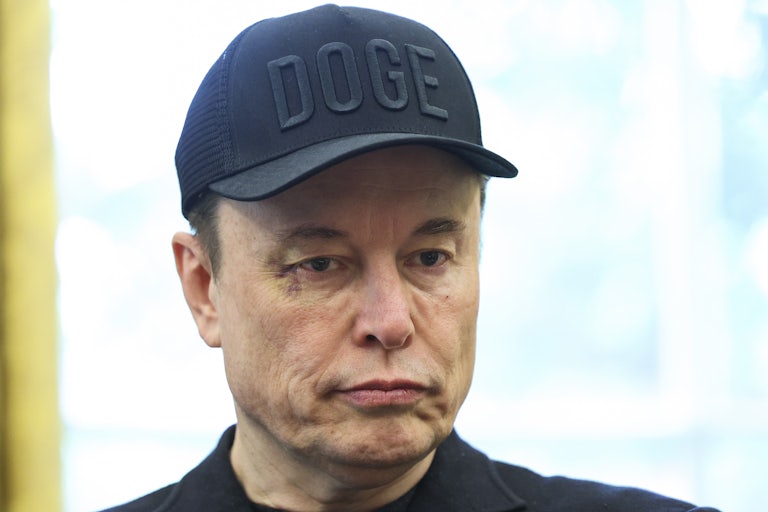
Elon Musk looks down while standing in the Oval Office
Tom Brenner/The Washington Post/Getty Images

Congressional Republicans are stuck between a rock and a hard place as their former financier, Elon Musk, threatens to use his gargantuan fortune to unseat anyone who supports the president’s “big, beautiful bill.”

Last month, Musk confessed in an interview with CBS that he believed Donald Trump’s spending package—which would add trillions to the national deficit in order to extend his 2017 tax cuts for the wealthy—was actually a bad idea. But the tech billionaire has become more brazen in his read of the bill in the weeks since he’s left the White House.

“I’m sorry, but I just can’t stand it anymore,” Musk wrote Tuesday afternoon on X, the social media platform he owns. “This massive, outrageous, pork-filled Congressional spending bill is a disgusting abomination. Shame on those who voted for it: you know you did wrong. You know it.”

In a separate post, the world’s richest man—who had promised to bankroll Republican primaries mere months ago—made clear what he now planned to do with his cash.

“In November next year, we fire all politicians who betrayed the American people,” wrote Musk.

The bill passed the House by a vote of 215–214, with two Republicans joining all Democrats in voting against it. Republicans plan to offset the expensive tax cut by slashing more than $800 billion from Medicaid. But Musk’s issue with Trump’s plan has little to do with slashing programs aimed at supporting and uplifting the most vulnerable Americans—instead, he condemns the bill because it would effectively undo his work atop the Department of Government Efficiency, which was tasked with paring down government spending.

Senator Rand Paul quote-tweeted Musk, arguing that Congress knows adding another $5 trillion to the national debt would be a “huge mistake.” Senators Ron Johnson, Rick Scott, and Mike Lee have also spoken out against the bill’s price tag. Senators Josh Hawley, Susan Collins, Lisa Murkowski, and Joni Ernst have claimed that slashing Medicaid—the third rail of American politics—could prove to be a fatal political move. Senators John Curtis and Thom Tillis have drawn red pen under the bill’s elimination of green energy tax cuts.

Representative Marjorie Taylor Greene told NewsNation Tuesday that she agreed with Musk “to a certain extent,” hitching herself to the tech billionaire as another conservative who entered government because she was irate with Republicans.

“However, I don’t want to continue this government on a CR that’s funding Democrat and Biden policies and funding, and this bill was important to transition over to exactly what the American people voted for,” Greene said. The Georgia lawmaker further specified that she was wary of some of the inclusions tacked onto the bill, one of which would prevent states from drafting regulation around the artificial intelligence industry for the next decade.

“I think that’s pretty terrifying,” she told NewsNation. “We don’t know what AI is going to be capable of within one year; we don’t know what it will be capable of in five years, let alone 10 years.”

(Greene had admitted earlier Tuesday that she hadn’t actually read the bill before voting in favor of it.)

Representative Scott Perry also hailed Musk as “right to call out House leadership” over the bill. “We expect MASSIVE improvements from the Senate before it gets back to the House,” he wrote on X Tuesday. (Perry voted for the bill.)

Still, Republican leadership has continued to defend the spending bill.

“It’s very disappointing, OK?” House Speaker Mike Johnson told CNN, reacting to Musk’s threat. “I’ve come to consider Elon a good friend. But with all due respect, my friend Elon is terribly wrong about the One Big Beautiful Bill.”

The White House similarly brushed off Musk’s threat.

“The president already knows where Elon Musk stood on this bill,” press secretary Karoline Leavitt said, during a press briefing Tuesday. “It doesn’t change the president’s opinion.”

Musk was Trump’s top financial backer in the 2024 election, spending at least $250 million in the final months of the president’s campaign after Trump was shot in July. Musk had also promised to funnel funds toward other Republicans, declaring in the wake of the November election that his super PACs would “play a significant role in primaries.” In the following months, Musk threatened to use his money to fund primary challengers to Trump’s agenda and go after Democrats, and that he would be preparing “for the midterms and any intermediate elections, as well as looking at elections at the district attorney level.”

Trump Officially Begins Meddling in Reports He Doesn’t Like

The Trump administration has blocked a key portion of a report on the growing deficit.

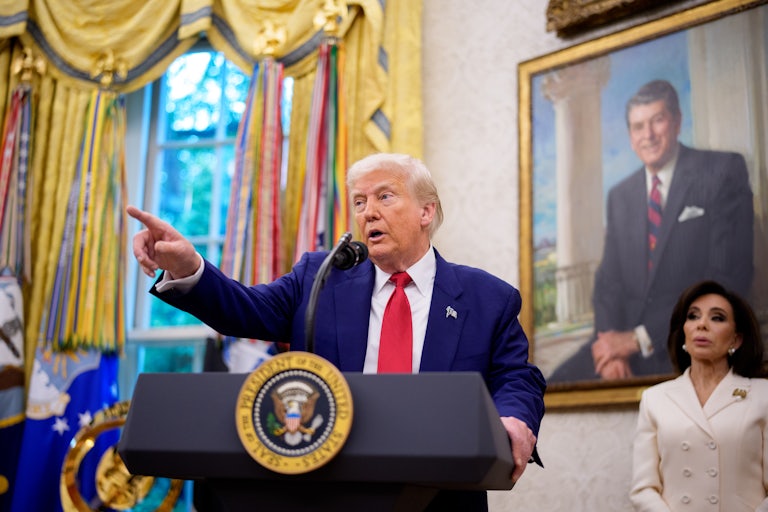
Donald Trump points while standing at the presidential poidum in the White House. Jeanine Pirro stands in the background.
Andrew Harnik/Getty Images

Trump officials blocked the written analysis on an economic report because it predicted an increase in the farm goods trade deficit, a direct contradiction of his stated plans to reinvigorate domestic agriculture.

According to Politico, the Trump administration delayed the report itself by five days before releasing it with numbers that were the same as they were in the original unredacted report.

This is a quarterly report from the Agriculture Department that farm organizations, traders, and elected officials have relied on for years for information on the status of U.S. import and export markets. Now, the Trump administration is openly threatening government transparency because the report doesn’t fit the narrative of Trump’s tariffs somehow being a positive for our domestic production capabilities. A trade deficit clearly shows that we’re buying more than we’re selling on agricultural goods, and Trump blocking that information from the report, at least in part, proves he knows exactly how bad it is.

“The report was hung up in internal clearance process and was not finalized in time for its typical deadline,” said USDA spokesperson Alec Varsamis. “Given this report is not statutory as with many other reports USDA does, the Department is undergoing a review of all of its non-statutory reports, including this one, to determine next steps.”

It is unknown whether the full and unredacted analysis of the report will ever be released.

“Objectivity is really key here and the public depends on it,” former USDA chief economist Joe Glauber told Politico. “To lose that trust would be terrible.”

Meanwhile, on the other side of the aisle:

Trump Whines About How Hard It Is to Make a Trade Deal With China

Donald Trump is mad at being stuck in a mess of his own making.

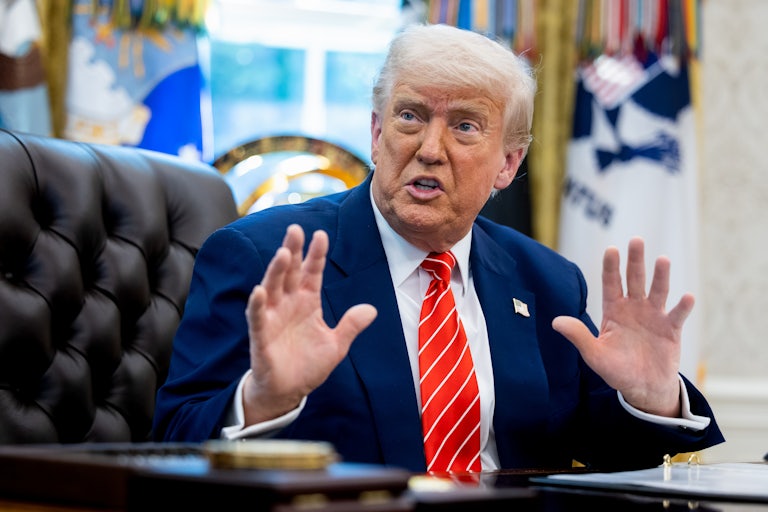
Donald Trump sits at his desk in the Oval Office of the White House and raises his hands as if in defense while speaking.
Francis Chung/Politico/Bloomberg/Getty Images

Donald Trump was up late at night whining about how hard it is to make a trade deal with China.

“I like President XI of China, always have, and always will, but he is VERY TOUGH, AND EXTREMELY HARD TO MAKE A DEAL WITH!!!” he posted at 2:17 a.m. on Wednesday.

The post came ahead of an expected call between Trump and the Chinese president on how to negotiate a deal on the two countries’ $600 billion trade relationship—which Trump threatened when he imposed tariffs.

Treasury Secretary Scott Bessent also tried to bully China into quickly accepting a deal. “They either want to be a reliable partner to the rest of the world, or they don’t,” he warned on Tuesday.

But Trump’s own decision seems to be driving him crazy.

“The president is obsessed with having a call with Xi,” one person familiar with the trade talks told Politico, adding that the president seems convinced he can personally come up with a deal with Xi.

In May, the United States and China reached a preliminary trade deal—as Trump lowered his 145 percent tariffs to 30 percent, while Beijing slashed levies on U.S. imports to 10 percent. That came with a 90-day deadline to reach a broader trade deal, but it looks like there’s been little progress since then.