Breaking News
Breaking News
from Washington and beyond

GOP Senator Slams Howard Lutnick’s Bonkers Tariff Logic

Senator John Kennedy admitted to being totally baffled by Lutnick’s purported reasoning.

Senator John Kennedy gestures while speaking in a hearing
Andrew Harnik/Getty Images

Senator John Kennedy tore into Commerce Secretary Howard Lutnick Thursday over his nonsensical answer on the logic of Donald Trump’s sweeping reciprocal tariff policy.

During an appearance on MSNBC’s Morning Joe, the Louisiana Republican described his experience questioning Lutnick during a hearing before the Senate Appropriations Committee the day before.

“Well, it’s clear that President Trump listens to Secretary Lutnick, so I spent the time I had trying to figure out where he’s coming from. And I don’t understand,” Kennedy said.

“I mean my vision of reciprocity, which I think is a good thing, is to lower tariffs if you can to zero on both sides. And let there be a free exchange of services on both sides, and let there be a free exchange of goods and services, and let the best product and the best service win. And I thought that’s where Secretary Lutnick was going,” Kennedy explained.

But that was in fact not what Lutnick had in mind at all. When asked if he would take a hypothetical deal with Vietnam where the tariffs on both sides went down to zero, Lutnick replied that accepting such a deal would be “the silliest thing we could do.” Lutnick’s baffling answer exposed that the goal of the ongoing tariff talks was not to ensure reciprocity, or even to reduce foreign tariffs on U.S. goods.

“So the obvious question is who’s on first, what’s on second, why are we having these trade talks? And I don’t understand based on his answers,” Kennedy explained.

Lutnick’s poor response Wednesday undermined the ultimate purpose of the tariff-induced trade talks, and the tariffs themselves.

“Can you get a sense, what is the point of these tariffs?” MSNBC co-host Jonathan Lemire asked.

“Well, I know what the point is for me. It’s reciprocity. But clearly the markets haven’t figured that out yet,” Kennedy replied.

“What I was trying to do with Mr. Lutnick was sort of flesh out, where are we going here? Where are we going here? And I don’t know whether he doesn’t know, I’m going to assume he was being purposefully evasive, but the uncertainty is hurting us,” he added.

The Trump administration has come a long way from its pledge to complete 90 deals during the 90-day pause on Trump’s sweeping “Liberation Day” tariffs. So far, Trump has only announced one deal with the U.K.—and that deal wasn’t even finished. Earlier this week, the U.S. sent out a friendly reminder to other countries urging them to formulate their best offers by Wednesday, but with Trump’s ever-vacillating tariff policies, it’s unclear why any country would take that request seriously.
China Makes It Clear: Trump Begged for Call With Xi

China mocked Donald Trump immediately after his phone call with Xi Jinping.

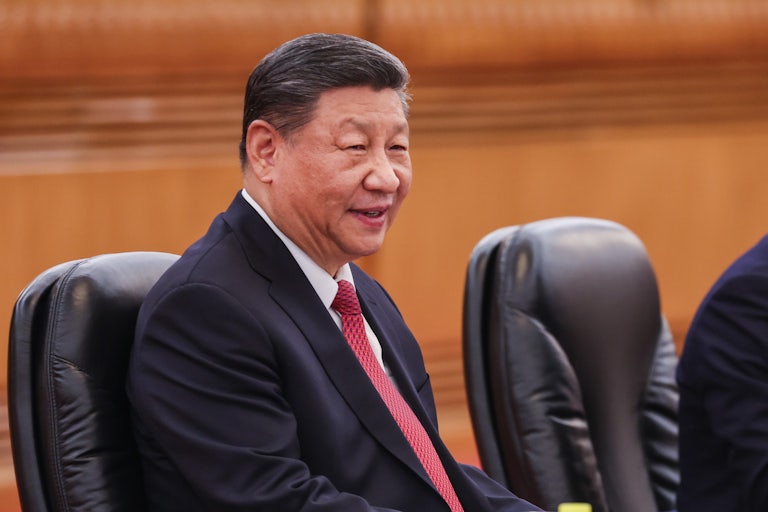
Chinese President Xi Jinping sits on a chair and smiles.
Wu Hao/Getty Images)

Trump finally got his call with China.

After Trump repeatedly told Americans that it was China that was so desperate to get him on the phone to discuss a trade deal, a recent post from the Chinese Embassy all but confirms the opposite. It is Trump, not President Xi Jinping, who was sitting by the phone waiting day and night for a call that didn’t come for months.

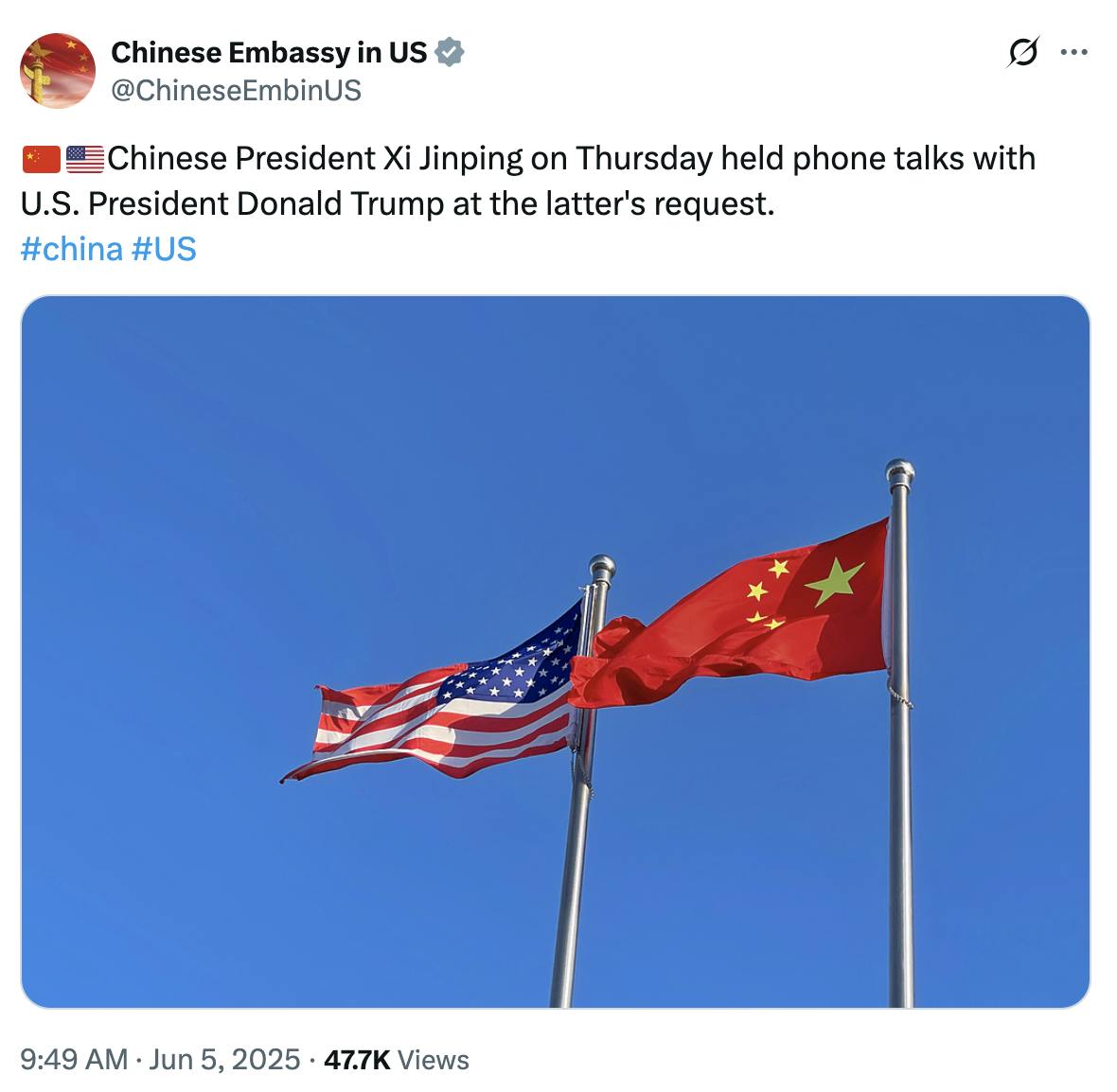
“Chinese President Xi Jinping on Thursday held phone talks with U.S. President Donald Trump at the latter’s request,” China’s U.S. Embassy posted from its X account on Thursday.

X Chinese Embassy in US @ChineseEmbinUS: 🇨🇳🇺🇸Chinese President Xi Jinping on Thursday held phone talks with U.S. President Donald Trump at the latter's request. #china #US

The “at the latter’s request” is certainly intentional. Since “Liberation Day,” Trump has insisted that he has the leverage, that countries far and wide will be lining up, eager to kiss the ring and make a deal with us. But still, China, the Asian powerhouse that faced the most aggressive tariffs from Trump, has shirked a potential deal-making phone call with the president, halting his visions of a sweeping agreement on trade, TikTok, and fentanyl export. The administration has nudged China to initiate the call since April, but to no avail until today. If you have to call someone just to tell them to call you, who really has the leverage?

“I just concluded a very good phone call with President Xi, of China, discussing some of the intricacies of our recently made, and agreed to, Trade Deal. The call lasted approximately one and a half hours, and resulted in a very positive conclusion for both Countries.... Our respective teams will be meeting shortly at a location to be determined,” Trump wrote on Truth Social on Thursday. “During the conversation, President Xi graciously invited the First Lady and me to visit China, and I reciprocated. As Presidents of two Great Nations, this is something that we both look forward to doing. The conversation was focused almost entirely on TRADE. Nothing was discussed concerning Russia/Ukraine, or Iran. We will inform the Media as to scheduling and location of the soon to be meeting. Thank you for your attention to this matter!”

Trump’s own summary of the conversation made no mention of who requested it.

SCOTUS Sides With Straight Woman in Sexuality Discrimination Case

The Supreme Court just made it easier for a a majority group that historically has not faced oppression to claim they are being discriminated against.

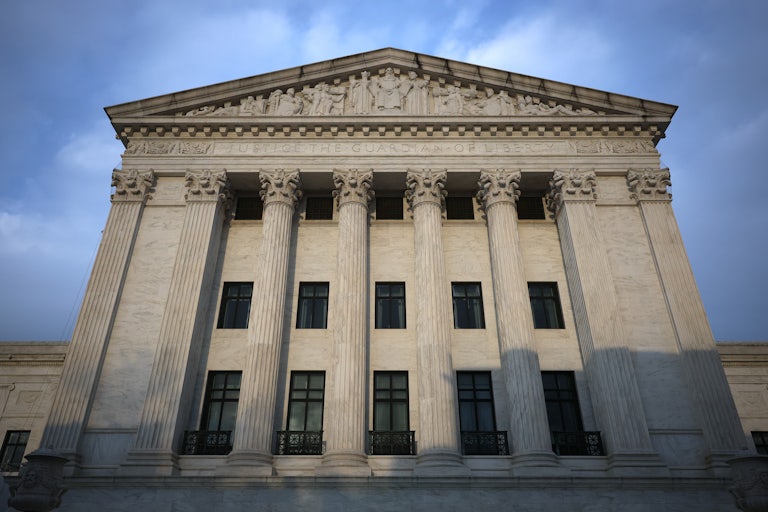
The Supreme Court building in Washington, D.C.
Win McNamee/Getty Images
The Supreme Court made it easier Thursday to file lawsuits over “reverse discrimination.”
The nation’s highest judiciary sided with an Ohio woman who claimed that she had been passed over for a job and was subsequently demoted because she was straight. Marlean Ames, a 20-year employee at the Ohio Department of Youth Services, claimed that the promotion and the job she previously held were both given to LGBTQ people.
Ames had previously lost her case in trial court and the Sixth Circuit Court of Appeals.
In siding with Ames, the court unanimously struck down a standard that had previously required individuals identifying as part of a majority group—such as being white, male, or heterosexual—to face a higher bar in proving discrimination.
The ruling will affect cases in 20 states and the District of Columbia. The Sixth Circuit was one of the courts that had tasked people like Ames with showing “background circumstances” as proof, such as an internal pattern of discrimination against her at her organization. Ames did not provide any circumstances to the appeals court.
In its opinion, the Supreme Court decided that the Sixth Circuit’s “background circumstances” requirement “cannot be squared with the text of Title VII or the Court’s precedents,” since the statute’s “disparate-treatment provision draws no distinctions between majority-group plaintiffs and minority-group plaintiffs.” Title VII of the Civil Rights Act of 1964 made it illegal for American employers to discriminate against employees or potential employees on the basis of their “race, color, religion, sex, or national origin.”
“The provision focuses on individuals rather than groups, barring discrimination against ‘any individual’ because of protected characteristics,” the court wrote. “Congress left no room for courts to impose special requirements on majority-group plaintiffs alone.”
In its opinion, the nation’s highest judiciary vacated the lower court’s ruling, remanding the case to be re-deliberated under the new standard.
In 2019, Ames had applied to be bureau chief of the Ohio agency. She was interviewed by two supervisors who did not hire her for it. Two more applicants for the role were also turned away. Eight months later, Ames claimed that one of the supervisors had hired a lesbian woman she knew personally to fill the role.
Ames was later removed from her post as program administrator and given the option of being demoted to executive secretary or leave the agency altogether. She chose the demotion, and was replaced by a gay man. Ames claimed that she had been discriminated against as both of the hiring supervisors were lesbian women.
This story has been updated.

Trump Spent Millions Trying to Claim DEI Causes Plane Crashes

Great use of taxpayer money here

AnAmerican Eagle plane takes off at an airport.
DANIEL SLIM/AFP/Getty Images

President Trump is spending $2.1 million on an investigation into whether diversity, equity, and inclusion policies played a role in the January plane crash at Ronald Reagan Washington National Airport and other recent aviation accidents, according to The Atlantic. This comes after he blamed the January plane crash—which killed 67 people—on diversity hiring.

The investigation, which began in March, is being led by Alex Spiro, a high-profile celebrity lawyer who has represented Jay-Z, New York City Mayor Eric Adams, and most notably billionaire Elon Musk. The investigation is expected to end soon and yield nothing, all while potentially costing even more than the $2.1 million Trump initially budgeted in March.

This investigation is a massive waste of taxpayer funds, especially while federal aviation is in the midst of an employment crisis. Millions will go down the drain based on Trump’s “very strong opinions and ideas,” according to the investigation’s scope of work document.

“The [Federal Aviation Administration] is actively recruiting workers who suffer severe intellectual disabilities, psychiatric problems, and other mental and physical conditions under a diversity and inclusion hiring initiative spelled out on the agency’s website. Can you imagine?” Trump said back in January. “Hearing, vision, missing extremities, partial paralysis, complete paralysis, epilepsy, severe intellectual disability, psychiatric disability, and dwarfism, all qualify for the position of a controller of airplanes pouring into our country.”

When Trump was pressed about how he could blame women, disabled people, and people of color for a plane crash well before any evidence was found, he doubled down, saying he just had “common sense.”

Will Budget Bill Fight Spell Doom for Trump and Elon Musk’s Bromance?

Donald Trump and Elon Musk are openly feuding over the president’s pet budget bill.

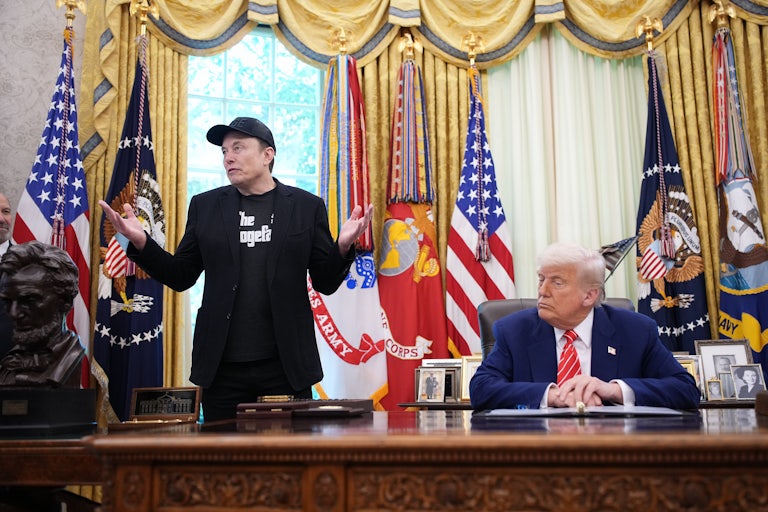
Elon Musk shrugs while standing next to Donald Trump, who sits at his desk in the Oval Office
Kevin Dietsch/Getty Images

Tensions are rising between Donald Trump and his biggest 2024 campaign financier, Elon Musk.

The dynamic duo—who were practically inseparable after November—are driving apart over their differing opinions on Trump’s “big, beautiful bill,” an extension to his 2017 tax cuts for multimillionaires and corporations that is projected to add trillions to the national deficit.

The president reportedly “wasn’t happy” and was left “confused” as to why his richest MAGA ally had become more outspoken in his criticism of the bill since exiting his role as a special government employee, according to senior White House officials who spoke with The Wall Street Journal. The whole situation caught senior Trump advisers off guard, the Journal reported.

Last month, Musk confessed in an interview with CBS that he believed Trump’s spending package was actually a bad idea. But the tech billionaire has become more brazen in his read of the bill in the weeks since he’s left the White House.

“I’m sorry, but I just can’t stand it anymore,” Musk wrote Tuesday afternoon on X, the social media platform he owns. “This massive, outrageous, pork-filled Congressional spending bill is a disgusting abomination. Shame on those who voted for it: you know you did wrong. You know it.”

In a separate post, the world’s richest man—who had promised to bankroll Republican primaries mere months ago—made clear what he now planned to do with his cash.

“In November next year, we fire all politicians who betrayed the American people,” wrote Musk.

The bill passed the House by a vote of 215–214, with two Republicans joining all Democrats in voting against it.

By Wednesday, Musk’s directive for more than 200 million of his social media followers was clear: “KILL the BILL.” That same day, Trump posted an image of Musk’s exit message from the previous week without further comment.

Media commentators picked up on the signal, with CNN host Erin Burnett laughing off Trump’s response to Musk’s online tirade against his “entire domestic agenda” as “thinly veiled.”

Republicans plan to offset the expensive tax cut by slashing some $880 billion from Medicaid. But Musk’s issue with Trump’s plan has little to do with slashing programs aimed at supporting and uplifting the most vulnerable Americans—instead, he’s condemned the bill on the basis that it would effectively undo his work atop the Department of Government Efficiency, which was tasked with paring down government spending.

Musk was Trump’s top financial backer in the 2024 election, spending at least $250 million in the final months of the president’s campaign after Trump was shot in July. Musk had also promised to funnel funds toward other Republicans, declaring in the wake of the November election that his super PACs would “play a significant role in primaries.” In the following months, Musk threatened to use his money to fund primary challengers to Trump’s agenda and go after Democrats, and that he would be preparing “for the midterms and any intermediate elections, as well as looking at elections at the district attorney level.”