Breaking News
Breaking News
from Washington and beyond

Trump Says Germany Being Liberated From Nazis Was “Not a Great Day”

Donald Trump made the deranged comment in a meeting with the German chancellor.

German Chancellor Friedrich Merz gestures and speaks while sitting next to Donald Trump in the Oval Office
Brendan Smialowski/AFP/Getty Images

Does Donald Trump think that German Chancellor Friedrich Merz is a Nazi?

During a press conference with Merz Thursday, Trump seemed confused when the foreign leader brought up the anniversary of the D-Day invasion, when U.S. troops landed on the beaches in Normandy during World War II, on June 6, 1944. The military operation marked a significant turning point in the war against the Nazis.

“That was not a pleasant day for you?” Trump asked Merz. The U.S. president then turned to the press, adding, “This was not a great day!”

“No, that was not a pleasant—well, but in the long run, Mr. President, this was the liberation of my country from Nazi dictatorship,” Merz said, as the U.S. president laughed.

Trump quickly composed himself. “That’s true, that’s true,” he said.

Trump’s wild comment about Germany’s defeat in World War II betrays a weak understanding of world history, framing the Nazis as simply a German political party and not a genocidal regime responsible for the murder of six million Jewish people, and millions of others.

This strange remark is yet another installment of the president’s sympathetic ideas about Nazis. Last month, during a meeting with Israeli Prime Minister Benjamin Netanyahu, Trump suggested that some Nazi soldiers had treated their Jewish prisoners with “love.” Trump also infamously claimed that Hitler had done “some good things.”

Despite Trump’s gaffe, Merz continued, saying that Germany and other European countries were hoping for help from the United States once again, and hoped to discuss Trump putting “more pressure on Russia” to end its invasion of Ukraine.
MTG Flip-Flops Again on Budget Bill She Didn’t Even Read

Marjorie Taylor Greene can’t seem to make up her mind about the bill.

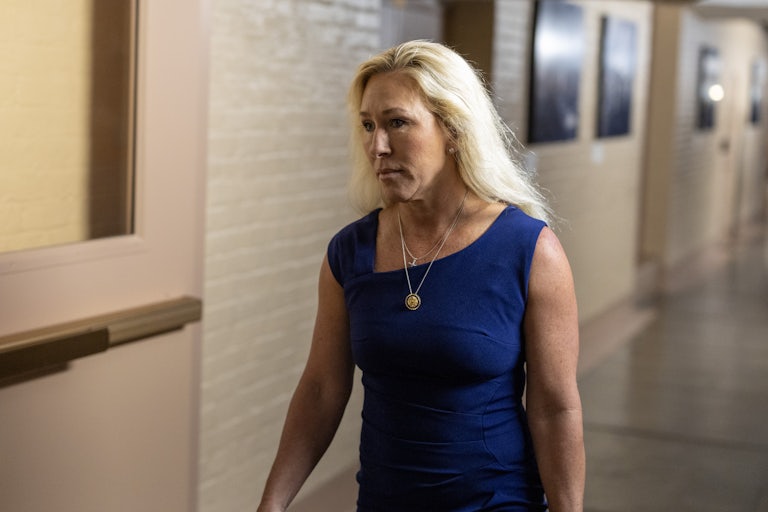
Representative Marjorie Taylor Greene walks in the Capitol
Tasos Katopodis/Getty Images

DOGE Committee Chair Marjorie Taylor Greene is apparently “proud” to have voted for the “big, beautiful bill” that she trashed just Tuesday.

During an exchange with Representative Robert Garcia in Wednesday’s House Subcommittee on Delivering on Government Efficiency meeting, Greene said that she was “proud to have voted for that bill to fund border security.”

“The bill actually destroys what you guys voted for for the past four years,” the Georgia lawmaker said.

But that was a far cry from the language that Greene used to describe the reconciliation package just 24 hours prior.

On Tuesday, Greene admitted on X that she hadn’t even read the bill in its entirety, and that she “would have voted NO” if she knew of some of the things that had been added to it, such as a provision that will prevent states from drafting regulation around the artificial intelligence industry for the next decade.

“Full transparency, I did not know about this section on pages 278-279 of the OBBB that strips states of the right to make laws or regulate AI for 10 years,” Greene wrote. “When the OBBB comes back to the House for approval after Senate changes, I will not vote for it with this in it. We should be reducing federal power and preserving state power. Not the other way around.”

In an interview with NewsNation Tuesday, Greene specified that the AI detail is “pretty terrifying.”

“We don’t know what AI is going to be capable of within one year, we don’t know what it will be capable of in five years, let alone 10 years,” Greene told the network.

In the same interview, Greene attempted to ideologically saddle herself alongside Elon Musk, the ex-DOGE adviser who has gone on a multiday tirade against the bill. In dozens of posts, Musk has lambasted practically the entirety of Donald Trump’s domestic agenda as “pork-filled” and a “disgusting abomination.”

“I fully understand what Elon is saying, and I agree with him to a certain extent,” Greene said, underscoring her support for the Department of Government Efficiency’s cost-cutting mission.

The bill passed the House by a vote of 215–214, with two Republicans joining all Democrats in voting against it. Republicans rushed the spending bill through the House, executing meetings and votes during late nights and over the weekend, in order to send it to the Senate.

The GOP has spent months attempting to pencil out the bill’s primary goal of extending Trump’s 2017 tax cuts for multimillionaires and corporations, which the Congressional Budget Office projected Wednesday would add $2.4 trillion to the national deficit. To make the cuts a reality for America’s elite, conservatives have taken a metaphorical chain saw to Medicaid and other popular social programs, demanding some $880 billion in cuts.

GOP Senator Slams Howard Lutnick’s Bonkers Tariff Logic

Senator John Kennedy admitted to being totally baffled by Lutnick’s purported reasoning.

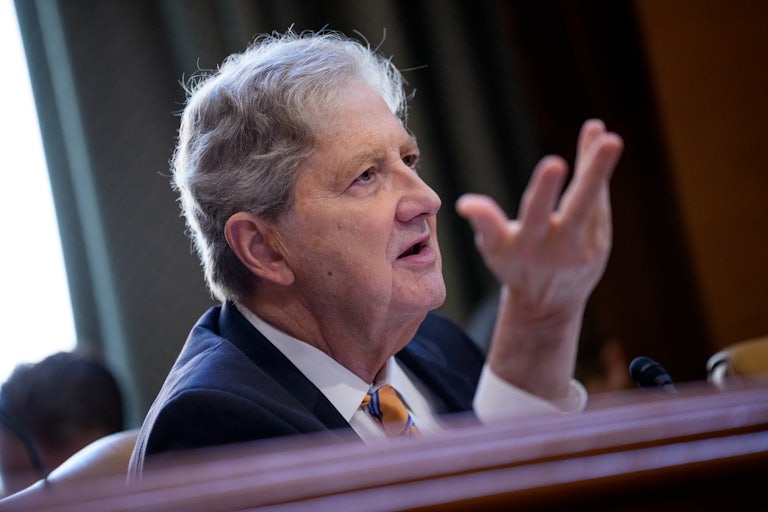
Senator John Kennedy gestures while speaking in a hearing
Andrew Harnik/Getty Images

Senator John Kennedy tore into Commerce Secretary Howard Lutnick Thursday over his nonsensical answer on the logic of Donald Trump’s sweeping reciprocal tariff policy.

During an appearance on MSNBC’s Morning Joe, the Louisiana Republican described his experience questioning Lutnick during a hearing before the Senate Appropriations Committee the day before.

“Well, it’s clear that President Trump listens to Secretary Lutnick, so I spent the time I had trying to figure out where he’s coming from. And I don’t understand,” Kennedy said.

“I mean my vision of reciprocity, which I think is a good thing, is to lower tariffs if you can to zero on both sides. And let there be a free exchange of services on both sides, and let there be a free exchange of goods and services, and let the best product and the best service win. And I thought that’s where Secretary Lutnick was going,” Kennedy explained.

But that was in fact not what Lutnick had in mind at all. When asked if he would take a hypothetical deal with Vietnam where the tariffs on both sides went down to zero, Lutnick replied that accepting such a deal would be “the silliest thing we could do.” Lutnick’s baffling answer exposed that the goal of the ongoing tariff talks was not to ensure reciprocity, or even to reduce foreign tariffs on U.S. goods.

“So the obvious question is who’s on first, what’s on second, why are we having these trade talks? And I don’t understand based on his answers,” Kennedy explained.

Lutnick’s poor response Wednesday undermined the ultimate purpose of the tariff-induced trade talks, and the tariffs themselves.

“Can you get a sense, what is the point of these tariffs?” MSNBC co-host Jonathan Lemire asked.

“Well, I know what the point is for me. It’s reciprocity. But clearly the markets haven’t figured that out yet,” Kennedy replied.

“What I was trying to do with Mr. Lutnick was sort of flesh out, where are we going here? Where are we going here? And I don’t know whether he doesn’t know, I’m going to assume he was being purposefully evasive, but the uncertainty is hurting us,” he added.

The Trump administration has come a long way from its pledge to complete 90 deals during the 90-day pause on Trump’s sweeping “Liberation Day” tariffs. So far, Trump has only announced one deal with the U.K.—and that deal wasn’t even finished. Earlier this week, the U.S. sent out a friendly reminder to other countries urging them to formulate their best offers by Wednesday, but with Trump’s ever-vacillating tariff policies, it’s unclear why any country would take that request seriously.

China Makes It Clear: Trump Begged for Call With Xi

China mocked Donald Trump immediately after his phone call with Xi Jinping.

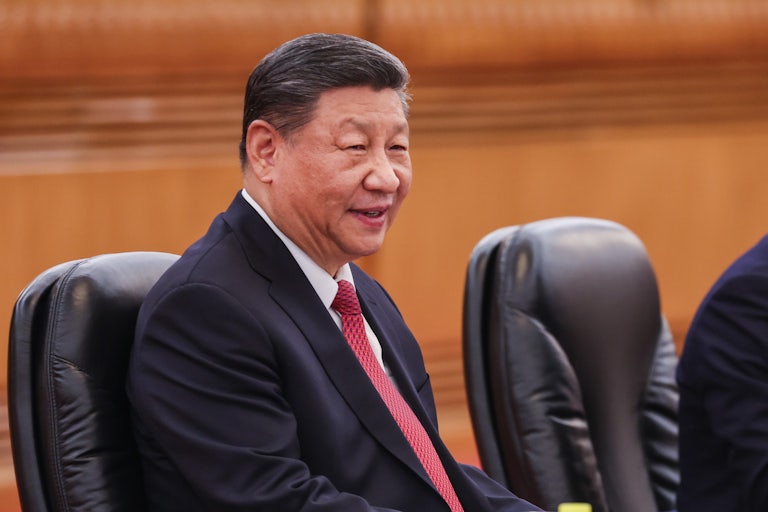
Chinese President Xi Jinping sits on a chair and smiles.
Wu Hao/Getty Images)

Trump finally got his call with China.

After Trump repeatedly told Americans that it was China that was so desperate to get him on the phone to discuss a trade deal, a recent post from the Chinese Embassy all but confirms the opposite. It is Trump, not President Xi Jinping, who was sitting by the phone waiting day and night for a call that didn’t come for months.

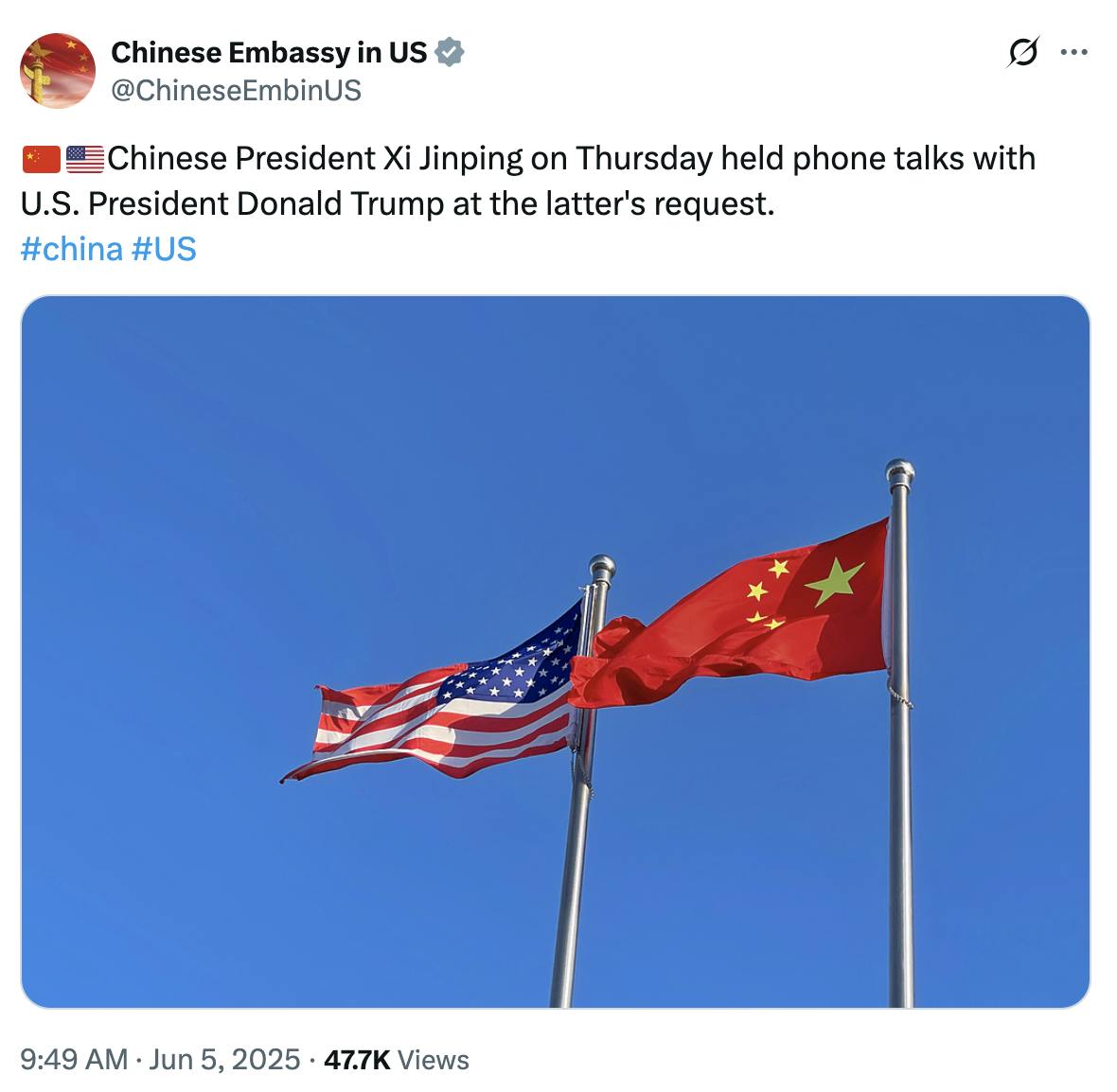
“Chinese President Xi Jinping on Thursday held phone talks with U.S. President Donald Trump at the latter’s request,” China’s U.S. Embassy posted from its X account on Thursday.

X Chinese Embassy in US @ChineseEmbinUS: 🇨🇳🇺🇸Chinese President Xi Jinping on Thursday held phone talks with U.S. President Donald Trump at the latter's request. #china #US

The “at the latter’s request” is certainly intentional. Since “Liberation Day,” Trump has insisted that he has the leverage, that countries far and wide will be lining up, eager to kiss the ring and make a deal with us. But still, China, the Asian powerhouse that faced the most aggressive tariffs from Trump, has shirked a potential deal-making phone call with the president, halting his visions of a sweeping agreement on trade, TikTok, and fentanyl export. The administration has nudged China to initiate the call since April, but to no avail until today. If you have to call someone just to tell them to call you, who really has the leverage?

“I just concluded a very good phone call with President Xi, of China, discussing some of the intricacies of our recently made, and agreed to, Trade Deal. The call lasted approximately one and a half hours, and resulted in a very positive conclusion for both Countries.... Our respective teams will be meeting shortly at a location to be determined,” Trump wrote on Truth Social on Thursday. “During the conversation, President Xi graciously invited the First Lady and me to visit China, and I reciprocated. As Presidents of two Great Nations, this is something that we both look forward to doing. The conversation was focused almost entirely on TRADE. Nothing was discussed concerning Russia/Ukraine, or Iran. We will inform the Media as to scheduling and location of the soon to be meeting. Thank you for your attention to this matter!”

Trump’s own summary of the conversation made no mention of who requested it.

SCOTUS Sides With Straight Woman in Sexuality Discrimination Case

The Supreme Court just made it easier for a a majority group that historically has not faced oppression to claim they are being discriminated against.

The Supreme Court building in Washington, D.C.
Win McNamee/Getty Images
The Supreme Court made it easier Thursday to file lawsuits over “reverse discrimination.”
The nation’s highest judiciary sided with an Ohio woman who claimed that she had been passed over for a job and was subsequently demoted because she was straight. Marlean Ames, a 20-year employee at the Ohio Department of Youth Services, claimed that the promotion and the job she previously held were both given to LGBTQ people.
Ames had previously lost her case in trial court and the Sixth Circuit Court of Appeals.
In siding with Ames, the court unanimously struck down a standard that had previously required individuals identifying as part of a majority group—such as being white, male, or heterosexual—to face a higher bar in proving discrimination.
The ruling will affect cases in 20 states and the District of Columbia. The Sixth Circuit was one of the courts that had tasked people like Ames with showing “background circumstances” as proof, such as an internal pattern of discrimination against her at her organization. Ames did not provide any circumstances to the appeals court.
In its opinion, the Supreme Court decided that the Sixth Circuit’s “background circumstances” requirement “cannot be squared with the text of Title VII or the Court’s precedents,” since the statute’s “disparate-treatment provision draws no distinctions between majority-group plaintiffs and minority-group plaintiffs.” Title VII of the Civil Rights Act of 1964 made it illegal for American employers to discriminate against employees or potential employees on the basis of their “race, color, religion, sex, or national origin.”
“The provision focuses on individuals rather than groups, barring discrimination against ‘any individual’ because of protected characteristics,” the court wrote. “Congress left no room for courts to impose special requirements on majority-group plaintiffs alone.”
In its opinion, the nation’s highest judiciary vacated the lower court’s ruling, remanding the case to be re-deliberated under the new standard.
In 2019, Ames had applied to be bureau chief of the Ohio agency. She was interviewed by two supervisors who did not hire her for it. Two more applicants for the role were also turned away. Eight months later, Ames claimed that one of the supervisors had hired a lesbian woman she knew personally to fill the role.
Ames was later removed from her post as program administrator and given the option of being demoted to executive secretary or leave the agency altogether. She chose the demotion, and was replaced by a gay man. Ames claimed that she had been discriminated against as both of the hiring supervisors were lesbian women.
This story has been updated.