Breaking News
Breaking News
from Washington and beyond

TACO Trump Announces Paltry Trade Deal With China

Trump has achieved nothing after months of tariff threats against China.

Donald Trump
PATRICK T. FALLON/AFP/Getty Images

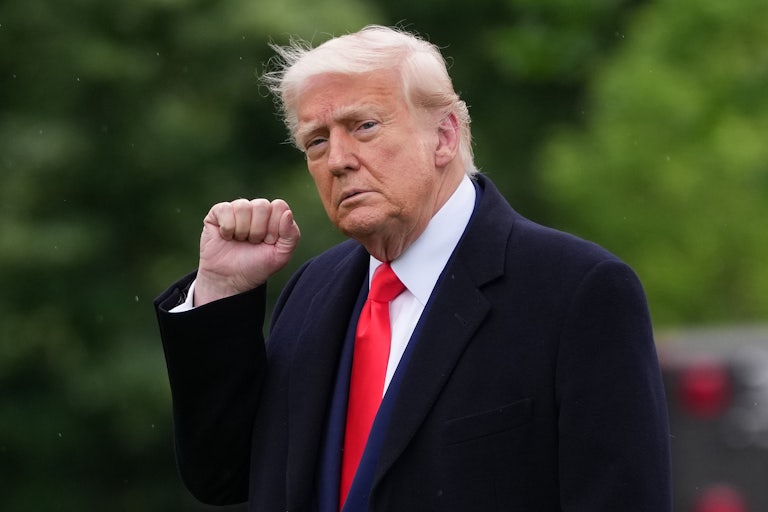
Donald Trump says he’s finally cracked a tentative deal with China—but why doesn’t it sound any good?

Trump announced on Truth Social Wednesday morning that a long-awaited trade deal had finally materialized, though it was still subject to “final approval” by Chinese President Xi Jinping and himself, and indicated that the U.S. would impose a 55 percent tariff on Chinese goods, while China would impose a 10 percent tariff.

While these numbers are significant deescalations from the whopping 145 percent tariff Trump had levied on Chinese exports and the 125 percent tariff rate on U.S. exports China imposed in response, Trump’s deal still leaves something to be desired.

Before Trump entered office, China and the U.S. both had roughly 20 percent tariffs on exports from each other’s countries. In an initial agreement last month, the U.S. had agreed to lower rates to 30 percent and China had lowered to 10 percent, before Trump blew up the deal.

So while the U.S. will still have to pay more for Chinese goods—a policy that will ultimately raise prices for American consumers—it seems that China has struck a deal to pay even less for American goods than it did before Trump was in office.

Meanwhile the other terms of that deal seemed to provide assets both countries had before Trump’s ridiculous trade war.

“FULL MAGNETS, AND ANY NECESSARY RARE EARTHS WILL BE SUPPLIED, UP FRONT, BY CHINA,” Trump wrote.

China’s grip on rare earths had provided it with a lot of leverage in negotiations with the United States. When Trump first levied his astronomically high tariffs on China, Beijing essentially shut down exports, and even after it agreed to a truce, in Geneva last month, Beijing still required companies to purchase special licenses to buy them, placing a particular strain on robotics and defense companies.

In return for resuming the supply of rare earths, the U.S. would allow Chinese students to attend American universities. Secretary of State Marco Rubio announced late last month that he would begin “aggressively” revoking the student visas of Chinese students, claiming concerns over national security. As one could probably assume, the purported threat posed by these students was never real but a bargaining chip for the Trump administration.

Trump noted that allowing Chinese students to study at American universities has “ALWAYS BEEN GOOD WITH ME!”
Newsom Warns America: Trump Is Destroying Democracy

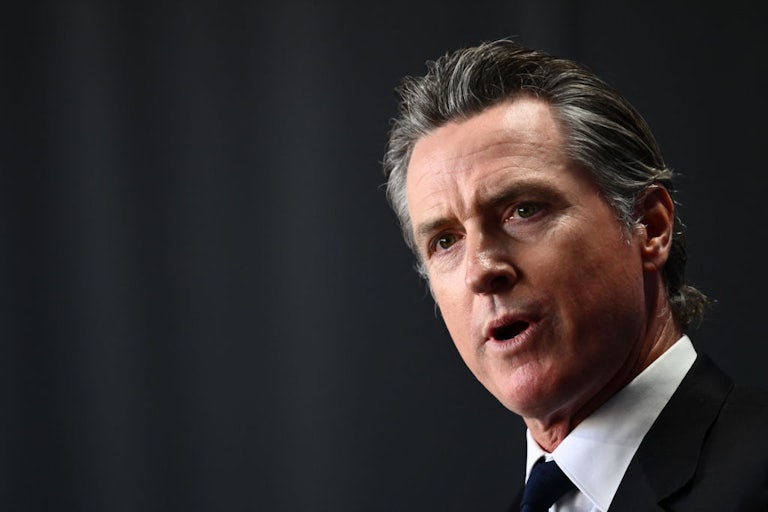
California Governor Gavin Newsom delivered a powerful message on how Donald Trump’s actions in Los Angeles prove “democracy is under assault.”

California Governor Gavin Newsom speaking
PATRICK T. FALLON/AFP/Getty Images

Democracy is “under assault” under Donald Trump’s leadership, according to California Governor Gavin Newsom.

In a nearly nine-minute address to his state and to the nation Tuesday evening, Newsom warned that the president’s choice to manhandle Los Angeles, without any input from the government or people of California, indicates a leader on the verge of authoritarianism.

“If some of us can be snatched off the streets without a warrant, based only on suspicion or skin color, then none of us are safe,” Newsom said. “Authoritarian regimes begin by targeting people who are least able to defend themselves. But they do not stop there.

“Trump and his loyalists, they thrive on division because it allows them to take more power and exert even more control,” he continued. “And by the way, Trump, he’s not opposed to lawlessness and violence as long as it serves him. What more evidence do we need than January 6?”

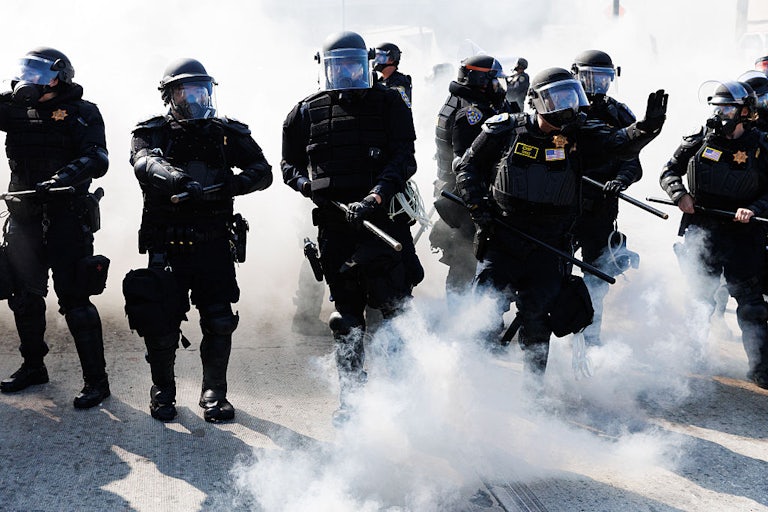
Thousands of locals flooded the streets of Los Angeles over the weekend in a stunning visual protest of the president’s agenda. Protesters blocked off a major freeway, trashed Waymos (self-driving cars), and organized outside of City Hall and the Metropolitan Detention Center. In reaction, law enforcement officials shot rubber bullets and fired tear gas and flash bangs into crowds of civilians. The FBI added protesters suspected of throwing rocks at police cars to its Most Wanted list and ominously threatened to intervene in the anti-Trump display without guidance from California or the White House.

California sued the federal government Monday to roll back Trump’s deployment of 4,100 National Guard members that state authorities said had not been authorized or requested to handle the protests—an order that Newsom slammed Tuesday night as “illegal” and a “brazen abuse of power” that “inflamed a combustible situation.”

“When Donald Trump sought blanket authority to commandeer the National Guard. he made that order apply to every state in this nation,” Newsom said. “This is about all of us. This is about you. California may be first, but it clearly will not end here. Other states are next. Democracy is next.”

In another decision that nobody responsible for overseeing peace in Los Angeles wanted, Trump additionally deployed 700 Marines to the City of Angels, an initiative that Defense officials revealed Tuesday would cost U.S. taxpayers $134 million.

Trump also endorsed threats to arrest Newsom when the California governor began to hit back, telling reporters that he’d “do it.”

“Democracy is under assault right before our eyes; this moment we have feared has arrived. He’s taking a wrecking ball, a wrecking ball to our Founding Fathers’ historic project: three coequal branches of independent government,” Newsom continued.

“The Founding Fathers didn’t live and die to see this kind of moment,” Newsom said, urging Americans to “stand up” to the Trump administration’s aggressive control. “I know many of you are feeling deep anxiety, stress, and fear,” he continued. “But I want you to know that you are the antidote to that fear and that anxiety. What Donald Trump wants most is your fealty, your silence: to be complicit in this moment. Do not give in to him.”

Trump Issues Horrifying Threat to Parade Protesters

The president said that anyone who protests his birthday parade on Saturday will be met with “very heavy force,” even if they’re being peaceful.

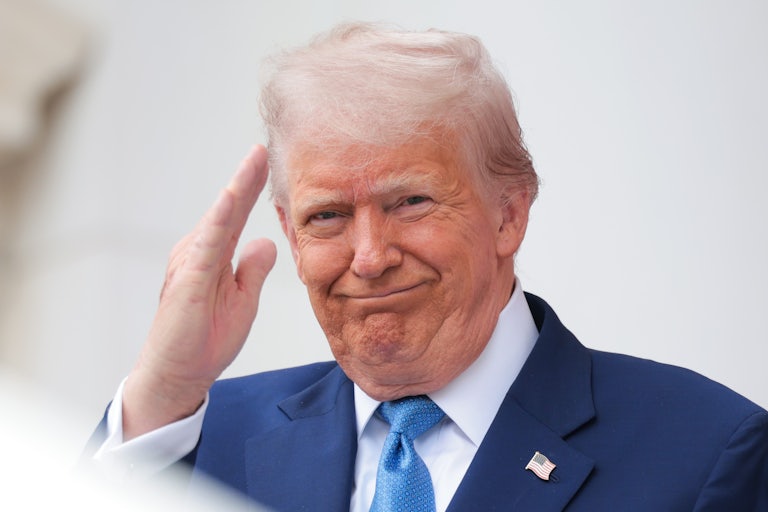
Donald Trump smiles and salutes during an event at Arlington National Cemetery
Kayla Bartkowski/Getty Images
Donald Trump in May

President Trump declared that anyone who protests his military/birthday parade—even peacefully—will be met with “very heavy force.” 

“We’re celebrating big on Saturday … if there’s any protest that wants to come out they will be met with very big force. And by the way, for those people who wanna protest, they’re gonna be met with very big force,” Trump said, repeating himself. “And I haven’t even heard about a protest, but, you know, these are people that hate our country. But they will be met with very heavy force.” 

This is the president saying that he will crush anyone who dares to use their First Amendment right to speak out against a lavish display of power—6,700 soldiers, 50 in-air helicopters, 34 horses, and 28 massive 70-ton M1 Abrams battle tanks—that will cost more than  $45 million in taxpayer dollars. His threats of “very heavy force” are entirely credible, given his gleeful deployment of thousands of National Guardsmen and Marines (who were without rules of engagement at the time) into Los Angeles without the consent of the city’s mayor, Karen Bass, or the state’s governor, Gavin Newsom, after protesters interfered with ICE roundups.

As far as protests go, there are at least 1,500 massive “No Kings Day” actions planned for the afternoon of Trump’s parade, June 14, in Washington, D.C. and across the country. There are signs that the president’s bombastic response in Los Angeles is causing the number of those who intend to attend a protest on Saturday to increase.

“This country doesn’t belong to a king—and we’re not letting him throw himself a parade funded by tens of millions of our taxpayer dollars while stealing from us and stripping away our rights, our freedoms, and the programs our families rely on,” said Indivisible, the organization organizing the actions. “On June 14th, we’re coming together to send one clear message: No Thrones. No Crowns. No Kings.”

Trump is itching to brutalize dissenters, and his history suggests that he is more than willing to send orders to do so, especially in the nation’s capital. Saturday has the potential to be disastrous.

World Bank: Trump’s Trade War Could Destroy the Global Economy

The World Bank’s Global Economic Prospects report sounds a dire warning about tariffs.

Donald Trump raises his fist in that dumb way he does
Kevin Dietsch/Getty Images

Trump’s trade war won’t just cripple domestic markets—it will slow global gross domestic product growth to its lowest point in 17 years.

The World Bank’s Global Economic Prospects report found that “international discord” surrounding trade has “upended many of the policy certainties that helped shrink extreme poverty and expand prosperity after the end of World War II.”

The report did not name President Trump explicitly, but made it clear that his unprecedented tariffs—a 10 percent tax on imports from the entire world—were the direct cause of the drop in global and domestic economic growth.

“The rise in trade barriers, heightened uncertainty, and the spike in financial market volatility are set to weigh on private consumption, international trade, and investment,” the report stated. “As a result, U.S. growth is expected to decelerate sharply in 2025, to 1.4 percent.” Additionally, global output is expected to slip by 0.5 percent.

The report’s future outlook is also not encouraging.

“In 2026-27, a tepid recovery is expected, leaving global output materially below January projections, the report said. “The outlook largely hinges on the evolution of trade policy globally. Growth could turn out to be lower if trade restrictions escalate or if policy uncertainty persists, which could also result in a build-up of financial stress.… On the upside, uncertainty and trade barriers could diminish if major economies reach lasting agreements that address trade tensions.”

It’s clear that these hits to GDP will impede the growth of the domestic and the international working class, as Trump struggles to make a single trade deal while kneecapping America’s diplomatic legitimacy in the process.

“The world economy today is once more running into turbulence,” World Bank chief economist Indermit Gill wrote. “Without a swift course correction, the harm to living standards could be deep.”

President Trump has yet to comment on the World Bank’s report.

Americans Hate Trump’s Plan to Unleash Troops on Los Angeles

A new poll finds double-digit disapproval of Trump’s decision to send in the Marines.

California Highway Patrol using smoke grenades and wearing face shields.
BLAKE FAGAN/AFP/Getty Images
California Highway Patrol using smoke grenades to advance and push protesters off the 101 freeway in Los Angeles, on June 8

The president’s decision to use the Marines on U.S. civilians in Los Angeles is not sitting well with the public.

A YouGov poll released Tuesday morning indicates that the majority of Americans disagree with Donald Trump’s order sending 700 Marines to break up anti-ICE protests in the city. The number of people against the president’s action eclipsed those who supported it by double digits, with 47 percent of polled Americans saying they disagreed with the order compared to 34 percent who approved.

When it comes to Trump’s decision to send 4,100 National Guard members to one of the country’s most populous cities, Americans were equally unhappy: 45 percent of polled Americans said they disapproved, while 38 percent supported the action.

A shocking percentage of Americans were undecided on both issues. Some 19 percent of those surveyed said they weren’t sure how they felt about Trump sending the Marines to manhandle anti-ICE demonstrators, while 17 percent said they were undecided about the president’s decision to send in the National Guard. Both of those groups were mostly composed of registered independents, according to polling data.

The results are remarkably aligned with Trump’s overall job approval, with 51 percent of Americans disapproving of his job performance while 44 percent approve, as tracked by The Economist.

The YouGov poll was conducted before the Defense Department unveiled the price tag of sending active duty troops into Los Angeles: $134 million, paid for by U.S. taxpayers.

Exactly who is breaking the law in L.A. is in question. Americans have a First Amendment right to protest, as protected by the U.S. Constitution—a document that every sitting president and public official swears an oath to uphold. But Trump has directed the military to squash the protests without California’s authorization, prompting a lawsuit from the state to peel back the order. California Attorney General Rob Bonta told reporters Monday that Trump had “trampled” California’s sovereignty.

Furthermore, Trump’s enforcement of his national agenda directly violates the will of the city of Los Angeles: The Los Angeles City Council unanimously voted in November to establish itself as a “sanctuary city,” prohibiting city resources from being used for federal immigration enforcement. Thrusting the military into the city to help federal agents rip undocumented immigrants out of their communities oversteps what Angelinos voted for.

Trump’s order also violated the Posse Comitatus Act, a federal law dating back to 1878, that forbids the government from using the military for law enforcement purposes. The White House could have bypassed the military doctrine by invoking the Insurrection Act, which allows the president to utilize the military during periods of rebellion or mass civil unrest, but had not done so by the time of the order. (Trump has openly discussed leveraging the nineteenth-century law to enact his agenda since his inauguration but has still not invoked the Insurrection Act as of the time of publishing.)

A month before the presidential election, the Brennan Center for Justice referred to the Posse Comitatus Act as “too flimsy a guardrail” to genuinely protect the nation from the White House, explaining that the principle within the act is protected “more by norms and historical practice” than the law itself. “Unfortunately, we’ve entered an era in which we can no longer rely on tradition to constrain executive action,” Joseph Nunn, a counsel in the Brennan Center’s Liberty and National Security Program, wrote at the time.