Breaking News
Breaking News
from Washington and beyond

Trump Treasury Secretary Makes Humiliating Admission About Trade Deals

So much for 90 deals in 90 days

Treasury Secretary Scott Bessent gestures while speaking to reporters
Chris J. Ratcliffe/Bloomberg/Getty Images
Treasury Secretary Scott Bessent

Treasury Secretary Scott Bessent admitted Friday morning that Donald Trump’s trade negotiations will likely continue into September.

During an appearance on Fox Business’s Mornings With Maria, Bessent moved the goalposts for Trump’s flailing trade negotiations yet again, as he struggled to answer simple questions about progress with other countries.

“What is the next country we should expect a trade deal to do with the United States?” asked host Maria Bartiromo. “Are you gonna be able to get some deal announcements beyond just the U.K. before this August deadline, when we’re gonna hear from the Court of the International Appeals?”

It’s not entirely clear what August deadline Bartiromo is citing, but she may have been referring to early August, when an appeals decision is expected of the U.S. International Court of Trade’s decision to block Trump’s tariffs under the International Emergency Economic Powers Act.

Trump announced two weeks ago that he and the U.K. had finally signed a trade deal. Trump also claimed Thursday that China had signed a trade deal just the day before, although Bessent notably did not mention the Asian nation in his mealymouthed defense.

“Maria, you know with all things, they get done at the end. You have to put on a deadline. As you and I know, nothing gets done in Washington well in advance. So, I think a lot of the countries are feeling pressure,” Bessent replied.

Bessent insisted that Trump was ready to go back to the original “Liberation Day” tariff levels, if satisfactory agreements weren’t reached. Bessent said that there were only 18 truly important trading partners, and referred to Commerce Secretary Howard Lutnick’s claim that the U.S. had 10 imminent deals coming.

“So, you know, if we can ink 10 or 12 of the important 18, then there are another important 20 relationships, then I think we can have trade wrapped up by Labor Day,” Bessent said.

Even if the Trump administration did succeed in getting 10 new trade agreements by Labor Day, that wouldn’t constitute failing to complete deals “in advance”—it would be months after the initial July 8 deadline. It also falls far short of the administration’s “90 deals in 90 days” promise.

Bessent’s waffling comes just hours after White House press secretary Karoline Leavitt said the July 9 deadline for reimposing steep global tariffs was “not critical.”
Supreme Court Caves to Trump in Ominous Birthright Citizenship Ruling

The Supreme Court has just limited the ability of lower courts to rein in Donald Trump’s anti-constitutional orders.

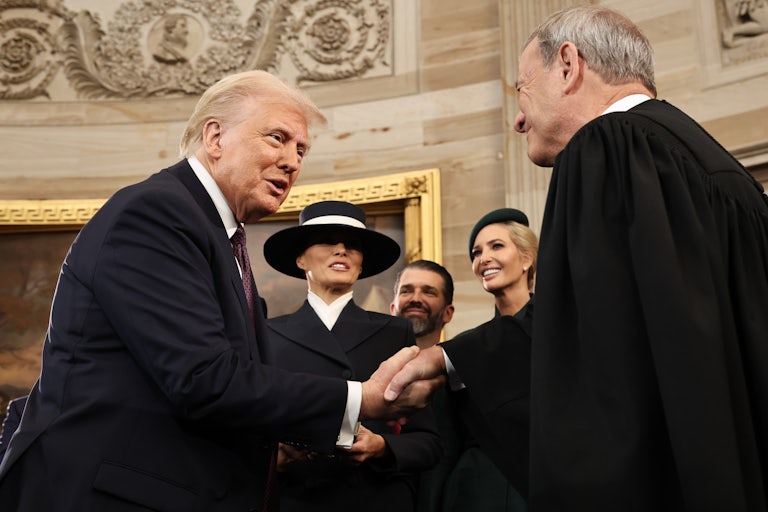
Donald Trump shakes hands with Chief Justice John Roberts during his inauguration as Melania Trump, Ivanka Trump, and Donald Trump, Jr. all look on and smile.
Chip Somodevilla/Getty Images
Donald Trump shakes hands with Chief Justice John Roberts during his inauguration on January 20.

The Supreme Court on Friday delivered Donald Trump a win in his ongoing war against birthright citizenship—limiting lower courts’ ability to issue nationwide injunctions, effectively eroding their ability to rein in anti-constitutional orders.

In a 6–3 decision, the court did not rule on the constitutionality of Trump’s January 20 executive order on birthright citizenship, which seeks to deny automatic citizenship to children born on U.S. soil to undocumented immigrants and those with temporary status.

However, the decision grants Trump’s request to do away with nationwide pauses on its enforcement. “Universal injunctions likely exceed the equitable authority that Congress has given to federal courts,” the court stated, in a decision written by Justice Amy Coney Barrett.

Joining Barrett were Chief Justice John Roberts and Justices Clarence Thomas, Samuel Alito, Neil Gorsuch, and Brett Kavanaugh. Liberal justices Sonia Sotomayor, Elena Kagan, and Ketanji Brown Jackson all dissented.

Sotomayor said that the “gamesmanship” in Trump’s request to stay the injunctions “is apparent and the Government makes no attempt to hide it. Yet, shamefully, this Court plays along.” Her dissent concludes: “With the stroke of a pen, the President has made a ‘solemn mockery’ of our Constitution. Rather than stand firm, the Court gives way. Because such complicity should know no place in our system of law, I dissent.”

Jackson filed a dissent agreeing with Sotomayor, but emphasizing that the court’s decision “is an existential threat to the rule of law.” The majority opinion, Jackson said, “gives the Executive the go-ahead to sometimes wield the kind of unchecked, arbitrary power the Founders crafted our Constitution to eradicate.”

Trump’s executive order was swiftly challenged in court—and rightly so, as it rides roughshod over the Fourteenth Amendment (and long-established Supreme Court precedent). Federal district courts in Massachusetts, Maryland, and Washington issued nationwide preliminary injunctions, preventing the government from enforcing a challenged policy not just against the parties involved in the lawsuit or people in a certain jurisdiction, but against everyone across the country.

This order blocks those universal injunctions—and gives Trump a powerful new tool to roll back civil liberties nationwide.

Republicans Forced to Remove Gun Deregulation From Budget Bill

Senate Republicans were blocked from using their sweeping budget bill to eliminate regulations on guns and gun silencers.

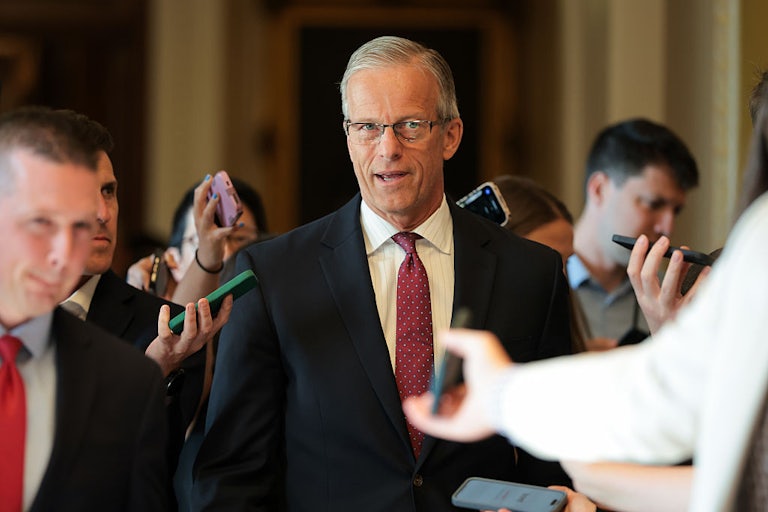
Senator John Thune speaks to reporters in the Capitol.
Kayla Bartkowski/Getty Images

The Senate parliamentarian has shot down another batch of provisions in Trump’s “big, beautiful bill”—this time including one that would’ve deregulated gun silencers and certain firearms.

Being a budget reconciliation, the Senate GOP’s bill can pass with a simple majority and elude a filibuster. However, it cannot contain non-budgetary provisions, and Parliamentarian Elizabeth MacDonough has in recent days been trimming away measures that run afoul of this rule.

According to a Friday press release from Senate Budget Committee Ranking Member Jeff Merkley, newly nixed provisions include one that would have eliminated a $200 tax—as well as certain background checks—to acquire gun silencers.

The provision also appeared in the version of the bill that passed the House in May, thanks to the efforts of Republican Representative Andrew Clyde, who owns a Georgia gun shop. But the Senate’s version went further than the House’s, as it would have eliminated the abovementioned hurdles for those purchasing sawed-off rifles and shotguns as well.

Now, in order for this and other rejected provisions to pass as written, the Senate would have to accomplish the unthinkable task of overcoming the 60-vote hurdle to overcome a filibuster.

MacDonough has dealt some significant blows to the Trump agenda in recent days, as GOP lawmakers are under the gun—with their self-imposed July 4 deadline to pass Trump’s tax and spending plan fast approaching. The parliamentarian’s cuts have rankled Republicans so much that some are calling for Senate Majority Leader John Thune to overrule or fire her, though Thune has expressed no interest in doing so.

Trump Tries Insanely Desperate Ploy to Convince Iran to Negotiate

Donald Trump is practically begging the country he just bombed to come to the negotiating table.

Donald Trump stands outside The Hague
Beata Zawrzel/NurPhoto/Getty Images

The Trump administration has been covertly seeking ways to bring Iran back to the negotiating table after Donald Trump issued airstrikes on three of the country’s nuclear facilities, pitching wildly expensive solutions to the geopolitical conflict.

A group of U.S. officials, led by special envoy Steve Witkoff, have so far suggested that the U.S. could invest $20 to $30 billion in a civilian non-enrichment nuclear program for Iran, or lift some $6 billion in sanctions against the country.

Iranian officials had previously made it clear that they were no longer interested in negotiating with U.S. leadership, citing the nation’s deception ahead of prearranged talks regarding Iran’s nuclear program that were scheduled to take place earlier this month. But Iranian leadership has apparently been in talks with the Trump administration since a ceasefire deal was struck earlier this week, reported CNN.

“The U.S. is willing to lead these talks” with Iran, the Trump administration official told CNN. “And someone is going to need to pay for the nuclear program to be built, but we will not make that commitment.”

The president’s attack, conducted Saturday without the express approval of Congress, damaged facilities in Fordo, Natanz, and Isfahan. A battle damage assessment by the Pentagon’s intelligence arm determined that the missile barrage only set Iran’s nuclear program back by a few months, rather than the “years” that Trump had advertised, CNN reported earlier this week. One of the other ideas floated last week was to have U.S.-backed allies in the Gulf pay to replace the damaged Fordo facility, though it wasn’t clear if that would hand ownership of the facility over to another nation, according to CNN.

Witkoff told CNBC Wednesday that the U.S. is seeking a “comprehensive peace agreement” with Iran, but at least one Trump official told CNN anonymously that it is “entirely uncertain what will happen.”

At least 627 people have been killed in Iran since Israel first attacked on June 13, according to Iran’s health ministry. Approximately 107 people died on Monday alone, making it the deadliest single day of the conflict.

Trump’s Budget Bill Is So Bad, Even Fox Is Calling It Out

Fox Business highlighted that Donald Trump’s pet budget bill will cut Medicaid and SNAP.

Agriculture Secretary Brooke Rollins gestures while speaking. The Department of Agriculture seal is on the wall behind her.
Andrew Harnik/Getty Images
Secretary of Agriculture Brooke Rollins

Donald Trump’s “big, beautiful bill” is so wildly unpopular that even Fox anchors have started bashing it.

Fox Business host Liz Claman highlighted some particularly unfavorable polling during an interview with Agriculture Secretary Brooke Rollins Thursday afternoon. “These are all showing that few people favor this thing,” said Claman.

A Fox News poll taken between June 13 and June 16 found that only 38 percent of registered voters support the gargantuan spending bill, while a whopping 59 percent oppose it. Another poll from Quinnipiac earlier this month found that only 27 percent of respondents supported the bill, and 57 percent opposed it. A Pew Research poll found that only 29 percent of respondents supported it, while 49 percent opposed it.

“Here’s the thing, a lot of Americans don’t like this, even some people who voted for President Trump,” Claman said. “For this reason, Madam Secretary, they don’t understand why cuts have to come from programs like SNAP, like food stamps for the poor, and like Medicare for the poor. That is the problem. So can you make a connection between why that should be OK?”

“Well, I think it’s really important to note that the entire media apparatus has been against this bill from the beginning, but here is what President Trump was elected to do,” Rollins replied.

Rollins insisted that under Joe Biden, federal spending on food stamps had grown “unsustainable” and that the cuts were necessary to keep the program running.

In fact, the bill directs nearly $300 billion to be cut from SNAP through 2034 to help fund tax cuts skewed for the very rich. By slashing federal assistance, states will then have to decide how to close the gaps to keep the programs running. The bill also proposes expanding SNAP’s work requirement, making it more difficult for low-income families to be eligible for benefits, and locks out lawful immigrants from using the program. In an average month in 2024, SNAP helped more than 41 million people achieve a nutritional diet.