Breaking News
Breaking News
from Washington and beyond

Pam Bondi Struggles to Answer Key Question on Birthright Citizenship

Donald Trump’s attorney general struggled to explain the new rules on birthright citizenship after the Supreme Court ruling.

Attorney General Pam Bondi testtifies in Congress.
Al Drago/Bloomberg/Getty Images
Attorney General Pam Bondi

In a 6–3 ruling, the Supreme Court on Friday restricted lower courts’ nationwide pauses on Trump’s birthright citizenship executive order, though it did not rule on the merits of the order itself.

Now, thanks to the court’s conservative supermajority, the undecidedly unconstitutional order may go into effect, in at least some states, come next month—a prospect that has left many wondering how the Trump administration would enforce it.

During a Trump press conference celebrating the ruling, Attorney General Pam Bondi was asked for some details on that matter but failed to clarify anything.

“Who would be tasked with actually vetting citizenship [under Trump’s policy]?” a reporter asked the attorney general. “Like, would this be a situation where you have nurses and doctors checking for citizenship of parents?”

Bondi offered a nonanswer, citing “pending litigation” and promising answers in October, when, she said, the Supreme Court will decide on the constitutionality of the executive order. (The Supreme Court has not yet agreed to hear another birthright citizenship case or announced its argument schedule for the fall.)

The reporter followed up, asking whether undocumented babies would “be an enforcement priority.”

Growing steely, Bondi replied, “The violent criminals in our country are the priority now.” That answer runs counter to ICE’s own records that, according to the Cato Institute, show the government is “primarily detaining individuals with no criminal convictions,” and that even deportees with convictions are “overwhelmingly” not violent offenders.

Nonetheless, Bondi continued: “But you should all feel safer now that President Trump can deport all of these gangs, and not one district court judge could think they’re an emperor over this administration.” But are we really “safer” now that the courts’ ability to rein in Trump’s lawless orders has been significantly diminished?
California Governor Hits Fox News With Defamation Suit Over Trump Call

Gavin Newsom has accused Fox News of misleadingly editing a video of Donald Trump.

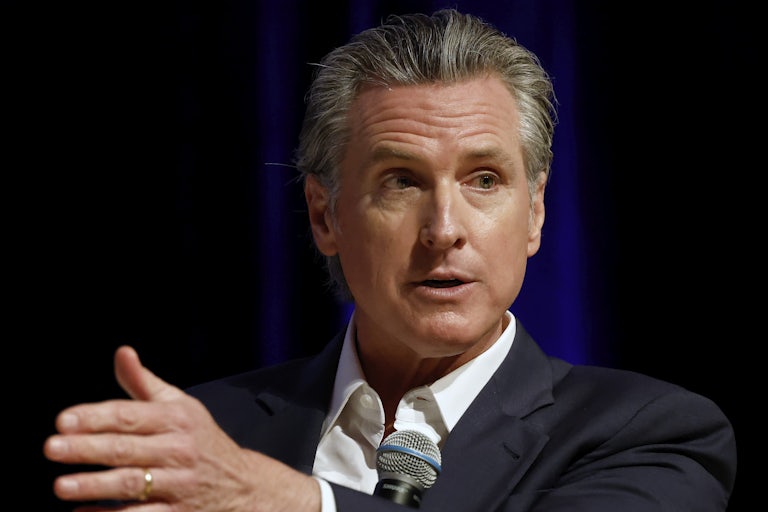
California Governor Gavin Newsom gestures while speaking
Mario Tama/Getty Images
California Governor Gavin Newsom

Fox News is headed back to court for another massive defamation lawsuit.

California Gavin Newsom announced Friday that he is suing the conservative media behemoth for $787 million after host Jesse Watters claimed that Newsom had lied about a call he had with Donald Trump during the Los Angeles anti-ICE protests.

Newsom accused Watters’s show of lying to viewers about the phone call by airing a misleadingly edited video of Trump to make their point.

“If Fox News wants to lie to the American people on Donald Trump’s behalf, it should face consequences—just like it did in the Dominion case,” Newsom told Politico in a statement. “Until Fox is willing to be truthful, I will keep fighting against their propaganda machine.”

The sum that Newsom is seeking is nearly identical to the amount that the network paid Dominion Voting Systems when they settled their lawsuit in 2023. Dominion had sued Fox for defamation after Fox accused the electronic voting machine company of stealing the election from Trump.

The California governor is suing in his personal capacity, using funds from his campaign account to cover any fines or possible penalties. He has also said that he’s willing to drop the lawsuit if Fox issues a correction and forces Watters to apologize on air—which doesn’t seem likely. A spokesperson for Fox News told The New Republic that the company was looking “forward to” the case “being dismissed.”

“Gov. Newsom’s transparent publicity stunt is frivolous and designed to chill free speech critical of him,” the spokesperson said in a statement.

In the event that the case settles or goes to trial, Newsom has pledged that all proceeds from the lawsuit will go toward anti-Trump legal causes.

Newsom spoke earlier this month with the president for nearly 20 minutes on the phone after the protests had started, but according to Newsom, the protests “barely” came up, despite his attempts to veer the conversation toward Los Angeles.

“He wanted to talk about all these other issues,” Newsom said of the phone call. “He never once brought up the National Guard. He’s a stone cold liar, he said he did.”

Despite the high bar required for a public official to prove defamation, the governor’s lawyers argued that Fox’s coverage of the call met the legal standard for defamation, potentially harming his reputation with voters for future elections.

The Democrat’s suit holds similarities to another case from the MAGA side, in which Trump sued CBS’s 60 Minutes over what he claimed was a deceptively edited interview with then–Democratic presidential candidate Vice President Kamala Harris. That suit, which the network settled, has so far resulted in the exit of two executives from CBS as the suit has become a cornerstone issue in the pending sale of Paramount.

This story has been updated.

Elena Kagan Torches Supreme Court’s Terrible Logic in Porn Ruling

The Supreme Court upheld a decision allowing age-verification laws for online porn.

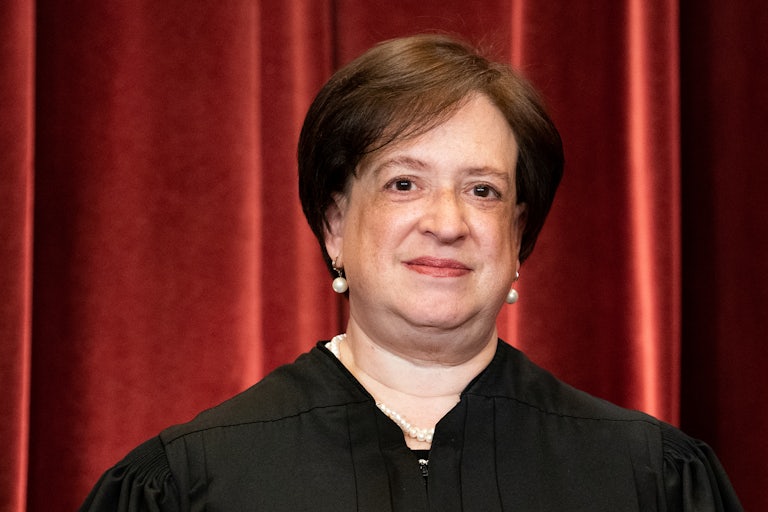
Supreme Court Justice Elena Kagan sits for a photo
Erin Schaff/Pool/Getty Images

Supreme Court Justice Elena Kagan ripped the court’s majority decision Friday upholding age-verification requirements for pornography websites.

In a scathing dissent joined by Justices Sonia Sotomayor and Kentanji Brown Jackson, Kagan accused the majority decision in Free Speech Coalition v. Paxton of diluting First Amendment protections for sexually explicit speech.

“The majority’s opinion concluding to the contrary is, to be frank, confused. The opinion, to start with, is at war with itself,” she wrote, because the majority opinion initially claims that age verification had nothing to do with the First Amendment, before ultimately it “gives up that ghost.”

Kagan argued that the Texas law requiring websites that host pornography or other sexually explicit materials to verify their users’ ages before allowing them access had restricted the access adults have to protected speech. While the rule was designed to prohibit minors from accessing explicit materials, many adults would likely be unwilling to hand over their personal information, such as a passport, to websites hosting pornography.

Kagan explained that the rule called for a higher level of scrutiny because it was not simply “incidentally” restrictive, as Justice Clarence Thomas—who wrote the majority opinion—claimed.

“Texas’s law defines speech by content and tells people entitled to view that speech that they must incur a cost to do so. That is, under our First Amendment law, a direct (not incidental) regulation of speech based on its content—which demands strict scrutiny,” she wrote.

Under intermediate scrutiny, Texas was not required to demonstrate that it had selected the option that was least restrictive for free speech. Kagan argued that this was not sufficient.

“A State may not care much about safeguarding adults’ access to sexually explicit speech; a State may even prefer to curtail those materials for everyone. Many reasonable people, after all, view the speech at issue here as ugly and harmful for any audience. But the First Amendment protects those sexually explicit materials, for every adult. So a State cannot target that expression, as Texas has here, any more than is necessary to prevent it from reaching children,” she wrote.

“That is what we have held in cases indistinguishable from this one. And that is what foundational First Amendment principles demand.”

Sotomayor Warns No One Is Safe After Birthright Citizenship Ruling

Liberal Justice Sonia Sotomayor torched the Supreme Court for siding with Trump on birthright citizenship—and putting every civil right under attack.

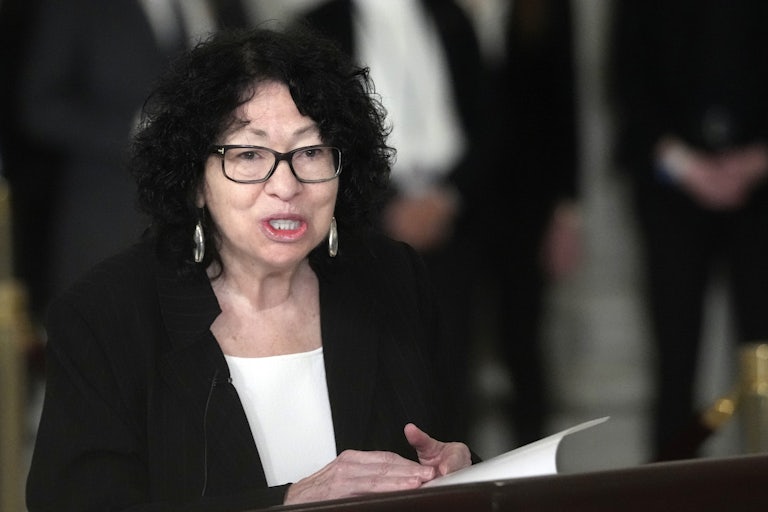
Justice Sonia Sotomayor speaks
Jacquelyn Martin/Pool/Getty Images

In dissenting opinions, Justices Sonia Sotomayor and Ketanji Brown Jackson excoriated the Supreme Court’s Friday ruling on birthright citizenship, which restricts courts’ ability to keep the Trump White House from carrying out its lawless orders.

At issue was whether lower courts can issue “nationwide injunctions” halting Trump’s anti–birthright citizenship order from being enforced against anyone, and not just those challenging the order in court or living in a jurisdiction where it’s being challenged.

While not acknowledging the constitutionality of the executive order, which denies automatic citizenship to children born on U.S. soil to undocumented immigrants and those with temporary status, the majority opinion stated that such injunctions “likely exceed the equitable authority that Congress has given to federal courts.”

Justice Sotomayor had choice words for this ruling, which seemingly provides Trump powerful ammunition in his attacks on civil liberties. She was joined by Justices Elena Kagan as well as Jackson, who also wrote a dissenting opinion.

“No right is safe in the new legal regime the Court creates,” Sotomayor’s dissent read. “Today, the threat is to birthright citizenship. Tomorrow, a different administration may try to seize firearms from lawabiding citizens or prevent people of certain faiths from gathering to worship.”

Sotomayor used an analogy to illustrate the absurdity of granting the government’s request to strike down nationwide freezes on plainly unlawful orders: “Suppose an executive order barred women from receiving unemployment benefits or black citizens from voting. Is the Government irreparably harmed, and entitled to emergency relief, by a district court order universally enjoining such policies? The majority, apparently, would say yes.”

Sotomayor torched her conservative colleagues for caving to Trump: “With the stroke of a pen, the President has made a ‘solemn mockery’ of our Constitution,” she wrote. “Rather than stand firm, the Court gives way. Because such complicity should know no place in our system of law, I dissent.”

Jackson began her dissent by noting she agrees “with every word of Justice Sotomayor’s dissent,” and decided to file hers to emphasize that the court’s ruling poses “an existential threat to the rule of law.”

Trump’s request to do away with universal injunctions, Jackson wrote, “is, at bottom, a request for this Court’s permission to engage in unlawful behavior” and “to continue doing something that a court has determined violates the Constitution.”

In granting that wish, Jackson wrote, the majority has permitted Trump to act not unlike a monarch, giving “the Executive the go-ahead to sometimes wield the kind of unchecked, arbitrary power the Founders crafted our Constitution to eradicate.”

By placing “the onus on the victims to invoke the law’s protection,” the court has created circumstances in which “a Martian arriving here from another planet would … surely wonder: ‘what good is the Constitution, then?’”

The court’s decision marks “a sad day for America,” Jackson said, requiring judges, faced with Trump’s lawlessness, “to look the other way” and permit “unlawful conduct to continue unabated.”

“Perhaps the degradation of our rule-of-law regime would happen anyway,” she wrote. “But this Court’s complicity in the creation of a culture of disdain for lower courts, their rulings, and the law (as they interpret it) will surely hasten the downfall of our governing institutions, enabling our collective demise.”

Sotomayor Rips SCOTUS for Causing Total “Chaos” in LGBTQ Books Case

Justice Sonia Sotomayor warned that the Supreme Court was actually enabling censorship.

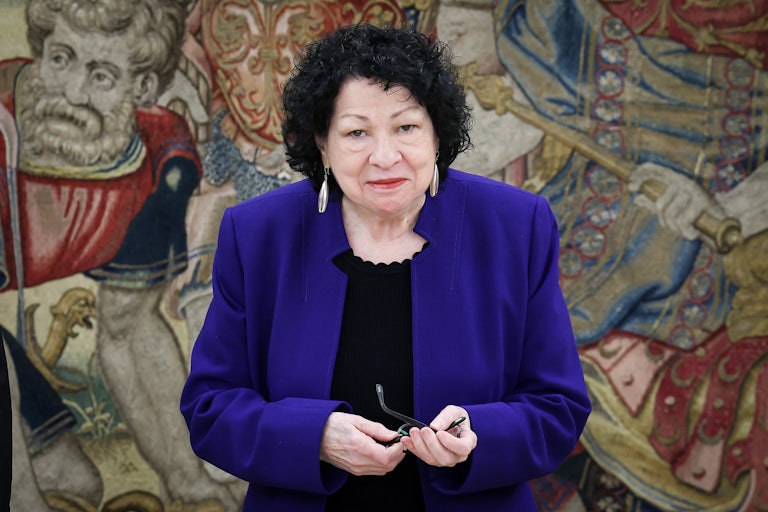
Supreme Court Justice Sonia Sotomayor holds her glasses while standing in the royal palace in Madrid, Spain
Pablo Cuadra/Getty Images
Supreme Court Justice Sonia Sotomayor

Justice Sonia Sotomayor excoriated the nation’s highest judiciary Friday for ruling 63 to permit a group of Maryland parents to withdraw their children from LGBTQ+ exposure in the public school curriculum on the basis of religious freedom.

The progressive justice railed against the majority opinion, writing that the result of the decision will be “chaos” as school administrators are forced either to overextend themselves to accommodate parents’ newly constitutionalized authority or strip LGBTQ+ material from the curriculum entirely.

In a dissenting opinion, Sotomayor argued that the decision would “impose impossible administrative burdens on schools” by requiring them to provide advance notice to parents before they utilized or taught LGBTQ-related content, in order to give parents ample time to “opt out” of the lesson plan.

“The harm will not be borne by educators alone: Children will suffer too,” she said. “Classroom disruptions and absences may well inflict long-lasting harm on students’ learning and development.”

But worse still, according to Sotomayor, is the opening that the nation’s highest judiciary has handed to a vocal minority of parents to disrupt local democracies, allowing them to legally challenge the decisions of publicly elected school officials, sparking educational ramifications for all families whether they agree with the curricula or not.

“The majority closes its eyes to the inevitable chilling effects of its ruling,” she wrote. “Many school districts, and particularly the most resource strapped, cannot afford to engage in costly litigation over opt-out rights or to divert resources to tracking and managing student absences.

“Schools may instead censor their curricula, stripping material that risks generating religious objections,” Sotomayor continued. “The Court’s ruling, in effect, thus hands a subset of parents the right to veto curricular choices long left to locally elected school boards. Because I cannot countenance the Court’s contortion of our precedent and the untold harms that will follow, I dissent.”

The court’s decision Friday was the culmination of a three-year legal battle. In 2022, the Montgomery County school board approved the use of LGBTQ+ themed storybooks for elementary school–age children, including Uncle Bobby’s Wedding, in which a kid goes to her uncle’s same-sex wedding, as well as a book where a puppy gets lost in a Pride Parade. At the crux of Friday’s case was a decision made the following year by the Montgomery County school board, preventing parents from opting their kids out of the coursework.

The ruling is most likely to result in a reduction in LGBTQ-adjacent education across the country, as cash-strapped educators attempt to avoid ruinous lawsuits.

Legal experts analyzing the case were quick to point out other flaws riddled in the decision, arguing that the “level of subtlety” permitted by the court to constitute a religious liberty violation could cook up more lawsuits along other theologically contested lines.

“Case in point: arguably this would permit Christian Scientists to opt out of any book where a doctor heals someone,” posted American Immigration Council senior fellow Aaron Reichlin-Melnick.