Breaking News
Breaking News
from Washington and beyond

Republicans Sneak Filibuster-Weakening Trick Into Bill to Help Trump

Senate Republicans are forcing through an anti-filibuster measure on the budget bill.

Lindsey Graham gestures and speaks during a Senate hearing
Eric Lee/Bloomberg/Getty Images

Senate Republicans are dropping to new lows to sidestep the filibuster and pass Donald Trump’s behemoth budget bill.

In an effort to more painlessly pass Trump’s wildly unpopular tax and spending bill, Republicans are pushing for a creative accounting method that uses a “current policy” baseline, which would prevent a filibuster and allow the bill to pass with 51 votes instead of 60.

Ironically, many Democrats have sought for years to eliminate the filibuster, a move Republicans opposed. In November, Republican Senate leadership swore they’d keep the filibuster in place.

To use a “current policy” baseline assumes the continuation of existing policy such as Trump’s 2017 tax plan, which is set to expire at the end of the year. The more typical “current law” baseline, which was used to pass the House’s version of the bill, assumes that Trump’s 2017 tax plan would expire in the next 10 years.

By using “current policy” rather than “current law,” Republican lawmakers can pretend that the bill’s exorbitant estimated costs are far lower than they actually are. A new estimate from the Congressional Budget Office found that the bill would add nearly $4 trillion to the national deficit through 2034, and continue to grow the deficit afterward, in violation of the Senate’s Byrd Rule. Republicans using “current policy” have claimed that the bill would only add $500 billion to the national deficit and doesn’t break any rules that would prevent it from being passed.

Although Democrats sought a meeting with the Senate parliamentarian to oppose the use of such a blatant gimmick, Republicans refused to hold a bipartisan meeting, arguing that it was up to Senate Budget Committee Chairman Lindsey Graham, who had opted to use “current policy.”

A “current policy” baseline has never been used for a budget reconciliation bill—and if allowed, could be used by the Democrats should they reclaim the majority next year.

“There is no filibuster if the Senate R’s do this and when Dems take power there is no reason why we should not use reconciliation to pass immigration reform,” wrote Arizona Senator Ruben Gallego on X Sunday.
Kristi Noem Secretly Took Mystery Donation From Dark-Money Group

When she was a governor, Noem boosted her income with money from a mysterious donor. Then she left it off her federal disclosure forms.

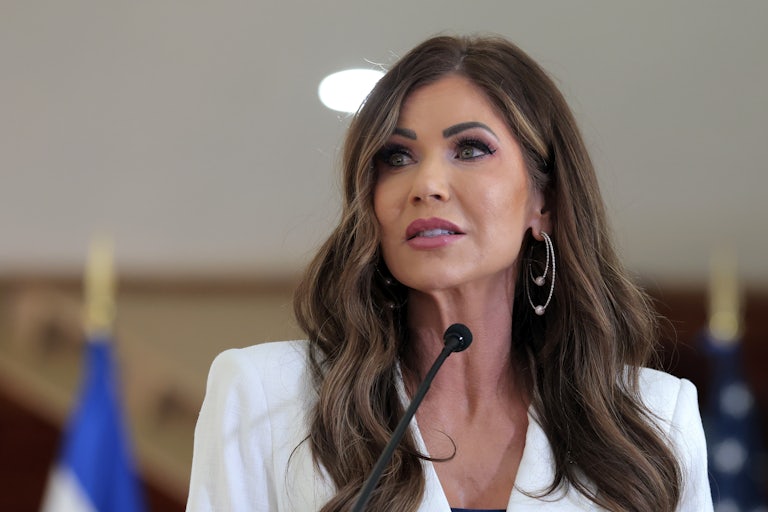
Homeland Security Secretary Kristi Noem speaks at a mic.
Anna Moneymaker/Getty Images

A ProPublica report Monday reveals that Trump’s Homeland Security Secretary Kristi Noem received and failed to publicly disclose an $80,000 payment from a dark-money group.

ProPublica reports that in June 2023, Noem, then the governor of South Dakota, set up an LLC in Delaware. Within four minutes, a dark-money group (i.e., a group that doesn’t disclose its sources of funding) was created, called the American Resolve Policy Fund. The group reported having no employees in 2023, and its activities are “unclear,” according to ProPublica.

In 2023, American Resolve reportedly raised just over a million dollars, and spent only about a fifth of that, including an $80,000 payment to Noem’s LLC, allegedly for having fundraised $800,000. When she was appointed by Trump, Noem then failed to publicly disclose the payment on the public financial disclosure form required of high-level government officials.

“If donors to these nonprofits [dark-money groups] are not just holding the keys to an elected official’s political future but also literally providing them with their income, that’s new and disturbing,” Daniel Weiner, former Federal Election Commission attorney and current campaign finance program director at the Brennan Center, told ProPublica.

Lee Schoenbeck, a South Dakota politician and attorney, added that the payment may have violated state law barring the governor from receiving “for any of their official services any other compensation, emoluments, or perquisites than the salaries provided by law.”

“There’s no way the governor is supposed to have a private side business that the public doesn’t know about,” Schoenbeck told ProPublica. “It would clearly not be appropriate.”

Noem’s attorney assured ProPublica that Noem had “fully complied with the letter and the spirit of the law,” and underwent proper scrutiny from the Office of Government Ethics. The attorney also said Noem had “fully disclosed all of her income on public documents that are readily available,” but failed to respond to ProPublica with evidence supporting this in light of the unreported $80,000 payment.

The revelation adds to a record of eyebrow-raising spending habits on the part of Noem—to say nothing of the Trump administration writ large. Noem faced scrutiny for carrying around hefty wads of cash, as well as for conspicuously sporting a $50,000 gold Rolex during a March trip to a prison in El Salvador. That same month, the Associated Press, despite Noem’s best efforts, exposed that taxpayers had footed the bill for her personal travel expenses as governor, including for a trip to go on a bear hunt in Canada and receive dental work in Houston.

Bernie Sanders Slams GOP Budget as Worst Bill in Modern U.S. History

The Vermont senator warned that Republicans’ budget bill is a “death sentence.”

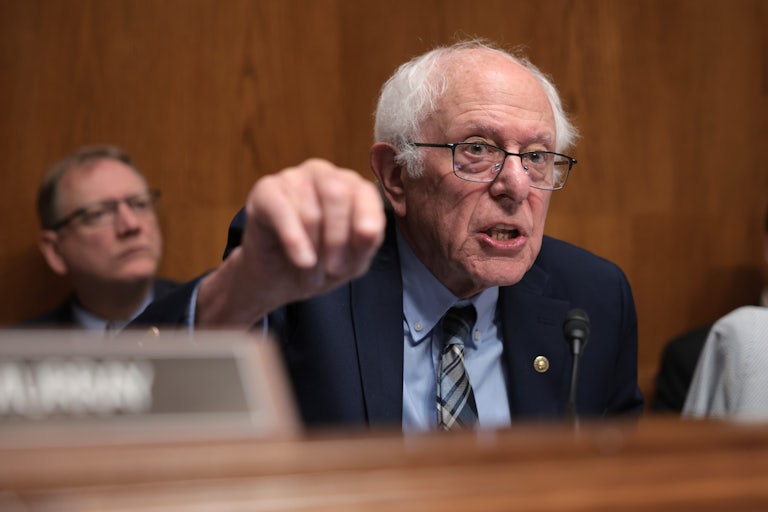
Senator Bernie Sanders speaking during a congressional hearing.
Kayla Bartkowski/Getty Images

Senator Bernie Sanders thinks that Trump’s budget bill is “the most dangerous piece of legislation in the modern history of our country.”

On Sunday evening, the country’s most recognizable socialist took time to offer a scathing rebuke of the president’s most significant piece of legislation to date, highlighting the bill’s obvious skew toward the wealthy at the expense of the working class.  

“If you are in the top one percent, you and the class you represent will receive a $975 billion tax break$975 billion tax break—at a time when the richest people in this country have never ever had it so good,” Sanders said. “If you are among the wealthiest two-tenths of one percent—not talking about one percent, talking about the top two-tenths of one percent—you will be able to pay zero taxes on your $30 million inheritance. So all of you folks out there who are waiting to inherit at least $30 million, today is a good day for you! Collectively, you will receive approximately $211 billion in tax breaks. For the top two-tenths of one percent: Congratulations, you hit the jackpot.” 

Sanders then moved to the massive corporate bias baked into Trump’s bill. 

“If you are a large corporation, and you want to throw workers out on the street and replace them with artificial intelligence, or maybe you want to shift your profits to the Cayman Islands or other tax havens: You are going to get a $918 billion tax break. Congratulations to the CEOs of large profitable corporations,” he said sarcastically. 

The senator from Vermont was most incensed about the bill’s attacks on Medicaid. 

“If you are concerned about health care, which I suspect that everybody in the world is, this bill throws over 16 million people off the health insurance they have, according to the Congressional Budget Office, by cutting Medicaid and the Affordable Care Act by over $1.1 trillion,” Sanders said. “In other words, the top one percent [is] getting a $975 billion tax break, and that is coming directly by throwing 16 million people off of the health insurance they have. 

“Over fifty thousand Americans will die unnecessarily every year,” Sanders warned. “Fifty thousand Americans will die unnecessarily in order to give tax breaks to billionaires who don’t need them. In other words, this bill is literally a death sentence for low-income and working-class people.”

Even two Republican senators have come out against the bill on the grounds that it will hurt their own constituents and possibly set the GOP back with voters in 2026 and 2028. 

“Alright, so what do I tell 663,000 people in two years or three years, when President Trump breaks his promise by pushing them off of Medicaid because the funding’s not there anymore, guys?” Senator Thom Tillis said Sunday, shortly after announcing his retirement. “The people in the White House advising the president … are not telling him that the effect of this bill is to break a promise.”

As Trump puts on his faux-populist act and lauds himself for little gifts like his no taxes on tips policy, it’s obvious that this bill is tailor-made for people like him: those who are incredibly wealthy and have a vested interest in protecting that wealth, even at the expense of health care for those in need.  

“Bottom line is that this legislation is the most significant attack on the health care needs of the American people in our country’s history,” Sanders said. 

Trump’s Budget Bill Is Most Unpopular Move Yet, New Poll Shows

Donald Trump’s budget bill is underwater in voter approval polls.

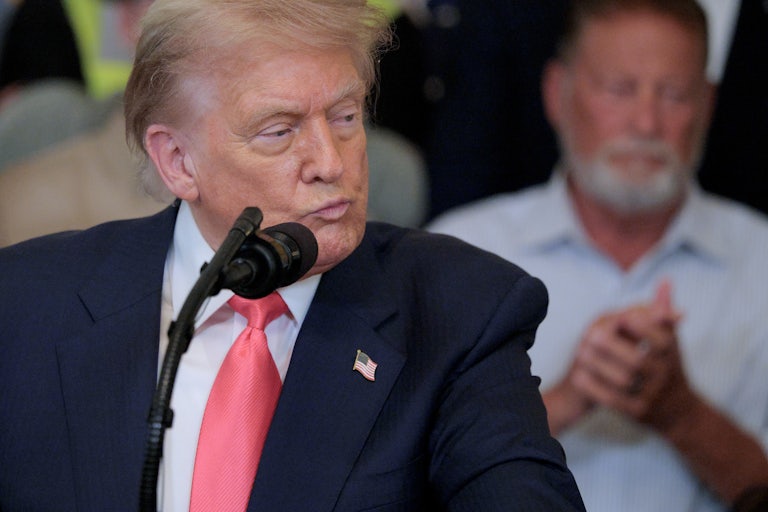
Donald Trump purses his lips while standing at a microphone
Chip Somodevilla/Getty Images

Americans oppose Donald Trump’s “big, beautiful bill” so overwhelmingly that the president may need to find a new name for it, according to CNN’s chief data analyst Harry Enten.

“Yeah, if we’re talking about adjectives, how ’bout they think it’s ‘awful,’ they think it’s ‘horrible,’ and to quote our colleague Charles Barkley, ‘terrible, terrible, terrible,’” Enten explained Sunday night.

Enten highlighted multiple polls from throughout June that found that Trump’s gargantuan budget and tax bill was wildly unpopular with voters. “I don’t just got one poll for you Omar, I got five of ’em,” Enten explained to CNN host Omar Jimenez.

A survey by The Washington Post found that 42 percent of Americans opposed the bill, while only 23 percent supported it, leaving the legislation with a net favorable rating of -19—and that was the most positive that the results got. A Pew Research Center poll found that the bill had a net favorable rating of -20, Fox News found a net favorable rating of -21, Quinnipiac found a net favorable rating of -26, and KFF found a net favorable rating of -29.

“You don’t have to be a mathematical genius to know that when the net favorable rating of your bill is somewhere between negative 19 and negative 29 points that it is not a positive bill as viewed by the American public,” Enten said.

CNN’s reporting only continues to confirm what is already clear: The public doesn’t support legislation that will add $3.2 trillion to the deficit while slashing critical Medicaid and food stamp programs and giving tax breaks to wealthy people and corporations. Even members of Trump’s own base have been left feeling betrayed by the president.

Stable Genius Trump Reveals Plan to Get Trade Deals: Mean Letters

Donald Trump also made it clear he has no clue who the prime minister of Japan is.

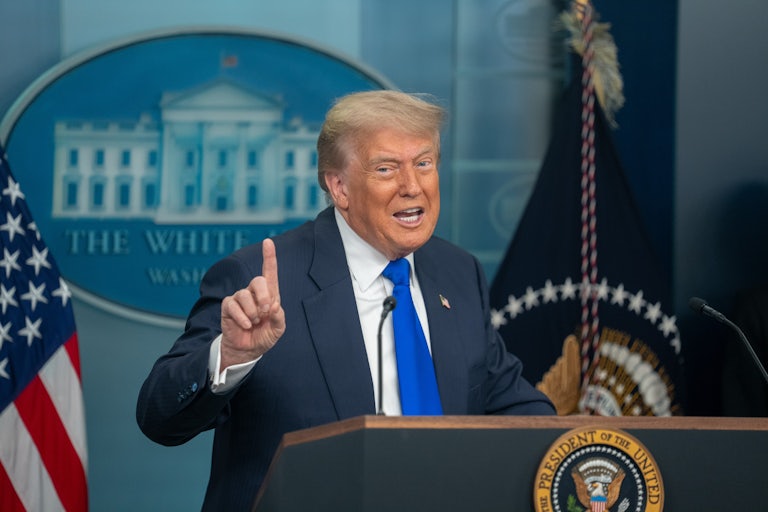
Donald Trump raises his finger while speaking at the podium in the White House press briefing room
Hu Yousong/Xinhua/Getty Images

Mister “Liberation Day” is suddenly tired of his tariff plan.

The newest chapter in Donald Trump’s global trade rearrangement will look like a series of “very fair” letters that will effectively dictate permitted trade rates with the U.S., the president outlined in a rough pitch on Fox News’s Sunday Morning Futures.

“We made deals, but I’d rather just send them a letter, a very fair letter, saying, ‘Congratulations, we’re going to allow you to trade in the United States of America, you’re going to pay a 25 percent tariff, or 20 percent, or 40 or 50 percent.’ I would rather do that,” Trump said.

The Trump administration has already extended trade discussions until July 9. Last week, there were murmurings among senior Trump officials that the deadline could be extended yet again, with press secretary Karoline Leavitt describing the hard stop as “not critical.” But on Sunday, Trump didn’t seem sure that he’d need to extend the pause.

“I don’t think I’ll need to. I could, there’s no big deal,” he told Fox. “What I wanted to do is, and what I will do just—sometime prior to the ninth—is we’ll send a letter to all these countries.”

The letters, according to Trump, will be the “end of the trade deal,” suggesting that no negotiations will take place after the White House hits the mailbox. “We don’t have to meet. We understand, we have all the numbers,” he said.

But one provided example did little to evoke confidence in the plan, as Trump apparently forgot the name of Japan’s prime minister: “‘Dear Mr. Japan, here’s the story,’” Trump proposed. “‘You’re going to pay a 25 percent tariff on your cars.’”

It’s not the first time that Trump has offered to stamp out trade talks by issuing a string of letters. He made similar promises on May 16 and June 11, claiming both times that the letters would be issued in a handful of weeks, though that never came to fruition.

Trump’s tariff proposals haven’t won the U.S. too much negotiating ground. Instead, countries around the world began observing that—rather than playing the waiting game to meet with the White House over potential trade relief—China’s tough negotiating strategy with the former real estate mogul had actually gotten the Eastern powerhouse a significantly better deal.

In the end, it will be America that pays the price when the Trump administration runs out of time on its “90 deals in 90 days” promise. Last week, Federal Reserve Chair Jerome Powell said that the central bank would wait to see the residual impacts of the country’s new tariff plan before reducing its key interest rate, as companies have already decided to increase product prices this year in reaction to hampered global supply chains.