Breaking News
Breaking News
from Washington and beyond

Justice Department Announces Chilling Plan to Revoke Citizenship

Trump’s DOJ issued a directive making it a priority to strip some Americans of their citizenship.

A brown woman seated holds a U.S. flag in her left hand and a stack of papers in her lap. The paper on top reads "Congratulations on Becoming a U.S. Citizen."
Robert Nickelsberg/Getty Images

Under Donald Trump, the Department of Justice is looking to ramp up denaturalization, or the revocation of citizenship, in order to fulfil its mass-deportation immigration agenda.

A June 11 memo from Assistant Attorney General Brett Shumate listed “prioritizing denaturalization” as a key administration directive for the civil division of the DOJ under Trump.

The DOJ’s civil division will now “prioritize and maximally pursue denaturalization proceedings in all cases permitted by law and supported by the evidence.” These include those “who pose a potential danger to national security,” those who engaged in fraud, and those who acquired citizenship through “material misrepresentations,” as well as “any other cases referred to the Civil Division that the Division determines to be sufficiently important to pursue.”

This would mark a notable departure from current norms.

Political scientist Patrick Weil estimates that, between 1907 and 1967, over 22,000 Americans were denaturalized—including, infamously, for political reasons during the first and second red scares. Denaturalization then fell out of use considerably, with only about 11 cases occurring each year from 1990 to 2017.

Denaturalization efforts were expanded under Obama, and increased further under the first Trump administration—which realized, as journalist Rafia Zakaria wrote in The Nation, that civil denaturalization cases have a lower burden of proof than criminal cases and no statute of limitations, making them easier targets.

The June 11 directive recalls Trump aide Stephen Miller’s October 2023 vow that the “denaturalization project” will be “turbocharged” in 2025, as well as Trump’s own statements in support of deporting naturalized citizens and even “homegrown criminals.”

The news comes as threats of denaturalization have become a common cudgel on the MAGA right, whose adherents—from media personalities to lawmakers—have increasingly called for the denaturalization and deportation of their ideological opponents, such as Democratic New York City mayoral nominee Zohran Mamdani, Representative Ilhan Omar, and journalist Mehdi Hasan. It also comes as the Trump administration has conflated pro-Palestinian activism with support for terrorism.
Elon Musk Tears Into Trump Over Budget in Infuriated Posting Spree

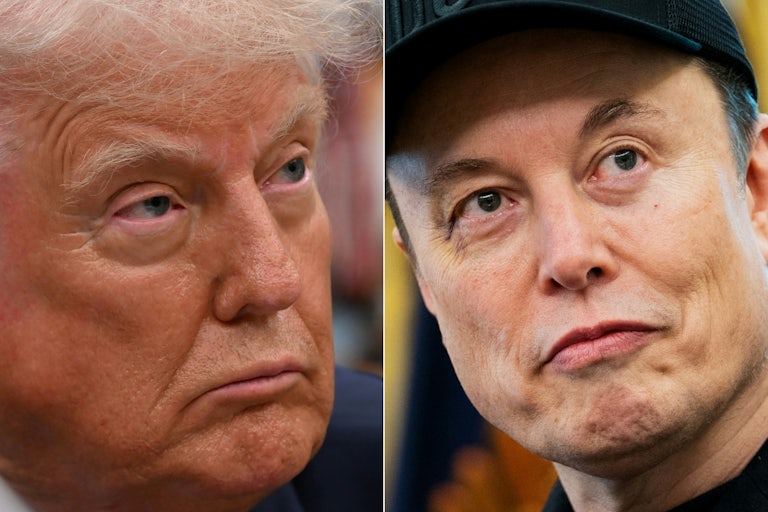
Elon Musk’s opposition to the budget is what prompted his very public breakup with Donald Trump.

Donald Trump smiles and leans over while seated at a conference table with Secetary of State Marco Rubio, Defense Secretary Pete Hegseth, Central Intelligence Agency Director John Ratcliffe, and U.S. Ambassador to Israel Mike Huckabee.
Alex Wroblewski, Allison Robbert/AFP/Getty Images

Elon Musk threw himself back into the federal fray over the weekend, drawing more attention to the conservative opposition to the president’s tax extension bill.

Donald Trump’s “big, beautiful bill” would extend his 2017 tax cuts for millionaires and corporations at a cost to critical social programs such as Medicaid. On Saturday, the Congressional Budget Office estimated that the Senate legislation would increase the deficit by more than $3.9 trillion over the next 10 years.

After Democrats forced a full read-through of the 1,018-page text on Saturday (which took approximately 16 hours), Senate Republicans initiated a “vote-a-rama,” in which lawmakers can propose an unlimited number of amendments as they vote back-to-back on the legislation. But by Monday, it wasn’t clear that the upper chamber actually had the support of the nation in moving to pass the bill—CNN data chief Harry Enten analyzed five recent polls that cumulatively indicated the bill is historically unpopular, with 49 percent of the country believing it will hurt their families as opposed to the 23 percent who think it will help them.

And despite publicly stitching up his feud with the president several weeks ago, Musk was right there with the majority of the American public in resisting the bill.

“Polls show that this bill is political suicide for the Republican Party,” Musk posted Saturday, sharing polling from polling firm the Tarrance Group suggesting that 58 percent of all registered voters in the country agreed with his previous assessment that the bill is “pork-filled.”

Musk also retweeted a statement from North American Building Trades Union President Sean McGarvey, who torched Trump’s bill as “a massive insult” to American construction workers, and underscored that “critical infrastructure projects essential to that future are being sacrificed at the altar of ideology.”

“We are especially outraged because all of this, all of these job losses for hardworking Americans, is being done for one reason only: to make room for more tax breaks for the wealthiest corporations and individuals in America,” McGarvey wrote.

The multibillionaire Musk went head-to-head with Trump earlier this month, when he threatened to change the tune of his Republican contributions and instead use his enormous wealth to influence the country to “fire all politicians who betrayed the American people.”

Republicans plan to offset the expensive tax cut by slashing some $880 billion from Medicaid. But Musk’s issue with Trump’s plan has little to do with its slashing of programs aimed at supporting and uplifting the most vulnerable Americans—instead, he’s condemned the bill on the basis that it would effectively undo his work atop the Department of Government Efficiency, which was tasked with paring down government spending.

Musk was Trump’s top financial backer in the 2024 election, spending at least $250 million in the final months of the president’s campaign after Trump was shot in July. Musk had also promised to funnel funds toward other Republicans, declaring in the wake of the November election that his super PACs would “play a significant role in primaries.” In the following months, Musk threatened to use his money to fund primary challengers to Trump’s agenda and go after Democrats, and that he would be preparing “for the midterms and any intermediate elections, as well as looking at elections at the district attorney level.”

Trump’s centerpiece legislation currently faces a self-imposed July 4 deadline.

Republicans Sneak Filibuster-Weakening Trick Into Bill to Help Trump

Senate Republicans are forcing through an anti-filibuster measure on the budget bill.

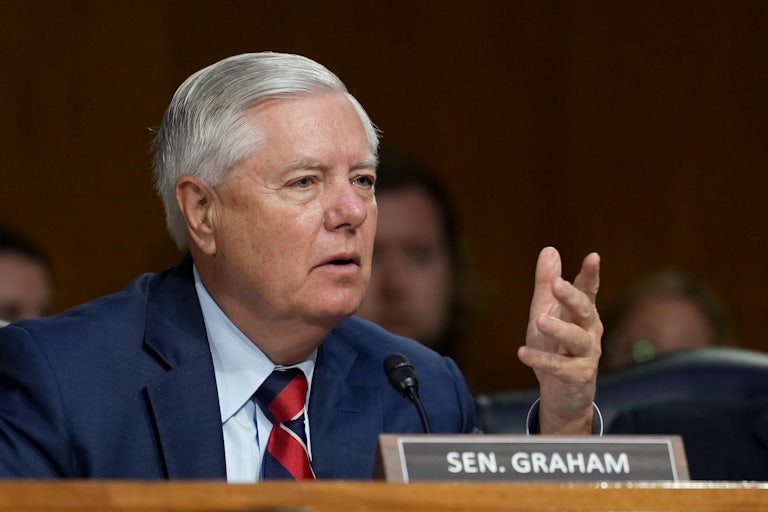
Lindsey Graham gestures and speaks during a Senate hearing
Eric Lee/Bloomberg/Getty Images

Senate Republicans are dropping to new lows to sidestep the filibuster and pass Donald Trump’s behemoth budget bill.

In an effort to more painlessly pass Trump’s wildly unpopular tax and spending bill, Republicans are pushing for a creative accounting method that uses a “current policy” baseline, which would prevent a filibuster and allow the bill to pass with 51 votes instead of 60.

Ironically, many Democrats have sought for years to eliminate the filibuster, a move Republicans opposed. In November, Republican Senate leadership swore they’d keep the filibuster in place.

To use a “current policy” baseline assumes the continuation of existing policy such as Trump’s 2017 tax plan, which is set to expire at the end of the year. The more typical “current law” baseline, which was used to pass the House’s version of the bill, assumes that Trump’s 2017 tax plan would expire in the next 10 years.

By using “current policy” rather than “current law,” Republican lawmakers can pretend that the bill’s exorbitant estimated costs are far lower than they actually are. A new estimate from the Congressional Budget Office found that the bill would add nearly $4 trillion to the national deficit through 2034, and continue to grow the deficit afterward, in violation of the Senate’s Byrd Rule. Republicans using “current policy” have claimed that the bill would only add $500 billion to the national deficit and doesn’t break any rules that would prevent it from being passed.

Although Democrats sought a meeting with the Senate parliamentarian to oppose the use of such a blatant gimmick, Republicans refused to hold a bipartisan meeting, arguing that it was up to Senate Budget Committee Chairman Lindsey Graham, who had opted to use “current policy.”

A “current policy” baseline has never been used for a budget reconciliation bill—and if allowed, could be used by the Democrats should they reclaim the majority next year.

“There is no filibuster if the Senate R’s do this and when Dems take power there is no reason why we should not use reconciliation to pass immigration reform,” wrote Arizona Senator Ruben Gallego on X Sunday.

Kristi Noem Secretly Took Mystery Donation From Dark-Money Group

When she was a governor, Noem boosted her income with money from a mysterious donor. Then she left it off her federal disclosure forms.

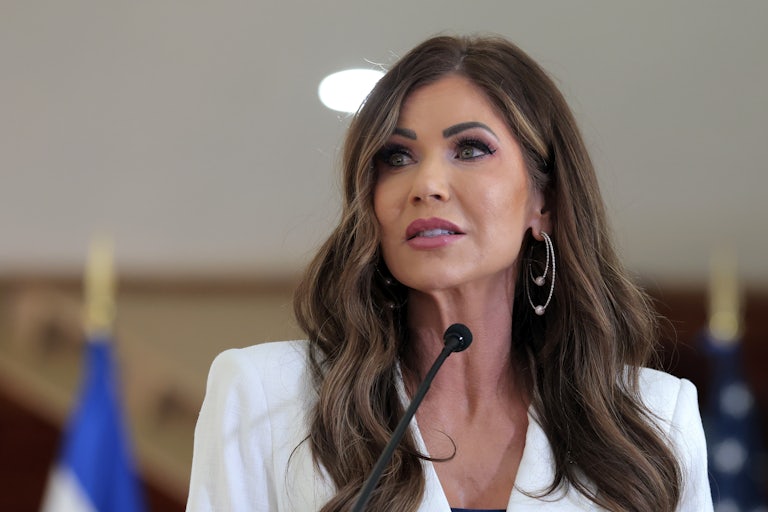
Homeland Security Secretary Kristi Noem speaks at a mic.
Anna Moneymaker/Getty Images

A ProPublica report Monday reveals that Trump’s Homeland Security Secretary Kristi Noem received and failed to publicly disclose an $80,000 payment from a dark-money group.

ProPublica reports that in June 2023, Noem, then the governor of South Dakota, set up an LLC in Delaware. Within four minutes, a dark-money group (i.e., a group that doesn’t disclose its sources of funding) was created, called the American Resolve Policy Fund. The group reported having no employees in 2023, and its activities are “unclear,” according to ProPublica.

In 2023, American Resolve reportedly raised just over a million dollars, and spent only about a fifth of that, including an $80,000 payment to Noem’s LLC, allegedly for having fundraised $800,000. When she was appointed by Trump, Noem then failed to publicly disclose the payment on the public financial disclosure form required of high-level government officials.

“If donors to these nonprofits [dark-money groups] are not just holding the keys to an elected official’s political future but also literally providing them with their income, that’s new and disturbing,” Daniel Weiner, former Federal Election Commission attorney and current campaign finance program director at the Brennan Center, told ProPublica.

Lee Schoenbeck, a South Dakota politician and attorney, added that the payment may have violated state law barring the governor from receiving “for any of their official services any other compensation, emoluments, or perquisites than the salaries provided by law.”

“There’s no way the governor is supposed to have a private side business that the public doesn’t know about,” Schoenbeck told ProPublica. “It would clearly not be appropriate.”

Noem’s attorney assured ProPublica that Noem had “fully complied with the letter and the spirit of the law,” and underwent proper scrutiny from the Office of Government Ethics. The attorney also said Noem had “fully disclosed all of her income on public documents that are readily available,” but failed to respond to ProPublica with evidence supporting this in light of the unreported $80,000 payment.

The revelation adds to a record of eyebrow-raising spending habits on the part of Noem—to say nothing of the Trump administration writ large. Noem faced scrutiny for carrying around hefty wads of cash, as well as for conspicuously sporting a $50,000 gold Rolex during a March trip to a prison in El Salvador. That same month, the Associated Press, despite Noem’s best efforts, exposed that taxpayers had footed the bill for her personal travel expenses as governor, including for a trip to go on a bear hunt in Canada and receive dental work in Houston.

Bernie Sanders Slams GOP Budget as Worst Bill in Modern U.S. History

The Vermont senator warned that Republicans’ budget bill is a “death sentence.”

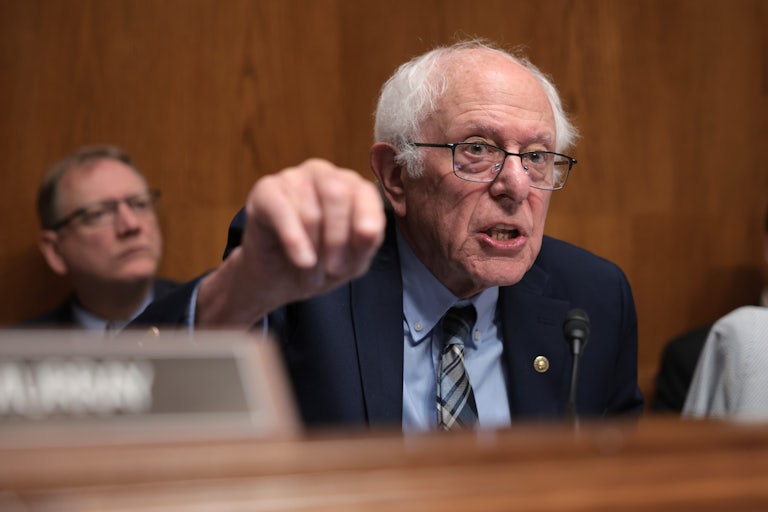
Senator Bernie Sanders speaking during a congressional hearing.
Kayla Bartkowski/Getty Images

Senator Bernie Sanders thinks that Trump’s budget bill is “the most dangerous piece of legislation in the modern history of our country.”

On Sunday evening, the country’s most recognizable socialist took time to offer a scathing rebuke of the president’s most significant piece of legislation to date, highlighting the bill’s obvious skew toward the wealthy at the expense of the working class.  

“If you are in the top one percent, you and the class you represent will receive a $975 billion tax break$975 billion tax break—at a time when the richest people in this country have never ever had it so good,” Sanders said. “If you are among the wealthiest two-tenths of one percent—not talking about one percent, talking about the top two-tenths of one percent—you will be able to pay zero taxes on your $30 million inheritance. So all of you folks out there who are waiting to inherit at least $30 million, today is a good day for you! Collectively, you will receive approximately $211 billion in tax breaks. For the top two-tenths of one percent: Congratulations, you hit the jackpot.” 

Sanders then moved to the massive corporate bias baked into Trump’s bill. 

“If you are a large corporation, and you want to throw workers out on the street and replace them with artificial intelligence, or maybe you want to shift your profits to the Cayman Islands or other tax havens: You are going to get a $918 billion tax break. Congratulations to the CEOs of large profitable corporations,” he said sarcastically. 

The senator from Vermont was most incensed about the bill’s attacks on Medicaid. 

“If you are concerned about health care, which I suspect that everybody in the world is, this bill throws over 16 million people off the health insurance they have, according to the Congressional Budget Office, by cutting Medicaid and the Affordable Care Act by over $1.1 trillion,” Sanders said. “In other words, the top one percent [is] getting a $975 billion tax break, and that is coming directly by throwing 16 million people off of the health insurance they have. 

“Over fifty thousand Americans will die unnecessarily every year,” Sanders warned. “Fifty thousand Americans will die unnecessarily in order to give tax breaks to billionaires who don’t need them. In other words, this bill is literally a death sentence for low-income and working-class people.”

Even two Republican senators have come out against the bill on the grounds that it will hurt their own constituents and possibly set the GOP back with voters in 2026 and 2028. 

“Alright, so what do I tell 663,000 people in two years or three years, when President Trump breaks his promise by pushing them off of Medicaid because the funding’s not there anymore, guys?” Senator Thom Tillis said Sunday, shortly after announcing his retirement. “The people in the White House advising the president … are not telling him that the effect of this bill is to break a promise.”

As Trump puts on his faux-populist act and lauds himself for little gifts like his no taxes on tips policy, it’s obvious that this bill is tailor-made for people like him: those who are incredibly wealthy and have a vested interest in protecting that wealth, even at the expense of health care for those in need.  

“Bottom line is that this legislation is the most significant attack on the health care needs of the American people in our country’s history,” Sanders said.