Breaking News
Breaking News
from Washington and beyond

ICE Finally Admits Truth About Dramatic Spike in Assaults of Agents

The Trump administration says there’s been a serious increase in assaults of ICE agents. Here are the actual numbers.

Four men wearing face masks and police vests stand inside a building.
BRYAN R. SMITH/AFP/Getty Images

Immigration and Customs Enforcement and the Department of Homeland Security have repeatedly cited an increase in assaults against federal agents conducting immigration enforcement to justify agents concealing their identities (and thereby conveniently avoiding accountability) while making arrests.

Newly reported data sheds clearer light on these figures.

On Tuesday, Bill Melugin of Fox News reported on X that DHS told him assaults against ICE and federal immigration enforcement are now up 690 percent from last year. While ICE has previously stuck to publishing percentages, Melugin was given raw data, reporting 79 assaults against immigration enforcement agents between January 21 and June 30, up from 10 that took place in the same time last year.

For comparison, from January through May, the New York Police Department reported 970 assaults on uniformed officers in the city (granted, the NYPD employs about 15,000 more officers than ICE does—though Trump’s “big, beautiful bill” would lessen the gap).

It’s also worth noting that the increase comes at a time when, under Trump, the number of ICE encounters taking place has increased staggeringly—a fact that criminal justice journalist Jessica Pishko said makes the figures “uniquely unimpressive.”

And the increasingly common encounters have been accompanied by increasingly aggressive policing tactics.

According to USA Today, law enforcement experts say that, by employing “practices that many American police departments have largely disavowed,” immigration enforcement agents “are exacerbating tense situations” and “provoking unnecessarily dangerous encounters.” Regarding these tactics, retired law enforcement veteran Diane Goldstein told USA Today that immigration enforcement officers’ “direction and their leadership is directly putting them in a horrific situation.”

The practice of wearing masks and making arrests that are virtually indistinguishable from kidnappings also increases the likelihood of confusion and bystander intervention, according to former ICE acting Director John Sandweg.

Further, reckoning rationally with ICE’s data would require scrutinizing what constitutes an assault in ICE’s eyes, as the agency has done itself no favors by making dubious assault accusations. Take, for example, those it made against New York City Comptroller Brad Lander, who was arrested “for assaulting law enforcement” earlier this month—a claim that The Washington Post’s Phillip Bump likened to a bully accusing his victim “of having gotten in the way of his fist.”
Senate Passes Trump Budget After Buying Lisa Murkowski’s Vote

Alaska Senator Lisa Murkowski’s last-minute “yes” vote proved pivotal for forcing Donald Trump’s budget through.

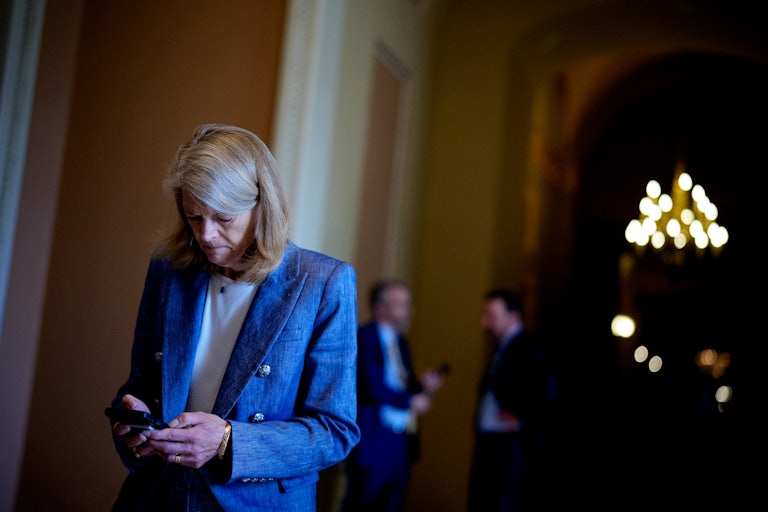
Senator Lisa Murkowski looks down at her phone while walking in the Capitol
Andrew Harnik/Getty Images

Donald Trump’s wildly unpopular “big, beautiful bill” just barely passed in the Senate Tuesday, and it’s all thanks to Alaska Senator Lisa Murkowski.

The bill passed with a vote of 51–50, with Vice President JD Vance providing the tie-breaking vote. But it was Murkowski’s vote that ultimately tipped the scales so the bill could pass.

In order to win Murkowski’s support, Republicans had added several provisions that would sweeten the deal for her state. But at the very last second, the Senate parliamentarian struck a carve-out that would’ve expanded federal funding for Medicaid in Alaska.

All 47 Democrats voted against the bill, and they were joined by Senators Rand Paul, Thom Tillis, and Susan Collins. Had Murkowski also voted “no,” the bill would have been defeated.

Murkowski told reporters that she hoped the House would send the bill back to the Senate so they could continue working on it. “My hope is that the House is gonna look at this and recognize that we’re not there yet,” Murkowski said, revealing just how misguided her support actually was.

When asked why she voted to pass the bill if she thought it wasn’t ready, Murkowski said, “Kill it and it’s gone.”

“There is a tax impact coming forward. That’s gonna hurt the people in my state,” she added.

In return for supporting the gutting of Medicaid to fund tax breaks for the rich, and adding trillions of dollars to the national deficit over the next 10 years, Murkowski walked away with some nice cash prizes.

The Alaska Republican won an exemption for a provision shifting greater portions of the cost to administer the Supplemental National Assistance Program (SNAP) onto the states. The exemption would apply to 10 states with the highest payment error rates, including New York, Florida, and of course, Alaska. Trump’s budget bill directs nearly $300 billion to be cut from SNAP through 2034 to help fund tax cuts skewed for the very rich.

Murkowski also secured a tax break for Alaskan fishing villages and whaling captains. Hope it was worth it.

This story has been updated.

Here Are the Only Three Republicans Who Voted “No” on Trump’s Budget

Trump’s “big, beautiful bill” is expected to kick millions of Americans off their health insurance. But only three Republican senators seem to care.

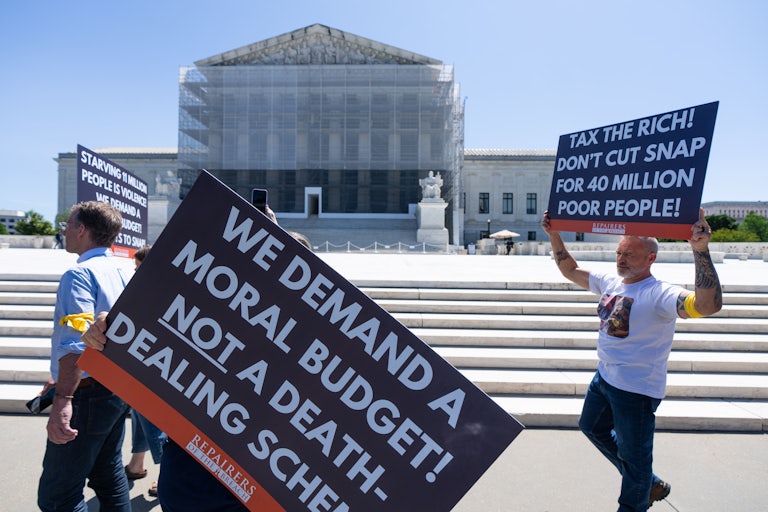
Protesters in front of the Supreme Court hold signs reading "We demand a moral budget not a death-dalign scheme" and "Tax the rich! Don't cut SNAP for 40 million poor people!"
Bill Clark/CQ-Roll Call, Inc/Getty Images

Only three Senate Republicans were brave enough to vote against Trump’s catastrophic budget, as the One Big Beautiful Bill Act passed through the Senate on Tuesday by the slimmest of margins, 51-50.

Republicans Rand Paul, Thom Tillis, and Susan Collins—who each voiced their distaste for the bill due to the $3.3 trillion it adds to the debt and the millions of Americans it takes Medicaid away from—voted no, along with all 47 Democrats.

Every other Republican voted yes, with Vice President JD Vance breaking the 50-50 tie. The bill now heads back to the House of Representatives.

The Senate version of the bill contains the biggest Medicaid cuts in history, and 17 million people are expected to lose their health insurance by 2034, according to the Congressional Budget Office.

Tillis warned about the dangers of the bill on Sunday night shortly after announcing his retirement at the end of this term. “Between the state-directed payments and the cuts scheduled in this bill—there’s a reduction of state-directed payments. And then there’s the reduction of the provider tax. They can’t find a hole in my estimate. So what they told me is that ‘yeah, it’s rough, but North Carolina’s used the system, they’re gonna have to make it work,’” Tillis said. “Alright, so what do I tell 663,000 people in two years or three years, when President Trump breaks his promise by pushing them off of Medicaid because the funding’s not there anymore, guys? The people in the White House advising the president … are not telling him that the effect of this bill is to break a promise.”

The bill is likely to face some minor obstruction in the House.

This story has been updated.

Full Results Show Mamdani Thoroughly Dragged Cuomo in NYC Mayor Race

Zohran Mamdani’s win just got even more delicious.

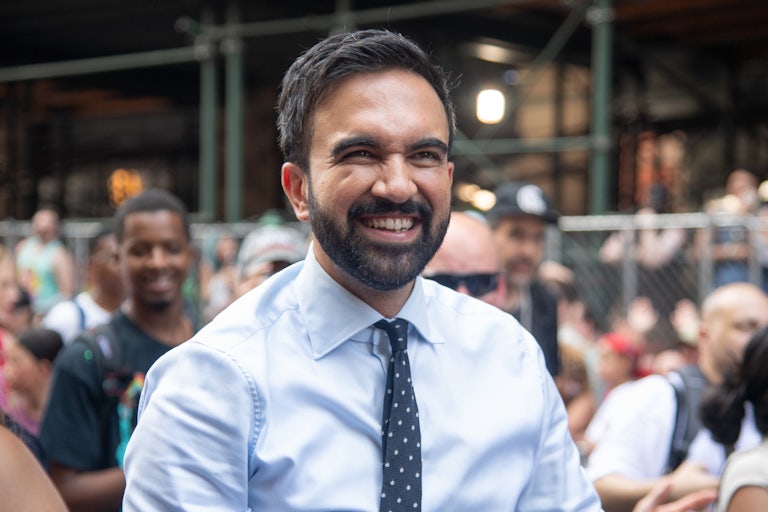
New York Democratic mayoral candidate Zohran Mamdani smiles while walking in the New York City Pride parade
Noam Galai/Getty Images

The New York City Democratic primary ranked-choice voting results are officially in: Zohran Mamdani won by a landslide.

The 33-year-old democratic socialist swept the competition with 56 percent of the vote once all the ranked-choice votes were tabulated. He eclipsed former New York Governor Andrew Cuomo by double digits, beating out the establishment Democrat by 12 points.

Ranked choice voting asks voters to mark multiple candidates in order of their preference. Unless a candidate is ranked first by more than 50 percent of voters, then the lowest-performing candidates will be knocked out of the running in instant runoff elections, until a majority winner emerges.

Last week’s election results exhausted just five percent of the city’s total ballots, indicating that 95 percent of voters had ranked either Cuomo or Mamdani in the race. That was a significant turnaround from the city’s first ranked choice voting election, conducted in 2021, when eight rounds of runoff elections gave Mayor Eric Adams the win, while leaving 140,000 ballots on the table.

Mamdani’s results are the inverse of what pollsters predicted prior to the election: that Cuomo, who resigned from the governor’s mansion in disgrace after he was accused of sexually assaulting his staff and covering up thousands of Covid-19-related nursing home deaths, would win the city’s mayoral election by 12 percentage points.

In a video statement Monday, Mamdani credited his primary success with his campaign’s focus on working class issues and actually “talking with New Yorkers.” Grassroots organizing was one of the biggest boons to his campaign: Mamdani’s 29,000 door-knocker army held talks with tens of thousands of New Yorkers, investing in topics where city governance impacts them most, such as childcare, housing, and public transportation.

Still, the biggest names in New York politics have refused to support Mamdani and the growing movement behind him. They include Governor Kathy Hochul, Senators Chuck Schumer and Kirsten Gillibrand, and Representatives Hakeem Jeffries, Richie Torres, Laura Gillen, Tom Suozzi, Dan Goldman, and George Latimer.

Some of those opposing the Ugandan-born Queens lawmaker have been sickeningly Islamophobic in their remarks, purportedly on behalf of New York’s Jewish community. During a radio interview Thursday, Gillibrand accused Mamdani of condoning “global jihad” after he refused to condemn the phrase “globalize the intifada,” which she claimed translated to “kill all the Jews.”

Many pro-Palestinian activists disagree: they argue that the phrase calls for Palestinian liberation from Israeli occupation. The smear brought protesters to the footsteps of Gillibrand’s New York City office. In a post, Gillibrand’s communications director walked back the senator’s language, claiming that Gillibrand “misspoke.”

This story has been updated.

Fed Chair Says Trump Screwed Himself on Demand for Low Interest Rates

Donald Trump has been demanding that the Federal Reserve cut interest rates. Jerome Powell finally said why they haven’t.

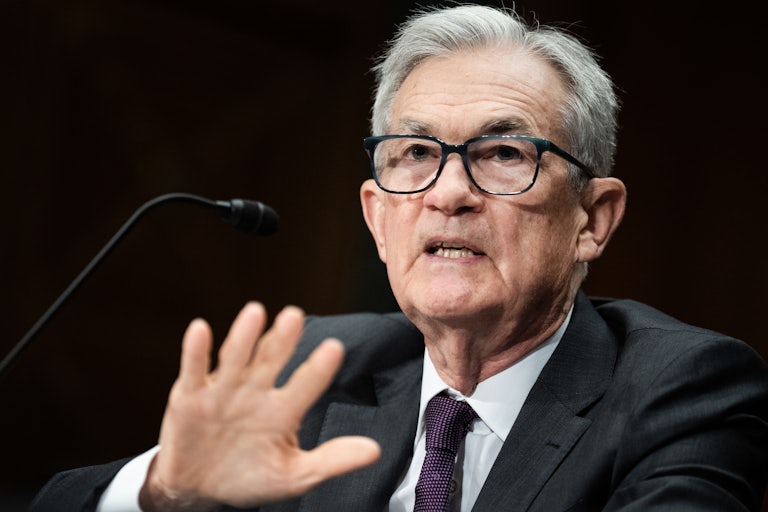
Federal Reserve Chair Jerome Powell gestures while testifying in Congress
Tom Williams/CQ-Roll Call, Inc/Getty Images
Federal Reserve Chair Jerome Powell

Donald Trump’s wishy-washy tariffs have been good for one thing: keeping Federal Reserve interest rates high, according to the central bank’s Chair Jerome Powell.

Speaking at a European Central Bank forum in Portugal Tuesday, Powell said that the Federal Reserve probably would have brought down rates already if it hadn’t been for the president’s “Liberation Day” announcement.

“In effect, we went on hold when we saw the size of the tariffs and essentially all inflation forecasts for the United States went up materially as a consequence of the tariffs,” Powell said.

Last month, Powell announced that the central bank would maintain its key borrowing rate—between 4.25 percent and 4.5 percent—and wait to see the residual impacts of America’s new tariff plan before reducing interest. That’s because companies had already decided to increase product prices through the remainder of the year in reaction to hampered global supply chains, according to Powell.

“For the time being, we are well positioned to wait to learn more about the likely course of the economy before considering any adjustments to our policy stance,” Powell said at the time.

The White House has not taken the news well. Last week, Trump derided the chairman as “terrible” and a “very average mentally person.”

“I’d say low in terms of what he does. Low IQ for what he does,” Trump said during a press conference at the NATO summit in The Hague.

Powell’s term atop the Federal Reserve expires May 2026, while his term as a Fed board member ends on January 31, 2028. And the president is already dreaming of the day, advertising to reporters that he has three or four replacements in mind for Powell, whom Trump appointed in 2018.

Trump threw even more pressure on America’s financial backbone Monday, when he wrote Powell a handwritten letter claiming that the chairman had cost America “a fortune.” The letter, held up by press secretary Karoline Leavitt in a press briefing, demanded that Powell cut rates “by a lot.”

In a social media post later that day, Trump also went after the Federal Reserve board, accusing them of standing by while Powell does his job balancing the American dollar in light of Trump’s trade antics.

“If they were doing their job properly, our Country would be saving Trillions of Dollars in Interest Cost,” Trump wrote. “The Board just sits there and watches, so they are equally to blame.”

But Powell is not alone in his assessment. Leading economists outside of the Federal Reserve have similarly argued that now is not the time to cut interest rates. Atlanta Fed President Raphael Bostic told Reuters last week that the country has “space and time” to figure out its ideal rates considering that companies have already boosted prices in reaction to heightened material and service costs in the wake of Trump’s tariffs.