Breaking News
Breaking News
from Washington and beyond

Trump DOJ Lawyers’ Incompetence in Abrego Garcia Case Stuns Judge

Judge Paula Xinis tore into Department of Justice lawyers for their claims about Kilmar Abrego Garcia.

Kilmar Abrego Garcia's wife stands in the center of a crowd of people protesting in his support outside a courthouse in Greenbelt, Maryland
Jim Watson/AFP/Getty Images

A federal judge torched Department of Justice lawyers Monday for providing slippery answers on their case against Kilmar Abrego Garcia, who was returned to the United States after being deported to El Salvador due to an “administrative error.”

During the hearing, U.S. District Court Judge Paula Xinis said that attempting to get a straight answer from the DOJ was like “nailing jello to a wall,” according to Politico.

It’s not just that the Trump administration has openly refused to fully comply with Xinis’s requests for information. They’ve also provided wildly contradictory answers to the court’s questions—and continued to do so on Monday.

During a hearing last month, one Department of Homeland Security agent revealed that he was only asked to look into Abrego Garcia’s case on April 28 of this year. But during Monday’s hearing, a DOJ attorney claimed that the investigation into Abrego Garcia’s alleged criminal activity had begun before then.

“Now I have real concerns, as if I haven’t for the last three months,” Xinis said.

Last month’s revelation was considered an especially damning admission, because April 28 was more than a month after Abrego Garcia was sent to a notorious Salvadoran prison without due process. It was also a full week after White House press secretary Karoline Leavitt claimed, seemingly out of nowhere and without providing any evidence, that Abrego Garcia had “engaged in human trafficking.” Clearly, the Trump administration was attempting to dig up dirt to retroactively justify Abrego Garcia’s unlawful removal.

The Trump administration had also repeatedly claimed that Abrego Garcia could not be returned to the United States under any circumstances—but last month, he arrived in Tennessee to face two charges related to illegally transporting undocumented immigrants for cash.

“For three months, your clients told the world they weren’t going to do anything to bring him back. The president said it in two interviews,” Xinis said Monday. “Am I really supposed to ignore all that?

“How is that not relevant to this inquiry?” she pressed.

Counsel to the Assistant Attorney General Bridget O’Hickey said the situation was “unique.”

“We have acknowledged this was an administrative error,” O’Hickey said, breaking from the White House’s official line about Abrego Garcia being a hardened gang leader who was intentionally deported, opting for the truth as it was stated months ago.

Despite a judge ordering Abrego Garcia’s release, he still remains in custody after claiming that he feared he’d be deported by immigration authorities. Xinis ordered that the DOJ produce a witness from the Department of Homeland Security Thursday to testify about the agency’s plans for Abrego Garcia.
Even Fox News Doesn’t Buy Trump’s Epstein Investigation Result

Reporter Peter Doocy came armed with receipts when asking Karoline Leavitt about the report.

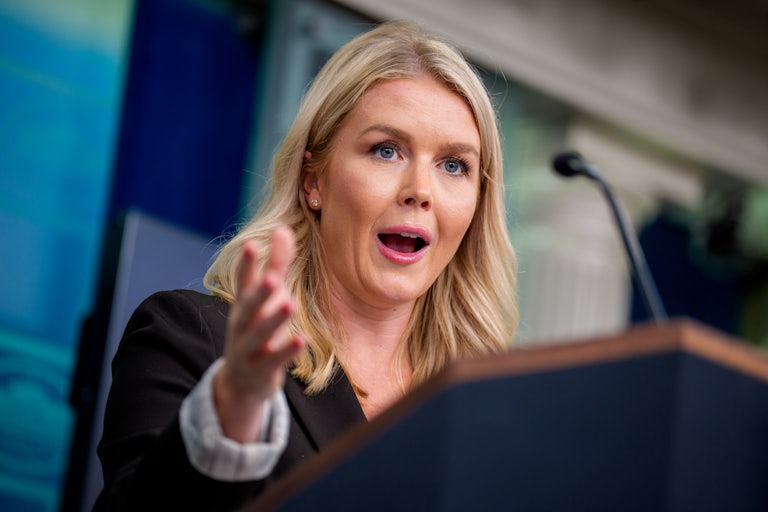
Press Secretary Karoline Leavitt gestures while speaking to reporters in the White House
Andrew Harnik/Getty Images

Fox News pushed back Monday on the Department of Justice’s claim that Jeffrey Epstein did not keep a list of clients, citing the head of that very agency, who’d claimed she’d seen the list.

During a press briefing, Fox News’s senior White House correspondent Peter Doocy questioned press secretary Karoline Leavitt about the DOJ’s memo declaring that the alleged sex trafficker kept no “incriminating ‘client list.’”

“So, what happened to the Epstein client list that the attorney general said she had on her desk?” Doocy asked.

“Well, I think if you go back and look at what the attorney general said in that interview which was on your network, on Fox News—” Leavitt began.

“I’ve got the quote,” Doocy said.

Doocy recounted that when Pam Bondi had been asked in February whether the DOJ was planning on releasing a list of Epstein’s clients, she’d replied, “It’s sitting on my desk right now to review.”

“Yes, she was saying the entirety of all the paperwork, all of the paper in relation to Jeffrey Epstein’s crimes. That’s what the attorney general was referring to, and I’ll let her speak for that,” Leavitt stammered in reply.

Leavitt insisted that the Trump administration had never promised to release names but had committed to conduct “an exhaustive investigation.”

“That’s what they did, and they provided the results of that. That’s transparency,” she said.

The shocking conclusion of the Trump administration’s investigation into Epstein has already produced stark schisms within the MAGA world. Laura Loomer, a prominent MAGA influencer with the president’s ear, has singled out Bondi, suggesting that she be fired.

In response to MAGA supporters seeking accountability for Epstein’s collaborators, Leavitt had this to say: “This administration wants anyone who has ever committed a crime to be held accountable.”

Well, clearly not everyone: Her boss happens to be a convicted felon and sex criminal. Not to mention the 1,500 recipients of Trump’s sweeping Inauguration Day pardon for violently opposing his loss in the 2020 presidential election.

Read more about the Epstein investigation:

Trump Announces New Tariffs in Bizarre Copy-Paste Letters

Donald Trump just revealed his not-so-brilliant economic strategy.

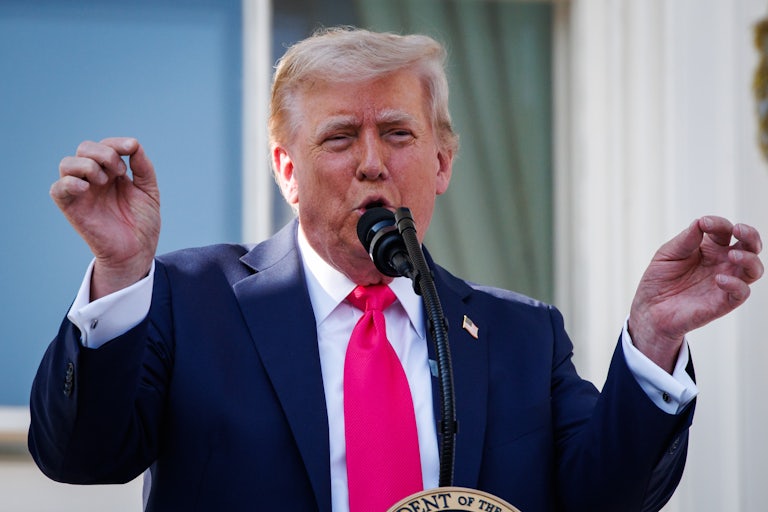
Donald Trump speaks at the presidential podium and raises both hands as if conducting an orchestra.
Samuel Corum/Getty Images

On Monday, Donald Trump announced new tariffs on five countries in letters shared to Truth Social that were identical in all but their addressees and rates.  

Japan, South Korea, Malaysia, Myanmar, and Kazakhstan will all face 25 percent tariffs; South Africa will face 30 percent tariffs; and Laos will face 40 percent tariffs.

“Our relationship has been, unfortunately, far from Reciprocal,” the letters state. Beginning on August 1, the will be placed on “any and all [of the countries’] products sent into the United States,” which will be separate from sectoral tariffs, or those specifically applied to products from certain industries.

The copy-paste letters state that the U.S. trade deficit with all countries “is a major threat to our Economy and, indeed, our National Security!”

The letters also warn, “If for any reason you decide to raise your Tariffs, then, whatever the number you choose to raise them by, will be added onto the [tariffs] that we charge,” and the tariffs “may be modified, upward or downward, depending on our relationship with your Country.”

Trump in early April paused planned tariffs for 90 days, promising to secure 90 trade deals in that time—and falling 88 short as of Monday morning, with two days to go. Since then, Trump has extended the deadline and said, in lieu of trade deals, he would send unilateral “tariff letters” to hundreds of countries to establish rates; on Fox News last week, he said such letters might say: “Dear Mr. Japan, here’s the story. You’re going to pay a 25 percent tariff on your cars.”

This story has been updated.

Texas Killed Bill on Siren Warning System Before Deadly Floods

Officials were worried about the high costs of the system, which could have saved lives.

ehicles sit submerged as a search and rescue worker looks through debris for any survivors or remains of people swept up in the flash flooding in Texas.
Jim Vondruska/Getty Images
Vehicles sit submerged as a search and rescue worker looks through debris for any survivors or remains of people swept up in the flash flooding on July 6, in Hunt, Texas.

The deadly flooding in Texas that took at least 80 people, including children, may have been avoided if the state legislature hadn’t killed a bill for an emergency siren alert system because it was too expensive.

House Bill 13, which would have established a state council to implement an emergency response plan and run a first-responder grant program, was struck down in the state Senate earlier this year. H.B. 13 would have helped create “the use of outdoor warning sirens,” like “emergency alert systems.” Some Texas lawmakers have since expressed deep regret for voting against the legislation, while others lamented that the effects of the bill, particularly the warning sirens, would not have kicked in in time to save lives given how fast the floodwaters rose.

“All the focus right now is let’s save all the lives we can,” Republican state Representative Wes Virdell told The Texas Tribune. “I can tell you in hindsight, watching what it takes to deal with a disaster like this, my vote would probably be different now.… I think even if you had a warning system there, this came in so fast and early in the morning it’s very unlikely the warning system would have had much effect.”

Republican Governor Greg Abbott refused to officially place improved emergency warning legislation on the state assembly agenda, even though he agreed that the issue was “something that will be looked at.”

Trump Treasury Secretary Reveals Humiliating Detail About Tariff Talks

Donald Trump is sending out new tariff rate notices in light of this embarrassing revelation.

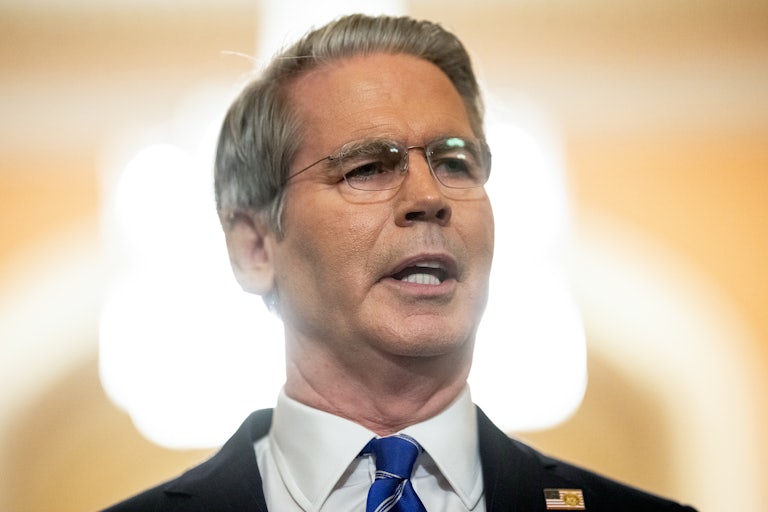
Treasury Secretary Scott Bessent speaks to reporters in the Capitol
Graeme Sloan/Bloomberg/Getty Images

Treasury Secretary Scott Bessent accidentally admitted that the White House was lying about countries begging Donald Trump for trade deals.

Bessent made the startling admission Sunday as he tied himself in knots trying to answer CNN host Dana Bash’s questions about the Trump administration’s long-forgotten promise of 90 trade deals during the president’s 90-day pause on his sweeping reciprocal tariffs.

“We’ve seen three, and they’re not concrete deals the way that we’re used to seeing trade deals, they’re frameworks,” Bash said. Given Trump’s reputation as a dealmaker, she asked: “Why haven’t we seen the kind of deals he promised in the last 90 days?”

“Again, he didn’t promise this,” Bessent said. “And when we send out the hundred letters to these countries that will set their tariff rates … so we’re gonna have a hundred done in the next few days.” Bessent was referring to Trump’s Sunday night Truth Social post announcing he would notify multiple countries the following day of their new tariff rates.

“But that’s not a deal, that’s a threat,” Bash pressed.

“No, that’s the level. That’s the deal. If you wanna trade with the United States, this is—” Bessent tried to explain.

“But that’s not a negotiation, that’s just a declaration,” Bash said.

“Well, many of these countries never even contacted us,” Bessent replied.

But just months ago, White House press secretary Karoline Leavitt claimed that the phones at the White House were “ringing off the hook” with countries calling to make deals with the United States.

Bessent is right about one thing: Trump didn’t promise 90 deals in 90 days; his top trade adviser, Peter Navarro, did. Trump, on the other hand, claimed to have already made 200 trade deals in April. Three months later, and barely three deals have materialized. But in the Trump administration, clearly a deal isn’t a deal, it’s a letter. And a talk isn’t a talk, it’s a threat shouted across the ocean.

Bessent continued to explain that even though dozens of countries had not, in fact, come knocking at the president’s door, the United States was able to set tariff rates because they still had all the “leverage.” But wasn’t that the same line the administration used to launch talks after Trump’s initial round of sweeping “reciprocal” tariffs in April?

Bessent’s arms must have gotten tired from moving the goalposts on Trump’s so-called tariff talks, having just last week said he hoped to wrap trade up by Labor Day. On Sunday evening, Commerce Secretary Howard Lutnick extended the deadline for tariffs to August 1 as Trump stammered beside him.