Breaking News
Breaking News
from Washington and beyond

Federal Judge Kills Trump’s Plan to Get Out of Releasing Epstein Files

A Florida judge has shot down Trump’s request on the Epstein grand jury transcript.

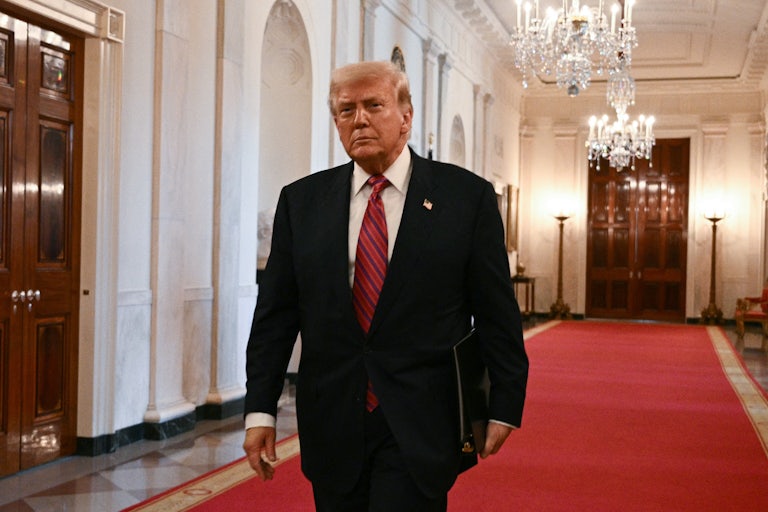
Donald Trump speaks in the White House
Anna Moneymaker/Getty Images

President Trump’s recent bid to quell outrage over his administration’s perceived lack of transparency about the late sex criminal (and the president’s onetime friend) Jeffrey Epstein has hit a stumbling block.

Trump over the weekend requested that grand jury transcripts related to United States v. Epstein be unsealed—a seeming sop to his angry supporters that falls far short of the release of all Epstein-related Justice Department files, which many are demanding. But on Wednesday, a federal judge in Florida denied the DOJ’s request.

In a 12-page opinion, Judge Robin L. Rosenberg wrote that “the Court’s hands are tied,” as Trump’s DOJ failed to argue that its request fell under an exception to “the general rule of secrecy” governing grand jury materials, instead invalidly claiming “special circumstances.”

The Trump administration even acknowledged that its petition wouldn’t pass muster, Rosenberg wrote, as the DOJ conceded that the court couldn’t flout existing precedent regarding grand jury materials. So, Rosenberg ruled, “consistent with [that precedent] and the Government’s concessions, the request to disclose is denied.”

The Justice Department has filed two other requests for Epstein grand jury testimony, both in New York. While those are still pending, the Florida decision is bad news for the president, who’s surely hoping for as swift an end as possible to MAGA’s fury over the Epstein story.
Trump’s EPA Plans to Kill Rule Critical to Fighting Climate Change

EPA administrator Lee Zeldin is about to hand Big Oil its biggest win yet.

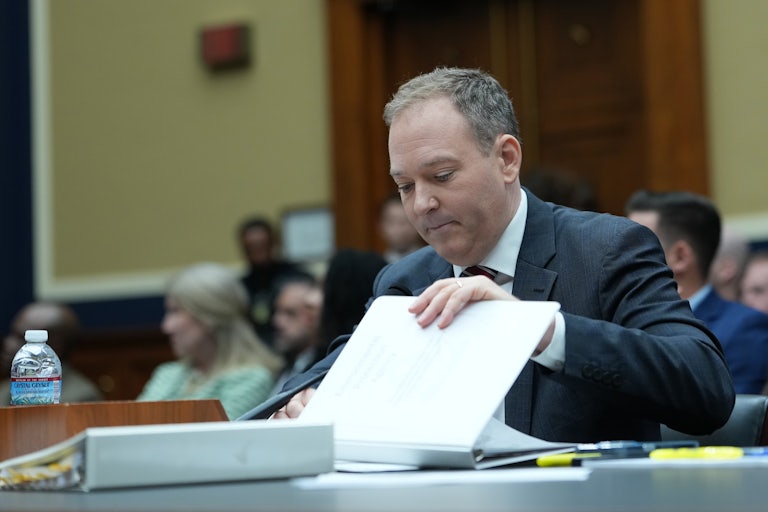
EPA Administrator Lee Zeldin looks through some papers on the table as he testifies in Congress.
Kevin Dietsch/Getty Images

The Trump administration reportedly plans to eliminate an Environmental Protection Agency rule that’s crucial to the federal government’s ability to combat climate change.

According to The New York Times, EPA Administrator Lee Zeldin is anticipated to officially do away with the agency’s “endangerment finding” in the coming days. The landmark 2009 rule scientifically establishes greenhouse gases as hazards to public health and welfare, and serves as the backbone of the agency’s ability to regulate such gases under the Clean Air Act.

The news of Zeldin’s plan comes on the very same day the United Nations’ top court ruled that countries have a “duty” to limit greenhouse gas emissions. Those that fail to take steps to protect the planet from climate change, the International Court of Justice said, may run afoul of international law.

Zeldin in March announced that the EPA was reconsidering the endangerment finding as part of a broader effort to drive “a dagger straight into the heart of the climate change religion.”

The planned move shows Trump’s EPA acting in accordance with the president’s long-standing conviction that climate change is a hoax. His administration’s second term priorities have included—among other iniquities—increasing American reliance on fossil fuels, gutting climate research, passing the “most anti-environment bill in history,” per Sierra Club, and once again withdrawing from the Paris Agreement.

RFK Jr. Is Letting AI Help Run the FDA. There’s Just One Problem

The FDA’s new AI assistant is straight-up inventing data.

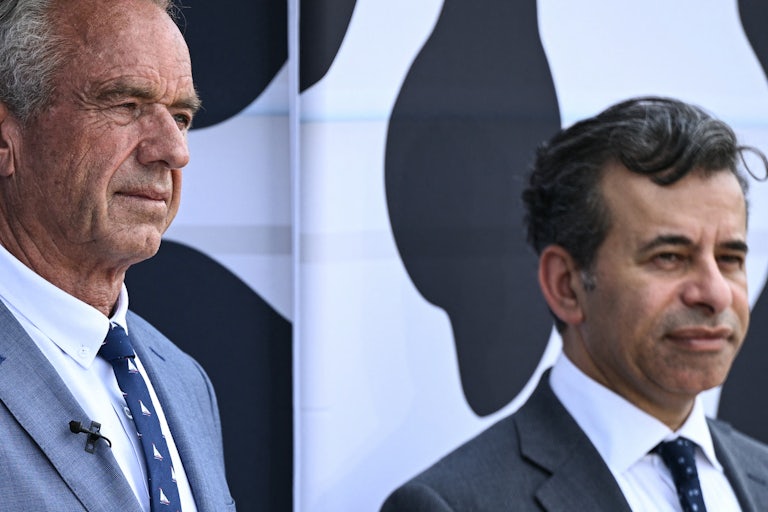
Health and Human Services Secretary Robert F. Kennedy Jr. and FDA Commissioner Marty Makary stand next to each other
Brendan Smialowski/AFP/Getty Images

Reliance on artificial intelligence is breaking down the Food and Drug Administration.

Health officials in the Trump administration have vaunted the burgeoning technology as a way to fast-track and streamline drug approvals, but that hasn’t been the case. Instead, the program is cooking up nonexistent studies, a process referred to as “hallucinating,” according to current and former FDA officials that spoke with CNN.

“Anything that you don’t have time to double-check is unreliable. It hallucinates confidently,” one agency worker told the network.

Insiders claim that the program, Elsa, is helpful when it comes to summarizing meetings or email templates, but its usefulness ends there.

“AI is supposed to save our time, but I guarantee you that I waste a lot of extra time just due to the heightened vigilance that I have to have” regarding fact-checking potentially fake or misrepresented studies, another FDA employee told CNN.

Hallucinations are a known problem with generative AI models—and Elsa is no different, according to Jeremy Walsh, the head of AI at the FDA.

“Elsa is no different from lots of [large language models] and generative AI,” Walsh told CNN. “They could potentially hallucinate.”

It’s not the first time that the Department of Health and Human Services has majorly fumbled its use of artificial intelligence.

In May, AI researchers claimed there was “definitive” proof that Health Secretary Robert F. Kennedy Jr. and his team used the tech to write his “Make America Healthy Again” report, and had completely botched the job in the meantime.

Kennedy’s report projected a new vision for America’s health policy, taking aim at childhood vaccines, ultraprocessed foods, and pesticides. But a NOTUS investigation found seven studies referenced in Kennedy’s 68-page report that the listed study authors said were either wildly misinterpreted or never occurred at all. Researchers noted 522 scientific references in the report that included the phrase “OAIcite” in their URLs—a marker indicating the use of OpenAI.

At the time, administration officials brushed off the controversy as a temporary flub. But the new over-reliance on the tech indicates that the MAHA report was actually a horrifically dangerous precedent, allowing the White House to tiptoe into the realm of unvetted and unverified AI usage to form the basis of America’s public health policy.

Trump’s Prison Swap Welcomed a Convicted Murderer Back to U.S.

Donald Trump says he wants to keep America safe. So why did his prison swap with Venezuela free a man convicted of murder?

Donald Trump walks n a red carpet in the White House.
BRENDAN SMIALOWSKI/AFP/Getty Images

The Trump administration’s massive prisoner swap last week, which saw 10 U.S. citizens and legal permanent residents imprisoned in Venezuela freed in exchange for about 250 Venezuelans deported and detained in El Salvador amid Trump’s immigration crackdown, has been framed as an effort to keep America safe.

But as part of that exchange, Trump freed one man convicted of a grisly murder. Dahud Hanid Ortiz, a naturalized U.S. citizen born in Venezuela, was not a political prisoner. Rather, he was convicted of brutally murdering three people at a law office in Spain in 2016, El País reported. Ortiz is exactly the kind of person Trump lies about every immigrant south of the border being, and yet he’s being welcomed back on American soil with open arms and warm smiles.

Ortiz, a former Marine, was convicted and jailed for a triple homicide in which he axed one man in the head, slashed a woman’s throat, and beat another woman to death before lighting the office on fire. Ortiz then fled to Venezuela, where he had dual citizenship and could not be extradited. He was arrested shortly thereafter and last year was sentenced to 30 years in prison. Thanks to Trump, the convicted murderer barely served his sentence. And even if you think the Venezuelan government’s conviction of Ortiz was unreliable, consider that the Spanish government tried to arrest him first.

Ortiz can be seen smiling for a picture on a State Department plane with the nine other freed prisoners, holding an American flag.

The Trump administration rounded up immigrants without due process and sent them to rot in one of the most inhumane prisons in the world, only to use them in a prison swap that freed a convicted murderer. Just as every other action he’s taken has proved, it isn’t actually about keeping violent, dangerous criminals out, it’s about making sure more people of color don’t come in. If the former were true, Ortiz would still be locked up in Venezuela right now.

Guess Who Was the Only President Less Popular Than Trump Right Now?

A brutal poll reveals a hilarious truth about Donald Trump’s approval numbers.

Donald Trump speaks while sitting in the Oval Office
Chip Somodevilla/Getty Images

Donald Trump’s approval rating has officially reached an all-time low—for his second term in the White House, that is.

“The USS Donald Trump is taking on a lot of water,” said CNN’s chief data analyst Harry Enten Wednesday. He reported that Trump’s net approval rating had sunk to -11 points.

“His net approval rating has dropped nearly 20 points in the aggregate since the beginning of his presidency,” Enten said. “The American people do not like what they’re seeing, and Donald Trump’s administration is in a ton of trouble at this point, in the minds of the American voters.”

Enten reported voters had come to disapprove of Trump on practically every single issue of the day. Trump had a net approval rating of -14 points on the economy and foreign policy, with his never-ending tariff negotiations earning him a -15 point approval rating on trade. On immigration, which is arguably Trump’s best issue, his net approval rating was only -5 points.

But Enten did have one piece of good news to offer.

“There is one other presidency that has a lower net approval rating at this point than this one,” Enten said. “The bad news is that it was Donald Trump’s other presidency, his first presidency.”

At this point in Trump’s first stint in the White House, Trump had a net approval rating of -16 points. Enten added that since 1953, the average U.S. president has had a net approval rating of 27 points, placing Trump laughably behind.

Unsurprisingly, the issue voters felt Trump was performing the worst on was Jeffrey Epstein, the alleged sex trafficker whose ties to the president have been resurfaced amid the Trump administration’s hapless flip-flopping on the release of materials related to Epstein’s crimes.

This is bad news for Republican lawmakers who have thrown their lot in with Trump. The House GOP is delaying, perhaps indefinitely, its own nonbinding resolution asking the Justice Department to release more Epstein documents, and previously blocked a Democratic attempt to force a vote on releasing the Epstein files, with zero Republicans supporting the measure.

CNN’s Poll of Polls, which tracks Trump’s average approval and disapproval rates in national polls, found that only 41 percent of voters approved of Trump, while 57 percent disapproved.

Last month, Enten analyzed five recent polls that cumulatively indicated that Trump’s “big beautiful bill” was historically unpopular, with 49 percent of the country believing it will hurt their families as opposed to the 23 percent who think it will help them.