Breaking News
Breaking News
from Washington and beyond

Epstein Victims’ Lawyer Reveals How to Find Trump’s Birthday Letter

Brad Edwards says it’s easy for Congress to get a hold of Jeffrey Epstein’s birthday book, which reportedly includes a letter from Donald Trump.

Ghislaine Maxwell, Jeffrey Epstein, and musician Michael Bolton at a party at Mar-a-Lago in February 12, 2000.
Davidoff Studios/Getty Images
Ghislaine Maxwell, Jeffrey Epstein, and musician Michael Bolton at a party at Mar-a-Lago in February 12, 2000

Bradley Edwards, who’s represented hundreds of survivors of sexual abuse by notorious sex criminal Jeffrey Epstein, affirmed that Epstein’s 50th birthday book—which, The Wall Street Journal reported, includes a lewd message from Donald Trump—exists. He also shared exactly where one can find it.

Asked about the book by MSNBC’s Lawrence O’Donnell Wednesday night, Edwards replied, “Yes, I know that the executors of [Epstein’s] estate are in possession of that book, and I think that after they turn it over, it should probably be set in the Smithsonian as an artifact at this point in time.”

Edwards had said moments earlier that anyone interested in seeing the book could simply reach out to Epstein’s executors, Darren Indyke and Richard Kahn, and, “If they didn’t just voluntarily turn over the book out of fear of reprisal, Congress could issue a subpoena to their attorneys at Patterson or at Troutman—those are the two law firms. I know those attorneys. They would turn the book over immediately. Nobody would have to guess. There wouldn’t need to be a lawsuit. There wouldn’t have [to be a] wait to [do] discovery. You would immediately have the answers. You could flip to the page. Is there a letter, is there not a letter?”

O’Donnell observed that the House Oversight Committee, which on Wednesday voted to subpoena the Justice Department for the Epstein files, might be interested in acting on Edwards’s tip. With confidence, Bradley said the lawyers of Epstein’s executors would comply “immediately,” citing his close working relationship with them.

Democratic Representative Rho Khanna, a member of the Oversight Committee who has led charges to force the Epstein files’ release, told MSNBC shortly thereafter that Edwards’s revelation is a “bombshell.” He indicated that the House Oversight Committee would look to subpoena Epstein’s estate for the birthday book, which, he added, would be much easier than subpoenaing the DOJ.

If Epstein’s birthday book is shared with the public, and it indeed includes Trump’s letter as reported by the WSJ (complete with its cryptic message and sketch of a naked woman), it would be a massive embarrassment for the president, who is currently suing the Journal for defamation over the story, which he asserts is “a fake thing.”

And such embarrassments are piling up for Trump in recent days, as his former friendship with Epstein is coming more clearly into view amid his administration’s scandalous lack of transparency on the deceased financier. On Wednesday, the Journal dropped another whopper, reporting that Trump’s Justice Department informed the president in May that his name is in the Epstein files—seemingly explaining the president’s outbursts and his team’s foot-dragging over the Epstein affair.
Trump Explains His Main Issue With AI—and It’s Nuts

“Very stable genius” Donald Trump isn’t totally in love with artificial intelligence.

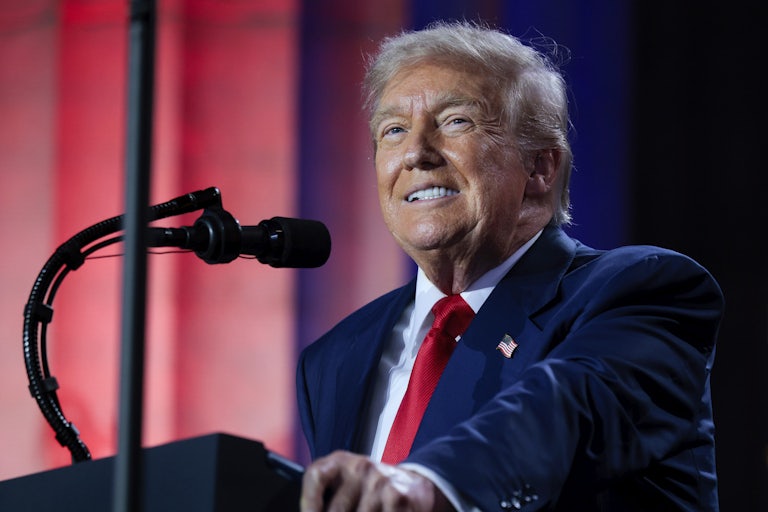
Donald Trump smiles while standing at a podium
Chip Somodevilla/Getty Images

President Donald Trump loves artificial intelligence, calling it “one of the most important technological revolutions in the history of the world” at an AI summit in Washington Wednesday.

But he’s got one big problem with the so-called revolutionary tech: its name.

“Everyone around the globe is talking about artificial intelligence…. ‘Artificial,’ I can’t stand it. I don’t even like the name,” he said. “You know, I don’t like anything that’s artificial. So could we straighten that out please? We should change the name.”

Over laughter, he clarified: “I actually mean that.”

Perhaps the president is taking a page out of naturopathic health crusader and vaccine-denier Robert F. Kennedy Jr.’s book. The health secretary too has a noted dislike of anything artificial, and has mandated that companies remove chemical food dyes from their products as part of his Make America Healthy Again initiative. (Though interestingly, Kennedy has displayed a disturbing willingness to rely on shoddy AI slop at the Department of Health and Human Services.)

Later Wednesday, Trump signed a trio of executive orders that would deregulate the AI industry and “[get] rid of woke,” as he said in his remarks. One order would ban federal agencies from contracting with AI companies that have so-called “ideological biases.”

We’ve been down this road before: After Elon Musk’s xAI chatbot Grok partly blamed Musk and Trump for deaths in the aftermath of the Texas floods, X updated the chatbot to “not shy away from making claims which are politically incorrect.” This resulted in a chatbot that spewed antisemitic dogwhistles and white supremacy and started calling itself “MechaHitler.”

Not quite at Grok level, the president has different nomenclature in mind for the tech.

“I don’t like the name ‘artificial’ anything because it’s not ‘artificial,’ it’s genius. It’s pure genius,” Trump said.

Trump’s choice of name isn’t surprising. The president has long had an affinity for the word genius, calling himself a “very stable genius” in a 2018 tweet about his mental capacities. He also just signed the GENIUS Act, the first major cryptocurrency legislation.

If only he were still in cahoots with former buddy Musk, we could perhaps expect to see the debut of Grok 5: Stable Genius Intelligence.

Trump’s Relationship With Epstein Further Exposed in Bombshell Video

In resurfaced video testimony, Jeffrey Epstein was asked if he and Donald Trump ever spent time with young girls.

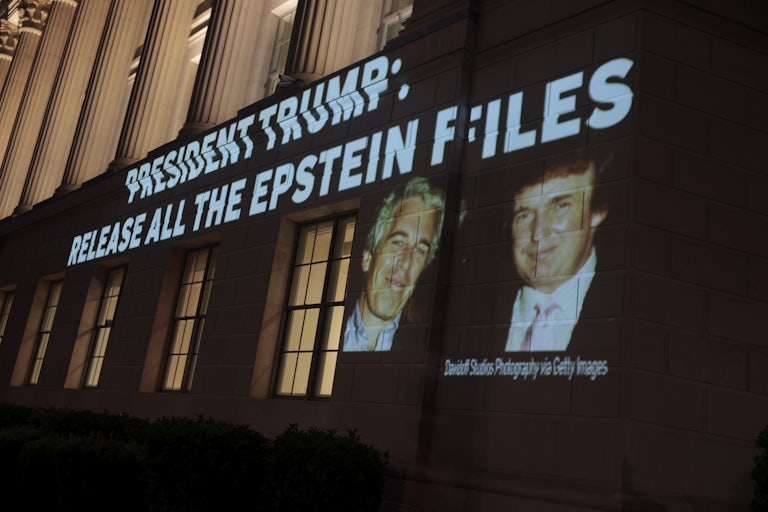
A photo of Donald Trump and Jeffrey Epstein and the phrase "President Trump: release all the Epstein files" are projected onto the U.S. Chamber of Commerce building in Washington, D.C.
Anna Moneymaker/Getty Images
A projection on the U.S. Chamber of Commerce building, directly across the street from the White House

Donald Trump and Jeffrey Epstein had a personal relationship, in Epstein’s own words.

In resurfaced footage of the pedophilic sex trafficker’s 2010 deposition, Epstein confesses to socializing with Trump—but refuses to answer whether or not they spent time with children.

“Have you ever had a personal relationship with Donald Trump?” the interviewer asked.

“What do you mean by ‘personal relationship,’ sir?” Epstein responded.

“Have you socialized with him?” the interviewer clarified, to which Epstein said, “Yes, sir.”

“Yes?” the interviewer pressed.

“Yes, sir,” Epstein repeated.

But Epstein wasn’t able to answer with such clarity when it came to darker topics.

“Have you ever socialized with Donald Trump in the presence of females under the age of 18?” the interviewer asked.

After a brief pause, Epstein failed to answer in the negative, notably under the threat of perjury. Instead, he sidestepped the question completely.

“Though l’d like to answer that question, at least today l’m going to have to assert my Fifth, Sixth, and 14th Amendment rights, sir,” he said.

There is mounting evidence that Trump and Epstein had a remarkably close relationship, though the president has vehemently denied any such connection since his administration became consumed by an internal scandal over Epstein’s alleged “client list.” A Quinnipiac poll published last week found that 63 percent of voters disapprove of the way the Trump administration has handled the Epstein case, which has so far included the Justice Department backtracking on the existence of certain documents and the president chalking up Epstein’s notoriety to a Democrat-invented “hoax.”

Prior to his death, Epstein described himself as one of Trump’s “closest friends.” The socialites were named and photographed together several times, Trump allegedly penned a salacious letter to Epstein for the pedophile’s 50th birthday, the real estate mogul reportedly flew on Epstein’s jets between Palm Beach and New York at least seven times, and the first time that Trump slept with his now-wife Melania was reportedly aboard Epstein’s plane, nicknamed the “Lolita Express.”

In a 2002 New York magazine profile of Epstein, Trump said he had known Epstein for 15 years and referred to him as a “terrific guy.”

“It is even said that he likes beautiful women as much as I do, and many of them are on the younger side,” Trump said at the time.

Pete Hegseth’s Signalgate Saga Somehow Gets Worse

We now know where Defense Secretary Hegseth got the information he shared in that infamous Signal group chat.

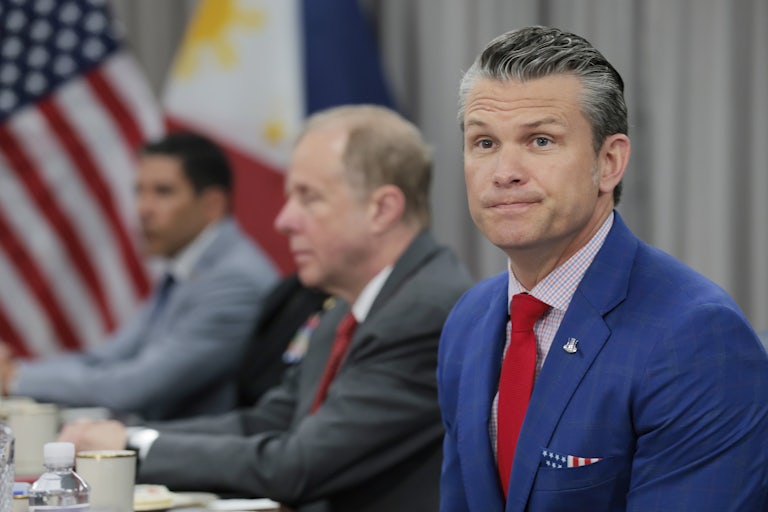
Defense Secretary Pete Hegseth sits at a conference table with two other men next to him.
Anna Moneymaker/Getty Images

A new report pokes gaping holes in the Trump administration’s already unconvincing assurances that no classified information was disclosed during the March “Signalgate” fiasco.

The Washington Post reports that Defense Secretary Pete Hegseth’s infamous Signal messages regarding strikes on Yemen—which were shared in a group chat that inadvertently included Atlantic editor in chief Jeffrey Goldberg—derived from a classified email from General Michael Kurilla, according to evidence obtained by the Pentagon inspector general’s office.

Notably, Kurilla’s email was classified as “SECRET/NOFORN,” with the “SECRET” label indicating material whose unauthorized disclosure “could be expected to cause serious damage to the national security,” and “NOFORN” (for “No Foreign Dissemination”) denoting information that is not to be disseminated to non–U.S. citizens or foreign governments, nationals, or international organizations.

Trump officials have, time and again, insisted that nothing classified was shared during the debacle. Hegseth, for his part, dodged questions about the classification level of the information he shared during a June congressional hearing.

During an exchange with U.S. Representative and Marine veteran Seth Moulton, Hegseth claimed that whether the information was classified was not something “that would be disclosed in a public forum.”

Moulton pushed back, observing, “You can very well disclose whether or not it was classified. It’s not classified to disclose whether or not it was classified. And in fact, DOD regulations state that any classified information has to be labeled with its classification—was it classified ‘secret’ or ‘top secret.’”

“What’s not classified is that it was an incredibly successful mission against the Houthis,” Hegseth replied, leading Moulton to conclude, “OK, so it was classified,” before asking, once more, if the defense secretary was “trying to say that the information was unclassified.”

“I’m not trying to say anything,” Hegseth said.

More on the “best people” Trump has hired:

Kilmar Abrego Garcia Is Finally Coming Home to Maryland (for Now)

While releasing him, a judge called some of the government’s accusations against Abrego Garcia “[bordering] on fanciful.”

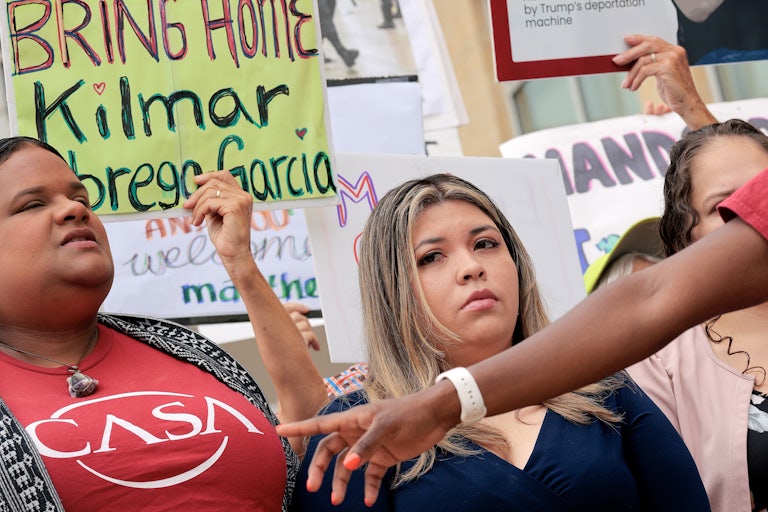
Kilmar Abrego Garcia's wife Jennifer Vasquez Sura stands with protesters demanding his release
Chip Somodevilla/Getty Images

A federal judge has barred ICE from detaining Kilmar Abrego Garcia should he be released from custody in Tennessee, ordering Wednesday that he be returned to Maryland to “ensure that his case is handled as it would have been before he was wrongly sent to El Salvador,” in accordance with the Supreme Court’s prior ruling.  

U.S. District Judge Paula Xinis issued a memorandum prohibiting the Department of Homeland Security from “taking Abrego Garcia into immediate ICE custody in Tennessee.” The judge added that Abrego Garcia must be restored to his ICE Order of Supervision in Baltimore.

The judge also ordered that if the government were to initiate proceedings to remove Abrego Garcia to a third country, as they’d previously threatened to do, they would need to provide 72 business hours’ notice to the plaintiff and his counsel. 

“Defendants have done little to assure the Court that absent intervention, Abrego Garcia’s due process rights will be protected,” she wrote.

Abrego Garcia’s attorneys had previously requested a 30-day stay on his release from pretrial detention, claiming that he feared immigration authorities would immediately deport him again. DHS officials confirmed this was their plan but were unable to offer any details as to where they hoped to send him. 

Meanwhile, it seems that after months away from home, Abrego Garcia may finally be headed back to Maryland. 

U.S. District Judge Waverly Crenshaw in Tennessee denied a motion from the government to revoke a magistrate judge’s order for Abrego Garcia’s release Wednesday, ruling that the government had failed to meet the burden to prove Abrego Garcia was a flight risk or danger to the community. The judge said Abrego Garcia could be released on bond with conditions.

Crenshaw found there was evidence that Abrego Garcia had smuggled individuals from the border but not that he was a member of or affiliated with any gang, as the government claims. Crenshaw referred to testimony provided by a Homeland Security agent who said that Abrego Garcia transported Barrio 18 and MS-13 gang members, claiming it “cuts against the already slim evidence demonstrating Abrego is a member of MS-13.”

“For the court to find that Abrego is a member of or in affiliation with MS-13, it would have to make so many inferences from the Government’s proffered evidence in its favor that such conclusion would border on fanciful,” Crenshaw said.