Breaking News
Breaking News
from Washington and beyond

Trump Moves U.S. One Chilling Step Closer to War With Russia

Donald Trump says he is moving nuclear submarines to be positioned near Russia.

Donald Trump speaking
Andrew Harnik/Getty Images

Donald Trump has reportedly ordered two nuclear submarines to be positioned closer to Russia after escalating a war of words with former Russian President Dmitry Medvedev.

The president posted on Truth Social on Friday, saying, “I have ordered two Nuclear Submarines to be positioned in the appropriate regions, just in case these foolish and inflammatory statements are more than just that.”

Trump and Medvedev, the deputy chairman of Russia’s Security Council, have been sparring online since Trump shortened his deadline for Russia to reach a ceasefire with Ukraine, lest the country incur his famous tariffs. Medvedev wrote on Monday that “each new ultimatum is a threat and a step towards war” with the U.S.

Trump fired back, telling the chairman to “watch his words.” Then Medvedev responded, warning Trump about the “fabled ‘Dead Hand,’” Russia’s secretive nuclear missile system, set to fire automatically if Moscow’s leadership is taken out.

Now Trump has responded by sending nuclear submarines—which have the capacity to launch nuclear weapons but do not necessarily carry them—to the “appropriate regions.”

Known for his hawkishness, Medvedev is generally regarded as nothing more than a “social-media attack dog” by Russian President Vladimir Putin and his circle, according to The New York Times. But luckily for Medvedev, we have a social media president. If only he wasn’t armed with the nuclear codes.
Trump Is Now Running the Worst Economy Since His Last Term in Office

The last three months have been brutal.

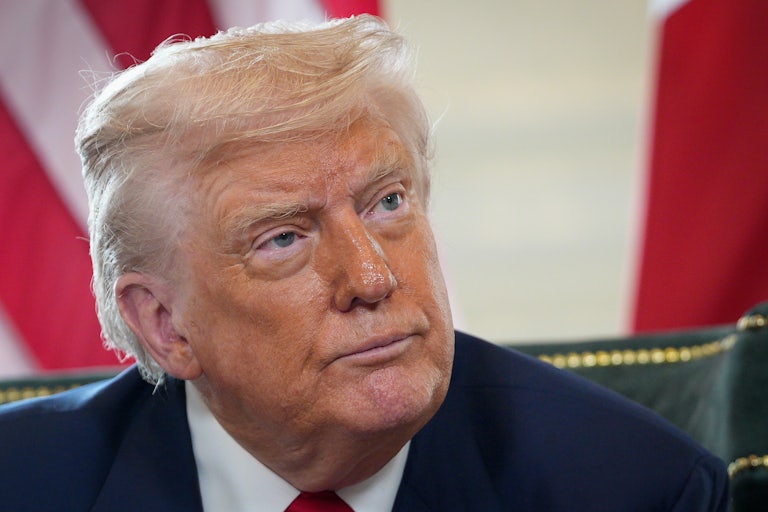
Trump scowls
Christopher Furlong/Getty Images

The last time America’s job numbers were this bad—besides the pandemic—was during the Great Recession.

Revisions to the last three months of job reports have moved the three-month growth average to 35,000, a lag that hasn’t emerged since 2010, and which some economists have said could indicate a recession is on the horizon.

“The labor market is much weaker than originally reported the last two months. While payrolls grew 73k in July, May and June data were revised down a total of 258k to 19k and 14k, respectively,” wrote Economic Policy Institute economist Elise Gould.

The health care and social assistance industries supplied practically all the new jobs over the last three months, while other sectors—including manufacturing, professional and business services, warehouse, retail, and government—lost jobs, according to the new figures.  

“Without health care, the last three months of payroll gains look like this: -53,000 in May, -45,000 in June, and -300 in July,” reported Bloomberg U.S. economy editor Matthew Boesler.

EPI chief economist Josh Bivens posited that if the U.S. enters a recession in the coming months, the “rapid softening/deterioration in the labor market” over the last three months will likely be marked in retrospect as the start of the country’s economic decline.

Trump administration officials blamed the abysmal numbers on “seasonal adjustment quirks,” though they failed to provide rationale on what made this season so different. In light of that, economists had their own ideas, pointing directly at Donald Trump’s trade policies.

“I’ve been calling this a ‘Frozen’ job market for awhile. Now I would call it a red flag,” wrote Navy Federal chief economist Heather Long. “Companies do not want to hire or invest with this much uncertainty about tariffs, inflation, etc.”

Federal Judge Delivers Scathing Rebuke to Trump’s Deportation Regime

“In a world of bad options, they played by the rules,” wrote U.S. District Judge Jia Cobb of immigrants with parole status.

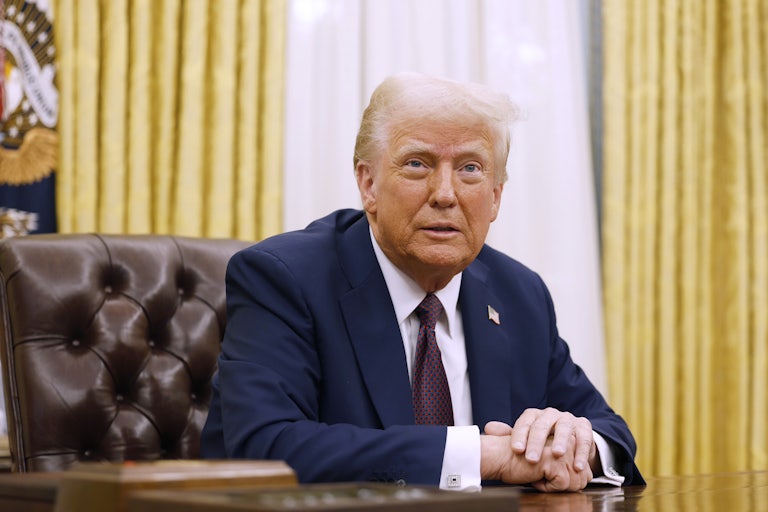
Trump folds his hands at the Resolute Desk
Anna Moneymaker/Getty Images

A federal judge offered a scathing rebuke of Donald Trump’s massive deportation scheme, while blocking the government’s attempts to remove immigrants who entered the country on parole.

U.S. District Court Judge Jia Cobb blocked three recent Department of Homeland Security actions that expanded the expedited removal of parolees, arguing that new policy changes were arbitrary and capricious and had exceeded its statutory authority.

In her 87-page ruling, Cobb slammed the Trump administration’s extrajudicial removals of immigrants who had been temporarily granted entry to the United States while awaiting admission application results, calling the case “a question of fair play.”

Plaintiffs who had followed the rules of their parole had suddenly been detained by immigration authorities. In some instances, their asylum cases had been abruptly dismissed, but in others they had not. Immigrants who had entered the country on parole were made subject to expedited removal, which provides minimal opportunities for immigrants to challenge their deportation.

“In a world of bad options, they played by the rules,” Cobb wrote. “Now, the Government has not only closed off those pathways for new arrivals but changed the game for parolees already here, restricting their ability to seek immigration relief and subjecting them to summary removal despite statutory law prohibiting the Executive Branch from doing so.”

“This case’s underlying question, then, asks whether parolees who escaped oppression will have the chance to plead their case within a system of rules. Or, alternatively, will they be summarily removed from a country that—as they are swept up at checkpoints and outside courtrooms, often by plainclothes officers without explanation or charges—may look to them more and more like the countries from which they tried to escape?”

Cobb determined that the parolees represented by the plaintiff nonprofit organizations, and the hundreds of thousands of immigrants like them who’d been paroled at a port of entry, faced “imminent, irreparable injury” that “outweighs any harm to the Government or the public from pressing pause.”

The government actions, including the termination of the Cuban, Haitian, Nicaraguan, and Venezuelan parole program in March, would be stayed until a final verdict is reached.

FBI Reportedly Redacted Trump’s Name in the Epstein Files

New details are emerging about the FBI’s review of its documents on Jeffrey Esptein.

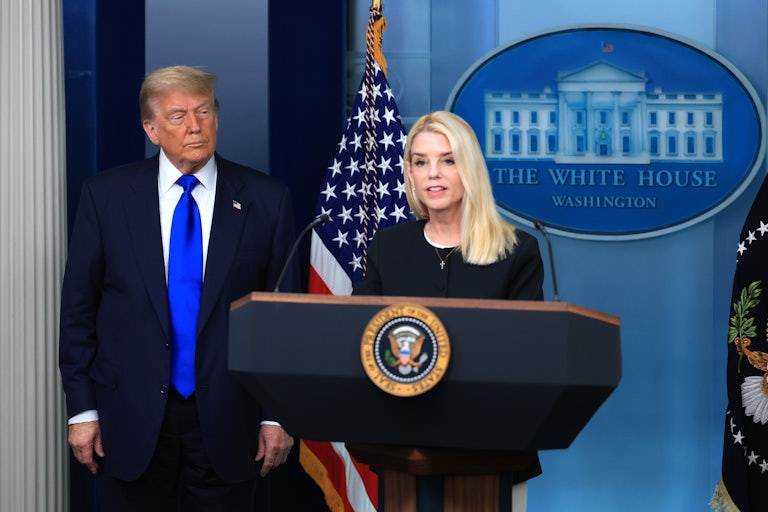
Donald Trump listens as Attorney General Pam Bondi speaks behind the lectern in the White House's press briefing room.
Joe Raedle/Getty Images
Donald Trump and Attorney General Pam Bondi

The FBI went through the Epstein files and redacted Donald Trump’s name, according to the “FOIA Files” newsletter by reporter Jason Leopold, published in Bloomberg Friday.

It was previously reported (in a July letter to the Justice Department from Dick Durbin, the Democratic Senate Judiciary Committee ranking member) that, under Attorney General Pam Bondi’s direction, FBI Director Kash Patel ordered around 1,000 FBI personnel to sift through more than 100,000 Epstein-related documents throughout two weeks in March. Working on 24-hour shifts, the staff were reportedly instructed to “flag” records mentioning Trump, prompting Durbin to ask the DOJ: “What happened to the records mentioning President Trump once they were flagged?”

Leopold reveals that Trump’s name was blacked out—as were the names of dozens of other public figures. The files then went before a unit of FOIA officers, and “Trump’s name, along with other high-profile individuals, was blacked out because he was a private citizen when the federal investigation of Epstein was launched in 2006.”

The FOIA team reportedly cited an exemption protecting individuals from “clearly unwarranted invasions[s] of personal privacy” and another protecting “personal information in law enforcement records.” As Leopold notes, it’s not very rare that even prominent public figures’ names are redacted from records on privacy grounds.

The rest is history: Bondi reportedly notifying Trump that he appears in the files; the DOJ and FBI releasing the case-closed memo; the ensuing (and ongoing) public outcry; the congressional attempts to force the files’ release; and, now, speculations that Trump might corruptly wield the pardon power to pressure Ghislaine Maxwell, the currently imprisoned Epstein co-conspirator, to clear his name.

The bottom line here, Leopold writes, is that the chances of Trump’s name being unredacted anytime soon are slim to none. We can wait for all the people mentioned in the files to die. Or Trump could decide to voluntarily waive his privacy rights, allowing his name to be unredacted, which at present seems very unlikely.

Trump Adviser Reminded on Live TV About Last Time Economy Was This Bad

The jobs report is out—and Trump’s team is scrambling to defend the terrible numbers.

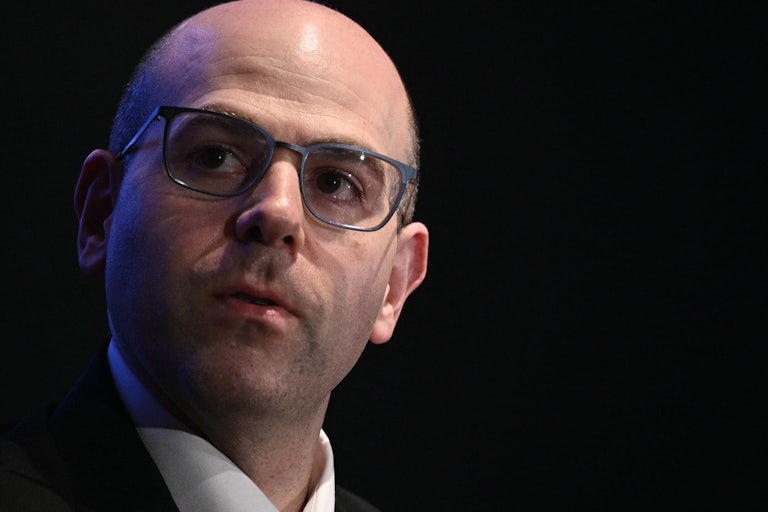
Stephen Miran, chair of the Council of Economic Advisers
RENDAN SMIALOWSKI/AFP/Getty Images
Stephen Miran, chair of the Council of Economic Advisers

One of Trump’s economic advisers grasped at excuses for Trump’s pitiful job growth numbers on CNN Friday morning, citing “seasonal adjustment quirks around teachers,” among other reasons.

July’s job numbers came in far lower than anticipated, and the administration issued revisions for stated job growth in May and June—reducing nearly 260,000 jobs off its last two reports. Stephen Miran, the chairman of the president’s Council of Economic Advisers, attempted to explain the chasm between prediction and reality.

CNN reporter Kate Bolduan pointed out that this marks the weakest month of jobs growth since December 2020, during the pandemic. Bolduan asked Miran what he attributed those numbers to, if not “the uncertainty created, in part, by the president’s trade war.” Miran rattled off reasons.

“About 40 percent of that is due to seasonal adjustment quirks around teachers, some of it is due to declining foreign-born employment, even as we created more American-born employment, and that is going to net out in a way that you see ultimately reflected in the data like that,” Miran said.

“Seasonal quirks” could hardly be responsible for such a massive revision, given that they occur, predictably, every year.

“Finally, there’s the uncertainty: Don’t forget, we are in the midst of restructuring the global trading system in a way that hasn’t been done in decades,” Miran said, echoing Bolduan’s assumption that the trade war was to blame, in so many words. “The president is standing up for American workers and American firms for the first time in decades,” Miran argued, “and of course that was going to induce some uncertainty.”

Miran was later asked about an auto parts maker in Detroit that blamed Trump’s tariffs after being forced to shut down a warehouse and lay off 100 workers. “It’s always convenient to blame political changes when your business fails,” he replied curtly.

May through July has been the weakest three-month period for job growth since December 2020, reported independent journalist Jamie Dupree on X. The next-weakest period was in the aftermath of the 2008 recession.

If we must rely on Trump’s unwavering commitment to his stated tariff rates and deadlines, we may be heading back in that direction.