Breaking News
Breaking News
from Washington and beyond

Trump Finally Admits the Truth About His Takeover of Blue Cities

It isn’t pretty.

President Donald Trump stands with federal troops in Washington, D.C.
Anna Moneymaker/Getty Images

President Donald Trump is so obsessed with punishing Democrats that he’s pretending red states don’t have a crime problem.

While speaking to reporters Monday, the president balked when asked whether he would consider sending National Guard troops to Republican-led cities and states that experience high rates of crime.

“Sure, but there aren’t that many of them,” Trump said. “If you look at the top twenty-five cities for crime, just about every one of those cities is run by Democrats.”

In Newsweek’s recent list of the 30 U.S. cities (with at least 100,000 residents) that had the highest number of violent crimes against people, 16—more than half—of those cities were in certifiably red states. These included Tennessee, Ohio, Arkansas, Texas, South Carolina, Missouri, Utah, Oklahoma, and Louisiana.

Four of those states were among the six to send National Guard troops to Washington D.C., which was notably absent from the recent list of the most crime-ridden cities.

But while a state like Ohio has a whopping four cities on the high-crime list—including Cleveland, Toledo, Dayton, and Akron—Trump has set his sights on another city, in Illinois: Chicago. Illinois Governor JB Pritzker has been a vocal critic of Trump, and hasn’t flinched at the president’s previous attempts to intimidate the city.

Twenty-two out of 30 of the cities on Newsweek’s list were led by Democratic mayors. While mayors are not powerless to contribute to crime prevention, funding for public safety initiatives and other programs, the rates of violent crimes are primarily driven by gun violence, which is a state and federal issue.


Earlier this year, the Trump administration terminated 69 of the 145 community violence intervention grants awarded through the DOJ, cutting a whopping $158 million in grants.
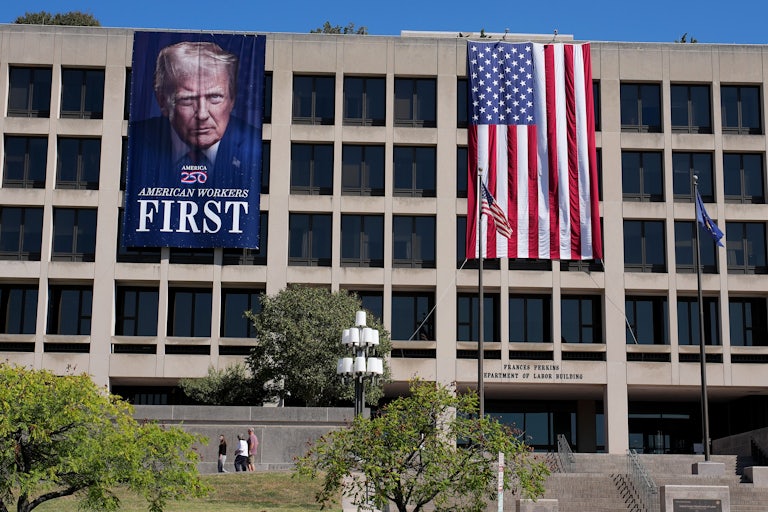
Trump Pulls From Dictator Playbook and Hangs Giant Banner of His Face

How much did the government spend on this banner of Dear Leader?

Donald Trump banner and U.S. flag hanging in front of Labor Department
Kevin Dietsch/Getty Images

On the same day that Donald Trump said many Americans yearn for a dictatorship, his administration took a page from the book of dictators everywhere and unfurled a giant banner of the president’s face on the facade of the Department of Labor.

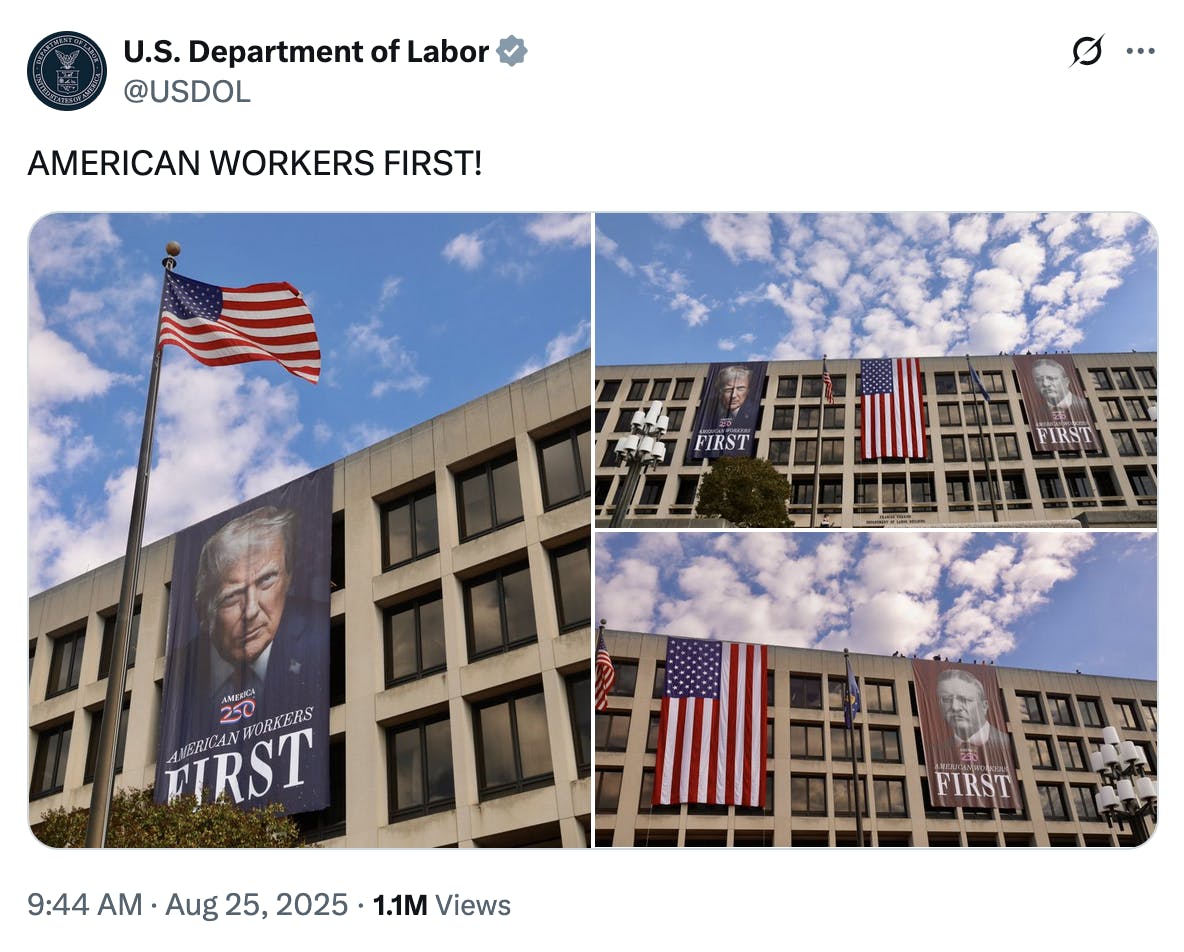
The banner, which features Trump’s steely second inaugural portrait, as well as the logo for Trump’s America 250 programming and the motto “American Workers First,” currently drapes over the windows of three stories of the building, according to photos posted online. Beside it are an American flag and a portrait of Theodore Roosevelt with the same text.

X screenshot U.S. Department of Labor @USDOL: AMERICAN WORKERS FIRST! (photos of the giant Trump banner) 9:44 AM August 25, 2025 1.1M Views

The department on which the banner hangs, under Trump, has undergone drastic cuts and pursued an agenda hostile to unions and workers.

Remarkably, this is not the first time a government building has displayed Trump’s visage. A banner with the same Trump presidential portrait, alongside one of Abraham Lincoln, was hung on the Department of Agriculture building in the spring, drawing comparisons to Saddam Hussein and Kim Jong Un.

As Trump’s scowl looms, Big Brother–style, over Washington, D.C., the president continues his federal takeover of the nation’s capital, usurping local law enforcement and pushing a draconian military occupation, with no end in sight.

Trump Rants About “Comfort Women” While Meeting with Foreign President

It happened while he was speaking with South Korean President Lee Jae-myung.

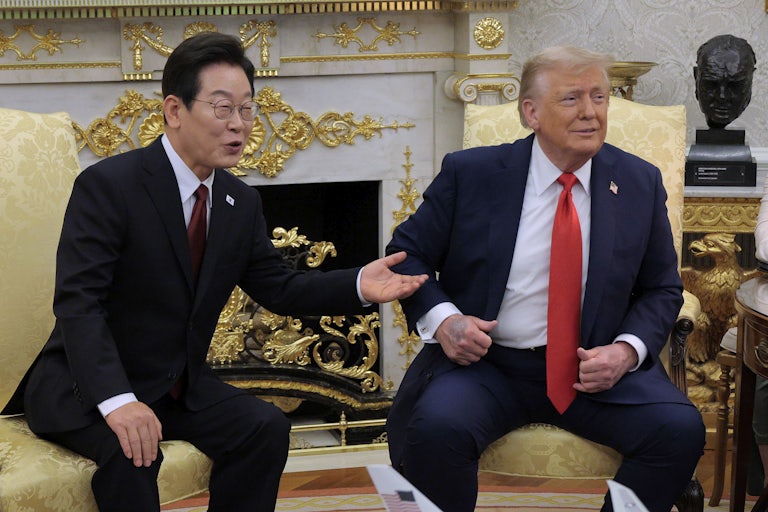
President Donald Trump and South Korean President Lee Jae Myung meet at the White House.
Chip Somodevilla/Getty Images

President Donald Trump’s meeting with South Korean President Lee Jae-myung took an unexpected turn Monday when the U.S. leader decided to bring up the topic of forced prostitution.

The White House meeting spanned several geopolitical issues, including potential unification of South Korea and North Korea, economic partnerships between South Korea and the U.S., as well as South Korea’s political stability, which has been on shaky ground since former President Yoon Suk Yeol declared martial law in December.

But then Trump dropped a seemingly unrelated doozy into the afternoon conversation: Japan’s sex-based war crimes.

“The whole issue of the women. Comfort women,” Trump remarked, seated beside Lee. “Very specifically, we talked and that was a very big problem for Korea, not for Japan. Japan was, wanted to go, they want to get on. And—but Korea was very stuck on that, you understand.”

The term “comfort women” was a euphemism coined by the Japanese military to describe women or girls who were forced into sexual slavery by Japanese soldiers during World War II, according to the Association of Asian Studies. It is estimated that hundreds of thousands of women were victimized by Japan and forced into military sex slavery during the war, which amounted to the largest case of government-sponsored human trafficking in modern history. The continued use of the phrase “comfort women” has been roundly criticized for minimizing the harm and gravity of Japan’s actions.

The topic is still a heavily charged political issue for the two nations, especially as surviving victims seek formal recognition of the atrocities by Tokyo.

But as Trump attempts to push his numerous ties to child sex trafficker Jeffrey Epstein into the rearview, it’s no surprise that he doesn’t understand why South Korea would have a difficult time moving past the abuse. The president has, after all, been found liable for sexually abusing women in the past.

In 2015, Japan apologized to the South Korean victims and reached an agreement with the conservative leadership in South Korea at the time to give 1 billion yen—or $6.8 million—in reparations.

Regardless, Lee called the matter a “heartbreaking issue” for South Koreans last week, noting that the 2015 arrangement was “very difficult to accept” for many victims in the country, but that it was nonetheless “undesirable to overturn it.”

James Comer Officially Sends Subpoena to Jeffrey Epstein’s Estate

Unlike Donald Trump, House Republicans aren’t closing the door on the Epstein story just yet.

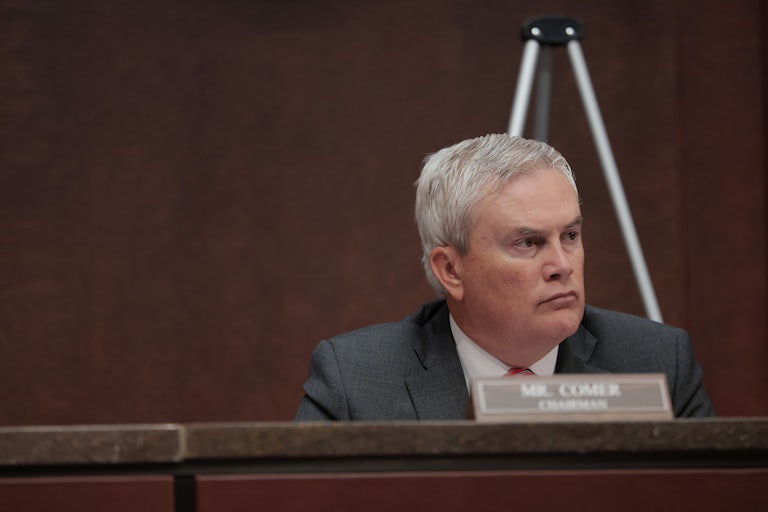
House Oversight Chair James Comer sits in a congressional hearing.
Anna Moneymaker/Getty Images

The Republican-led House Oversight Committee on Monday sent a to subpoena the estate of deceased serial sex predator Jeffrey Epstein.

“It is imperative that Congress conduct oversight of the federal government’s enforcement of sex trafficking laws generally and specifically its handling of the investigation and prosecution of Mr. Epstein and [his former partner Ghislaine] Maxwell,” Oversight Committee Chair James Comer wrote in a letter alongside the subpoena. “It is our understanding that the Estate of Jeffrey Epstein is in custody and control of documents that may further the Committee’s investigation and legislative goals.

The subpoena demands things like Epstein’s infamous 50th “birthday book” that includes a letter from Trump, flight logs, bank information, anything that “could be reasonably construed to be a potential list of clients,” and more. Comer’s committee has already spoken to William Barr, who was attorney general when the Justice Department indicted Epstein in 2019, and Alex Acosta, who as federal prosecutor in 2007 refused to press charges against Epstein, giving him the sweetheart plea deal that allowed him to continue his sex trafficking.

This subpoena has the potential to cede new information, an opportunity that hasn’t been raised since Trump’s Justice Department conveniently declared the case closed in July. Trump, who has spent all of his time trying to convince the public that none of this matters despite having a well-documented close friendship with the infamous serial abuser, has yet to comment on the Oversight Committee’s subpoena.

Trump’s Bruised Hand Seen Without Makeup—and It Looks Quite Bad

Donald Trump desperately tried to hide his giant bruise from the cameras. It didn’t work.

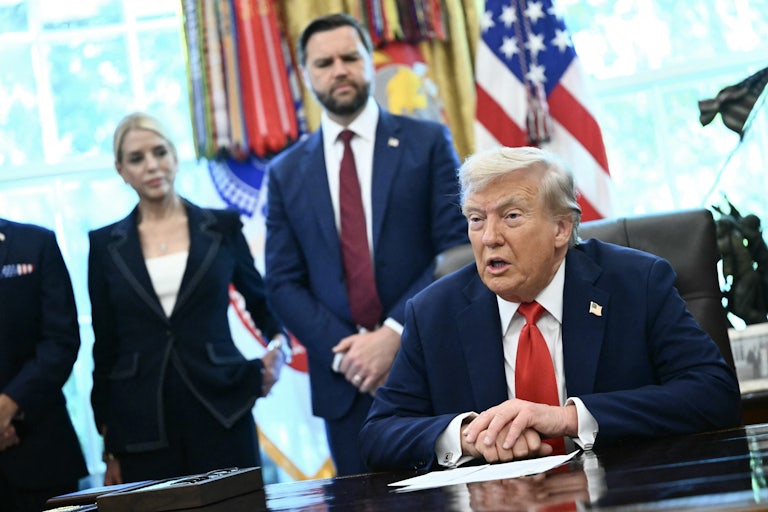
Donald Trump speaks while seated at his desk in the Oval Office of the White House. He places his left hand over his right hand. JD Vance and Pam Bondi watch.
MANDEL NGAN/AFP/Getty Images

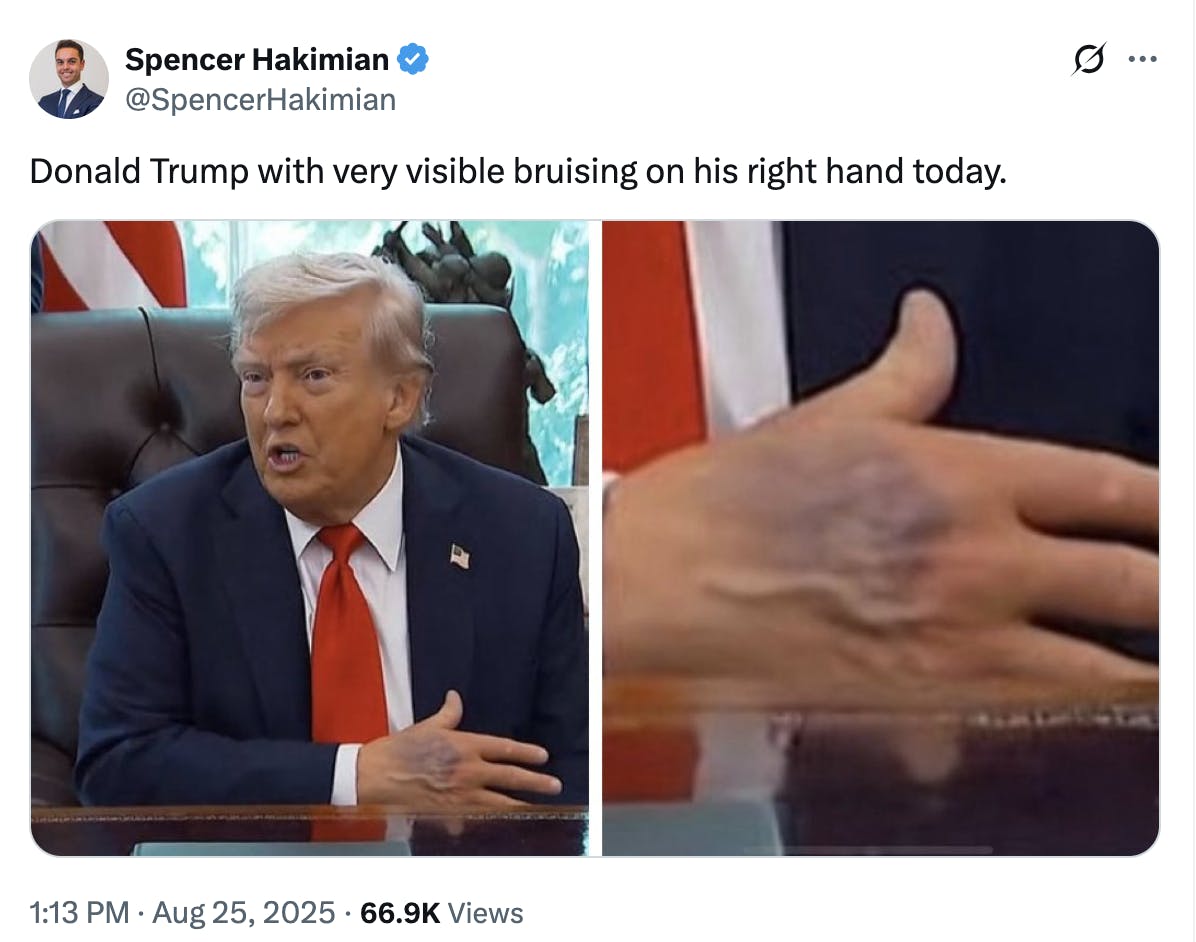
As questions swirl about recurrent bruising on the back of Donald Trump’s right hand, the 79-year-old president’s injury was clearly visible—without the daub of mismatched makeup with which it’s usually covered—during his public appearances early on Monday.

The bruising was spotted repeatedly during a Monday morning executive order–signing, and again during an afternoon meeting with South Korean President Lee Jae Myung. While Trump has previously sought to hide the mark with a (quite conspicuous) smear of concealer, observers noticed on Monday that it was exposed, despite apparent efforts by the president to hide his bruised hand from view.

X screenshot Spencer Hakimian @SpencerHakimian Donald Trump with very visible bruising on his right hand today. (photos of his bruised hand)

In Trump’s second term, the bruising has been spotted regularly, in at least February, April, June, and July, thus giving rise to speculations about the president’s health—including as to whether he is receiving undisclosed intravenous treatment.

Such concerns mounted in July, as images circulated of the hand bruise as well as of swelling in his ankles. At the time, the White House attributed the swollen ankles to “a benign and common condition,” chronic venous insufficiency.

As for the bruising, the White House cites “frequent hand shaking and the use of aspirin”—a dubious line, given that the mark appears on the part of the hand subjected to the least, if any, pressure during a handshake.

This can be seen in a video, posted by a communications staffer, of Trump greeting Lee Jae Myung outside of the White House. The South Korean president shakes Trump’s right hand, making contact only with the area around the bruise. When Myung goes to rest his left hand on the back of Trump’s right, he abruptly grabs the president’s sleeve instead, perhaps to deliberately avoid touching the empurpled part.