Breaking News
Breaking News
from Washington and beyond

Trump’s NATO Ambassador Takes Unhinged Stance on “Russian Threat”

The Trump administration continues to play as nice as possible with Russia.

Russian President Vladimir Putin and Donald Trump shake hands while standing on the tarmac of a military base in Alaska
Andrew Harnik/Getty Images

The Trump administration’s messaging on Russia’s recent incursions is loud and clear: It’s just not a big deal.

Speaking with Fox Business Friday, America’s NATO Ambassador Matthew Whitaker claimed that Russia’s threat was “a little overstated” and that the superpower was actually weaker than American and European media had portrayed.

“They have not had a lot of success. And to your point, Ukraine has actually taken back territory. And, you know, to me that points to a weakness in Russia,” Whitaker said. “As their economy continues to falter, I think their continuation of this war is going to be difficult.”

But European leaders do not feel the same way—particularly as Russia has escalated its position. Last week, Russian drones were spotted in Polish airspace, forcing the NATO ally to shut down four of its airports as it scrambled to fire up its defense systems against the incursion. Poland’s leadership invoked Article 4 of the NATO Treaty the following day, calling the ​​situation the “closest” that Poland had come to armed conflict “since the Second World War.”

Rather than de-escalate the brewing situation in Eastern Europe, Russia followed up the incursion by threatening Finland, another NATO ally. And on Friday, three Russian fighter jets flew into Estonian airspace.

Meanwhile, Donald Trump’s soft touch on Russia has been noted by both the Kremlin and America’s Western allies. Speaking inches away from Trump during a press conference in England Thursday, British Prime Minister Keir Starmer insisted that the U.S. leader needed to “put extra pressure” on Russian President Vladimir Putin, underscoring that it’s only when the United States forces the Russian dictator’s hand that Moscow has “actually shown any inclination to move.”

Trump told reporters that he believed resolving the Ukraine-Russia conflict would be easy because of his “relationship” with Putin, but that the Russian leader had instead let him down. He also scolded European leaders for waylaying sanctions against Russia as they continue to consume the country’s oil, bolstering Russia’s economy in the process.

But overall, the U.S. president has little to show for the profound international recognition he’s offered the Kremlin over the last few months. Against the advice of world leaders, Trump invited Putin to Alaska in August—tasking U.S. soldiers to literally roll out the red carpet for the Russian dictator. It was the first time that Putin had stepped foot on U.S. soil in more than a decade.

Still, Russia has not agreed to peace terms in its ongoing war against Ukraine. The superpower has instead insisted on receiving “international legal recognition” of its 2014 annexation of Crimea, an internationally recognized portion of Ukraine, along with four regions it has claimed in the three years since it first invaded Ukraine.

Whitaker, however, is still holding out hope that his boss will make the best call.

“President Trump is going to continue to find the leverage and to find the conditions where he can bring both sides and mediate a resolution,” Whitaker told Fox Business.

Read more about Trump’s stance on Russia:

Senate Republicans Push Through Motion to Honor Charlie Kirk

Senate Republicans passed a resolution creating a day of remembrance for Charlie Kirk.

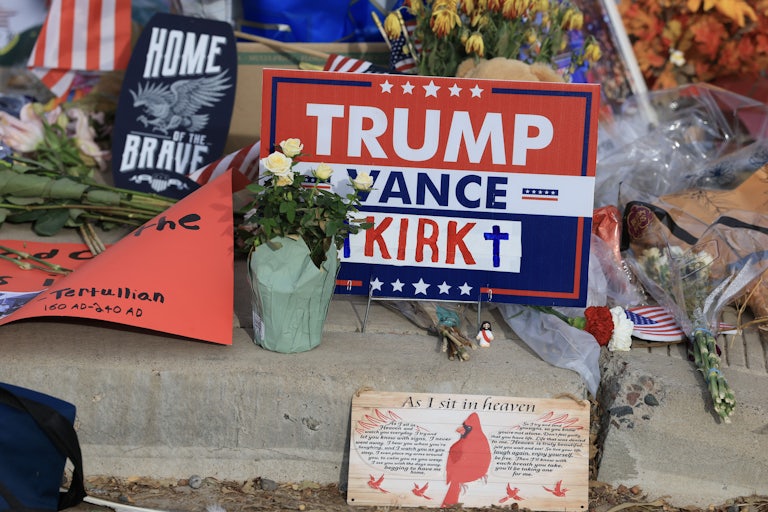
A memorial for Charlie Kirk
Joe Raedle/Getty Images

The Senate has passed a “National Day of Remembrance” resolution to honor conservative podcaster Charlie Kirk after he was killed last week.

Introduced by Senator Rick Scott, the resolution praises Kirk as a “courageous American patriot” who sought to “elevate truth, foster understanding, and strengthen the Republic.”

It calls Kirk’s killing “a sobering reminder of the growing threat posed by political extremism and hatred in our society.” It does not mention the things Kirk said that were divisive, racist, and promoted the intense polarization to which Republicans credit his killing.

Since this is just a simple resolution passed by unanimous consent, it is not enshrined law and didn’t require a full Senate vote.

In June, the House passed a resolution to condemn the killing of Minnesota state lawmaker Melissa Hortman, but it did not create a national day of mourning in her honor.

Kirk’s day of remembrance will take place on his birthday, October 14.

In a twist of fate, that date also marks the birthday of another slain American father, one whom Kirk called a “scumbag,” and whose murder at the hands of police Kirk falsely suggested was really a drug overdose: George Floyd.

Majority of Republican Voters Now Think Country is Going Wrong Way

The change is largely being driven by Charlie Kirk’s assassination, but also points to Trump’s failure to bring the country together.

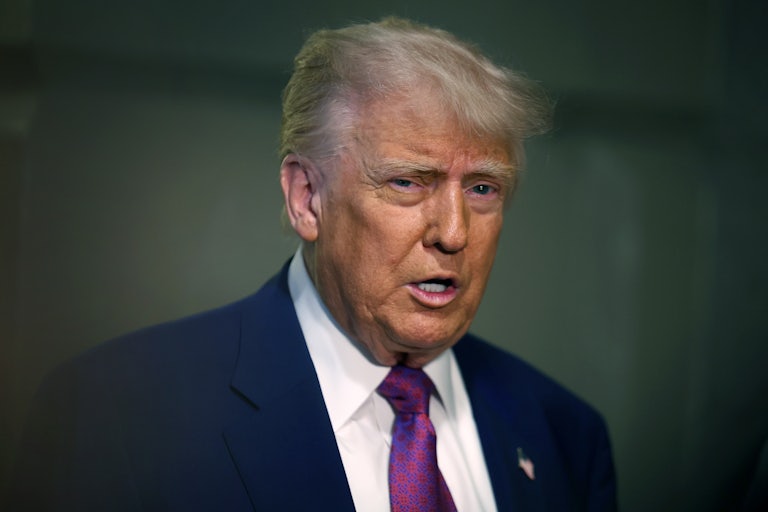
Donald Trump looks confused
Photo by Tasos Katopodis/Getty Images

The majority of Republican voters now feel that the country is going in the wrong direction, a huge spike in negativity from the 29 percent who were saying that in June, according to a new poll of over 1,000 Americans from the Associated Press.

This spike in pessimism on the right is in some part linked to the killing of Charlie Kirk and the discourse around political violence that followed. And while polls aren’t everything, numbers like these in the midst of Trump’s second term may spell trouble for the party going into the midterms, as its base’s feelings might indicate that the GOP has overplayed its hand on issues like immigration, the economy, and free speech.

“I’ve spent a lot of time worrying about the worsening political discourse and, now, the disturbing assassinations,” 42-year-old Texas Republican Chris Bahr told the AP. “If you’d have talked to me two weeks ago, I wouldn’t have brought it up as a main concern but more of a gnawing feeling.… It’s something I’ve been thinking about. But now it’s violence, while before it was just this sense of animosity and division.”

The outlook is even worse for GOPers under 45, as 61 percent of them think this country is backsliding—a 30 percent increase since this June. And they have plenty of reasons to be. The cost of living is still high, inflation is not down, and the prices on everyday goods are likely to go up too. And nearly 75 percent of Republican women think they’ve lost their way, compared to 56 percent of Republican men. The conditions for a ballot box rebuke of the current GOP are fomenting.

“It’s like, you think you’re heading in the right direction with your career and your job, but everything around you is going up in price. It seems like you can’t catch a break,” 42-year-old truck driver Mustafa Robinson told AP. “But we are also supposed to be united as a country and coming together. And we are not. I’m so perplexed how we’re not on the same page about anything, so bad that these people are being shot.”

Overall, only about 25 percent of Americans think we’re headed in the right direction, whatever that may be to them. This is down from 40 percent just two months ago. The poll can be seen here.

House Kicks Off Chaotic Battle After Passing Spending Bill

Senate Minority Leader Chuck Schumer has promised to defeat the House bill.

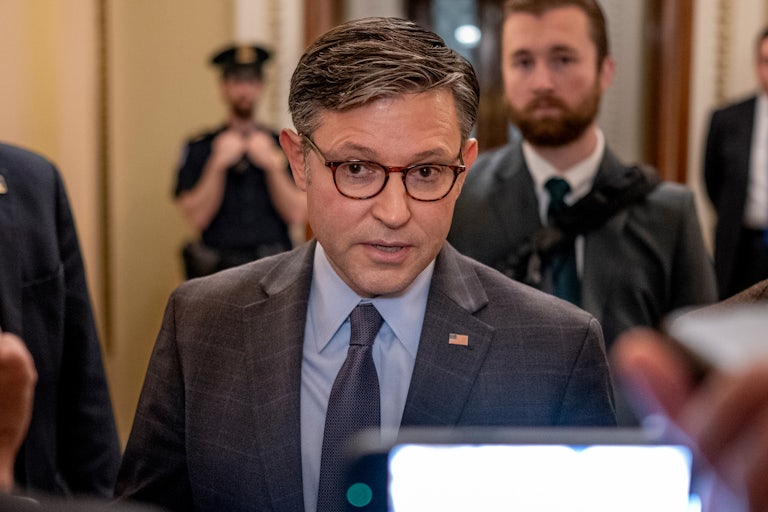
House Speaker Mike Johnson speaks to reporters in the Capitol
Daniel Heuer/Bloomberg/Getty Images

The Republican-controlled House has passed another stopgap bill to keep the government chugging along until late November.

The final tally Friday morning was 217–212, with just one Democrat—Maine Representative Jared Golden—voting alongside all but two Republicans to pass it. Conservative Representatives Tim Burchett and Victoria Spartz sided with the rest of the Democrats in voting against the continuing resolution.

The measure now advances to the Senate, where Minority Leader Chuck Schumer has already promised to defeat it. In its stead, Democratic leadership in the upper chamber have proposed a separate funding plan—though that is also expected to be rejected on the Senate floor late Friday.

The House bill extends the current level of federal funding without making any changes to federal policy. It will keep the government up and running until November 21, which will likely cause another kerfuffle on the eve of Congress’s Thanksgiving recess.

The Democratic Senate bill, meanwhile, would initiate a series of policy changes, including extending Obamacare subsidies and nixing the “big, beautiful” bill’s Medicaid cuts. That plan would fund the government through October 31.

House Speaker Mike Johnson addressed Schumer shortly after the vote, informing the New York politico that the ball was now in his court.

“I hope he does the right thing,” Johnson told reporters. “I hope he does not choose to shut the government down and inflict pain, unnecessarily, on the American people. I hope that they will vote on this clean, short-term CR, so that we can continue the work to get our appropriations done.”

If Schumer’s recent actions are anything to go by, the senator is unlikely to force his caucus into a shutdown showdown. Months ago, when the party was unified in its opposition to Trump’s landmark legislation, Schumer argued that a government shutdown would have “consequences for America that are much, much worse” than the president’s $880 billion cut to social programs.

A shutdown would give the Trump administration “carte blanche to destroy vital government services at a significantly faster rate than they can right now,” Schumer said at the time. “Under a shutdown, the Trump administration would have full authority to deem whole agencies programs and personnel nonessential, furloughing staff with no promise they would ever be rehired.”

The FBI Is Coming for Trans People

According to a new report, the Federal Bureau of Investigation is planning on labeling all trans people “violent extremists.”

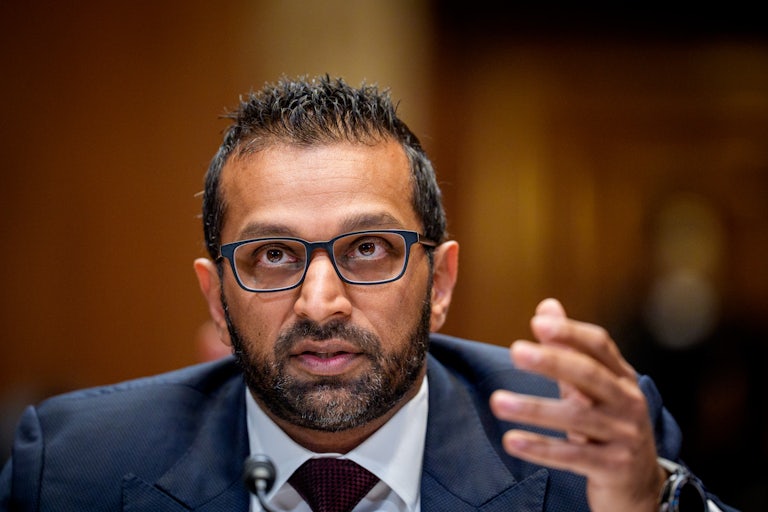
Kash Patel holds out his hand while speaking before Congress
Andrew Harnik/Getty Images
Kash Patel

The FBI is rearing up to target transgender people, according to a new report by independent national security journalist Ken Klippenstein.

Discussions are reportedly underway in the Trump administration to designate transgender people as “violent extremists” in the wake of last week’s shooting of conservative activist Charlie Kirk.

Authorities say the roommate and apparent romantic partner of Tyler Robinson, the alleged gunman, is “transitioning from male to female.” Notably, Robinson’s partner had no prior knowledge of the attack and “has been very cooperative with authorities,” according to Utah Governor Spencer Cox. There “is not a solid understanding” as to whether Robinson’s relationship was connected to his alleged actions, a federal official told NBC.

And yet the attack is, per Klippenstein, being used to justify plans to go after trans individuals by labeling them “nihilistic violent extremists.” Klippenstein reports that “the new classification, sources say, gives Trump officials political (and media) cover.”

“They are cynically targeting trans people because the shooter’s lover was trans,” said a senior intelligence official, one of two national security personnel to tell Klippenstein of the FBI’s plan. “The administration has convinced itself that the Charlie Kirk murder exposes some dark conspiracy.”

Klippenstein’s report offers yet another example of the Trump administration and broader MAGA right seizing on Kirk’s death as a flimsy pretext to crack down on purported undesirables.