Breaking News
Breaking News
from Washington and beyond

Karoline Leavitt Says Trump Can Destroy Entire White House if He Wants

Leavitt dodged a key question on the limits to Donald Trump’s abilities to renovate.

Karoline Leavitt speaks at the podium in the White House briefing room while holding up a photo of previous White House renovations
Jim Watson/AFP/Getty Images

Donald Trump has free license to reshape the White House as he sees fits, according to his staff.

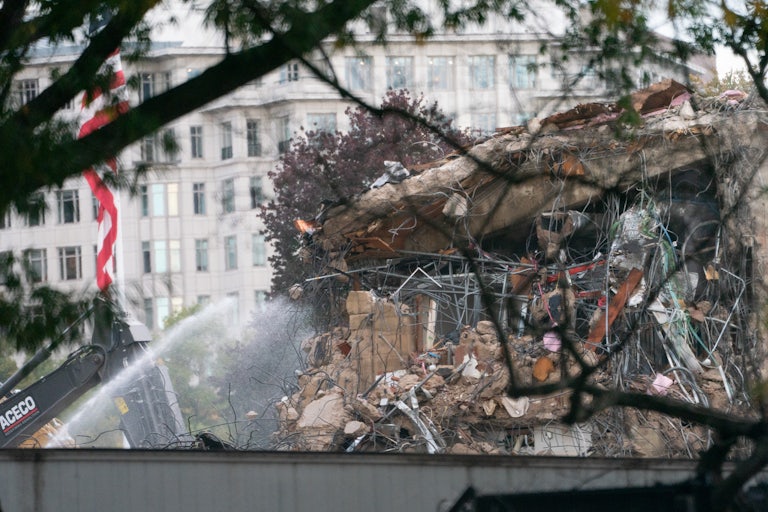
With no warning, the president razed the White House’s East Wing this week to make way for a $300 million ballroom that he claimed would be “100 percent” paid for by himself and his “friends.” 

As the demo bore on, it became clear that what had been originally pitched as a minor expansion to one of the most prominent symbols of American democracy would not only destroy the historic two-story addition, which was constructed under the presidency of Franklin D. Roosevelt. It would also overshadow the White House entirely, with a square footage nearly double the size of the rest of the building.

Despite public backlash, White House press secretary Karoline Leavitt doubled down Thursday that the president had total, unquestionable authority to alter the premises however he desires, repeatedly leaning on the supposed allowances of a legal precedent that she failed to name. 

“The White House has explained that the reason you didn’t submit construction plans to the [National Capital Planning Commission] is because that commission, along with others, don’t have oversight over demolitions, but only over construction,” CBS reporter Weijia Jiang said. “So, can you help us understand—can the president tear down anything he wants without oversight? Could he demolish this building or, say, the Jefferson Memorial?”

“So, it’s not the president who came up with that legal opinion himself. That’s a legal opinion that’s been held by the NCPC for many years,” Leavitt said, suggesting that only vertical construction requires the express approval of the federal planning agency. “There have been many presidents in the past who have made their mark on this beautiful White House complex.”

“It sounds like the answer is yes, he can tear down whatever he wants?” Jiang pressed. 

“That’s not what we’re saying. That’s a legal opinion that’s been held for many years,” the 27-year-old press secretary reiterated. 

“That’s how you’re interpreting it,” Jiang said. 

“No, it’s something that presidents have done for years and years,” Leavitt continued, holding up photos of the West Wing’s construction in 1902 while condescendingly prompting Jiang to explain where the “rubble” in the photo came from.

The White House (along with the U.S. Capitol and the Supreme Court) is technically exempt from the National Historic Preservation Act, which requires agencies to undergo a review process and field public opinion before altering historical landmarks. Traditionally, presidents have voluntarily submitted construction proposals to the NCPC anyway, in a show of transparency.

But the Trump administration’s rationale for bulldozing past presidential precedent and public expectation also flagrantly ignores the fact that any significant project on the White House grounds, such as tearing down walls or new construction, requires congressional approval and a lengthy approval process to proceed.

The destruction is a far cry from what Trump had proposed when he first floated the idea of constructing a ballroom on the White House grounds. During the initial announcement in July, Trump claimed that his project “won’t interfere with the current building. It won’t be. It’ll be near it but not touching it.”

Beyond the gargantuan overhaul, the sitting president doesn’t appear to be a huge fan of the national symbol. During his first term, Trump reportedly called the White House “a dump” (an allegation that he has publicly refuted), and he has spent no small part of his second term living and dining at his own properties rather than the executive mansion.

It is not clear whether the National Capital Planning Commission was consulted or received any meaningful insight prior to the White House’s demolition, particularly as it has been closed since the government shut down 23 days ago.

“The decisions were made in complete secrecy and undertaken without public disclosure or proper consultation,”  the ranking members on the House Oversight and Natural Resources committees and the subcommittee on energy on mineral resources wrote Trump in a letter Thursday. “The American people deserve full transparency regarding the substantial demolition, preparation, and construction at the White House during a government shutdown, particularly when it concerns alterations to one of our nation’s most historically significant buildings.”
Trump Credits His Tech Buddies for Decision to Back Off San Francisco

Trump has surprisingly backed off a federal “surge” in San Francisco.

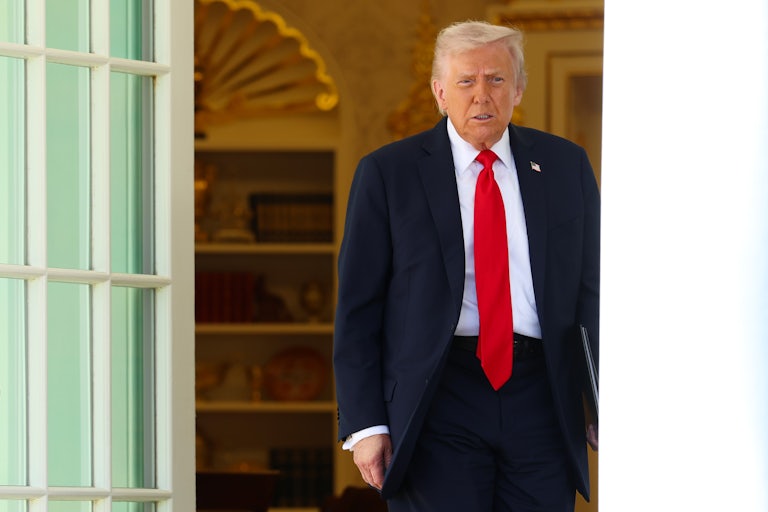
Donald Trump at the White House
Anna Moneymaker/Getty Images

Donald Trump has been convinced not to deploy federal troops to the city of San Francisco, as he has in other cities across the country. 

In a Truth Social post Thursday afternoon, Trump wrote that he was persuaded by a phone call with San Francisco Mayor Daniel Lurie and conversations with tech industry leaders such as Nvidia CEO Jensen Huang and Salesforce chief executive Marc Benioff. 

“They want to give it a ‘shot.’ Therefore, we will not surge San Francisco on Saturday. Stay tuned!” Trump’s post read.  


Donald J. Trump
President of the United States
The Federal Government was preparing to “surge” San Francisco, California, on Saturday, but friends of mine who live in the area called last night to ask me not to go forward with the surge in that the Mayor, Daniel Lurie, was making substantial progress. I spoke to Mayor Lurie last night and he asked, very nicely, that I give him a chance to see if he can turn it around. I told him I think he is making a mistake, because we can do it much faster, and remove the criminals that the Law does not permit him to remove. I told him, “It’s an easier process if we do it, faster, stronger, and safer but, let’s see how you do?” The people of San Francisco have come together on fighting Crime, especially since we began to take charge of that very nasty subject. Great people like Jensen Huang, Marc Benioff, and others have called saying that the future of San Francisco is great. They want to give it a “shot.” Therefore, we will not surge San Francisco on Saturday. Stay tuned!

The post confirms a statement from Lurie Thursday morning that Trump assured him he “was calling off any plans for a federal deployment in San Francisco.” Last month, Trump named the city as one of many places where he planned to deploy the U.S. military for “training,” and on Wednesday, the San Francisco Chronicle reported that the administration planned to send 100 federal agents, including from the Coast Guard and Customs and Border Protection, there within days. 

Those plans appear to be on hold for now, thanks to Trump’s tech baron allies talking him out of targeting San Francisco as he has other cities across America, including Chicago, Los Angeles, and Washington, D.C. The city may also have benefited from the fact that unlike the other cities Trump has targeted, it doesn’t have a Black mayor

Whatever the reasoning, California’s Bay Area has momentarily been spared from Trump’s heavy-handed federal agents, a surprise considering that California governor (and former San Francisco mayor) Gavin Newsom has positioned himself as a persistent Trump critic. Maybe other cities should try to convince a wealthy tech CEO or two to keep the president from siccing his agents on them. 

Dems Investigate Trump Attempt to Take $230 Million From His Own DOJ

Leading House Democrats have launched a probe into Trump’s attempt to pay himself $230 million using taxpayer funds.

Donald Trump sits in his gold-filled Oval Office.
Aaron Schwartz/CNP/Bloomberg/Getty Images

House Democrats have formally begun an investigation into President Trump’s brazen attempt at a $230 million payout from his own Justice Department.

The probe is led by Representatives Jamie Raskin and Robert Garcia.

“If either of your claims had any merit, you could have taken them to court by now and litigated them publicly,” wrote Raskin and Garcia, the top Democrats on the House Oversight and Judiciary committees. “You did not do that. Instead, you waited until you became President and installed your handpicked loyalists at DOJ, knowing that you could instruct them to co-sign your demand notes in secret behind closed doors, and then you could present the notes to the U.S. Treasury for cold hard cash courtesy of the American taxpayer. That isn’t justice, it is theft.”

The president is seeking reimbursement for DOJ investigations into Russian election interference and Russian ties to Trump’s 2016 campaign, as well as for the 2022 FBI search of Mar-a-Lago for classified documents. Trump made the claims in 2023 and 2024, but now his own DOJ is in charge of resolving the matter. The $230 million payout would come from taxpayer funds.

Republicans, however, don’t seem to be too worried about the high levels of potential fraud and corruption associated with an unprecedented move like this.

“I don’t know the details about that, I’ve just read it, I didn’t talk with him about that,” House Speaker Mike Johnson replied when asked about the payout on Wednesday. “I know that he believes he’s owed that reimbursement. What I heard yesterday was if he receives it, he was gonna consider giving it to charity, he doesn’t need those proceeds.”

White House Stops Press From Documenting Trump’s Disaster Renovation

Donald Trump wants to make it harder for the American public to see how he’s wrecking parts of the White House in his quest to tack on a massive ballroom.

White House crumbling walls
Stefani Reynolds/Bloomberg/Getty Images

Donald Trump is apparently so proud of the ballroom he’s building at the White House that he doesn’t want anyone to see the construction in progress. 

On Thursday, the Secret Service closed off access to the Ellipse park, where journalists were taking pictures and video of the demolition of the White House’s East Wing. Both CNN and Reuters photojournalists had to leave the area, according to CNN’s Jim Sciutto.

Images of the ongoing destruction of a major section of the White House seem to have caused enough of a backlash that Trump is trying to keep the public from seeing them. It’s easy to see why: Trump previously claimed that the ballroom would result in no demolition of any part of the White House, and ignored the normal legal process for making any changes to the building. 

The ballroom itself is going to be a garish 90,000-square-foot construction full of Trump’s trademark gold decor. Gone will be a guest entrance as well as offices for the first lady’s staff and other White House employees. A majority of Americans are opposed to the demolition, but White House press secretary Karoline Leavitt has called the backlash “fake outrage.” She  claims that Trump is doing what other presidents have only dreamed of, saying “he was reelected back to this people’s house because he’s good at building things.” 

While Trump claims that the ballroom construction isn’t being paid for by taxpayer funds, that’s not reassuring: $300 million in donations is coming from the president’s wealthy friends, allies, and corporations looking to curry favor with his administration. That money could be considered a bribe. 

Now the Trump administration is attempting to hide the probably illegal destruction and construction from news coverage, and while that won’t make the story and images disappear, nothing will or likely can be done now that a big chunk of the White House is gone. Future occupants of the Oval Office will now inherit a big ballroom that nobody asked for. 

Trump Pardons Major Ally Who Helped Boost His Family’s Cryptocurrency

Binance founder Changpeng Zhao was sentenced to four months in prison for money laundering.

Binance founder Changpeng Zhao sits during an event
Samsul Said/Bloomberg/Getty Images

Donald Trump just pardoned a crypto criminal who’s making the president’s family richer, according to an exclusive Wall Street Journal report Thursday.

After months of lobbying the Trump administration, the president signed a presidential pardon Wednesday for Changpeng Zhao, the founder and former chief executive of Binance, the world’s largest cryptocurrency exchange.

“The Biden Administration’s war on crypto is over,” announced White House press secretary Karoline Leavitt. But is another war on American customers just beginning?

Zhao pleaded guilty in 2023 for failing to maintain an anti-money-laundering program at Binance, earning him a four-month prison sentence. Binance Holdings Limited agreed to pay the United States $4 billion to resolve an investigation into violations related to the Bank Secrecy Act, failure to register as a money-transmitting business, and the International Emergency Economic Powers Act.

Why would Trump pardon Zhao? Likely because he helped line the Trump family’s pockets through his support of World Liberty Financial, or WLFI, the decentralized finance platform that is majority-owned by a Trump business entity.

Binance has repeatedly boosted and incentivized the use of USD1, WLFI’s stable coin, which is a cryptocurrency that maintains a value of $1. Binance provided WLFI its first significant boon in May when the platform accepted a shady $2 billion investment from Abu Dhabi–based MGX made in Trump’s stable coin. The announcement followed an April meeting between Zachary Witkoff, son of special U.S. envoy Steve Witkoff, who is a “promoter” of WLFI, and Zhao in Abu Dhabi where they discussed USD1.

The Wall Street Journal reported in March that representatives from the president’s family met with Zhao to discuss a potential stake in Binance.US, the company’s American arm, which has been heavily restricted due to regulatory issues. The company had first reached out to the president’s allies last year, looking to strike a deal to bring the exiled firm back to the United States.

Read more about Trump’s crypto endeavors: