Breaking News
Breaking News
from Washington and beyond

Pam Bondi Warns Nancy Pelosi She’s Next

Attorney General Pam Bondi has announced Donald Trump’s next target in his revenge crusade.

Attorney General Pam Bondi
Alex Wong/Getty Images

Donald Trump is planning to prosecute another one of his adversaries: Representative Nancy Pelosi.

Attorney General Pam Bondi told Jesse Watters on Fox News Thursday that the Justice Department sent the former House speaker a letter after she suggested that local police could arrest federal agents who violate California law during immigration raids.

“Pelosi got a letter today from Deputy Attorney General Todd Blanche,” Bondi said, adding that the DOJ told Pelosi and San Francisco District Attorney Brooke Jenkins to “preserve your emails, preserve everything you have on this topic, because if you are telling people to arrest our ICE officers, our federal agents, you cannot do that, you are impeding an investigation.”

“We will charge them if they are violating the law. We will protect our federal agents,” Bondi added. “These people are out there working to keep Californians safe, yet you’ve got Pelosi out there saying to obstruct their investigation. You can’t do it, and we’re going to investigate her now as well as that DA.”

The threats against Pelosi follow federal indictments against former FBI Director James Comey over allegations of lying to Congress and New York state Attorney General Letitia James for alleged bank fraud, both of which Trump has all but admitted were at his direction.

If Pelosi is charged as a result of a DOJ investigation, Trump would be emboldened to target more of his critics, including other elected officials. Right now, all that stands in the way of his revenge prosecutions are that the cases are shoddy, lack merit, and are led by inexperienced attorneys.

Canada’s Leaders Double Down After Trump Blows Up Trade Talks

Canadian Prime Minister Mark Carney and Ontario Premier Doug Ford aren’t backing down.

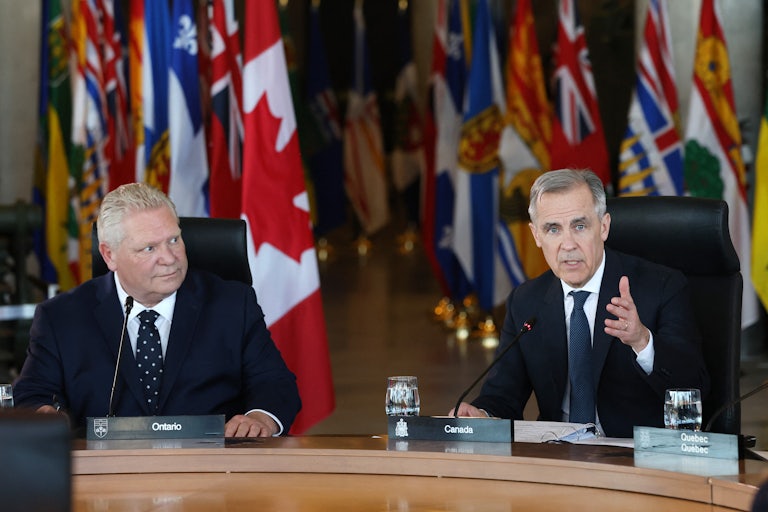
Canada’s Prime Minister Mark Carney speaks as Ontario premier Doug Ford looks on.
DAVE CHAN/AFP/Getty Images

President Trump pulling out of trade talks with Canada has inspired its leaders to continue to rally around the flag rather than capitulate.

“CANADA CHEATED AND GOT CAUGHT!!! They fraudulently took a big buy ad saying that Ronald Reagan did not like Tariffs, when actually he LOVED TARIFFS FOR OUR COUNTRY, AND ITS NATIONAL SECURITY,” Trump wrote Friday morning on Truth Social, after announcing a suspension in talks the night before. “Canada has long cheated on Tariffs, charging our farmers as much as 400%. Now they, and other countries, can’t take advantage of the U.S. any longer. Thank you to the Ronald Reagan Foundation for exposing this FRAUD. MAKE AMERICA GREAT AGAIN!!!”

Trump’s rampage was sparked by an ad paid for by the government of Ontario that featured a voiceover of former President Ronald Reagan warning about the dangers of tariffs.

Canadian Prime Minister Mark Carney responded calmly Friday morning on the tarmac in Ottawa.

“We can’t control the trade policy of the United States. We recognize that that policy has fundamentally changed from the policy in the 1980s, 1990s, and 2000s, and it’s a situation where the United States has tariffs against every one of their trading partners,” he told reporters. “What we can control, absolutely, is how we build here at home.… What we can also control, or at least heavily influence, is developing new partnerships and opportunities, including with the economic giants of Asia, which is the focus of this trip.”

Ontario Premier Doug Ford also chimed in, posting Reagan’s full speech that inspired the ad, in which the former president openly bemoans having to use tariffs against Japan. “Imposing such tariffs or trade barriers, or restrictions of any kind, are steps that I am loath to take.”

It isn’t hard to read between the lines here. Canada will be moving forward with its own plans and policies with or without the United States, no matter how much Trump posts.

Trump Approves Disaster Relief—But Just for States That Voted for Him

Donald Trump is playing favorites at a major cost.

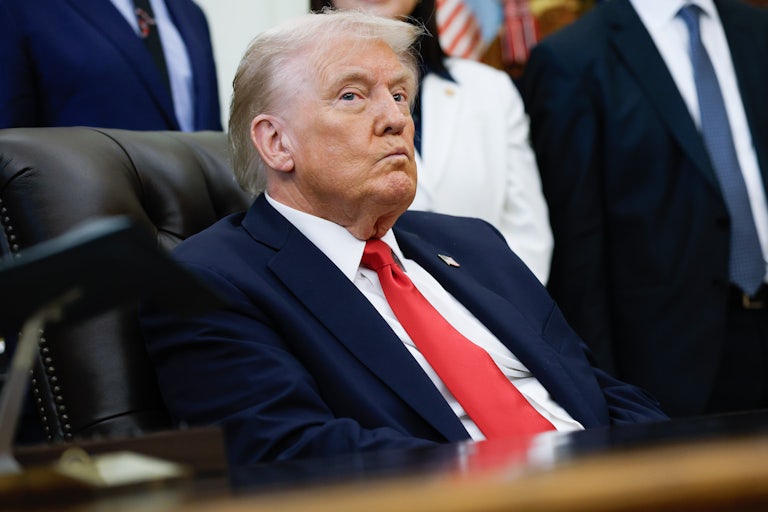
Donald Trump purses his lips while sitting at his desk in the Oval Office
Kevin Dietsch/Getty Images

Whether or not a state receives federal disaster aid under the Trump administration appears to boil down to their vote in the 2024 presidential election.

Donald Trump unlocked Federal Emergency Management Agency aid for several states this week, including Alaska, Nebraska, and North Dakota, but he denied it to others seemingly along party lines.

In multiple posts to Truth Social over the course of the week announcing the aid, Trump boasted that he had “won BIG” in Alaska and was honored to extend federal financial assistance to the “incredible Patriots” of Missouri.

Meanwhile, three states that recently voted blue received nothing: Vermont, Illinois, and Maryland.

Trump pledged $25 million to Alaska to deal with the aftermath of Typhoon Halong, which ravaged the state’s western coast, displaced some 2,000 residents, and killed at least one person. Severe flooding in the wake of the storm lifted houses off their foundations and obliterated some coastal villages.

“It is my Honor to deliver for the Great State of Alaska, which I won BIG in 2016, 2020, and 2024—ALASKA, I WILL NEVER LET YOU DOWN!” Trump wrote on Truth Social Tuesday.

North Dakota and Nebraska received aid approval to deal with fallout from multiple storms and tornadoes in August. Trump said Thursday he granted North Dakota $3 million, emphasizing on social media that he “won THREE times in 2016, 2020, and 2024.”

Trump also granted FEMA aid to the Leech Lake Band of Ojibwe in Minnesota, which is still dealing with thousands of felled trees on tribal lands from a June storm, reported the Associated Press.

The president denied four requests for federal disaster relief. That included Maryland’s appeal for reconsideration to deal with massive flooding that affected the state’s western region in May, despite damages that nearly tripled the qualifying threshold for assistance.

In a statement, Maryland Governor Wes Moore said that Trump’s denial was “deeply frustrating,” leaving residents to deal with the wreckage on their own.

“President Trump and his Administration have politicized disaster relief, and our communities are the ones who will pay the price,” said Moore.

Vermont officials similarly underscored that damages caused by July storms far exceeded what locals could afford to fix on their own.

“It’s well over the annual budget or two years’ budget (of some towns), to fix those roads,” Eric Forand, Vermont’s emergency management director, told the Associated Press.

Steve Bannon Reveals There’s a Plan for a Third Trump Term in 2028

Just another reminder that this is completely unconstitutional.

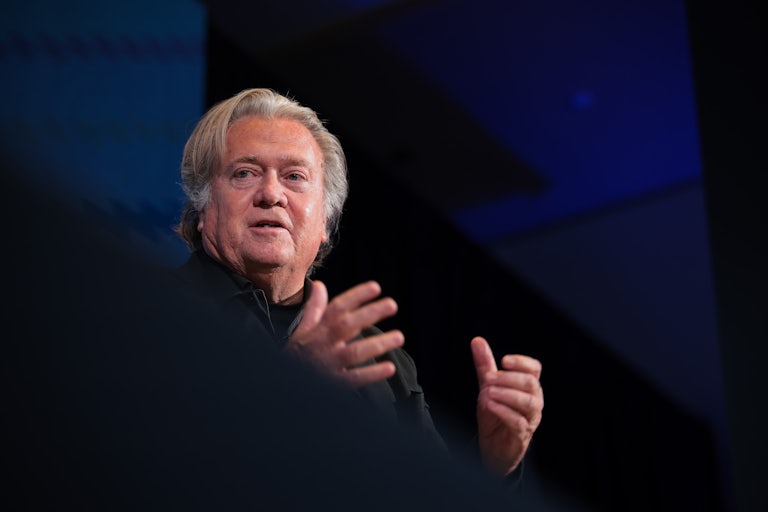
Steve Bannon
Kayla Bartkowski/Getty Images

Far-right commentator and former Donald Trump adviser Steve Bannon says the president will serve a third term despite being barred by the Constitution. 

In a video interview with The Economist published Thursday, Bannon said, “Well, he’s gonna get a third term.” 

“Trump is gonna be president in ’28, and people ought to just get accommodated with that,” Bannon said, brushing off concerns about the Twenty-Eigth Amendment. 

“There’s many different alternatives. At the appropriate time, we’ll lay out what the plan is, but there’s a plan and President Trump will be the president in ’28,” Bannon added. 

Bannon’s odious remarks echo several threats and “jokes” made by Trump associates and administration officials, as well as the president himself. It’s not even the first time Bannon has mentioned plans to keep Trump in office longer—he mentioned “many different alternatives” for Trump’s presidency to continue in a NewsNation interview earlier this month. 

One of Trump’s lawyers was also exploring the possibility of Trump violating the Constitution’s term limits back in 2023, and Trump encouraged calls for a third term at a Michigan rally in April. The response from other conservatives, such as Senator Lindsey Graham and even Supreme Court Justice Amy Coney Barrett, has not been reassuring.  

While Trump has claimed to be “joking,” he still is selling “Trump 2028” merchandise, and should be taken seriously. The question is whether Democrats have a plan to stop him by the time the presidential elections roll around in three years. Judging by their efforts against the president’s agenda this year, work needs to begin immediately.  

Watch the full interview with Bannon on YouTube (third-term chatter begins at 6:15). 

As Trump Loses It at Canada, Here’s What Reagan Really Said on Tariffs

Donald Trump and the Ronald Reagan Presidential Foundation and Institute said Canada’s ad took the late president’s words out of context.

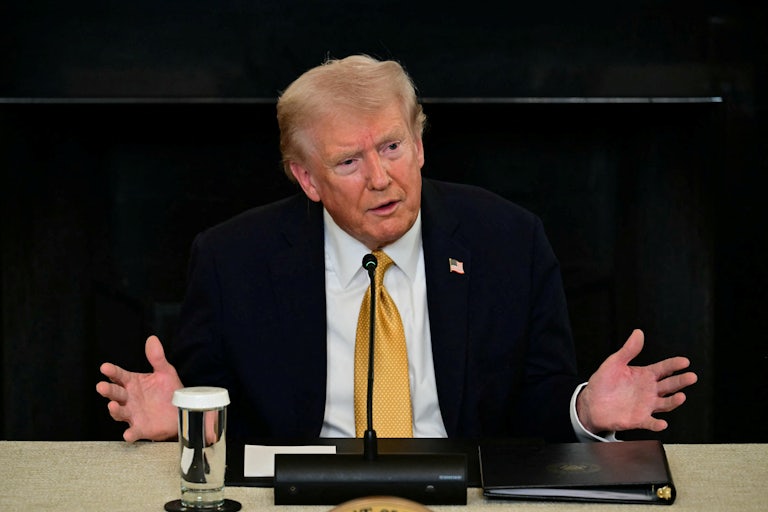
Donald Trump gestures while speaking during an event
Jim Watson/AFP/Getty Images

The White House has terminated all trade negotiations with Canada after Donald Trump claimed an advert misrepresented former President Ronald Reagan’s thoughts on tariffs. But that’s not quite true.

Last week, Ontario’s provincial government issued an ad featuring a clip of Reagan from a 1987 radio address in which the conservative icon argued that tariffs undermine economic prosperity, and that they only serve to “hurt every American.”

Late Thursday, Trump nixed trade talks with Canada, declaring the clip was a “fake.” The Ronald Reagan Presidential Foundation also claimed that the footage of the fortieth president was selectively edited and is reportedly seeking legal options.

The axed negotiations leave in place a 35 percent tariff on Canadian goods, as well as additional tariffs on Canada’s car and steel products, two fines that have particularly devastated Ontario.

The one-minute advertisement uses portions of Reagan’s five-minute speech, creating the impression that Reagan is saying several sentences in succession that were actually separate during the original address. As edited, Reagan appears to say this during Ontario’s ad:

When someone says, “Let’s impose tariffs on foreign imports,” it looks like they’re doing the patriotic thing by protecting American products and jobs. And sometimes, for a short while, it works—but only for a short time.

But over the long run such trade barriers hurt every American worker and consumer. High tariffs inevitably lead to retaliation by foreign countries and the triggering of fierce trade wars. Then the worst happens: Markets shrink and collapse, businesses and industry shut down, and millions of people lose their jobs. Throughout the world, there’s a growing realization that the way to prosperity for all nations is rejecting protectionist legislation and promoting fair and free competition. America’s jobs and growth are at stake.

In reality … Reagan was still very critical of tariffs during the brief speech, perhaps even more so than depicted by the ad’s brevity. Not all of the sentences used in the advert, however, are in the exact order they appear in the complete speech. Here’s what Reagan actually said in his full address at Camp David on April 25, 1987, as released by the Reagan Foundation:

My fellow Americans, Prime Minister Nakasone of Japan will be visiting me here at the White House next week.

It’s an important visit because while I expect to take up our relations with our good friend Japan, which overall remain excellent, recent disagreements between our two countries on the issue of trade will also be high on our agenda. As perhaps you’ve heard, last week I placed new duties on some Japanese products in response to Japan’s inability to enforce their trade agreement with us on electronic devices called semiconductors.

Now, imposing such tariffs or trade barriers and restrictions of any kind are steps that I am loath to take, and in a moment I’ll mention the sound economic reasons for this, that over the long run such trade barriers hurt every American worker and consumer. But the Japanese semiconductors were a special case. We had clear evidence that Japanese companies were engaging in unfair trade practices that violated an agreement between Japan and the United States. We expect our trading partners to live up to their agreements. As I’ve often said, our commitment to free trade is also a commitment to fair trade.

But you know, in imposing these tariffs, we were just trying to deal with a particular problem, not begin a trade war. So next week, I’ll be giving Prime Minister Nakasone this same message: We want to continue to work cooperatively on our trade problems and want very much to lift these trade restrictions as soon as evidence permits. We want to do this because we feel both Japan and the United States have an obligation to promote the prosperity and economic development that only free trade can bring.

Now, that message of free trade is one I conveyed to Canada’s leaders a few weeks ago, and it was warmly received there. Indeed, throughout the world, there’s a growing realization that the way to prosperity for all nations is rejecting protectionist legislation and promoting fair and free competition. Now, there are sound historical reasons for this. For those of us who lived through the Great Depression, the memory of the suffering it caused is deep and searing, and today, many economic analysts and historians argue that high tariff legislation passed back in that period called the Smoot-Hawley Tariff greatly deepened the Depression and prevented economic recovery.

You see, at first when someone says, “Let’s impose tariffs on foreign imports,” it looks like they’re doing the patriotic thing by protecting American products and jobs. And sometimes, for a short while, it works—but only for a short time. What eventually occurs is, first homegrown industries start relying on government protection in the form of high tariffs. They stop competing and stop making the innovative management and technological changes they need to succeed in world markets. And then while all this is going on, something even worse occurs. High tariffs inevitably lead to retaliation by foreign countries and the triggering of fierce trade wars.

The result is more and more tariffs, higher and higher trade barriers, and less and less competition. So soon, because of the prices made artificially high by tariffs that subsidize inefficiency and poor management, people stop buying. Then the worst happens: Markets shrink and collapse, businesses and industries shut down, and millions of people lose their jobs.

The memory of all this occurring back in the ’30s made me determined when I came back to Washington to spare the American people the protectionist legislation that destroys prosperity. Now, it hasn’t always been easy. There are those in the Congress—just as there were back in the ‘30s—who want to go for the quick political advantage, who risk America’s prosperity for the sake of a short-term appeal to some special interest group, who forget that more than five million American jobs are directly tied to the foreign export business and additional millions are tied to imports.

Well, I’ve never forgotten those jobs. And on trade issues, by and large, we’ve done well. In certain select cases, like the Japanese semiconductors, we’ve taken steps to stop unfair practices against American products, but we’ve still maintained our basic long-term commitment to free trade and economic growth.

So with my meeting with Prime Minister Nakasone and the Venice economic summit coming up, it’s terribly important not to restrict the president’s options in such trade dealings with foreign governments. Unfortunately, some in the Congress are trying to do exactly that. I’ll keep you informed on this dangerous legislation because it’s just another form of protectionism, and I may need your help to stop it. Remember, America’s jobs and growth are at stake. Until next week, thanks for listening and God bless you.

Watch Reagan’s full speech here.