Breaking News
Breaking News
from Washington and beyond

GOPer Joins Dems in Calling Out Trump Over Lack of Boat Strike Info

Representative Mike Turner said Donald Trump had not even briefed the House Armed Services Committee.

Representative Mike Turner gestures while speaking
Anatolii Stepanov/AFP/Getty Images

The Trump administration is keeping Congress in the dark on its Caribbean boat bombings—and it’s angering people on both sides of the aisle.

The United States has committed 14 known strikes on small boats in the Caribbean Sea and eastern Pacific Ocean over the last two months, killing at least 61 people.

But not all lawmakers are being treated equally when it comes to accessing information regarding the attacks. On Wednesday, it became abundantly clear that Democrats had been shut out of a Senate briefing on the extrajudicial killings, sending lawmakers on both sides of the aisle into a frenzy.

In an interview with CNN’s Eric Burnett Wednesday, Republican Representative Mike Turner emphasized that Congress had not “received the information that it needs to.”

“I do think that there are serious concerns as to both the legal construct as to what the administration is doing, and there needs to be more information that’s provided to Congress,” Turner said. “And I think both the logistics and the intelligence information needs to be shared more, more broadly.”

Turner, a member of the House Armed Services Committee, revealed that no one in Congress had received a “full presentation” of the scope of and plan for future boat strikes.

Senator Mark Warner, the top Democrat on the Senate Intelligence Committee, issued a venomous statement Wednesday arguing that the partisan information gap was “indefensible” and a “slap in the face” to Congress’s war powers responsibilities.

“Shutting Democrats out of a briefing on U.S. military strikes and withholding the legal justification for those strikes from half the Senate is indefensible and dangerous,” Warner posted on X. “Decisions about the use of American military force are not campaign strategy sessions, and they are not the private property of one political party. For any administration to treat them that way erodes our national security and flies in the face of Congress’ constitutional obligation to oversee matters of war and peace.”

Warner then underscored previous commitments by State Secretary Marco Rubio, who Warner said had “personally promised” a face-to-face meeting on Capitol Hill regarding the details and alleged justification for the attack.

The White House has insisted the violence is justified, broadly accusing the boats of trafficking narcotics to the U.S. from Venezuela and Colombia. U.S. lawmakers have been more than skeptical, though—particularly since several of the boats were thousands of miles away in international waters, and since the attacks were conducted without prior investigations or interdiction.

Trump has blamed the attacks on Venezuelan leader Nicolás Maduro, who has remained atop the country’s government despite Trump’s forceful attempts in 2019 to install then-opposition leader Juan Guaido.

On Friday, the Pentagon announced it would deploy the world’s largest warship—the USS Gerald R. Ford—to Latin America in an effort to ramp up the military firepower available for fighting the small watercraft.

But the escalation has only further strained America’s relationship with its Latin American neighbors. In an address to his country late last week, Maduro accused the U.S. of seeking “a new eternal war.”

“They promised they would never again get involved in a war, and they are fabricating a war,” he said.

“Not a Signal Chat”: Mike Waltz Interrupted in Middle of U.N. Speech

Trump’s ambassador to the United Nations was embarrassed while speaking to the General Assembly.

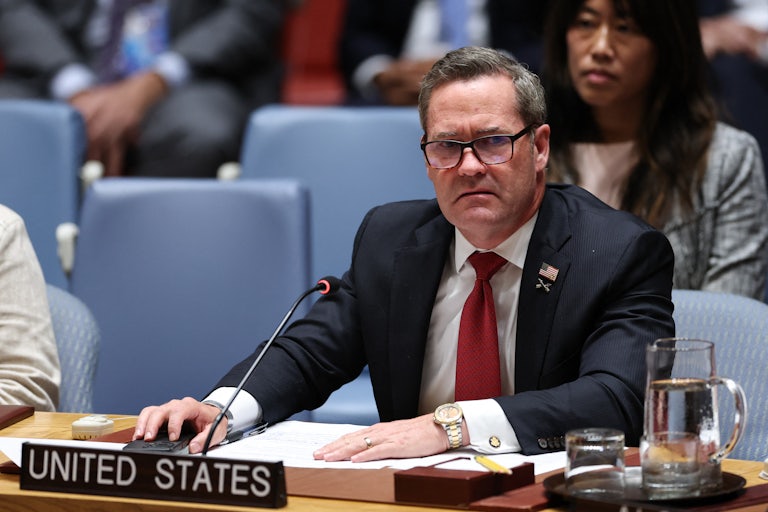
Mike Waltz speaks at the United Nations, looking pissed off.
ANGELA WEISS/AFP/Getty Images

That infamous Signal chat keeps coming back to haunt the Trump administration.

On Tuesday, U.S. Ambassador to the United Nations Mike Waltz was interrupted in the middle of a speech before a U.N. General Assembly vote on whether to condemn U.S. economic restrictions on Cuba.

“Mr. Waltz, this is the United Nations General Assembly,” Cuban Foreign Minister Bruno Rodriguez said, cutting off Waltz. “It is not a Signal chat. Nor is it the House of Representatives,” he added, also calling Waltz’s remarks “uncivilized, crude and gross.”

Waltz was not happy.

“I am well aware of the location in which we are speaking,” the ambassador responded. “And this is also not a Communist illegitimate legislature in Havana.”

Waltz attacked the Cuban government as “illegitimate and brutal,” claiming that he was correcting “the fake news, the misinformation, and this false reality the regime seeks to create year after year with this vote.”

Ultimately, Waltz’s tough talk swayed few, if any, countries, as the U.N. General Assembly voted 165–7, with 12 abstentions, Wednesday to condemn the American economic embargo against Cuba, the thirty-third year in a row it has done so. The resolution is symbolic and carries no legal weight, but reflects global opinion.

The whole reason Waltz is the U.N. ambassador is because, while previously serving as national security adviser, he set up a Signal chat where secret military plans were discussed with Defense Secretary Pete Hegseth, Vice President JD Vance, and other top government officials and then mistakenly added The Atlantic’s editor in chief Jeffrey Goldberg. Waltz was removed from his position and instead nominated to the U.N. post, a job that requires diplomatic savvy, which he seems to be lacking.

Texas Judges No Longer Required to Marry Same-Sex Couples

Marriage equality is collapsing across this country, even without the Supreme Court’s help.

Someone with a flower tattoo on their arm draws a rainbow in chalk.
Elizabeth Conley/Houston Chronicle/Getty Images
Protesters draw a rainbow in chalk on the sidewalk near the rainbow crosswalk in the Montrose neighborhood in Houston, on October 19.

In a massive rollback for LGBTQ rights, the Texas Supreme Court has ruled that judges have the right to refuse to officiate gay weddings if they have a “sincerely held religious belief.”

This rule change came last week in a comment added to the state’s judicial code. “It is not a violation of these canons for a judge to publicly refrain from performing a wedding ceremony based upon a sincerely held religious belief,” the new rule reads.

This move essentially nullifies Canon 4 of the Texas judicial code, which blocked judges from doing things that would “cast doubt on their ability to act impartially or interfere with the proper performance of judicial duties”—like officiating weddings of straight couples but not gay ones. (In Texas, judges are not required to officiate weddings at all.)

In 2019, Justice of the Peace Dianne Hensley was accused of violating the judicial code when she was given a public warning for refusing to officiate gay weddings. Hensley stopped doing all wedding officiating when the Supreme Court legalized gay marriage in Obergefell v. Hodges in 2015, but promptly started discriminating again when she returned to straight-only weddings the following year, refusing any same-sex couples who came to her. Hensley sued over the public warning she later received, but now, she’s been temporarily vindicated.

“Now going forward, every judge in Texas will enjoy the freedom Judge Hensley has fought so hard for in her case,” Hiram Sasser of the conservative First Liberty Institute said. “As for her case specifically, this amendment melts away the reasons the Commission relied on to punish Judge Hensley.”

“Judge Hensley treated them respectfully,” Texas Chief Justice Jimmy Blacklock wrote, of the same-sex couples she refused. “They got married nearby. They went about their lives. Judge Hensley went back to work, her Christian conscience clean, her knees bent only to her God. Sounds like a win-win.”

Not everyone agrees.

“One of the claims that I think will be made in response to litigation that is likely is that, ‘Well, there are other people who can perform the wedding ceremony, so you can’t insist that a particular judge do it,’” law professor Jason Mazzone said. “But that, of course, is not how equal protection works, and it’s not how we expect government officials to operate.”

That one sentence at the bottom of the Texas judicial code is effective immediately, and may even have an impact on the right’s efforts to overturn gay marriage protections in the United States, adding the right to love to the list of quickly eroding liberties currently under attack.

Trump Tries to Flex on China by Bringing Back Nuclear Weapons Testing

The last time the U.S. tested a nuclear weapon was in 1992.

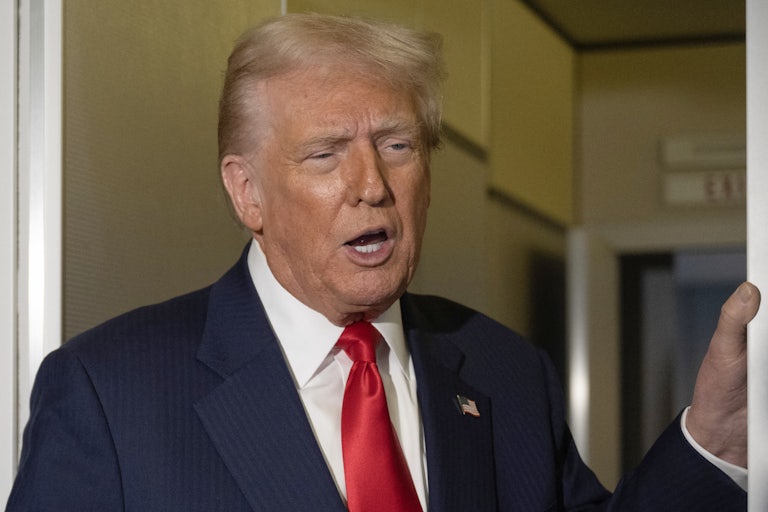
Donald Trump speaks to reporters on Air Force One
Andrew Caballero-Reynolds/AFP/Getty Images

Amid the crumbling relations with Russia and China, President Donald Trump is pushing for the United States to resume nuclear weapons testing.

As the president returned to the United States from his trip to Asia, he took to Truth Social to make an explosive announcement. “Because of other countries testing programs [sic], I have instructed the Department of War to start testing our Nuclear Weapons on an equal basis,” Trump wrote Wednesday night. “That process will begin immediately.”

The president also claimed that the United States “has more Nuclear Weapons than any other country,” thanks to his efforts during his first term, followed by Russia and then China as a “distant third.” However, in 2025, the Federation of American Scientists found that Russia possessed more nuclear warheads than any other country.

Trump’s tremendous step backwards away from nuclear disarmament comes amid strained relations with both Russia and China, as well as a North Korean missile test on Tuesday.

After a falling out with Trump, Russian President Vladimir Putin has resumed saber-rattling amid stalled peace negotiations with Ukraine. Russia tested the world’s first nuclear-powered missile on Saturday, and on Tuesday, it tested an underwater superweapon designed to trigger tsunamis. Trump warned Russia Monday that the U.S. was “not playing games” and had a nuclear submarine stationed offshore.

China has honored the moratorium on nuclear testing established in the 1996 Comprehensive Nuclear-Test-Ban Treaty, which Russia and the U.S. both signed. (The U.S. never ratified the treaty, and Russia later rescinded its ratification.) Still, China is reportedly rapidly expanding its nuclear arsenal. Tense trade negotiations sparked by Trump’s sweeping tariffs have strained relations with Chinese President Xi Jinping, but Trump claimed Thursday the two leaders had had a productive meeting.

North Korean leader Kim Jong Un, whom Trump tried and failed to connect with during his tour in Asia, also tested strategic missiles capable of carrying nuclear weapons this week. North Korea is the only country in the world to conduct live nuclear weapons tests since the 1990s.

Nuclear weapons testing made an appearance in Project 2025, the authoritarian playbook for the second Trump administration. The plan called for the U.S. to “reject ratification of the Comprehensive Test Ban Treaty and indicate a willingness to conduct nuclear tests in response to adversary nuclear developments if necessary.”

Trump Brags About New Deal With China. Did He Actually Get Anything?

Donald Trump admitted he hadn’t asked all that much of Chinese President Xi Jinping.

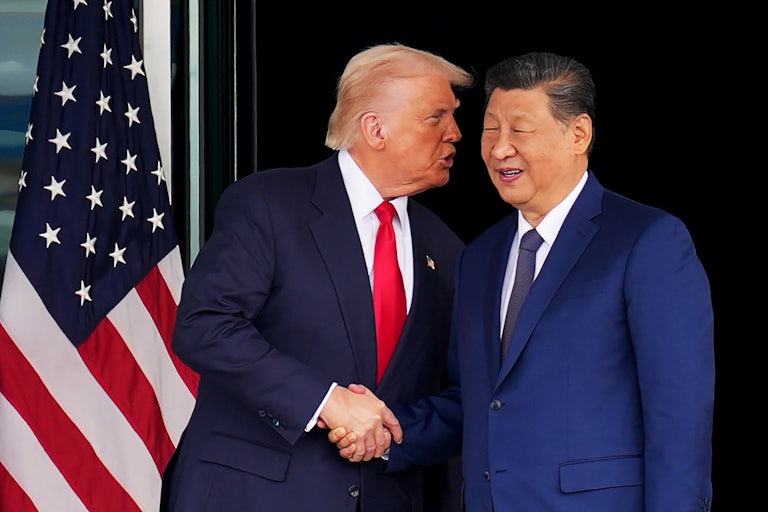
Donald Trump speaks into Chinese President Xi Jinping's ear as they shake hands
Andrew Harnik/Getty Images

Donald Trump’s absolutely incredible, stupendous meeting with Chinese President Xi Jinping appears to have almost undone the damage of his own trade policies.

Details of the quid pro quo were remarkably vague but appeared to return trade relations between the two international powers closer to where they had been before Trump announced his “Liberation Day” tariffs in April.

Speaking to reporters aboard Air Force One shortly after the meeting, Trump detailed that he and Xi had agreed to immediately drop the tariff rate on China by 10 percent (from 57 percent to 47 percent) in exchange for more aggressive policing of the Chinese fentanyl pipeline.

Trump also said that China agreed to pause its controls on precious rare earth minerals for the next year in order to avoid Trump’s threat of an additional 100 percent tariff that would have been enacted on Saturday.

“It was an amazing meeting,” Trump said. “From zero to 10 (with 10 being the best), the meeting was a 12.”

Soybean farmers also got a potential solution to a problem that Trump created. China will buy “tremendous amounts” of soybeans from American farmers starting “immediately,” per the president. Soybean farmers have been pushed to the brink of bankruptcy, practically begging the administration for a bailout since Trump’s previously unsuccessful attempts to trade with China resulted in axing access to the U.S. soybean industry’s number one foreign market.

Treasury Secretary Scott Bessent—who was present at the meeting between Trump and Xi—elucidated those details hours later in an interview with Fox Business.

“The Chinese have agreed to buy 12 million metric tons of soybeans during this season, right now, between now and January, and then for the next three years they’re going to be buying a minimum of 25 million tons per annum for the next three years,” Bessent said.

Other purported gains out of the negotiation, however, seemed rather empty. Trump promised that a bigger U.S.-China trade deal was coming “pretty soon” and that he would travel to China again in April. He added in a lengthy Truth Social Post that China “may” make a “very large scale transaction” of oil and gas from Alaska.

But a couple details that emerged did not sound like they would benefit the U.S. in any way—perhaps most notably Trump’s decision to allow China to “talk to Nvidia and others” about scooping more computer chips. That alone is likely to rile GOP hawks who have clutched Nvidia as a precious stateside asset in the burgeoning AI tech wave.

“I said, that’s really up to you and Nvidia,” Trump recalled he told Xi. “We’re sort of the … referee.”

Trump also faltered on the topic of brokering peace in Ukraine, apparently allowing Chinese consumption of Russian oil to continue unchallenged.

Still, Trump was quick to celebrate his own work on brokering the deal.

“China—you know, I think they feel very strongly,” Trump told reporters early Thursday. “They congratulated me on the tremendous success that we’ve had, because there’s never been a country that has had so much money come into it for purposes of investment, for building, for auto plants, for AI, et cetera. So he was very strong on congratulating me on that.”