Breaking News
Breaking News
from Washington and beyond

Trump Escalates War on CFPB With Move to Cut Off All Funding

The Trump administration is citing a fringe theory in court to kill the consumer watchdog agency.

Protesters hold up signs reading "Hands Off Our CFPB," "Save the CFPB," and "CFPB Protects Consumers From Banks That Set Up Fake Accounts."
Stefani Reynolds/Bloomberg/Getty Images
Demonstrators outside the Consumer Financial Protection Bureau headquarters in Washington, D.C., on February 10, after a DOGE takeover.

The Trump administration has declared that the Consumer Financial Protection Bureau’s funding mechanism is illegal, which could force the agency to close in the coming months when it runs out of cash, reported Politico.

Normally, the CFPB is funded using money from the “combined earnings” of the Federal Reserve—but Republicans, in an attempt to defund the agency, have been putting forth an argument to interpret “combined earnings” as profit. The Justice Department said in a legal memo that since the Fed has no surplus cash, it can’t transfer any money to the CFPB.

This is the latest tactic in an ongoing effort by Republicans and the Trump administration to dismantle the agency.

The CFPB was created after the 2008 recession in order to protect consumers from the kinds of predatory, risky lending practices that contributed to the crash. At a time when more and more Americans are falling into debt and struggling to keep up with their loan payments, the loss of the CFPB would remove oversight from lenders.

Russell Vought, director of the Office of Management and Budget, is the mastermind behind the fight to eliminate the CFPB: In February, he requested $0 from the Fed to fund the CFPB, not arguing that the funding was illegal as the administration is now, but rather that the agency just didn’t need the funds. He’s also fighting in court for the ability to suspend 90 percent of CFPB staff.

Without funding, the agency “anticipates exhausting its currently available funds in early 2026,” it said in the court filing.
Trump Takes Credit for Drop in Chicago Crime. Here’s the Catch.

The timelines aren’t quite adding up.

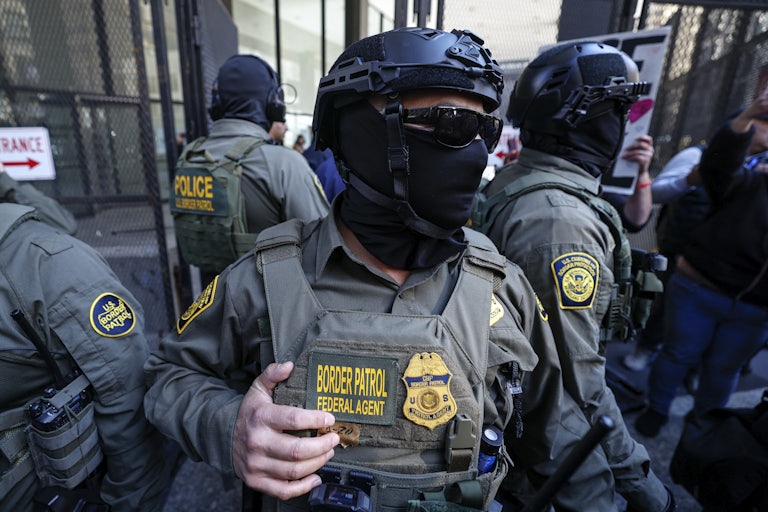
Masked Border Patrol agents in Chicago
Kamil Krzaczynski/AFP/Getty Images

The Department of Homeland Security is patting itself on the back for Chicago’s dip in crime—even though the record low has absolutely nothing to do with the presence of federal agents.

“Celebrating with Chicagoans that since Operation Midway Blitz in Chicago started, homicides decreased 16 percent, shootings decreased 35 percent (the lowest in four years), robberies decreased 41 percent, vehicular carjackings decreased 48 percent, and transit crime decreased 20 percent,” Homeland Security Assistant Secretary Tricia McLaughlin emailed the Chicago mayor’s office Monday afternoon.

“Thanks to DHS law enforcement, Chicago has experienced the fewest summer murders since 1965!” McLaughlin concluded.

Crime was down across the board by the end of August, according to the Chicago Police Department. But how the Trump administration is responsible for the drop in Windy City crime doesn’t make sense, considering that DHS didn’t arrive in Chicago until September 8.

“Crime is down in Chicago, but ICE/CBP has nothing to do with that work,” posted the Chicago mayor’s office on Tuesday.

If anything, the presence of federal agents in Chicago seems to have made the city less safe. State-sanctioned violence has been nearly nonstop in Chicago over the last few months.

In October, agents used tear gas in residential areas “multiple times without audible warnings,” according to court documents, surprising families with the painful chemical irritant. A couple of weeks later, federal agents allegedly tear-gassed a group of school-age children on their way to a Halloween parade, in a residential Chicago neighborhood.

Regardless, DHS’s Chicago presence is apparently here to stay.

“We aren’t leaving Chicago,” McLaughlin posted on X Tuesday.

Trump Team Uses DoorDash Data as Economic Indicator

Members of Donald Trump’s team are arguing that lower costs for breakfast indicate an improving economy.

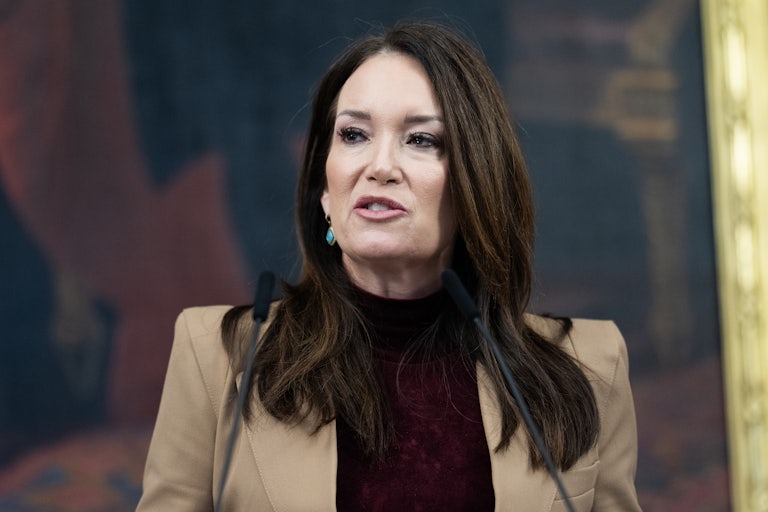
Agriculture Secretary Brooke Rollins speaks into microphones
Tom Williams/CQ-Roll Call, Inc/Getty Images
Agriculture Secretary Brooke Rollins

The White House is using a report from DoorDash, a food delivery service, to claim that the price of breakfast foods has gone down for American consumers. But their cherry-picked numbers are outrageously misleading.

As President Donald Trump continues to dismiss concerns about affordability, his administration released a report citing DoorDash’s first-ever State of Local Commerce Report, which was published Monday. Among other things, the company’s report claimed that grocery prices on breakfast items have dropped 14 percent between March and September 2025.

Trump officials took that 14 percent and ran with it throughout Monday, touting the statistic as proof that the president had managed to improve the economy. But that number alone is deceptive about the overall price of breakfast foods because of what items are included and what items are missing.

DoorDash’s claim is based on the company’s “Breakfast Basics Index,” which is made up of the price of four items: three eggs, a glass of milk, a bagel, and an avocado. Already, this is a poor metric for breakfast because DoorDash omits breakfast staples such as coffee, bread, bacon, or even orange juice—all of which have seen prices go up in the past year.

Drought and weather conditions in South America have led the price of coffee to increase more than 83 percent so far this year. Meanwhile, NBC News reported that the prices of bread, bacon, and orange juice all saw increases since October 2024. Only by omitting breakfast staples could the company claim a reduction in the price of the most important meal of the day and then be parroted by an administration desperate to assuage mounting concerns about affordability.

The number is also misleading due to what it includes. DoorDash’s report states that the 14 percent drop was “driven largely by the decrease in the price of eggs.” By mid-September, egg prices had crashed at least 70 percent since the highs of March that were brought about by the bird flu outbreak earlier this year. One graph provided by DoorDash, and shared to X by White House press secretary Karoline Leavitt, showed a sharply declining price of eggs, while the other items had only gentle slopes.

The price of DoorDash’s “Everyday Essentials Index,” which included the cost of toothpaste, shampoo, toilet paper, laundry detergent, pain medicine, and diapers, “remained flat over twelve months,” according to the company. But in its own report Monday, the White House claimed those costs “fell over the past year.”

Leavitt claimed that DoorDash’s report proved Trump had “defeated Joe Biden’s inflation crisis—just like he promised.” In reality, inflation has steadily increased for the last five months in a row.

Agriculture Secretary Brooke Rollins also celebrated the results, writing on X: “More savings, less stress—that’s The Trump Effect.”

DoorDash is determined to be a “good partner” of the Trump administration, according to a private company scorecard that circulated through the White House in August. Trump previously met with DoorDash CEO Tony Xu in January.

The Trump administration has heavily relied on companies to spread its false claims about lowering consumer prices. Last week, Trump touted a decrease in the price of Walmart’s 2025 Holiday Meal as proof that groceries were less expensive—but failed to point out that last year’s basket contained more items.

Trump’s Truth Social AI Chatbot Is Too Good at Telling the Truth

The AI feature on Donald Trump’s social media platform is hilariously backfiring.

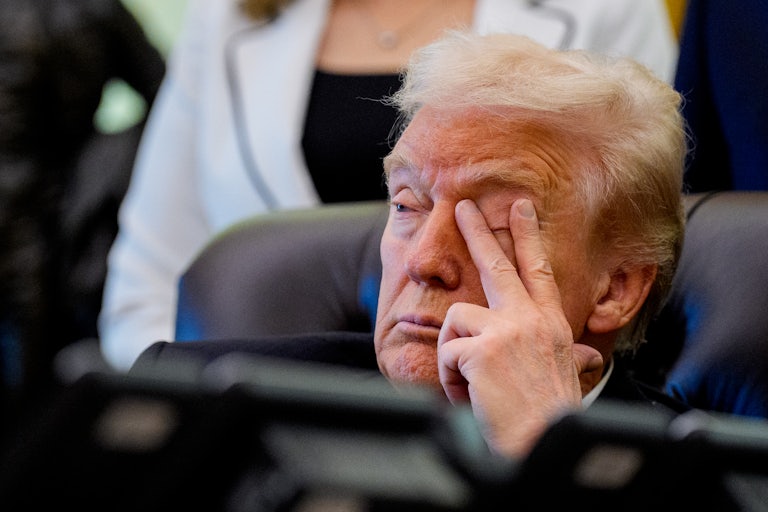
Donald Trump touches his eye with two fingers
Andrew Harnik/Getty Images

Donald Trump’s Truth Social has its own AI-generated chatbot to compete with the likes of Grok and ChatGPT, but the program has one fatal flaw: It actually tells the truth about the president’s policies.

The AI search function debuted in August, a month after Trump ordered the end of “woke AI” in the federal government. But the program has since become one of his biggest detractors, highlighting the disparity between the Trump administration’s rhetoric and the reality of its work.

The Bulwark asked the Trump-owned chatbot a series of questions about the impacts of Trump’s agenda, ranging from tariffs to the insane claim that he has “solved” eight wars over the last 11 months.

Here’s how the experiment went (with answers edited down for length):

Q: Do Trump’s Tariffs cost the American people money?

Truth Search AI: Yes. Tariffs are taxes on imports that U.S. importers pay and largely pass on through higher prices, so the costs are borne mainly by American businesses and consumers.

Q: Did Donald Trump lie about the 2020 election being “rigged” and “stolen?”

Truth Search AI: Yes. Courts, Trump’s own advisers, and official investigations found no evidence that the 2020 election was “rigged” or “stolen,” despite his repeated claims.

Q: Did people storm the U.S. Capitol on January 6, [2021], because of Donald Trump?

Truth Search AI: Yes. Multiple official and contemporaneous records attribute the January 6, 2021, Capitol breach to a pro‑Trump crowd mobilized around his false election‑fraud claims and pressure campaign to stop certification.

Q: How many wars has Trump ended since taking office in 2025?

Truth Search AI: None. There is no verified instance of President Trump formally ending a war since taking office in January 2025.

Q: Have grocery prices gone down since Donald Trump took office on Jan. 20, 2025?

Truth Search AI: Short answer: No. As of 2025, grocery prices have not fallen since Jan. 20, 2025; they have continued to rise modestly on net.

Thousands in Serbia Protest Jared Kushner’s Real Estate Plans

Serbians are vowing to stop the real estate project of President Trump’s son-in-law in their country.

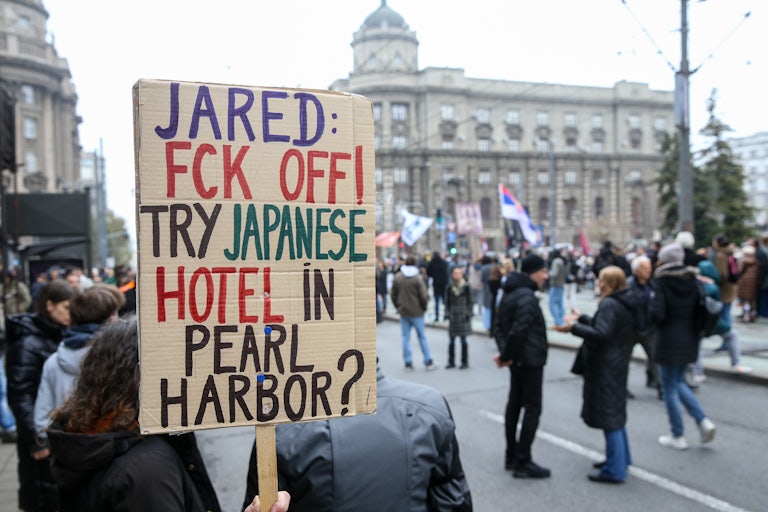
A protester in Serbia holds a sign that reads, "Jared: Fck Off! Try Japanese hotel in Pear Harbor?"
Filip Stevanovic/Anadolu/Getty Images
Demonstrators gather outside the former General Staff building in Belgrade, Serbia, to protest a decision to demolish the structure, on November 11.

Thousands of student protesters in Belgrade, Serbia, formed a human shield on Tuesday around a bombed-out military complex, vowing to stop Jared Kushner’s redevelopment company, Affinity Partners, from turning the historical monument into a luxury complex.

NATO bombed Serbia for 78 days in 1999 in an effort to end then–President Slobodan Milosevic’s violent ethnic cleansing of Albanians living in Kosovo, which resulted in the death of 13,000 people (mostly ethnic Albanians). NATO bombed bridges, military buildings, and government buildings. Human Rights Watch estimates that as many as 528 civilians were killed in the bombings. 

Many Serbians still see the bombed buildings as a point of cultural and architectural pride today. 

But in May, Kushner’s company and the Serbian government signed a deal for a 99-year lease of the land the bombed-out buildings are on for “revitalization”—meaning a high-rise hotel, office space, and stores. It will be a $500 million project. Kushner’s company will reportedly build a separate memorial for the bombing elsewhere.  

“The economic progress in Serbia over the past decade has been impressive,” Kushner said at the time. “This development will further elevate Belgrade into the premier international destination it is becoming.”

Protests were planned from the minute the deal was signed. “This is a warning that we will all defend these buildings together,” one of the students told the Associated Press on Tuesday. “We will be the human shield.”

It is unclear how effective the protests will be in delaying or denying the project.