Breaking News
Breaking News
from Washington and beyond

Epstein Victims Call Out Trump for Being a “National Embarrassment”

Epstein’s victims urged Donald Trump to stop politicizing the files’ release.

Survivors of Jeffrey Epstein's abuse stand around a podium outside the Capitol
Graeme Sloan/Bloomberg/Getty Images

The survivors of Jeffrey Epstein’s child sex-trafficking empire are begging Donald Trump to stop turning their suffering into a political issue.

Speaking during a press conference outside the U.S. Capitol Tuesday, a group of the financier’s victims excoriated Trump’s dogged efforts to minimize interest in the case as a “national embarrassment.”

Jena-Lisa Jones, who publicly accused Epstein in 2019 of abusing her in his home years earlier, described the process to obtain transparency into the government’s investigation as “distressing.”

“First, the administration said it would release everything, and applauded President Trump for that,” Jones said. “Then it fought to release nothing.

“Now that the checks and balances of our democracy have worked, and the bill is getting passed to release the files, we are hearing the administration say they intend to investigate various Democrats who were friends with Epstein.

“I beg you, President Trump—please stop making this political. It is not about you, President Trump. You are our president, please start acting like it. Show some class, show some real leadership. Show that you actually care about the people other than yourself,” Jones continued. “I voted for you, but your behavior on this issue has been a national embarrassment.”

The women met on Capitol Hill hours ahead of a House vote that could unlock public access to the Epstein case files.

The Trump administration first bungled the release of the files in July, when the Justice Department issued a memo that contradicted Attorney General Pam Bondi on the alleged existence of Epstein’s so-called “client list.” Since then, Trump has attempted to brush off the scandal, repeatedly referring to it as a Democrat-invented “hoax.”

Pressure on lawmakers dramatically ramped up last week after Representative Adelita Grijalva was sworn in, adding the final signature necessary to force a vote in the House on the files’ release.

The House Oversight Committee also released more than 20,000 documents that they had obtained from Epstein’s estate, revealing that Trump was a frequent topic of conversation between Epstein and his pen pals.

Senior Republicans privately expect dozens of their party members—“possibly 100 or more”—to vote in favor of a bill that would make the federal government’s trove of Epstein files publicly available.

Their split sent Trump into a tailspin, inspiring him to meet with conservative lawmakers one-on-one in an apparent pressure campaign to kill the vote. But by Sunday, Trump appeared to acknowledge that he had lost the battle—at least in the House—writing on Truth Social that Republicans should release the files because they had “nothing to hide.”

But the sudden reversal didn’t win him any favors with Epstein’s survivors.

“To the president of the United States of America, who is not here today, I want to send a clear message to you,” said Haley Robson, who was 16 when she met Epstein. “While I do understand that your position has changed on the Epstein files and I’m grateful that you have pledged to sign this bill, I can’t help to be skeptical of what the agenda is.

“I want to relay this message to you: I am traumatized. I am not stupid,” Robson added, repeating herself. “I am traumatized. I am not stupid.”
White House Stepped in to Help Accused Sex Trafficker Andrew Tate

Here’s how the White House saved Tate and his brother during a federal investigation.

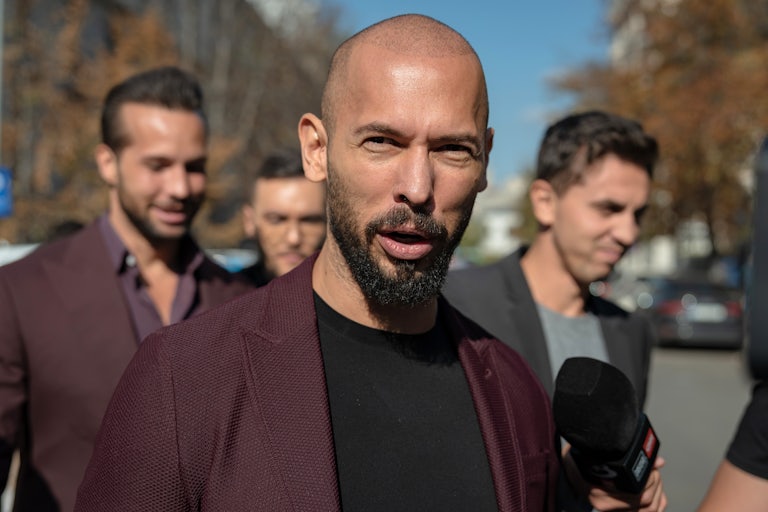
Andrew Tate speaks to reporters.
Andrei Pungovschi/Getty Images
Andrew Tate talks to the media outside the Court of Appeal on October 15, 2024, in Bucharest, Romania, where he and his brother face charges of rape, human trafficking, and forming a criminal gang to exploit women.

When misogynistic influencer Andrew Tate and his brother left Romania in February to return to the United States, a Trump administration official intervened on their behalf with Customs and Border Protection.

ProPublica reports that Paul Ingrassia, a White House lawyer who had previously represented the Tate brothers and once bragged about having a “Nazi streak,” intervened on their behalf when customs officials seized their electronic devices at the airport in Fort Lauderdale. 

Ingrassia, working as the administration’s liaison to the Department of Homeland Security, personally sent a letter to senior DHS officials urging them to return the devices. Ingrassia’s letter, obtained by ProPublica, told the officials that seizing the items was not a good use of the department’s time or resources, and that the request came from the White House. 

The letter reportedly alarmed the officials, who thought they could be interfering in a federal investigation if they returned the devices. Tate is under investigation for criminal and civil charges in Romania and the U.K. relating to sexual assault, tax evasion, and human trafficking. A woman in Florida has also sued Tate for coercing her into sex work. 

Ingrassia’s request disgusted at least one government official because of its “brazenness and the high-handed expectation of complicity.”

“It was so offensive to what we’re all here to do, to uphold the law and protect the American people,” the person told ProPublica. “We don’t want to be seen as handing out favors.”

Ingrassia already has a negative reputation inside and outside of government. Currently working for the General Services Administration, he was forced to withdraw his nomination to the Office of Special Counsel last month after text messages surfaced where he made blatantly racist comments. 

Not only is Ingrassia a racist, it seems he has a misogynist streak as well. It’s no surprise that he has also been accused of sexual harassment. But in the Trump administration, all that matters is loyalty to the president, and both Ingrassia and the Tates have it.  

Trump Judges Throw Out His “Meritless” Lawsuit Against CNN

An appeals court upheld a lower court’s decision to dismiss the years-old suit.

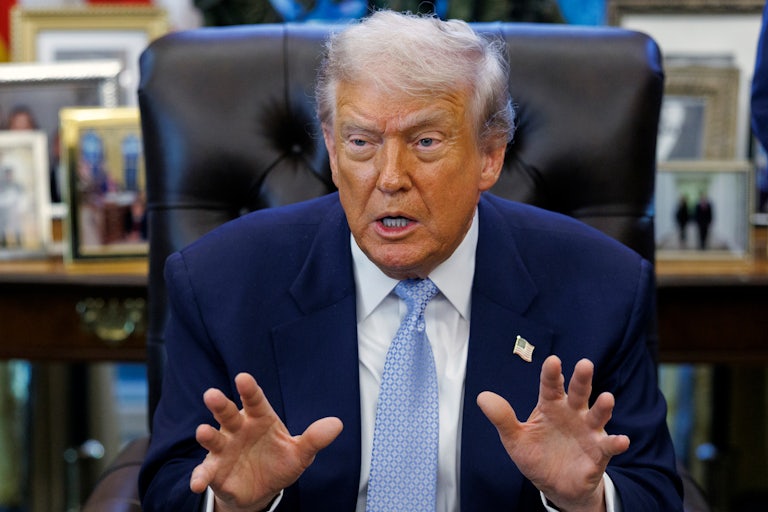
Donald Trump gestures and speaks while sitting at his desk in the Oval Office
Will Oliver/EPA/Bloomberg/Getty Images
A federal appeals court panel affirmed the dismissal Tuesday of President Donald Trump’s $475 million defamation lawsuit against CNN for using the term “the Big Lie,” calling the president’s claims “unpersuasive” and “meritless.”
“Trump has not adequately alleged the falsity of CNN’s statements. Therefore, he has failed to state a defamation claim,” wrote Eleventh Circuit Court of Appeals Judges Adalberto Jordan, Kevin Newsom, and Elizabeth L. Branch, in an eight-page filing. “Trump’s other arguments are likewise meritless.”
Trump had nominated both Newsom and Branch, as well as District Judge Raag Singhal, who first dismissed the case in July.
The term “the Big Lie” refers to Trump’s debunked claims of sweeping election fraud that supposedly robbed him of a second term in the White House in 2020. Trump alleged when he sued the network in 2022 that CNN’s use of the term was part of a “campaign of dissuasion in the form of libel and slander.”
He also accused CNN of using “the Big Lie” to create a “false and incendiary association” between him and Adolf Hitler, who originally coined the term in Mein Kampf. But the lower court ruled that “bad rhetoric is not defamation when it does not include false statements of fact.”
The panel of appeals court judges ruled that Trump’s argument was “unpersuasive,” because the term “Big Lie” did not constitute a statement of fact. “This assumption is untenable,” the judges wrote.
“Trump’s argument hinges on the fact that his own interpretation of his conduct—i.e., that he was exercising a constitutional right to identify his concerns with the integrity of elections—is true and that CNN’s interpretation—i.e., that Trump was peddling his ‘Big Lie’—is false. However, his conduct is susceptible to multiple subjective interpretations, including CNN’s,” the judges wrote.
“We have held that, by using ‘Big Lie’ to describe Trump, CNN was not publishing a false statement of fact. Therefore, whether CNN used ‘Big Lie’ one time or many is irrelevant to the question of falsity,” they added.
This is the latest of Trump’s failed lawsuits against a media company reporting on his lies. In September, a federal judge dismissed the president’s $15 billion defamation lawsuit against The New York Times, stating it was chock full of “tedious and burdensome” language that had nothing to do with the case itself.
In July, Trump sued The Wall Street Journal over a report linking Trump to alleged sex trafficker Jeffrey Epstein. That lawsuit came shortly after the Trump administration won a $16 million settlement from Paramount for a supposedly “deceptively” edited 60 Minutes interview of failed Democratic presidential candidate Kamala Harris.
Earlier this month, CBS seemed to have no problem cutting Trump’s tirades out of his interview.
This story has been updated.

Trump Goes on Wild Tangent About McDonald’s Filet-O-Fish

Donald Trump paused mid-speech to complain about tartar sauce.

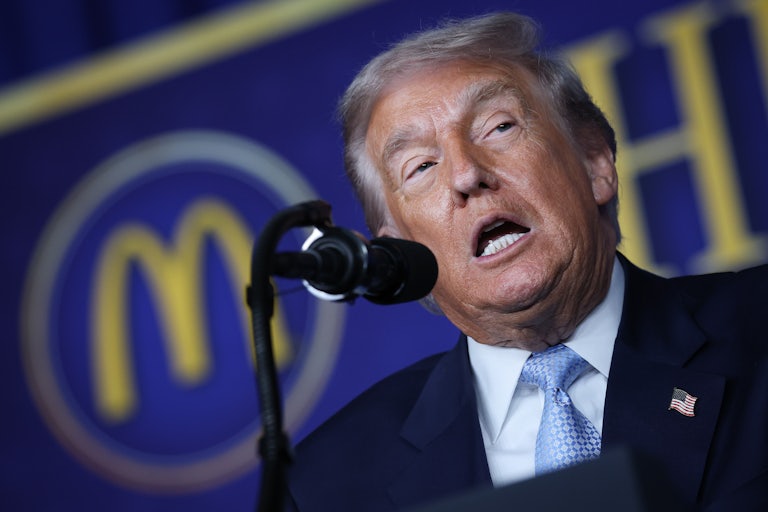
Donald Trump speaks into a microphone. The McDonald's logo is in the background
Win McNamee/Getty Images

President Donald Trump interrupted his own scrambled attempt to elucidate his affordability pitch to talk about his favorite sandwich.

“I like the fish,” said a hoarser-than-usual Trump while speaking at the McDonald’s National Impact Summit in Washington Monday night. He waved his hand and released a throaty hiss, ostensibly to mime the fish he liked.

“I like it. You could do a little bit more tartar sauce though, please. Seriously. I hate when I say, ‘Do you have any tartar sauce? Do you understand that? Yes, he understands that.’”

Trump’s latest weird attempt to tout the McDonald’s brand in order to seem like a normal person comes just one week after McDonald’s chief executive Christopher Kempczinski told investors that ballooning prices at the fast-food chain had caused traffic from low-income households to drop by double digits.

But it seems that Trump accidentally made clear that his emphasis on the cost of living was simply an attempt to steal the issue from his political opponents, who’d used it to great effect on Election Day earlier this month.

“The word is ‘affordable,’” Trump said. “And affordable should be our word, not theirs, because the Democrats got up and said, ‘Affordability, affordability,’ and they don’t say that they had the worst inflation in history, the highest energy prices in history, everything was the worst. What they are great at is lying.”

In reality, inflation has steadily increased for the last five months in a row.

Clearly, the nation’s economic anxieties have become a sore spot for the president, who has repeatedly claimed to have brought grocery prices down despite consumers experiencing the biggest price jump in more than three years. Earlier this month, he ranted that he didn’t want to “hear about affordability.” Now he can’t seem to stop talking about it.

But he still failed to acknowledge his own role in raising prices—through tariffs and his crackdown on immigrants—and blamed former President Joe Biden for, well, everything.

“We’re gonna make the American dream a word that—two words that you didn’t have. You didn’t have those two words. Remember when Biden said, ‘It’s all about three words: the American dream’? You don’t ever want to get in that situation. Remember that? That was not good,” Trump said.

“You are so damn lucky that I won that election,” Trump said.

He’s right: If he hadn’t, we’d never get to hear him make great economic addresses like this one.

Republicans Prove Irony Is Dead With Vote on Condemning Fascism

Republicans hate being called fascist, and yet ...

Representative Virginia Foxx
Anna Moneymaker/Getty Images
House Rules Committee Chair Virginia Foxx

American politics has come a long way since World War II.

More than 250,000 Americans lost their lives fighting fascism in the European theater between 1942 and 1945, but decades later, that fervor to reject the destructive ideology seems to have died among the country’s ruling class.

Republicans on the House Rules Committee refused to condemn fascism Monday, voting against an amendment that would formally rebuke the hyper-nationalistic, authoritarian credo.

Lawmakers that opposed the effort included Representatives Michelle Fischbach, Ralph Norman, Chip Roy, Erin Houchin, Nicholas Langworthy, Austin Scott, H. Morgan Griffith, Brian Jack, and Chairwoman Virginia Foxx.

The conservative fascism defense comes days after the White House branded antifa—a catchall for self-described antifascists—as a foreign terrorist organization. President Donald Trump has used the famously decentralized antifascist network as a scapegoat for years, leveraging the provocative label to push narratives that an organized network of violent, far-left radicals is wreaking havoc in cities across the country.

Fascism, however, has become a remarkably touchy topic. In recent weeks, Republicans have flown into a fury over getting called fascists and accused Democrats of inciting political violence by using the term. Since at least 2015, Americans have argued over the application of the phrase, debating the merits of torching Trump’s authoritarian populist ideology as a fascist groundwork or staying silent to maintain the gravitas of the word.

But this wasn’t always true. Decades ago, fascism and its followers had a clear definition in the U.S. consciousness, especially among the Americans who spent their lives fighting it.

“A fascist is one whose lust for money or power is combined with such an intensity of intolerance toward those of other races, parties, classes, religions, cultures, regions or nations as to make him ruthless in his use of deceit or violence to attain his ends,” wrote Vice President Henry A. Wallace for The New York Times in 1944.

“The American fascists are most easily recognized by their deliberate perversion of truth and fact. Their newspapers and propaganda carefully cultivate every fissure of disunity, every crack in the common front against fascism. They use every opportunity to impugn democracy. They use isolationism as a slogan to conceal their own selfish imperialism,” continued Wallace, who served as the editor of The New Republic after the war.

“They claim to be super-patriots, but they would destroy every liberty guaranteed by the Constitution. They demand free enterprise, but are the spokesmen for monopoly and vested interest. Their final objective toward which all their deceit is directed, is to capture political power so that, using the power of the state and the power of the market simultaneously, they may keep the common man in eternal subjection.”

This story has been updated.