Breaking News
Breaking News
from Washington and beyond

Republicans Tear Into Each Other Over Payout in Shutdown Deal

Some lawmakers aren’t happy that only a select few of their colleagues are poised to collect a check.

Senate Majority Leader John Thune speaks to reporters while walking in the Capitol
Graeme Sloan/Bloomberg/Getty Images

Senate Republicans are still planning to take advantage of a provision of the shutdown-ending bill that would allow them to rake in cash from the federal government.

At the close of the 44-day federal hiatus, the caucus quietly slipped in a self-serving resolution that granted senators the ability to pursue financial compensation from the Justice Department—up to $500,000 each—if they had their phone records seized by former special counsel Jack Smith as he investigated Donald Trump’s 2020 election conspiracy.

Despite passing the measure, the House adamantly opposed the detail: House Speaker Mike Johnson has signaled his support for an effort to repeal it altogether. As of last week, it wasn’t clear whether anyone in the Senate actually planned to pursue the new retribution pathway, save for Senator Lindsey Graham—but the upper chamber’s initial resistance appears to have ebbed in recent days.

“The House is going to do what they’re going to do with it. It didn’t apply to them,” Senate Majority Leader John Thune told CNN Tuesday. “There’s a statute that obviously was violated, and what this does is enables people who are harmed, in this case, United States senators, to have a private right of action against the weaponization by the Justice Department.”

When asked whether he believed Senate Republicans would actually line their pockets with U.S. taxpayer funds, Thune said he wasn’t convinced “anybody was talking about taking the money.”

“But I think the penalty is in place to ensure that in the future … there is a remedy in place,” Thune told the network.

Eight known Senate Republicans had their phone records subpoenaed as part of Smith’s inquiry: Senators Marsha Blackburn, Lindsey Graham, Bill Hagerty, Josh Hawley, Ron Johnson, Cynthia Lummis, Dan Sullivan, and Tommy Tuberville. Of that lot, five indicated late last week that they have no intentions to utilize the controversial provision.

“This fight is not about the money; it is about holding the left accountable for the worst weaponization of government in our nation’s history,” Blackburn told CBS News, signaling her support to change the language of the resolution. “If leftist politicians can go after President Trump and sitting members of Congress, they will not hesitate to go after American citizens.”

Smith’s team from the case has clarified that it was not spying on senators and, in fact, was well within its rights to request the phone records. Two of the team members issued a letter in October stating that they had requested phone toll records, which only show incoming and outgoing phone numbers, as well as call duration—not the contents of the calls.

Jeffrey Epstein Emails Finally Catch Up to Larry Summers

Larry Summers has stepped down from the OpenAI board, as Harvard University opens up an investigation.

Larry Summers
Kevin Dietsch/Getty Images

Former Treasury Secretary and Jeffrey Epstein confidant Larry Summers has resigned from the board of Sam Altman’s OpenAI company amid renewed scrutiny caused by the release of his countless emails to the disgraced sex offender.

“I am grateful for the opportunity to have served, excited about the potential of the company, and look forward to following their progress,” Summers said in a statement. He was also cut from his temporary guest columnist position at The New York Times. Meanwhile, Harvard announced Tuesday that it has begun an investigation into Summers, who said he will still teach at the university.

Summers and Epstein were contacting each other back and forth frequently like high schoolers in 2018 and 2019, when both men were in their sixties.

“We talked on phone. Then ‘I can’t talk later’. Dint think I can talk tomorrow’. I said what are you up to. She said ‘I’m busy’. I said awfully coy u are,” Summers wrote to Epstein, seeking advice on the young female “mentee” he was trying to seduce at the time (he was married then, and still is). “And then I said. ‘Did u really rearrange the weekend we were going to be together because guy number 3 was coming.’ She said no his schedule changed after we changed our plans.”

“Shes smart. making you pay for past errors. ignore the daddy im going to go out with the motorcycle guy, you reacted well.. annoyed shows caring., no whining showed strentgh,” Epstein wrote back, just months before his death in prison.

Summers has addressed these new revelations in a “statement of regret.”

“Some of you will have seen my statement of regret expressing my shame with respect to what I did in communication with Mr. Epstein,” Summers told a lecture hall full of students at Harvard earlier this week, stating that he’d be stepping away from other public engagements. “But I think it’s very important to fulfill my teaching obligations.”

This is a former treasury secretary and high-powered Harvard professor who was asking Epstein—a known sex offender by then—for girl advice. Some think he should be far away from the undergraduate students he’s currently teaching too.

“If he had so little ability to distance himself from Jeffrey Epstein even after all that was publicly known about Epstein’s sex offenses involving underage girls, then Summers cannot be trusted to advise our nation’s politicians, policymakers, and institutions—or teach a generation of students at Harvard or anywhere else,” Massachusetts Senator Elizabeth Warren said on Monday.

Mike Johnson Gives Away the Game on Next Steps on Epstein Bill

The House speaker is pissed that the Senate passed the bill so quickly.

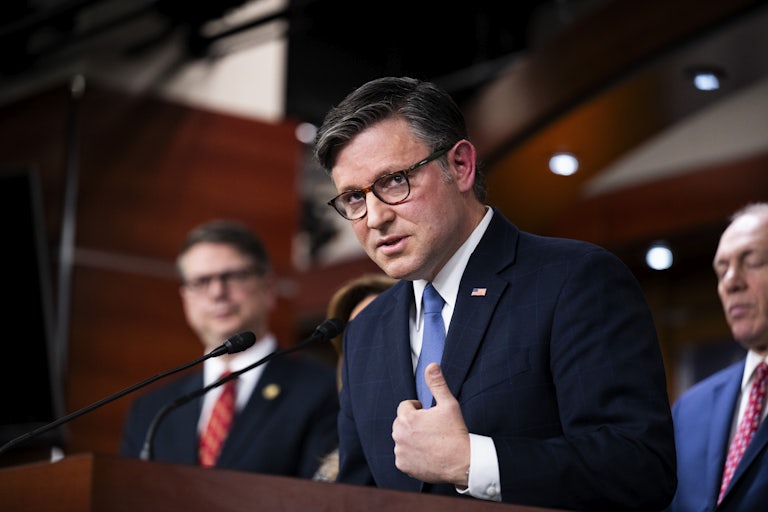
House Speaker Mike Johnson speaks in the Capitol
Roberto Schmidt/Getty Images

Republican House Speaker Mike Johnson—who was so set on blocking the release of the Epstein files that he wouldn’t swear in Adelita Grijalva—says he has “concerns” about Congress’s decision to open the files up.

“Any reaction to Leader Thune releasing the bill without adding amendments or changing it?” MS NOW’s Mychael Schnell asked Johnson, hours after the Senate passed the bill on Tuesday.

“I am deeply disappointed in this outcome. I think … I was just told that Chuck Schumer rushed it to the floor and put it out there preemptively. It needed amendments, I just spoke to the president about that. We’ll see what happens.”

“So do you think he may veto it? You say you spoke to the president—”

“I’m not saying that—”

“Is he supportive of it in its current form?”

“We both have concerns about it, so we’ll see.”

It’s unclear what exactly Johnson has to be worried about (aside from more allegations and potentially incriminating references to President Trump, of course).

“Yesterday the House did the People’s will by voting overwhelmingly to release the Epstein files, overcoming Mike Johnson’s five month long obstruction,” Representative Thomas Massie, the original Republican co-sponsor of the discharge petition behind the bill, wrote in response to Johnson. “His last hope was that the Senate would insert a loophole to kill the intent of the bill, but the Senate was having none of it.”

From “the files are on my desk” to this, the GOP’s handling of the Epstein case has been completely botched from the jump. Now, Johnson is hand-wringing about amendments and concerns while the majority of Congress—and the country—is longing for any semblance of truth or transparency. What amendments would Johnson possibly introduce that would get in the way of that?

“I cannot believe they took all the Goodwill they had after the election and called us stupid for wanting the files then trying to primary two Republicans to then in the end release the files anyway,” one user replied to Massie. “MAGA needs a better PR firm.”

“Insane, isn’t it?” Massie replied.

ICE Agent Arrested in Sex-Trafficking Sting Told Cops: “I’m ICE, Boys”

An employee for Immigration and Customs Enforcement was one of 16 men arrested in a sex-trafficking sting.

A white man wearing glasses, a face mask, and an ICE vest walks as he looks directly at the camera.
Spencer Platt/Getty Images

The Trump administration has not hired the best people to work for Immigration and Customs Enforcement. One of them was arrested for sex trafficking as part of a three-day sting earlier this month.

The man is an auditor for ICE, and was one of 16 men arrested who were allegedly attempting to solicit a 17-year-old girl in Bloomington, Minnesota. The ICE employee, 41-year-old Alexander Steven Back, could face federal charges, said Bloomington Police Chief Booker Hodges at a news conference on Tuesday.

Back, a resident of Robbinsdale, Minnesota, responded to a fake online ad “offering prostitution services,” and wasn’t dissuaded when an undercover officer pretending to be 17 years old wrote, “U ok if I’m a lil younger than my ad says … just wanna be honest.”

“Sure,” Back responded, according to charging documents.

“K cause I am 17 and one guy got hella mad at me,” the undercover officer, going by the name “Bella,” replied.

“Bella” told Back that she was 17 a second time, and then gave him a Bloomington address, where police arrested him and took his phone.

“When he was arrested, he said, ‘I’m ICE, boys,’” Hodges said. “Well, unfortunately for him, we locked him up.”

Under the Trump administration, ICE’s hiring has become so haphazard that many people aren’t properly vetted, with some being turned away due to disqualifying criminal backgrounds or failed drug tests. Many end up being terminated because they don’t meet academic or physical standards. Back’s case seems to show that the agency is attracting the wrong kinds of people.

Red State GOP Gives Trump the Middle Finger on Gerrymandering

Yet another of Donald Trump’s efforts to get more Republican House seats has fallen apart.

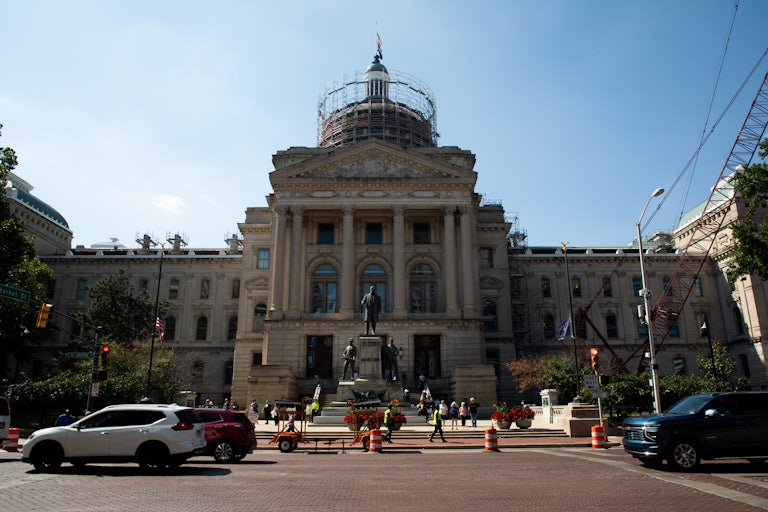
The Indiana Statehouse in Indianapolis
Kaiti Sullivan/Bloomberg/Getty Images
The Indiana Statehouse

Indiana’s Senate has decided not to meet until January, signaling that redistricting will not be on the state’s legislative agenda this year.

The decision is in direct defiance of an order issued earlier this year by Donald Trump, who met privately with Indiana Republicans in August as part of a pressure campaign to maximize GOP House seats before the 2026 midterms.

The White House visits were, apparently, ineffective at changing the minds of state lawmakers. The issue came down to a 29–18 vote Tuesday, with 19 Republicans joining 10 Democrats to effectively adjourn until next year.

But the elected officials’ anticipated rebuke didn’t minimize the president’s gaze: Indiana Governor Mike Braun has remained in Trump’s hot seat so far this week. The two reportedly had a “good conversation” on Monday, in which Trump reiterated that he expected the state Senate to vote to draw up new maps.

“Unfortunately, Senator Rod Bray was forced to partner with DEMOCRATS to block an effort by the growing number of America First Senators who wanted to have a vote on passing fair maps,” Braun wrote in a statement after the vote. “Now I am left with no choice other than to explore all options at my disposal to compel the State Senate to show up and vote.

“I will support President Trump’s efforts to recruit, endorse, and finance primary challengers for Indiana’s senators who refuse to support fair maps,” he added.

The other half of Indiana’s Congress was not on the same page, however. House Speaker Todd Huston told state lawmakers to keep the first two weeks of December clear for a potential redistricting vote, reported the Indiana Capital Chronicle.

The White House’s intense focus on this issue illustrates just how nervous the GOP is about maintaining its razor-thin majority in Congress: Indiana holds nine seats in the U.S. House—seven of those are already held by Republicans.

Trump issued similar directives for a handful of other red states, including Missouri, Ohio, Florida, and Texas, though some of those redistricting efforts have also crumbled. After facing similar fire—including legal threats—from the Trump administration, a federal judge threw out Texas’s gerrymandered congressional maps earlier Tuesday, ruling that there was “substantial evidence” the state had “racially gerrymandered” its 2025 maps at the president’s direction.