Breaking News
Breaking News
from Washington and beyond

Abbott Releases—and Blacks Out—1,400 Pages of Emails With Elon Musk

Texas Governor Greg Abbott was forced to reveal his emails with Musk. He didn’t totally comply.

Texas Governor Greg Abbott
Brandon Bell/Getty Images

After Texas news outlets made a public records request to see emails between the office of Texas Governor Greg Abbott and tech oligarch Elon Musk’s companies, state officials took months fighting and delaying their release.

Then, they released 1,374 pages of mostly redacted documents, with all but 200 of those pages entirely blacked out.

According to The Texas Newsroom, a collaboration between NPR and Texas public radio stations that made the request, the emails don’t reveal much about the relationship between Musk and Abbott, or how the tech oligarch influences Texas’s government. The unredacted documents contained little new information, consisting mostly of things like old incorporation records and some meeting agendas.

Abbott’s office claimed over the summer that the governor’s emails with Musk were private and too “intimate or embarrassing” to be released to the public, which begs the question of what law protects that reasoning. Musk has also fought against disclosing communications, claiming that releasing emails could hurt his competitive advantage.

Musk has relocated many of his businesses to Texas and has lobbied for new state laws to help those companies, making his communications with the state of vital public interest to Texans. But thanks to a June court ruling, Texas officials have increased protections from having to disclose public records, leaving news outlets with little recourse to get more documents released.

In effect, Musk’s activities in Texas are taking place with little oversight or scrutiny. It seems that his presence in Texas shields him from accountability, and Abbott is only too happy to protect him.
Trump Makes Ridiculous Claim About Saudi Investment in the U.S.

Is Donald Trump just making up numbers at this point?

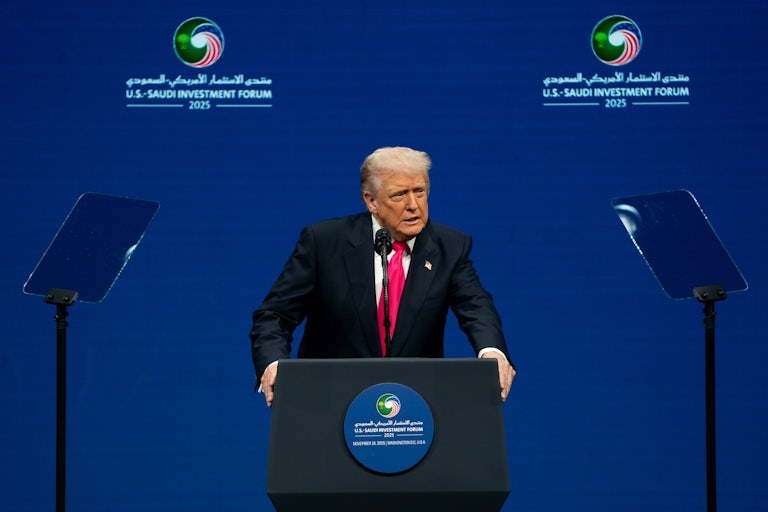
Donald Trump leans forward on a podium during an event
Stefani Reynolds/Bloomberg/Getty Images

Saudi Arabia is so invested in U.S. development that the country’s leadership is apparently willing to give more than they’ve got.

Hours after the U.S. president penned a $1 trillion economic agreement with Crown Prince Mohammed bin Salman, Donald Trump told a crowd at the U.S.-Saudi Investment Forum Wednesday that he had actually pressed for $1.5 trillion, billions more than the nation’s gross domestic product.

“While we were taking the picture, I said, ‘Could you make it $1.5 trillion?’ So he’s got something to think about,” Trump said, to laughs. “We’ll get something, I think we’ll get something.”

Given that Saudi Arabia’s GDP is $1.24 trillion, that seems unlikely.

The deal came as an enormous upgrade to Saudi Arabia’s previously pledged investment of $600 billion, the details of which included “investments and trade” but were otherwise vague. It also came after Trump promised to sell highly coveted F-35 fighter jets to the newly appointed non-NATO ally, ignoring Pentagon concerns that the sale could provide China with a golden opportunity to steal U.S. military technology.

“We will be doing that, we’ll be selling F-35s,” Trump told reporters at the White House Monday, adding that the Saudis “want to buy them, they’ve been a great ally.”

Trump has touted several major investment deals over the span of his second administration to detract from the failures of his wildly unpopular tariff plan, claiming that he has reeled in $17 trillion in just eight months. But that figure is fiction, even according to the digits highlighted on the White House website, which lists $8.8 trillion in active investment.

That includes the Saudi sum, as well as $600 billion from firms in the European Union, though the coalition of countries has made clear that the amount is simply an estimate of potential investment rather than a legitimate commitment.

It also includes a $1.2 trillion deal with Qatar, which was an “economic exchange” rather than direct investment; a seemingly impossible $1.4 trillion investment from the United Arab Emirates that is more than double that nation’s GDP, and $1 trillion from Japan, which in actuality is roughly half that and will be predominantly composed of loans.

Treasury Sec Has Idiotic Idea for How People Can Use Stimulus Checks

Secretary Scott Bessent is trying to regulate how people use the extra cash Donald Trump has promised.

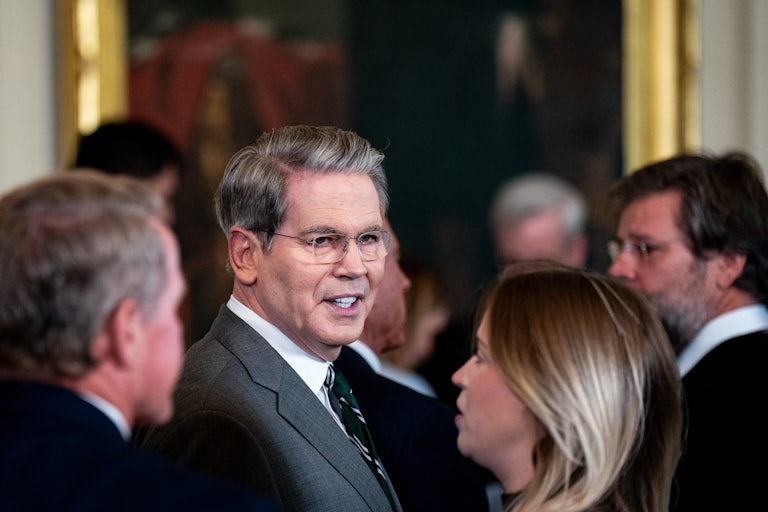
Treasury Secretary Scott Bessent stands outside the White House
Eric Lee/Bloomberg/Getty Images

Treasury Secretary Scott Bessent hopes that Americans will save their $2,000 checks President Donald Trump promised for a rainy day—if they get them at all.

During a disastrous appearance on Fox News Tuesday, host Brett Baier asked whether Trump’s repeated promise to deliver $2,000 dividends of tariff money to every American would be inflationary.

“Well, there are a lot of things that are gonna happen next year, and that could be one of them,” said Bessent. “And maybe we could persuade Americans to save that.”

Bessent suggested that parents could potentially put the money into their children’s “Trump accounts,” where the government plans to deposit $1,000 for Americans born between 2025 and 2028. Parents are encouraged to contribute up to $5,000 annually. Bessent has claimed that the accounts will give disillusioned young people a stake in the economy, while providing a “backdoor” to privatize Social Security.

But if the secretary’s plan to fight steadily rising inflation relies on Americans not immediately spending a $2,000 check, we’re in some serious trouble. Americans are increasingly worried about how to pay for necessities such as food and health care, concerns helped in no small part by the Trump administration’s attacks on SNAP and Obamacare. Some extra cash would likely go straight into paying for bills.

It’s also not clear that an actual payout is coming. Earlier this month, Bessent claimed that the president’s promise of a two-grand payout “could come in lots of forms,” listing the supposedly “substantial” tax deductions outlined in Trump’s behemoth budget bill that passed in July, and falsely claiming that Social Security would no longer be taxed.

Additionally, Trump’s tariffs haven’t actually collected enough money to pay for the kind of payout the president promised. The Trump administration has collected more than $220 billion in tariff revenue, but the $2,000 paid to all 163 million Americans who filed their taxes would cost roughly $326 billion, according to CNN. So that would leave -$106 billion to pay off the national debt.

Man Who Trump Pardoned for Fraud Is Headed Back to Prison … for Fraud

Surprise, surprise.

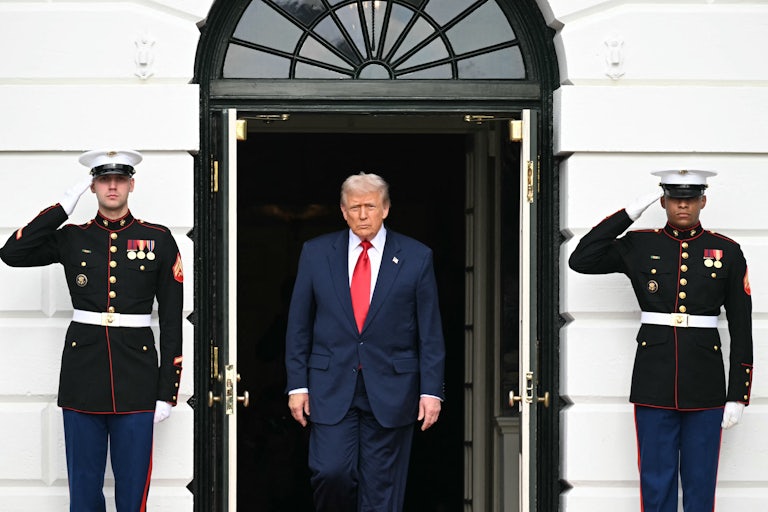
Donald Trump walks out of a door of the White House. The door is flanked on each side by a saluting soldier
SAUL LOEB/AFP/Getty Images

A Ponzi schemer who Donald Trump saved from prison is headed right back to the clink.

Eliyahu “Eli” Weinstein was sentenced Friday to 37 years in prison in a New Jersey courtroom, capping the career criminal’s third fraud conviction.

Prosecutors argued that Weinstein, who in recent years went by the alias Mike Konig to hide his criminal history, milked roughly $35 million from dozens of investors who believed they were putting their money into Covid-19 masks, baby formula, and first aid kits for Ukraine, according to the indictment.

It was a crime that Weinstein never would have been able to cook up if the president hadn’t lifted him out of federal prison in 2021. At the time, Weinstein had served just eight years of a combined 24-year prison sentence for two fraud convictions—a real estate fraud scheme in which he utilized a portfolio of fake property investments to reel in $200 million from unsuspecting buyers, and another in which he duped dozens of investors into investing in Facebook just before the social media company went public (swindling at least one investor of $6.7 million).

For whatever reason, Trump decided Weinstein was the guy who deserved a get-out-of-jail-free card. The 51-year-old was a part of a whopping 143-person pardon the president issued the day before he left office in 2021. Other recipients of the unexpected clemency included former Trump adviser Steve Bannon, rapper Lil Wayne, and former Detroit Mayor Kwame Kilpatrick, who was sentenced to 28 years on corruption charges.

But Weinstein wasn’t ashamed of his behavior. In August 2022, he recalled that he “finagled, and Ponzied, and lied to people,” according to court documents. Shortly after he was released from prison, he started defrauding people again, orchestrating the Ponzi scheme that he was sentenced for last week.

U.S. District Judge Michael Shipp ruled that Weinstein must pay more than $44 million in restitution for his most recent offense, due immediately.

Treasury Sec Flails When Asked If Trump’s Foreign Investments Are Real

Donald Trump keeps bragging about bringing in billions of dollars in foreign investments.

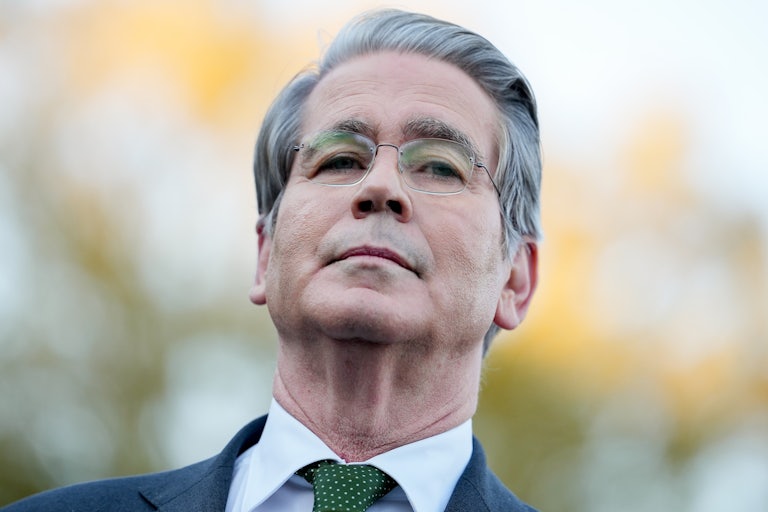
Treasury Secretary Scott Bessent speaks while standing in a crowd at the White House
Al Drago/Bloomberg/Getty Images

Treasury Secretary Scott Bessent struggled to sell President Donald Trump’s outrageous claims about how much money the United States is making from his trade deals.

During an interview on Fox News Tuesday night, host Brett Baier asked Bessent how much money Trump was bringing in through trade deals, corporate commitments, and tariff revenue.

“Well, the president uses the number ‘20 trillion’ in terms of total investments, and I think that those commitments are real,” Bessent replied, sounding slightly unsure.

He rattled off a few examples of major investments as part of trade deals with Japan and Korea, as well as a commitment from Apple, calling them “investments like we’ve never seen.” But the Treasury secretary offered no exact number, just the president’s own propaganda.

Bessent’s waffling answer could indicate that he knows how ridiculous that “20 trillion” claim actually is. The White House’s own investments website lists the total of all U.S. and foreign investments at only $9 trillion—but crucially, the Trump administration also misstated some investments.

They claimed that Japan had agreed to make a $1 trillion investment, when the most recent deal from July was for only a little more than half of that. The website claimed that Korea has pledged a $450 billion investment in U.S. energy products, when the number is actually $350 billion, made up of $200 billion in cash installments capped at $20 billion per year and another $150 for shipbuilding. Similarly, Apple has pledged to spend more than $500 billion, and the White House website bumped that up to $600 billion.

At the same time, tariff revenue for FY 2025 was only $195 billion, which is a significant increase from the year before, but doesn’t push that number anywhere near the $20 trillion Trump has claimed.