Breaking News
Breaking News
from Washington and beyond

Bessent Says Oil Prices Will Drop “if Something Happens” in Venezuela

Trump’s treasury secretary appears to be revealing the administration’s ultimate plan in Venezuela.

Treasury Secretary Scott Bessent speaks while using both hands to indicate the height of somthing.
SAUL LOEB/AFP/Getty Images

On Thursday, Treasury Secretary Scott Bessent said that oil prices could go down “if something happens down in Venezuela.”

“I am very confident about job growth and the momentum that we’ve got for next year,” Bessent told Laura Ingraham on Fox News. “Capital expenditure is always followed by job growth. The peace deals—we are seeing a peace dividend from that. And I think there’s a very good chance that if something happens with Russia, Ukraine, if something happens down in Venezuela, that we could really see oil prices go down even more.”

The remark from a top Trump official appears to suggest that the administration is planning for “something” to happen in Venezuela. Trump has cast the country as a major drug-trafficking hub to justify his strikes of drug boats in the surrounding waters, and seems to have regime change—potentially through military intervention—as his ultimate goal.

“U.S. military action could trigger a crisis on the same order as happened in Iraq after the U.S. regime change effort there,” Caracas-based International Crisis Group senior analyst Phil Gunson told The New Republic. “If the U.S. does decapitate the government, the multiple armed actors could bring about a degree of anarchy. None of these different groups have any incentive to just lay down their arms. There have been several decades of accumulated resentments on various sides, and it’s not fanciful to imagine that there could be lynchings. There could be bombings or selective assassinations.”

Judge Rips Immigration Agent for Using ChatGPT to Write Protest Report

Judge Sara Ellis warned the agency was undermining its own credibility.

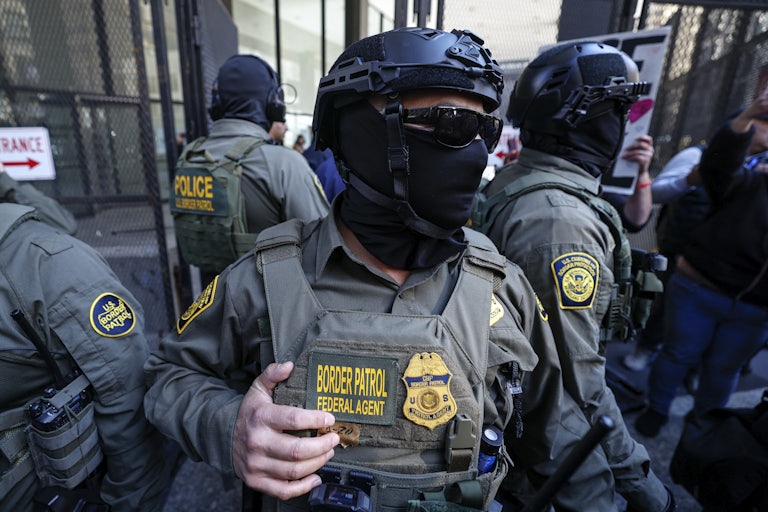
Masked Border Patrol agents in Chicago
KAMIL KRZACZYNSKI/AFP/Getty Images

A federal judge called out federal officers in Chicago for producing unreliable use-of-force reports—noting that at least one had used an AI chatbot to write a report for them.

In a 223-page injunction ruling Thursday, U.S. District Judge Sara Ellis cited body-worn camera footage to document the many ways federal agents made unreliable and false statements when describing their several violent clashes with Chicago residents, the Chicago Tribune reported.

“The Court also notes that, in at least one instance, an agent asked ChatGPT to compile a narrative for a report based off of a brief sentence about the encounter and several images,” Ellis wrote in one footnote.

“To the extent that agents use ChatGPT to create their use of force reports, this further undermines their credibility and may explain the inaccuracy of these reports when viewed in light of the BWC footage,” she added.

This is particularly concerning because, as OpenAI’s own website states: “ChatGPT can be helpful—but it’s not always right.”

Ellis also accused Border Protection Commander Gregory Bovino of giving testimony that was specifically “not credible,” either responding to questions with “cute” answers or “outright lying.”

An appeals panel blocked Ellis’s injunction Wednesday, stating that it was “overbroad” in its application to the government, but asserted that her findings could “support entry of a more tailored and appropriate preliminary injunction.”

Ellis’s injunction would have barred federal agents from using tear gas and other riot prevention methods against protesters, “unless such force is objectively necessary to stop an immediate threat.”

It seems that using ChatGPT may be an emerging, and concerning, trend in the armed forces. Last month, a U.S. Army general told reporters that he’d become very fond of “Chat,” even trusting the algorithm to make “key command decisions” in relation to his post.

Zelenskiy Warns Ukraine May No Longer Be Able to Count on Trump

Donald Trump’s proposed peace plan for Russia and Ukraine heavily favors Moscow.

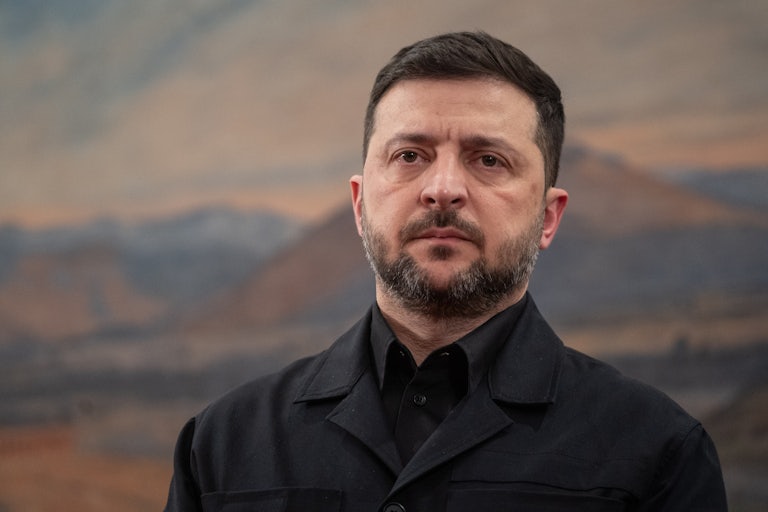
Ukrainian President Volodymyr Zelenskiy
NICK PALEOLOGOS/AFP/Getty Images

Ukrainian President Volodymyr Zelenskiy warned his countrymen Friday that they must choose between losing U.S. support or a quick conclusion to their 11-year war with Russia “without dignity” and “without justice.”

The U.S. unveiled a peace plan earlier this week that spans 28 points, catering to some of Russia’s most outrageous demands, such as requiring Ukraine to swear off NATO membership and to hand over Crimea and the eastern Donbas region. Those two points alone have reversed long-standing U.S. policy with regard to the area.

“Now the pressure on Ukraine is one of the most difficult,” Zelenskiy said in his native language, standing outside his presidential office, in a video statement. “Now is one of the most difficult moments of our history. Now, the pressure on Ukraine is one of the heaviest. Now, Ukraine can face a very difficult choice—either losing dignity or risk losing a major partner.

“Either 28 difficult points (of the framework), or an extremely harsh winter—the harshest ever—and further risks. Life without freedom, without dignity, without justice,” Zelenskiy said, according to an English translation provided by Reuters.

“We will work calmly with America and all our partners. We will seek constructive solutions with our main partner. I will present arguments, I will persuade, I will offer alternatives, but we will definitely not give the enemy any reason to say that Ukraine does not want peace, that it is disrupting the process and that Ukraine is not ready for diplomacy.

“I am now addressing all Ukrainians. Our people, citizens, politicians—everyone. We must come together. Pull ourselves together. Stop the spat. Stop the political games,” he said.

Earlier that morning, AFP reported that Zelenskiy had warned Vice President JD Vance over the phone that Washington risked rupturing ties with Ukraine over the lopsided arrangement.

It remained unclear, as of late Friday morning, whether both nations would agree to the White House’s peace plan. It is even less clear whether Russia will honor the arrangement after it is brokered.

Ukraine is already working on a counterproposal with France, Germany, and the United Kingdom, Reuters reported Friday.

Ukraine and its European partners were excluded from the plan’s drafting process, reported The Guardian. But there is some evidence that the plan may have come directly from the Kremlin: Several sentences in the document are passive and clunky in English but make more sense when translated into Russian. That could be the influence of Kirill Dmitriev, Russian President Vladimir Putin’s envoy, who worked on the project alongside special envoy Steve Witkoff.

Donald Trump has touted himself for months as a great peacemaker, pushing a narrative that he has—so far—solved eight foreign conflicts. Practically all of his war-solving braggadocio is “demonstrably untrue,” to the extent that several of the examples he often lists were never even at war. But despite repeated efforts, he has not made any headway on the Russia-Ukraine war.

Trump has conceded quite a bit to the Russian dictator, to no avail. This summer, Trump literally rolled out the red carpet for Putin in Alaska, marking Putin’s first return to U.S. soil in more than a decade. After the theatrics were over, the two world leaders still failed to reach a consensus on how to end the bloodshed, with Trump losing his cool while Putin demanded that Ukraine cede even more territory to Russia.

More than 13,300 civilians have been killed and 31,700 injured in Ukraine since Russia invaded in February 2022, according to a United Nations report from June.

FBI Caught Spying on Signal Group Chat of Immigration Activists

Keep a close eye on who’s joining your group chats.

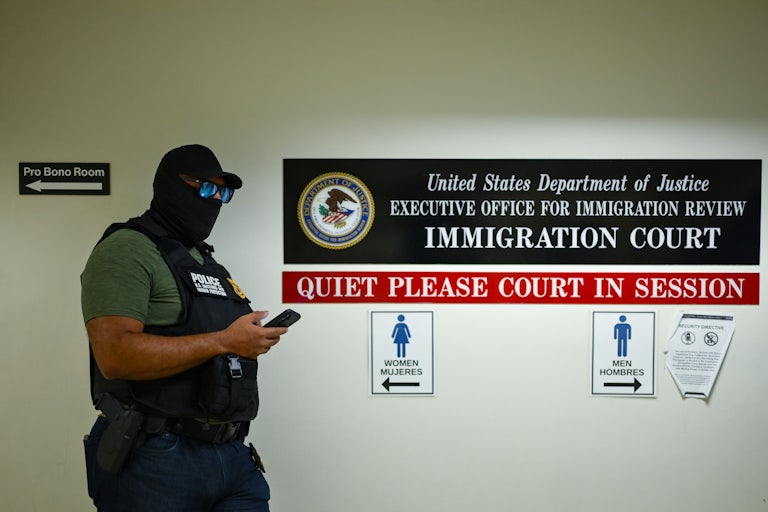
A masked agent looks at his phone in immigration court.
Mostafa Bassim/Anadolu/Getty Images

The FBI spied on the private group chat of an immigrants rights group that was monitoring immigration court proceedings in New York City.

The Guardian reports that the bureau gained access to a “courtwatch” Signal group coordinating volunteers to attend proceedings at three immigration courts in the city. A joint report between the FBI and the New York Police Department from August quoted from the group chat and called them “anarchist violent extremist actors.”

That report was distributed to other law enforcement agencies around the country, and the FBI called it a warning about “extremist actors targeting law enforcement officers and federal facilities.” The Guardian got the report after Property of the People, a nonprofit organization dedicated to government transparency, obtained it via public records requests.

Signal chats have end-to-end encryption, so law enforcement could have only accessed the group chat if an agent was part of the chat, had access to a member’s phone, or was sent copies of the conversation. According to the FBI, a “sensitive source with excellent access” provided the information, dodging the requirement for a warrant.

The FBI also claims that the person who created the chat advocated violence against law enforcement, but it has not responded to questions about the identity of the person or given more details on why it called the group “anarchist violent extremist actors.”

Violent detention and arrests in immigration court buildings, sometimes just after rulings, have become the norm in the last year. In one case, an ICE agent tackled a woman to the ground right after her husband was arrested in a New York City immigration court. For some reason, the government considers that legal but has a problem with citizens monitoring what’s going on in and around the courts.

Trump Reverses Some Food Tariffs, Claims to Solve Problem He Created

As grocery prices skyrocket, the president appears to realize he made a mistake with the tariffs on Brazil.

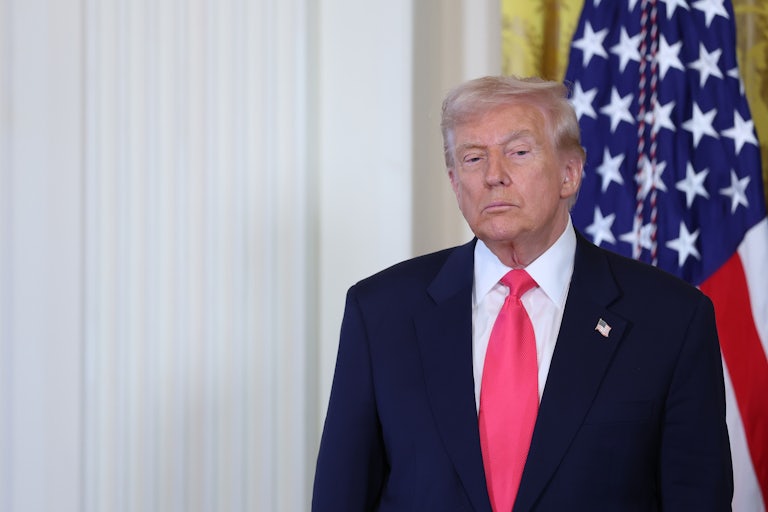
Donald Trump looks downcast
Anna Moneymaker/Getty Images

On Thursday, President Trump decided to renege on his 40 percent tariffs on Brazilian goods, ending a problem he created. The agricultural products tariffed—beef, fruit, coffee, cocoa—were getting more and more expensive for Americans everywhere.  

“After considering the information and recommendations these officials have provided to me and the status of negotiations with the Government of Brazil, among other things, I have determined that it is necessary and appropriate to modify the scope of products subject to the additional ad valorem rate of duty imposed under Executive Order 14323,” Trump wrote in an executive order. “Specifically, I have determined that certain agricultural products shall not be subject to the additional ad valorem rate of duty imposed under Executive Order 14323.”

Trump initially levied the tariffs against Brazil on the grounds that it was unfairly prosecuting former right-wing President Jair Bolsonaro—who was recently sentenced to 27 years in prison for attempting to stage a coup in 2023, which some compare to the January 6, 2021 insurrection in the U.S. Bolsonaro had his supporters raid Brazil’s presidential palace, the Supreme Court, and Congress, all because he’d lost the election to leftist Luiz Inácio Lula da Silva. 

Now, with Bolsonaro in jail and grocery prices in the U.S. skyrocketing, Trump is backtracking. The Brazilian president made it clear early on that he wouldn’t cave to Trump, stating over the summer that “at no point will Brazil negotiate as if it were a small country up against a big country.” It appears he meant it.

“Trump’s decision to remove many tariffs on Brazilian products is a significant political victory for the Lula administration ahead of next year’s presidential elections,” Brazilian professor Oliver Stuenkel wrote on X. “And a vindication of Brazil’s choice to pursue a calm and pragmatic negotiation strategy vis-à-vis Trump.”