Breaking News
Breaking News
from Washington and beyond

Trump Sure Seems Stressed Republicans Are at Risk of Losing House Seat

A special election in Tennessee is closer than it should be for Republicans.

Donald Trump speaks with reporters aboard Air Force One.
Pete Marovich/Getty Images

President Trump dedicated part of his day Monday to attacking Tennessee Democratic House candidate Aftyn Behn, only further confirming that the GOP is desperate for wins as it limps into 2026.

Last week, an Emerson College Polling/The Hill survey of the special election had Behn just behind Republican candidate Matt Van Epps, 46 percent to 48 percent—with 2 percent voting elsewhere and 5 percent undecided. A victory for Behn would be a massive upset to a Republican House majority already on its last legs in the wake of Representative Marjorie Taylor Greene’s resignation announcement—and the impending resignations of various others.

“We have to win this seat. We’ve gotten you the largest tax cuts in history, and the new bill—the Great Big Beautiful Bill—kicks in, as you know, on January 1. It hasn’t even kicked in yet,” Trump told a Van Epps rally while on House Leader Mike Johnson’s speaker phone. “Number one, [Behn] hates Christianity, number two, she hates country music. How the hell can you elect a person like that? … It’s a big vote, and it’s gonna show something. It’s gonna show that the Republican Party is stronger than it’s ever been.”

The president also noted that he’d be doing a telerally for Van Epps on Monday night.

The narrative that Behn “hates Christianity” is one of many falsities that the GOP has pushed in a race where more than $3.3 million has been spent against her. Behn has mentioned that she disapproves of religions being “at the core of everything we do in the legislature” but has never said anything close to what Trump claimed.

Many also noted the urgency that Trump spoke with.

“‘The whole world is watching,’ President Trump says of tomorrow’s special election for Tennessee’s 7th congressional district—which Trump carried by 22 points in 2024,” USA Today’s Joey Garrison wrote.

The special election is on Tuesday. .
Only One President Was Less Popular Than Trump Is Right Now: Poll

A brutal new poll shows Donald Trump’s popularity is tanking across the board.

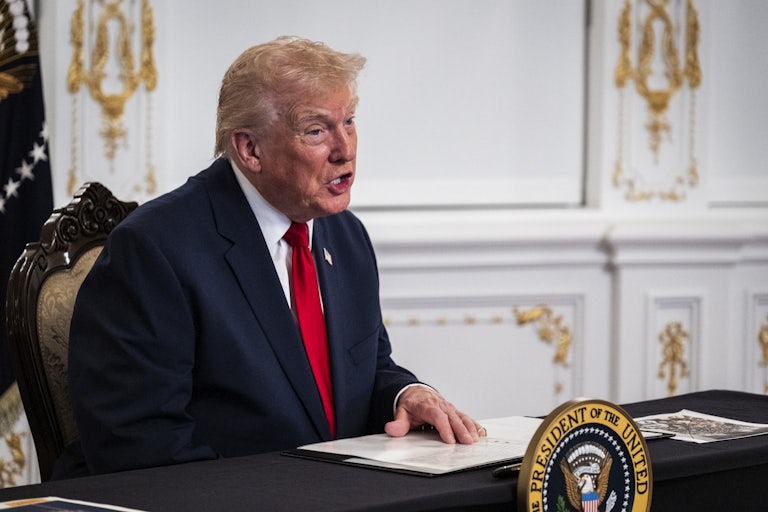
Donald Trump speaks while sitting at a desk in Mar-a-Lago
Pete Marovich/Getty Images

A recent series of polls are signaling disaster for President Donald Trump’s hopes of carrying the Republican Party through the 2026 midterm elections.

CNN’s chief data analyst Harry Enten on Monday discussed several different polls that found that Trump had hit an approval low for his second term.

Enten cited a recent Gallup poll that saw Trump’s net approval rating sink to -24 percent from -1 percent in January. “We’re talking about a drop of over 20 points in the wrong direction for the president of the United States,” the analyst said.

The only president who was less popular than Trump at this point in his second term? Richard Nixon, who had an approval rating of -36 points just a few months before he resigned from office. “Anywhere you look this is the second-worst for a president of either party in their second term dating all the way back since the 1940s,” Enten said.

Since the 1940s, Enten said, no president has successfully increased their approval rating by more than five points between this point in their second term and the midterm elections. Unless Trump can “break history,” he can say, “‘See you later!’ to that Republican majority,” Enten cried.

To be sure, Trump’s approval rating is expected to have an outsize impact on Republicans’ performance in next year’s midterm elections. In November’s off-cycle elections, as in 2018 and 2020, voters who disapproved of Trump’s performance in the White House supported the other party’s candidates at a higher rate than for any other recent president, according to CNN.

As Enten pointed out, Trump has garnered a negative net approval rating across several recent polls. The Gallup poll, conducted from November 3 to 25, found that the president’s approval rating had fallen to 36 percent, approaching his all-time low approval rating of just 34 percent after the deadly riot at the U.S. Capitol in 2021.

Another poll by the American Research Group found that Trump’s net approval rating was -27 percent, and another sponsored by Fox News placed him at just -17 percent. A recent Reuters/Ipsos poll found that he had a net approval rating of -22 percent, thanks to the Trump administration’s handling of the Epstein files and high consumer prices.

Alleged D.C. Shooter Begged CIA for Help as He Tried to Find Work

The National Guard shooting suspect felt abandoned by the CIA after working together for so long, his fellow unit member said.

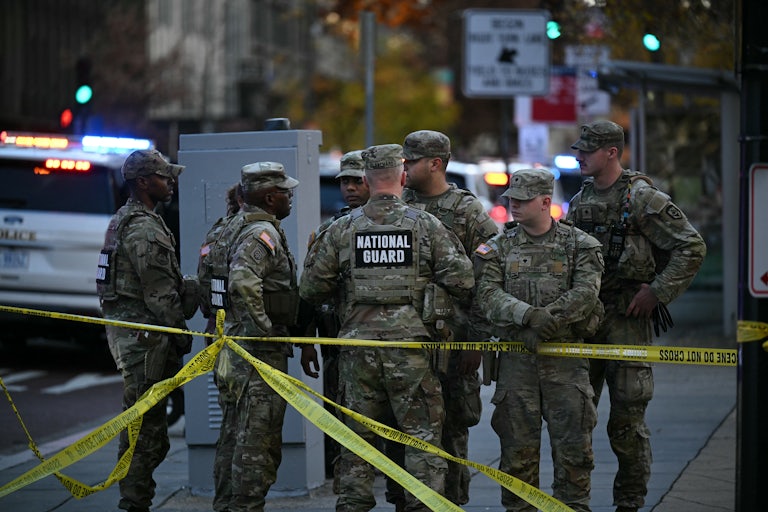
Six National Guard soldiers gather near the crime scene after a shooting in downtown Washington, D.C.
Drew ANGERER/AFP/Getty Images
National Guard soldiers gather near the crime scene after a shooting in downtown Washington, D.C., on November 26.

The Afghan refugee accused of shooting two National Guard members Wednesday used to serve in a CIA-backed military unit, and felt abandoned by the agency, Rolling Stone reports.

Rahmanullah Lakanwal served in the “Zero Units,” a paramilitary unit in Afghanistan led by the CIA and trained by U.S. special operations soldiers. After the Taliban returned to power in the country in 2021, Lakanwal came to the United States with his wife and five sons, settling in Bellingham, Washington.

Lakanwal’s move to the U.S. was helped by Operation Allies Welcome, a Biden administration initiative to help resettle Afghans fleeing the new regime, especially those who had worked with U.S. personnel and could be in danger from the Taliban. Lakanwal struggled in his new life, though.

Despite receiving asylum and work authorization from the Trump administration, he was fired from a laundromat job because he didn’t have a work authorization card, a fellow member of his unit told the magazine. Lakanwal’s nephew also wrote a letter to the Bellingham housing authority asking to move the family closer to an Afghan community, citing a physical attack on his uncle that required hospital treatment.

The letter noted that Lakanwal was isolated, lacked English skills, and would benefit from being in a larger area like Seattle where he could easily find work. More than one month ago, Lakanwal reportedly told his unit mate that his missing paperwork meant that he couldn’t get a job, leaving his family unable to afford food or a place to rent.

As a result, Lakanwal had to borrow money from friends and other unit members, breaking down in tears when speaking to his unit mate. In June, Lakanwal reached out to a CIA program meant to aid Zero Unit veterans with their immigration issues. Rolling Stone saw a screenshot of a group chat where unit members shared their issues with an agency representative, including Lakanwal, who repeatedly asked for help.

Lakanwal’s last post was unanswered and deleted by the group’s administrator. When the magazine contacted the CIA representative, they claimed it was a wrong number. The agency did not respond to the magazine’s request for a comment.

All of this must not have helped Lakanwal’s mental health. Other reports say that he spent weeks at a time isolated in a dark room and would suffer “manic episodes,” according to a case worker who helped with his family’s relocation. During these episodes, which could last weeks, Lakanwal would make cross-country drives by himself.

After last week’s shooting, which killed one National Guard member and hospitalized another, the Trump administration has used the incident to attack immigration and refugee asylum policies, claiming that Lakanwal was not properly vetted, despite the administration’s approving his asylum claim in April.

Its claim belies the fact that Lakanwal worked directly with U.S. personnel in Afghanistan in a select unit that required extreme vetting and a probationary period. Zero Unit veterans were also vetted upon arrival in the U.S. before getting Special Immigrant Visas, meant for Iraqis and Afghans who aided the U.S. government.

Lakanwal may have been suffering from PTSD and feeling frozen out by the U.S. government, an unfortunately common problem affecting military veterans. He also couldn’t work thanks to missing immigration paperwork, a problem exacerbated by the Trump administration’s wholescale gutting of the federal government. If he had gotten the help he was seeking, who knows if last week’s tragedy could have been averted.

Trump Spirals When Asked Why He Pardoned Notorious Drug Trafficker

Donald Trump has previously bragged about stopping the flow of drugs into the United States.

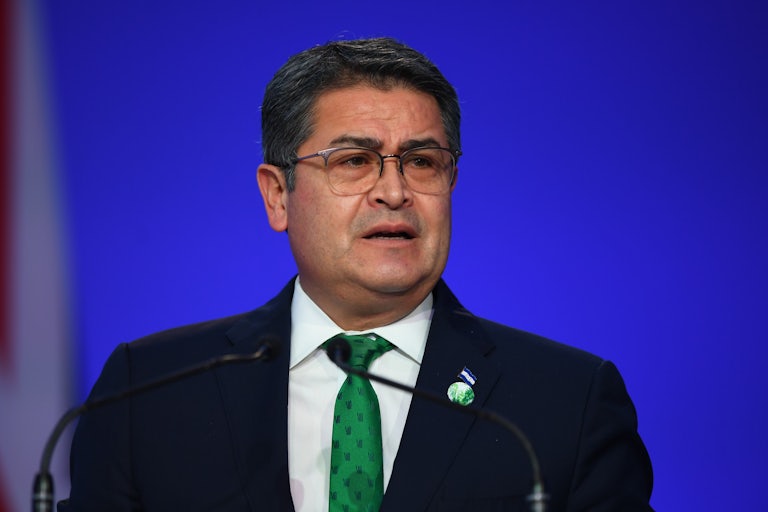
Former Honduran President Juan Orlando Hernández speaks into microphones
Andy Buchanan/Getty Images
Former Honduran President Juan Orlando Hernández in 2011

President Donald Trump offered up a truly nonsensical rationale for his latest presidential pardon.

While traveling on Air Force One Sunday, Trump was asked about his decision to pardon former Honduran President Juan Orlando Hernández, who was sentenced to 45 years in prison on drug trafficking and weapons charges.

“You’ve made so clear how you want to keep drugs out of the U.S., can you say more about why you would pardon a notorious drug trafficker?” asked one reporter.

“Well, I don’t know who you’re talking about,” Trump replied. It was not a particularly comforting response after the president previously revealed he has no idea who he’s pardoning. After the reporter clarified that she was asking about Hernández, Trump scrambled to justify his decision.

“Well, I was told—I was asked by Honduras, many of the people of Honduras, they said it was a Biden setup—I don’t mean Biden, look, Biden didn’t know he was alive—but it was the people that surround the Resolute Desk. Surround Biden, when he was there, which was about very little time,” Trump ranted.

“The people of Honduras really thought he was set up and it was a terrible thing. He was the president of the country, and they basically said he was a drug dealer because he was the president of the country. And they said it was a Biden administration setup. And I looked at the facts and I agreed with them.”

“What evidence can you share that he was set up and that he wasn’t—?” the reporter asked, before being interrupted by Trump, who had no such evidence to share.

“Well, you take a look. I mean, they could say that you take any country you want; if somebody sells drugs in that country, that doesn’t mean you arrest the president and put him in jail for the rest of his life,” Trump babbled. “And that includes this country, OK?”

But Hernández wasn’t imprisoned simply for being the president of Honduras. In 2021, U.S. federal prosecutors presented an array of evidence connecting the former foreign leader to the drug-trafficking activities of his brother, Juan Antonio “Tony” Hernandez Alvarado, who was sentenced to life in prison for importing at least 185,000 kilograms of cocaine, securing bribes to public officials, as well as other weapons and false statement offenses. Prosecutors had described the former president as being involved in a “violent, state-sponsored drug trafficking conspiracy.”

Trump pardoned Hernández on the eve of Honduras’s presidential election, in which the U.S. president has endorsed Nasry “Tito” Asfura, a former sportscaster and candidate from the conservative National Party. While it’s unclear what Trump’s exact reasoning is—considering that he had no evidence to back up his claims of a “setup”—it’s possible that pardoning the ex-president may have been an attempt to fire up the conservative voting base on Election Day.

Trump Insists Ballroom Is Just Fine Amid Dumb Fight With Architect

Donald Trump reportedly is at odds with the architect he handpicked to build his precious ballroom.

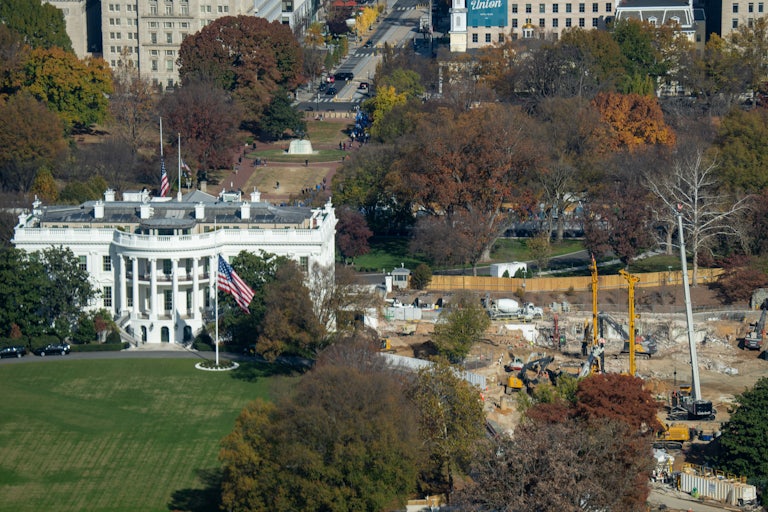
An aerial shot of the demolition at the White House
Andrew Leyden/Getty Images

Donald Trump issued a cryptic message regarding his White House ballroom project, promising online that the 90,000-square-foot project would be done “right.”

The president referred to the construction zone as the “presidential ballroom” in a Truth Social post Sunday, insisting—again—that it would be funded entirely by private donations. But then he made note of a curious detail.

“It is something that has been needed and desired at the White House for over 150 years, but something which no other President was equipped to do—But I am, and as long as we are going to do it, we are going to do it RIGHT,” Trump wrote. “It will be a magnificent addition to the White House, the most important since the building of the West Wing!”

The comment comes days after news broke that Trump has been feuding with his architect, James McCrery II, who reportedly doesn’t see eye to eye with him on the ballroom’s proposed size.

Insiders told The Washington Post last week that McCrery has argued the 90,000-square-foot blueprint would overshadow the 55,000-square-foot White House mansion, violating basic architectural principles in the process.

After promising Americans in July that his proposed ballroom would “be near but not touching” the White House East Wing, Trump completely razed the FDR-era extension in October, plowing forward without prerequisite approval from the National Capital Planning Commission or the express permission of Congress. Conveniently, Trump started demolition during the government shutdown, when the NCPC was consequently closed.

The Trump administration said that the forthcoming 90,000-square-foot event space will be capable of hosting 650 people, a 200-person bump from current maximum seating at the White House East Wing. But real estate experts have since pointed out that the possibilities of that square footage should be much broader, considering a space of that size will be roughly equivalent to two football fields.

The project’s price tag also inexplicably grew by 50 percent after Trump began tearing down the East Wing. What Trump had originally pitched as a $200 million project was instead referred to in late October as a $300 million development plan. The White House suggested that the project would be funded, in part, by some of the country’s wealthiest families and biggest corporations, including Apple, Google, Amazon, Microsoft, and Meta.

Some major players in the defense industry with massive federal contracts, including Lockheed Martin and Palantir, have also forked over significant cash to develop the ballroom, though it’s unclear what they would get out of building a venue designed for dancing.