Breaking News
Breaking News
from Washington and beyond

NY Times Sues Pete Hegseth for Kicking Them Out of the Pentagon

Hegseth imposed new restrictions on media access that resulted in multiple legacy outlets leaving the Pentagon.

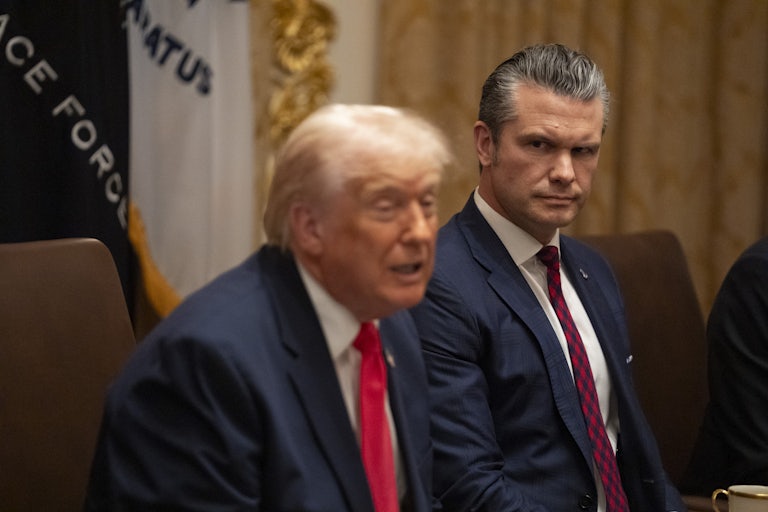
Defense Secretary Pete Hegseth looks down while sitting in Donald Trump's cabinet meeting
ANDREW CABALLERO-REYNOLDS/AFP/Getty Images

America’s news media companies are not taking the Pentagon’s new press restrictions laying down.

The New York Times named several key Trump officials in a sweeping lawsuit Thursday, including Defense Secretary Pete Hegseth and Pentagon spokesman Sean Parnell. The newspaper argued that the Pentagon’s new rules—which effectively forced out dozens of highly lauded legacy journalists and replaced them with fawning, far-right upstarts—actually “violates the Constitution’s guarantees of due process, freedom of speech and freedom of the press.”

The suit further argued that the punitive policy violated the First Amendment by seeking “to restrict journalists’ ability to do what journalists have always done—ask questions of government employees and gather information to report stories that take the public beyond official pronouncements.”

Under Hegseth’s new rules, credentialed Pentagon reporters were required to pledge that they would not report on anything from the department that had not been approved for official release. The new policy, announced in October, forced journalists to choose between reporting government-sponsored propaganda or having their press credentials revoked.

Dozens of journalists walked away from their desks at the Pentagon as a result, refusing to capitulate to Hegseth’s new standard. In turn, Pentagon officials offered those newly vacated spots to conservative outlets ideologically aligned with the Trump administration, including One America News, The Federalist, and LindellTV, a new outlet formed by Mike Lindell, the My Pillow CEO who practically bankrupted himself by broadcasting conspiracies about the 2020 presidential election.

The Times’ legal complaint seeks a court order to suspend Hegseth’s new rules, as well as a declaration that the initiative “targeting the exercise of First Amendment rights” was illegal.

In a press briefing Wednesday, a senior attorney for the Times said that the paper had discussed a joint lawsuit with other news organizations similarly affected by the policy, but ultimately decided to proceed alone.
Bombshell Report Undercuts Pete Hegseth’s Main Defense for Boat Strike

The report shows Pete Hegseth had a direct hand in making key decisions on the strikes.

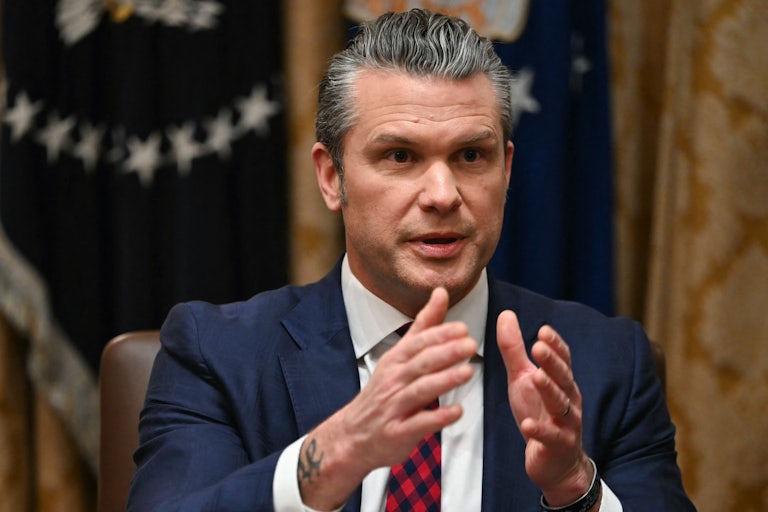
Defense Secretary Pete Hegseth gestures and speaks while sitting in Donald Trump's cabinet meeting
ANDREW CABALLERO-REYNOLDS/AFP/Getty Images

The Defense Department’s decision to kill the two survivors of a boat bombing in the Caribbean Sea—which may very well be a war crime—was all part of Secretary Pete Hegseth’s contingency plan, The New York Times reported.

The Hegseth-approved plan involved rescuing any helpless survivors and killing them if they tried to contact a “cartel” member. The Defense Department is alleging that the men killed on September 2 did the latter, initiating the second half of the contingency plan.

The White House has insisted the violence is justified, as the administration accuses the boats of trafficking narcotics to the U.S. from Venezuela and Colombia. Of course, the government has yet to provide evidence that the men they murdered contacted a cartel, or that they were trafficking drugs at all. But this plan once again begs the question: Who was actually responsible here?

Hegseth has made a point to shift the blame for the actual decision to strike the boat a second time—the potential war crime—onto Admiral Frank “Mitch” Bradley.

“I didn’t stick around [after the first strike],” Hegseth told reporters at Donald Trump’s Tuesday Cabinet meeting. “Couple of hours later, I learned that … Admiral Bradley made the correct decision to sink the boat and eliminate the threat.… It was the right call, we have his back.”

Hegseth is trying so hard to distance himself from the attack that he’s claiming he wasn’t even in the room when it happened. Regardless, his version of events made no mention of the report that he approved the contingency plan that Bradley followed.

This saga has drawn the ire of both the left and right.

“This is an act of a war crime. Ordering survivors—who the law requires be rescued—instead to be murdered,” Newsmax host and current Hegseth co-worker Judge Andrew Napolitano said on Tuesday. “There’s absolutely no legal basis for it. Everybody along the line who did it, from the secretary of defense to the admiral to the people who actually pulled the trigger, should be prosecuted for a war crime for killing these two people.”

Bradley is expected to meet with House and Senate Armed Services Committee members on Thursday to clear up exactly what happened.

Did Pete Hegseth Even Read the Signalgate Report?

The Pentagon spokesman insisted the report completely exonerated Hegseth.

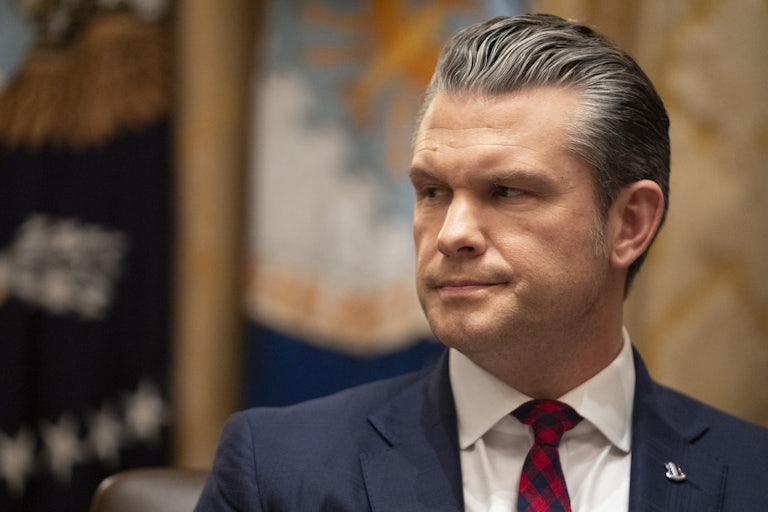
Defense Secretary Pete Hegseth frowns and looks to the side
Carolyn Van Houten/The Washington Post/Getty Images

It seems that Pete Hegseth’s brilliant response to the watchdog report finding that the defense secretary had directly endangered U.S. troops is just to lie and say he didn’t.

Pentagon spokesperson Sean Parnell didn’t even try Wednesday to spin the results of the inspector general’s report on a major scandal earlier this year, when Hegseth sent highly sensitive information in a nonsecure Signal group chat.

“This Inspector General review is a TOTAL exoneration of Secretary Hegseth @PeteHegseth and proves what we knew all along—no classified information was shared. This matter is resolved and the case is closed,” Parnell said in a statement, per Trump acolyte Laura Loomer.

Sources had previously told CNN that Hegseth sent messages detailing materials marked classified at the time. One message from Hegseth—“This is DEFINITELY when the first bombs will drop”—seemed obviously classified. But the war chief has maintained that he had the power to unilaterally declassify information discussed, though no documentation of that actually happening seems to exist.

A classified version of the inspector general’s Signalgate report was sent to Congress on Tuesday night, finding that Hegseth should not have used the app at all. Four sources familiar with the report told CNN that Hegseth had risked compromising sensitive military information and could have potentially endangered troops and mission objectives.

A declassified version of the report is expected to be released to the public Thursday.

Trump Backs Pete Hegseth on Boat Strikes Even as GOP Turns on Him

Donald Trump said Pete Hegseth is doing “exactly” the right thing in the Caribbean.

Donald Trump speaks while sitting next to Pete Hegseth
Carolyn Van Houten/The Washington Post/Getty Images

Donald Trump is still backing Pete Hegseth, despite growing scrutiny over reports that the defense secretary issued orders to mercilessly kill survivors of a September 2 airstrike on a small boat in the Caribbean.

“If it is found that survivors were actually killed while clinging on to that boat, should Secretary Hegseth, Admiral [Frank M.] Bradley, or others be punished?” asked a reporter at the White House Wednesday.

“I think you’re going to find that this is war, that these people were killing our people by the millions, actually, if you look over a few years. I think last year we lost close to 300,000 people were killed. That’s not mentioning all the families—have you seen what happens with the families?” Trump said.

The White House has insisted the violence is justified, broadly accusing the boats of trafficking narcotics to the U.S. from Venezuela and Colombia while vaguely and inaccurately referring to the death toll caused by fentanyl, a synthetic opioid 50 times stronger than heroin.

Fentanyl overdoses in the U.S. were on the rise for a decade before falling slightly in 2023, when more than 72,000 people died from the synthetic opioid, according to the Centers for Disease Control and Prevention.

U.S. lawmakers on both sides of the aisle have been more than skeptical of the White House’s theory—particularly since several of the boats were thousands of miles away in international waters, and since the attacks were conducted without prior investigations or interdiction. Pentagon officials reportedly haven’t been concerned with identifying the people on the boats before attacking.

“I think you’re going to find that there’s a very receptive ear to doing exactly what they’re doing taking out those boats,” Trump said. “And very soon we’re going to start doing it on land, too. Because we know every route, we know every house, we know where they manufacture this crap, we’re going to put it all together.”

“So to be clear, you support the decision to kill survivors after—” the reporter pressed, before Trump interjected that he “supports the decision to knock out the boats.”

“Whoever is piloting those boats, they’re guilty of trying to kill people in our country,” Trump added, referring to the alleged drug mules, who would be the lowest and least significant participants on the drug trade totem pole.

Meanwhile, Trump pardoned former Honduran President Juan Orlando Hernández on Monday, freeing a man who was sentenced to 45 years in prison for playing a central role in what the Biden administration deemed to be “one of the largest and most violent drug-trafficking conspiracies in the world.”

Hernández’s case was initially prosecuted during Trump’s first administration.

Trump Plasters His Own Name on U.S. Institute of Peace Headquarters

This is not Donald Trump’s building, but he’s certainly acting like it is.

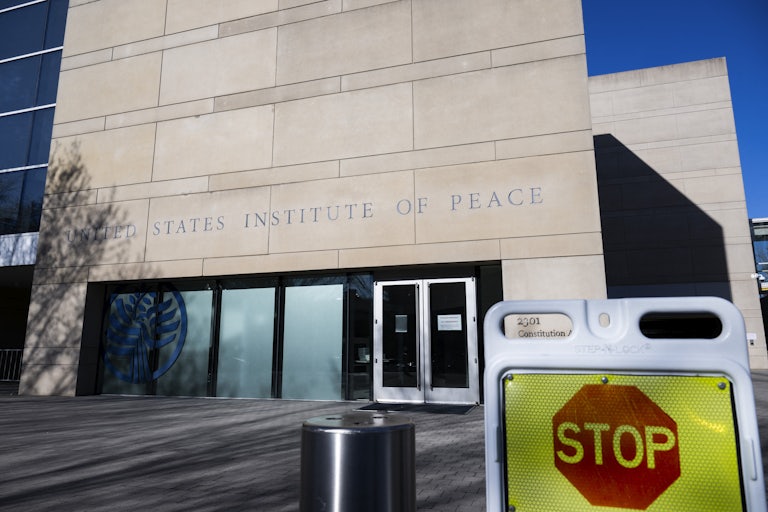
U.S. Institute of Peace headquarters
ROBERTO SCHMIDT/AFP/Getty Images
The U.S. Institute of Peace building on March 18, as DOGE took over

Donald Trump has taken over the United States Institute of Peace building in Washington, D.C., and put his name on it, even as the legal battle over who owns the building is ongoing.

Independent journalist Marisa Kabas posted about the visible signage on the building Wednesday on Bluesky, showing “DONALD J. TRUMP” in block letters tacked to the building. Kabas reports that Trump plans to use the building to host the signing of a peace agreement between Rwanda and the Democratic Republic of the Congo on Thursday.

SCOOP: Sources tell me Donald Trump's name was added to the exterior of the US Institute of Peace building ahead of Thursday's peace agreement signing between Rwanda and the Democratic Republic of the Congo (DRC), which will be held inside the building. Confirming if it's been officially renamed.

[image or embed]

— Marisa Kabas (@marisakabas.bsky.social) December 3, 2025 at 2:31 PM

The USIP was created by Congress in the 1980s as a nonprofit organization independent of the federal government. The letters making up Trump’s name seem to have been taken from USIP’s sign inside the building, when the Department of Government Efficiency took over the think tank by force in March.

The metal letters the administration used to plaster Trump's name on the side of the USIP building today appear very similar to the ones DOGE pulled off the wall when they illegally took over the space in March.

[image or embed]

— Marisa Kabas (@marisakabas.bsky.social) December 3, 2025 at 2:59 PM

In May, that takeover was blocked in federal court, with U.S. District Judge Beryl Howell ruling that the firing of the USIP’s leadership and staff, their replacement by DOGE-affiliated staff, and the building’s transfer to the General Services Administration were “effectuated by illegitimately installed leaders who lacked legal authority to take these actions, which must therefore be declared null and void.”

But in June, the U.S. Court of Appeals for the District of Columbia granted the Trump administration a stay of Howell’s ruling pending appeal, ordering that the building be turned over to the GSA and restoring the Trump administration’s preferred leadership.

“The President faces irreparable harm from not being able to fully exercise his executive powers,” the three-judge panel wrote at the time.

“Because the Institute exercises substantial executive power, the Government is likely to succeed on its claim that the Board’s removal protections are unconstitutional,” they wrote, referring to the USIP’s governing board.

“We agree with the Government that ‘[f]acilitating the foreign policy of the United States by brokering peace among warring parties on the international stage is plainly an exercise of executive power under our Constitution,’” the judges added. The appeal is still ongoing, but since then, most of the USIP’s staff have been fired and the institute’s website states that it is under maintenance.

The USIP’s building occupies prime Washington, D.C., real estate between the Potomac River and the National Mall, and is worth approximately $500 million, so it’s no surprise that the Trump administration wanted the building. Now it appears that Trump wanted something else with his name on it where he could be feted and praised, and isn’t willing to wait for the legal case to conclude in his favor.