Breaking News
Breaking News
from Washington and beyond

Trump Official Fights for His Life as Fox News Grills Him on Economy

Kevin Hassett, director of the National Economic Council, was having a tough time defending Donald Trump’s economy on Fox News.

Kevin Hassett being interviewed by someone
Al Drago/Bloomberg/Getty Images

Director of the National Economic Council Kevin Hassett is fighting for his life trying to put a positive spin on the latest economic data—and even Fox News isn’t having it.

Fox host Martha MacCallum asked Hassett on Thursday about the brutal new layoff numbers from consulting firm Challenger, Gray & Christmas. “Year-to-date job cuts show an increase of 54 percent,” MacCallum asked Hassett. “That seems like a troubling number. What’s your take on it?”

Hassett waffled, claiming that jobs were in flux. “Don’t forget that there’s hires and there’s fires, there’s separations and new jobs, and so net job creation for the year is very positive. But the flow of jobs in and out is a little bit higher, there’s a little bit more turnover. A lot of times that happens because people feel that they’re able to get another job if they leave this job,” Hassett said.

Hassett seems not to realize that the report does not measure the normal ebb and flow of people choosing to leave a job, but job cuts—layoffs. Layoffs this year have surpassed one million for the first time since Covid-19.

MacCallum hit Hassett with another unpleasant truth: that despite Hassett’s and the Trump administration’s attempt to spin the affordability crisis, voters still know who’s to blame. Looking at a Fox News poll, MacCallum noted that 76 percent of respondents see the economy as “only fair” or “poor.”

“And then, when we have ‘Who is responsible for current economic conditions, President Trump or President Biden?’ We have Trump at 62 percent.… What would you say to people who are answering the survey that way, Kevin?”

Hassett defaulted to one of the Republicans’ favorite recent scapegoats: the shutdown. “One of the things that we’ve seen, we’ve studied over the last couple of weeks, is that when there’s a government shutdown … the survey data tend[s] to really tank because everyone is in a terrible mood, because Washington can’t work and the government’s shut down, and they’re worried about how bad it’s going to be,” Hassett said.

Right. If even Fox News isn’t convinced, I’m not sure how Hassett thinks he’ll convince the American people.
France’s Macron Warned Other Leaders About Potential Trump Betrayal

European leaders don’t trust the United States when it comes to Ukraine.

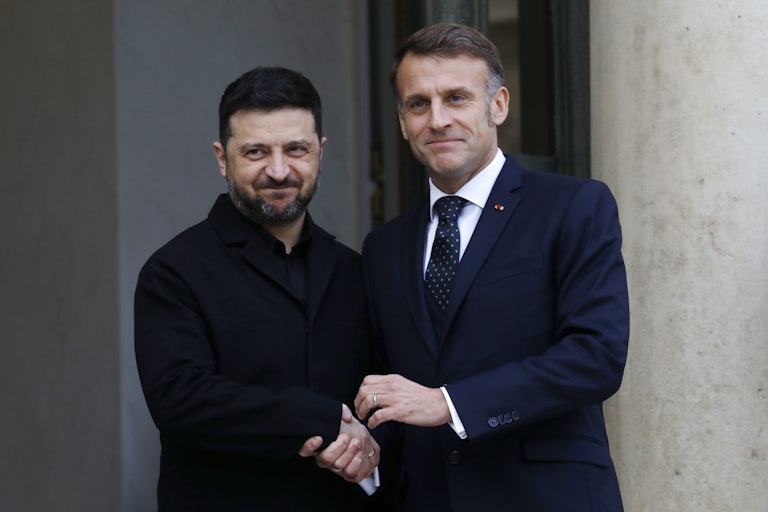
Ukranian President Zelenskiy and French President Macron shake hands.
Antoine Gyori/Corbis/Getty Images

French President Emmanuel Macron warned Ukrainian President Volodymyr Zelenskiy and other European leaders on a phone call that Donald Trump could betray Ukraine.

A transcript of the Monday call to strategize how to protect Ukraine was leaked to the German newspaper Der Spiegel and published Thursday. Macron, Zelenskiy, German Chancellor Friedrich Merz, NATO Secretary General Mark Rutte, Finnish President Alexander Stubb, and other European leaders all took part and discussed U.S. negotiation efforts to end the Russia-Ukraine war.

“There is a possibility that the U.S. will betray Ukraine on the issue of territory without clarity on security guarantees,” Macron said, noting that there was “a big danger” for Zelenskiy. German leader Merz also expressed his misgivings, telling Zelenskiy that Trump’s handpicked negotiators, Jared Kushner and Steve Witkoff, “are playing games with both you and us.”

While European leaders have expressed their concerns about America’s Ukraine policies, this transcript is the clearest indication of how they feel about the Trump administration and its efforts. The Finnish president has gotten along well with Trump in public but still said, “We must not leave Ukraine and Volodymyr alone with these guys,” referring to Witkoff and Kushner.

“I agree with Alexander that we need to protect Volodymyr,” added NATO Secretary General Rutte.

Late last month, the Trump administration presented a 28-point peace plan to resolve the conflict that was considered a Russian “wish list” and appeared to be translated from Russian. Under that plan, Ukraine would give up substantial territory, refrain from joining NATO, and limit the size of its military.

After Ukraine weighed in, a new plan was released with a shortened 19 points, to which Russia has not agreed. But it seems that Europeans are worried about Trump deferring to Russia and abandoning Ukraine, and, based on past events, who can blame them?

Trump Accidentally Lets Slip Plan to Rename Kennedy Center

Donald Trump wants to rename the Kennedy Center after himself after doing everything he could to destroy it.

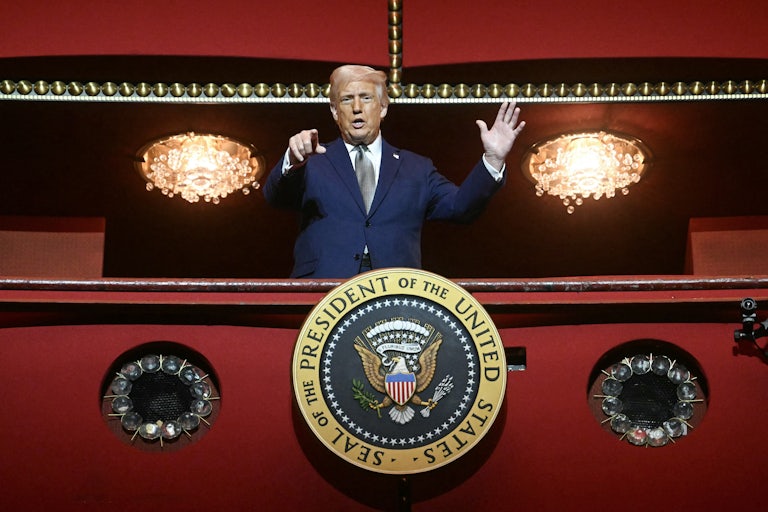
Donald Trump in a Kennedy Center balcony, speaking and pointing at the camera below. The shot makes him seem like a dictator.
JIM WATSON/AFP/Getty Images
Donald Trump at the Kennedy Center in March

President Donald Trump “accidentally” let slip on Thursday the next target for Trumpification: the Kennedy Center.

“You have a big event on Friday at the Trump-Kennedy Center—op, excuse me. The Kennedy Center,” Trump said with a laugh.

“Pardon me, such a terrible mistake,” he continued, grinning.

Trump’s “terrible mistake” came during a speech at the U.S. Institute of Peace for the signing of a peace agreement between Rwanda and the Democratic Republic of Congo. Coincidentally, the Institute of Peace is the latest building that the president has stamped his name on, even in the midst of a legal battle over who owns the building.

The president is gearing up for a big weekend, with the storied arts institution hosting the World Cup draw on Saturday and then the annual Kennedy Center Honors on Sunday. Trump may receive a special peace prize from FIFA Saturday, and is hosting Sunday’s ceremony—after personally taking over the job of selecting the Kennedy Center’s honorees, one usually done by a bipartisan council.

Trump has already brought financial ruin to the Kennedy Center, and is angling to bring aesthetic ruin as well. If he has his way, reputational ruin won’t be far behind.

Trump Is Now Denying Visas to People Who Worked in Content Moderation

If an H-1B visa applicant or one of their loved ones worked in content moderation, such as fact-checking, the State Department has said to consider the application ineligible.

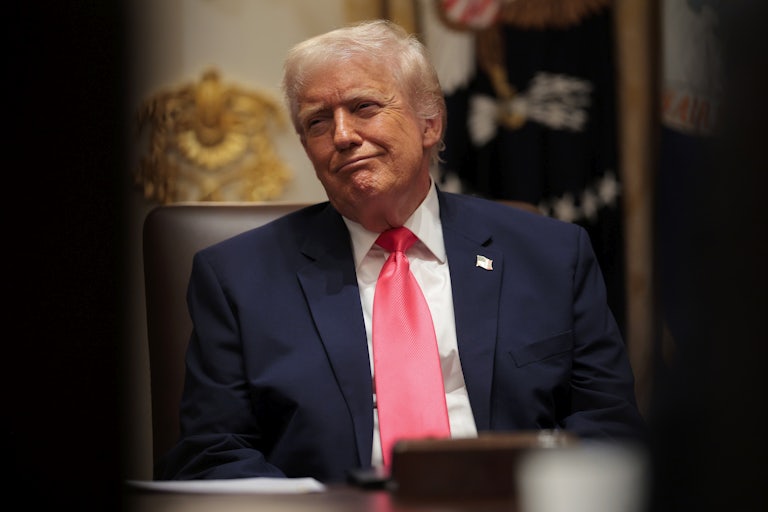
Donald Trump smiles while sitting in a Cabinet meeting
Chip Somodevilla/Getty Images

The Trump administration may revoke H-1B visa eligibility from people who worked in content moderation, fact-checking, and online safety. Their family members would lose visa status as well. 

A cable, dated Tuesday, obtained by Reuters moves U.S. consular officers to increase vetting for these individuals by looking into their résumés and LinkedIn profile pages. 

“If you uncover evidence an applicant was responsible for, or complicit in, censorship or attempted censorship of protected expression in the United States, you should pursue a finding that the applicant is ineligible,” the cable said. This includes working at “social media or financial services companies involved in the suppression of protected expression.”

“You must thoroughly explore their employment histories to ensure no participation in such activities,” the cable read.

The State Department, however, made it sound more like they were going after liberal cyberbullies more than free speech suppressors.

“We do not support aliens coming to the United States to work as censors muzzling Americans,” a spokesperson said. “In the past, the President himself was the victim of this kind of abuse when social media companies locked his accounts. He does not want other Americans to suffer this way. Allowing foreigners to lead this type of censorship would both insult and injure the American people.”  

It’s hard to believe that the State Department is saying that about Donald Trump, who is infamous for his willingness to publicly verbally abuse people online. The policy, however, is very believable, as it aligns with the larger arc of the administration’s free speech suppression efforts, from disappearing Rümeysa Öztürk for writing an op-ed to requiring universities to vet for pro-Palestinian social media posts before awarding student visas.  

Trump Nearly Has a Stroke Trying to Pronounce Names of African Leaders

Donald Trump struggled to pronounce the names of the Rwandan and Congolese presidents.

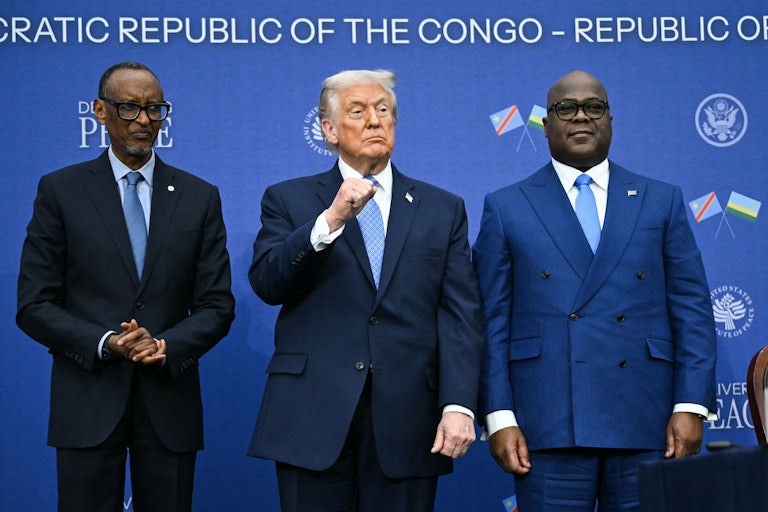
Donald Trump raises his fist while standing in between Rwandan President Paul Kagame and Democratic Republic of Congo President Felix Tshisekedi
ANDREW CABALLERO-REYNOLDS/AFP/Getty Images
Trump with (from left) Rwandan President Paul Kagame and Democratic Republic of Congo President Felix Tshisekedi

Donald Trump insulted the presidents of two countries right before signing a peace deal when he introduced the duo as “courageous leaders”—but couldn’t follow the flattery up with the correct pronunciation of their names.

The U.S. president couldn’t wrap his mouth around the name of Congolese President Felix Tshisekedi or Rwandan President Paul Kagame as the trio met in Washington Thursday to advance a peace deal that could cap 30 years of violence between the brother nations.

“I want to thank the two courageous leaders—they are courageous leaders, they really are courageous leaders, great people. President Ja-secky-theh-eh, of the Democratic Republic of the Congo,” Trump wheezed.

He then introduced Kagame, whose name he spilled out as “President Keh-goo-may.”

Tshisekedi’s name is pronounced Chi-sek-ed-dee. Kagame’s is pronounced Kah-gah-may.

Trump opted to fully skirt attempting Tshisekedi’s name when his speech required it a second time, instead referring to him as “president of DRC.”

It’s far from the first time that Trump has butchered a foreign name. Last month, he messed up the pronunciation of Kazakhstan, a decades-long U.S. ally, while seated right next to the country’s president.

During a White House dinner with Central Asian leaders, Trump claimed that “Ka-ZACK-a-stan” had joined the Abraham Accords, adding a syllable and stressing the wrong one in the country’s name while announcing supposedly new diplomatic ties between Kazakhstan (which is actually pronounced Kahz-uck-stan) and Israel.

And in 2017, Trump famously remarked on the nonexistent country of “Nambia” during a conference with African leaders.

But don’t be fooled: Trump does have a knack for language—so long as it’s the version he made up. When English proves too difficult for the president, he frequently turns to his own inventive terms, such as “bigly” (an abbreviation of big league), “ana-nomish” (an attempt to pronounce anonymous), and “covfefe,” which still no one has been able to decipher.