Breaking News
Breaking News
from Washington and beyond

National Parks Now Free on Trump’s Birthday, but Not on Black Holidays

Donald Trump’s war on Black history continues.

Three black people at a national mark. A woman puts her arm around a man.
MANDEL NGAN/AFP/Getty Images
Yellowstone National Park

The Trump administration removed free national park access on Martin Luther King Jr. Day and Juneteenth, while adding it for President Trump’s birthday. 

Now two federal holidays that celebrate Black American history will be ticketed—from around $3 to $30—while Trump’s birthday on June 14 is free entry. 

This change, first reported by SFGATE, is emblematic of the small-scale, antagonistic ways in which Trump wages his MAGA culture war on any federal mention of Black history in America, or any minority group, for that matter. 

The NPS has been a battleground for much of that war. Since taking office for the second time, Trump has ordered the removal of signs and exhibits documenting American slavery, including an iconic 1863 portrait of an ex-slave, often referred to as either Peter or Gordon, and the brutal whipping scars on his “scourged back.” 

He signed an executive order directing the Interior Department to erase any information that could be misconstrued as a “corrosive ideology,” which of course included anything relating to race relations, LGBTQ rights, and sexism. He also removed a picture of Harriet Tubman from the National Park Service page on the Underground Railroad, and changed the words “enslaved African Americans” to “enslaved workers” while removing a section that discussed Benjamin Franklin being a slave owner.

This move is spiteful and self-centered, and a perfect opportunity for the president to center himself while punching down on MLK Day and Juneteenth in the name of MAGA.  
FIFA Gives Trump a Dumb Medal So He’ll Stop Talking About Nobel Prize

Would a peace prize by any other name smell as sweet?

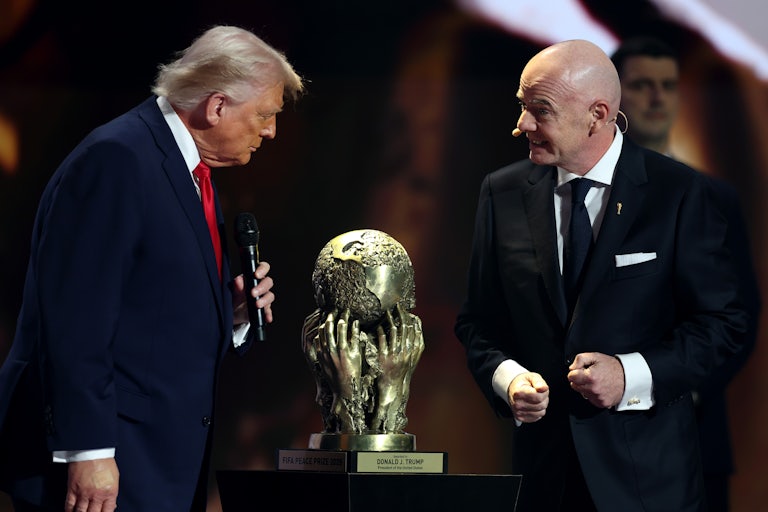
Donald Trump and FIFA President Gianni Infantino stand on stage with the FIFA Peace Prize between them
Michael Regan/FIFA/Getty Images

The U.S. president on Friday became the inaugural recipient of FIFA’s newly minted peace prize.

The prize was the invention of Gianni Infantino, the boss of the international soccer league, who shocked his own top officials by cooking up the concept after Donald Trump begged, pleaded, and failed to win the Nobel Peace Prize in October.

“This is truly one of the great honors of my life, and beyond awards, Gianni and I were discussing this, we’ve saved millions and millions of lives,” Trump said after the medal—a sculpture of hands holding a soccer ball—had been draped around his neck. “So many different wars that we were able to end.”

But whether a soccer prize will scratch Trump’s itch for global recognition remains to be seen. Trump has coveted the Nobel Peace Prize for years, going so far as to lie about solving nonexistent international conflicts and phoning Norwegian officials this past summer in lame efforts to snag the title (Norway’s government has no influence on decisions made by the committee).

Part of the president’s obsession could stem from the fact that four other U.S. presidents have received the award, perhaps most notably Trump’s political nemesis, former President Barack Obama.

Infantino had publicly lobbied for Trump to win the award. But his failure to launch that process offered Infantino a new opening to flatter the president: inventing an entirely new award to satisfy Trump’s ego.

Trump was announced as the winner during the 2026 FIFA World Cup final draw.

This story has been updated.

Read about Trump and the Nobel:

RFK Jr.’s Handpicked Advisers Change Hepatitis B Vaccine Guidance

Despite outrage from doctors and medical professionals, the CDC is changing its hep B vaccine recommendations for newborns.

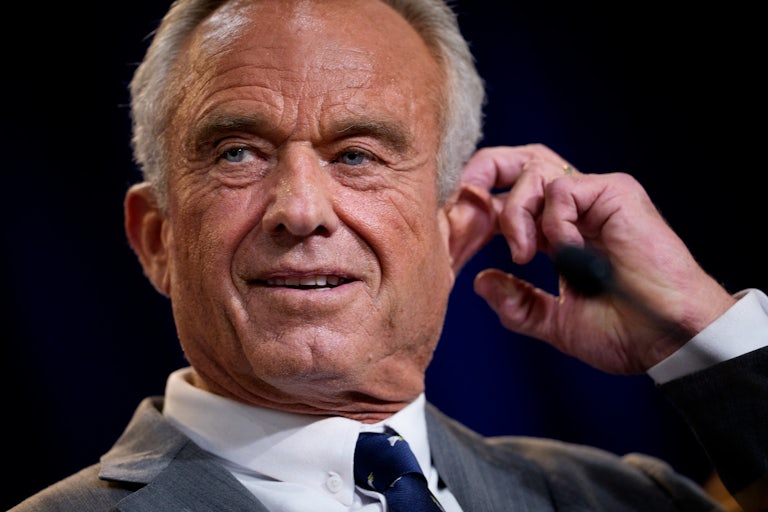
Defense Secretary Robert F. Kennedy Jr.
Andrew Harnik/Getty Images

A federal vaccine advisory panel handpicked by Health Secretary Robert F. Kennedy Jr. voted Friday to recommend delaying the hepatitis B vaccine for most newborns.

The 8–3 vote by the Advisory Committee on Immunization Practices reverses the government’s longtime stance that all babies be vaccinated at birth against the liver infection. Now the panel is recommending the vaccine—which has been credited with preventing thousands of illnesses—be given only to those infants whose mothers test positive or haven’t been tested.

If parents or guardians decide not to get the vaccination at the time of birth, the committee’s vote recommends that the baby should get the dose at two months. One committee member, Dr. Cody Meissner, expressed misgivings, saying, “We are doing harm by changing this wording, and I vote no.”

When asked Thursday by the Associated Press why the committee chose to reexamine this vaccine, committee member Vicky Pebsworth said it was because of “pressure from stakeholder groups wanting the policy to be revisited,” but did not elaborate. A spokesperson for Kennedy did not respond to a question on the subject. Senator Bill Cassidy, a doctor and liver specialist, called the committee “totally discredited” on Thursday.

In 2022, longtime vaccine skeptic Kennedy said the hepatitis B vaccine “was made for prostitutes and for promiscuous gay men.” The virus isn’t just spread through sexual contact, though: Even contact with small amounts of infected blood can put someone at risk.

Now the decision on whether to accept the recommendation goes to the acting head of the Centers for Disease Control and Prevention, Jim O’Neill. But the American Academy of Pediatrics plans to keep promoting the existing CDC guidance for babies to get the first dose of the vaccine at birth, followed by a second at one or two months with the third dose coming between six and 18 months.

At least one state will also continue recommending the hepatitis B vaccine at birth: Governor Maura Healey of Massachusetts said on CNN Thursday that “D.C., the Trump administration, RFK, that panel, they are not doing their jobs. And in the face of that, as governor, I’m going to do mine.”

Trump Judges Rule He Can Fire Whoever He Wants

In a dissenting opinion, Judge Florence Pan warned the move “paves the way to autocracy.”

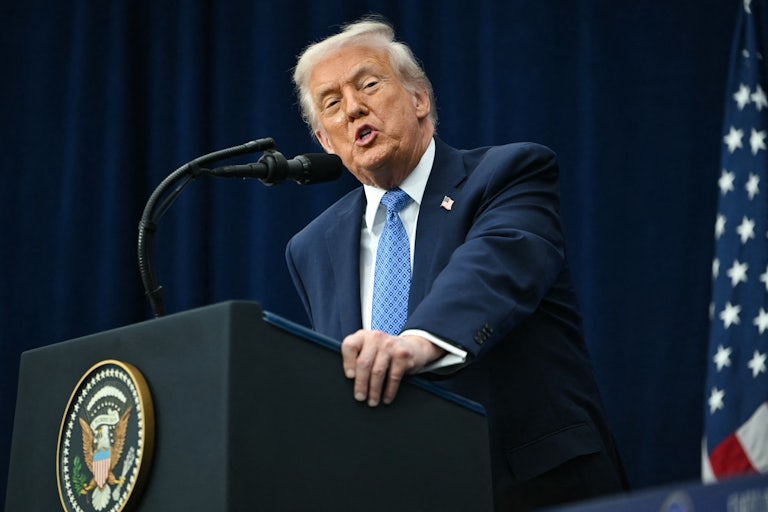
Donald Trump speaks at a podium
ANDREW CABALLERO-REYNOLDS/AFP/Getty Images

An appeals court judge tore into her colleagues’ decision Friday to “pave the way for autocracy” by allowing President Donald Trump to summarily fire the Democratic members of independent federal agencies.

In a 2–1 ruling, Trump-appointed D.C. Circuit Court Judges Gregory Katsas and Justin Walker greenlit the president’s efforts to remove Democratic members of the National Labor Relations Board and Merit Systems Protection Board.

“Congress may not restrict the President’s ability to remove principal officers who wield substantial executive power,” Katsas wrote in the majority opinion. “As explained below, the NLRB and MSPB wield substantial powers that are both executive in nature and different from the powers that Humphrey’s Executor deemed to be merely quasi-legislative or quasi-judicial. So, Congress cannot restrict the President’s ability to remove NLRB or MSPB members.”

Humphrey’s Executor v. United States is a 1935 Supreme Court case that established Congress can pass laws limiting the president’s ability to fire executive officials of independent federal agencies.

In a scathing dissenting opinion, Judge Florence Pan warned that the decision was a disastrous consolidation of executive power behind the president. “Adoption of the government’s maximalist theory of executive power (implicitly or explicitly) threatens to fundamentally change the character of our government,” she wrote.

“Taken to its logical end, the government’s theory will eliminate removal protections for all employees of the Executive Branch and place every hiring decision and agency action under the political direction of the President. But such a radical upending of the constitutional order is not supported by the text or structure of the Constitution and is inconsistent with the intent of the Framers. And while the government claims to uphold the separation of powers, its theory instead concentrates excessive power in the President and thus paves the way to autocracy.”

The Supreme Court previously allowed Trump to oust Gwynne Wilcox at the National Labor Relations Board and Cathy Harris at the Merit Systems Protection Board—whose terms weren’t due to expire until 2029—as well as three Democratic appointees on the Consumer Product Safety Commission and Rebecca Slaughter, a Democratic commissioner on the Federal Trade Commission.

Mike Johnson Is Struggling to Keep Control of His Party

One lawmaker said the caucus has realized they are all “on our own.”

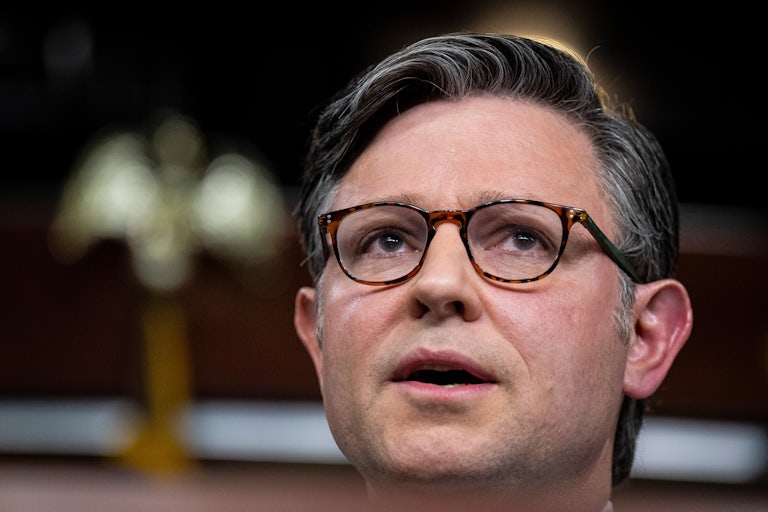
House Speaker Mike Johnson speaks during a press conference
Graeme Sloan/Bloomberg/Getty Images

Republicans are slowly but steadily peeling away from House Speaker Mike Johnson.

The Louisiana lawmaker is facing mounting scrutiny from his caucus, who are reportedly concerned about his leadership ahead of the 2026 midterm elections.

Democrats’ surprise performance in the Tennessee special election earlier this week put Johnson’s capabilities into laser focus, stressing already fraught tensions between House Republicans and their leader.

“The confluence is weakened political power by Trump, the result from the elections in New Jersey, New York, and Virginia, and people getting anxious about the election,” a senior House GOP lawmaker told NBC News Thursday. “There’s a lot of anxiety and stress about the election, and people looking at their own districts, saying, ‘I thought things were going to be different.’”

The government shutdown only exacerbated the effect, leaving Republicans in vulnerable districts without the support that they thought they could rely on.

“I just think being off for 50 days, there was no continuity. Nobody was here. There was nobody like, ‘Hey, you’re doing great. Keep it up,’” the lawmaker continued. “Everyone being back in their district, there was a loneliness. A lot of members may have felt like we’re on our own.”

Johnson shocked the halls of Congress when he catapulted into the House leadership position in late 2023, replacing former Speaker Kevin McCarthy amid a historically divided caucus. That was possible, in part, because Johnson was a relative unknown with practically zero enemies. But that’s no longer the case.

In recent weeks, Johnson has made enemies out of Representatives Elise Stefanik, Anna Paulina Luna, and Marjorie Taylor Greene on issues ranging from his reluctant release of the Epstein files to his resistance to bipartisan legislation on insider trading.

Speaking with reporters Thursday, Johnson claimed that “friction” and “vigorous debate” were “all part of the process.”

“They’re going to get upset about things. That’s part of the process. It doesn’t deter me in any way. It doesn’t bother me,” he said.

Just nine representatives of the majority party are needed to trigger a vote of no confidence against a House speaker. But for all the malcontent, exactly who could unite the conference to replace Johnson is still not clear.

“I support Mike Johnson and what he’s been doing. I think he’s in line with the president. I think he has the ear of the president,” Representative Troy Nehls, who is retiring when his term ends in January 2027, told NBC. “If it’s not Mike Johnson, well, then who?… Who could get enough votes to even replace him? And quite honestly, it’s probably nobody.”